
Pacific Electric/MCL PCC no. 5021 pauses for passengers at Brand Boulevard and Glendale Avenue in 1954.
Robert T. McVay Photo

Pacific Electric/MCL PCC no. 5021 pauses for passengers at Brand Boulevard and Glendale Avenue in 1954.
Robert T. McVay Photo
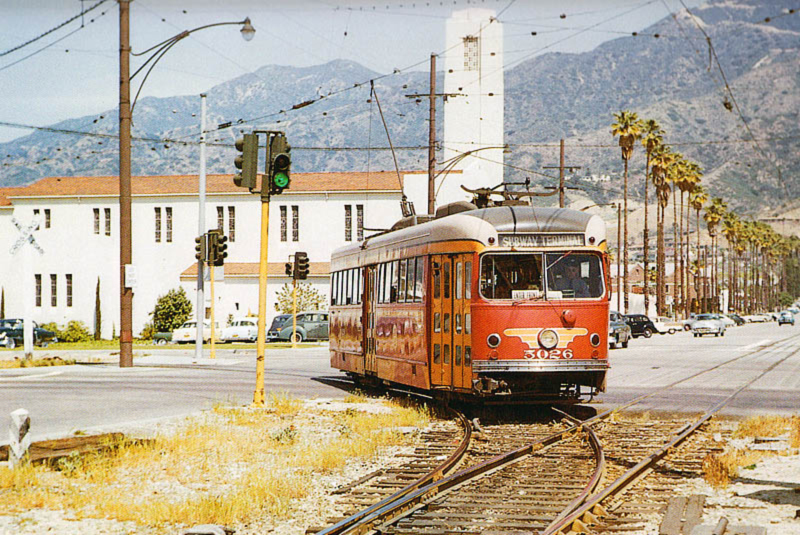
Metropolitan Coach Lines (ex-Pacific Electric) PCC no. 5026 turns at Glenoaks and Brand Boulevards headed for the Subway Terminal Building in this image dated April 12, 1955.
Robert T. McVay Photo
By Ralph Cantos
Pacific Electric’s Hollywood cars were true survivors with some of them in service 40 years stateside to 65 years in Buenos Aires. The cars were built in four orders over a six-year time span (1922, 1924, 1925, and 1928) but PE management considered them “all equal” in every respect.
The “Hollywoods” endured some of the most demanding service conditions that could be imposed on a transit vehicle. The cars were very well built, with the 160-car fleet remaining fully intact for most of 30 years. So highly regarded were the Hollywood cars by PE management, that two cars — nos. 608 and 616, which had suffered “catastrophic” damage that would have ended the career of lesser cars — were completely rebuilt to “better than new” condition after their respective calamities (616 a burned out shell, 608 a twisted hulk after a major collision). Both incidents occurred during 1943, and so desperate was the PE for passenger cars, that scrapping of the two cars was not an option.
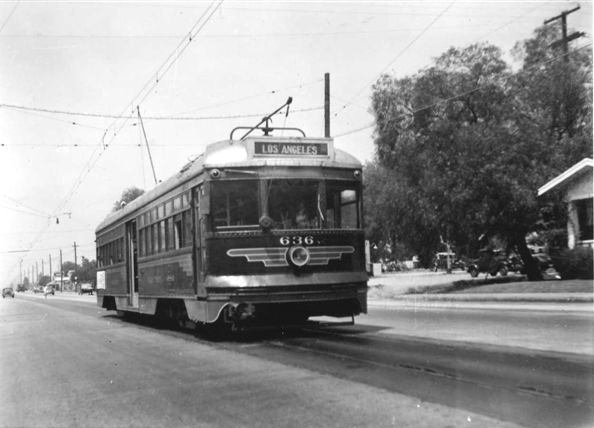
In this photo, car no. 636, class of 1922, takes a little spot time at the end of the Burbank Line on December 5, 1940. At 18 years of age, the 636 was in prime condition, ready to join PE’s new PCCs on the Glendale/Burbank Line. The PE had put the Hollywood cars through a complete rebuilding and “modernization” program during 1939-40, along with other PE rail cars. The Hollywood cars could and did match PCCs at every performance level, except perhaps braking. But even so, Hollywood cars would and could knock you on your ass in both acceleration and braking.
By the time of this photo, I would doubt that few if any buses built in 1922 were still on the road, let alone still in transit service. In little more than one year, the 636 and its 159 sisters would be put to the test, carrying crush passenger loads all during World War II.
In 1949-50, with the demands of the war behind them, the Hollywood cars would again go through PE’s Torrance Shops for an modest safety upgrade and repainting program to bring the cars up to “one-man/two-man” operational standards. The 636 was renumbered to 5113. By this time, the financial condition of the Pacific Electric’s passenger service was dire at best, and this would be the last time the trusty Hollywood cars would ever see any type of preventative maintenance. The “Hollywoods” were now on their own to face ten years of “we don’t give a damn” NO MAINTENANCE service conditions. Lesser-built cars would have succumbed much sooner, but at least 15 Hollywood’s would endure under the worst conditions that could be inflicted on an “in-service” transit vehicle.
From 1950 to 1953, massive rail abandonments made many Hollywood cars surplus; they were stored at several locations on the system. The last months of 1952 saw 28 of the BEST Hollywood cars head for Buenos Aires, and 1953 would see the first scrapping of these remarkable cars. Eight Hollywood cars made their escape to Portland, Oregon, where their service life was a brief 5 years because of a management change that favored buses over rail transit. Seven of the eight Portland cars were gone by 1958.
PE’s passenger service had been sold to bus-minded Metropolitan Coach Lines in the late months of 1953. MCL leased all needed rail cars from the PE, turning themn back to the PE when MCL “WAS DONE WITH THEM.” The PE forced MCL to purchase the last 15 operational Hollywood cars needed for the Watts Line service, and about 60 Blimps in 1957.
Five years of RTF (run til failure) no-maintenance was taking its toll on the “surviving” cars now operating in slave-like conditions. In the early months of 1958, the first LAMTA took control of all transit operations in LA. The first thing the LAMTA did was to renumber all rail cars except the LATL PCCs. ALL rail cars numbered below the 2000 number series were DOOMED. The 5113 became LAMTA 1802. The Blimps were renumbered into the 1500 and 1700 numbers and the LATL H-3s went to scrap with their “factory” 1400 numbers in early 1959. (The LATL H-3s were in MINT CONDITION at the time of their scrapping.)
The condition of the last remaining Hollywood cars under LAMTA control became “desperate.” More than ten years had passed since the last major maintenance was performed on the Watts Line Hollywood cars. NO modern diesel bus of 1950 vintage could remain operational nor operate under these harsh, no-maintenance conditions, but the last Hollywood cars continued to operate under “slave labor” conditions. Finally and perhaps mercifully. the LAMTA abandoned the WATTS line in November 1959, ending almost 40 years of continued service of the 636. The 636 had enjoyed 30 years of pampered care under PE ownership, BUT the last ten years of 636’s life can only be described as pure HELL. The 636 had provided 40 years of reliable service, a testament to her fine construction and PE maintenance.
As an additional note, the East St. Louis & Suburban Railway took note of the Hollywood cars and ordered four near-duplicate cars from the St. Louis Car Co in 1924. The four cars were sold to the Illinois Terminal Railroad in 1935 and continued in service until 1959. The Illinois Terminal 470s looked like a PE Hollywood car on steroids — basically the same car, on much larger trucks.
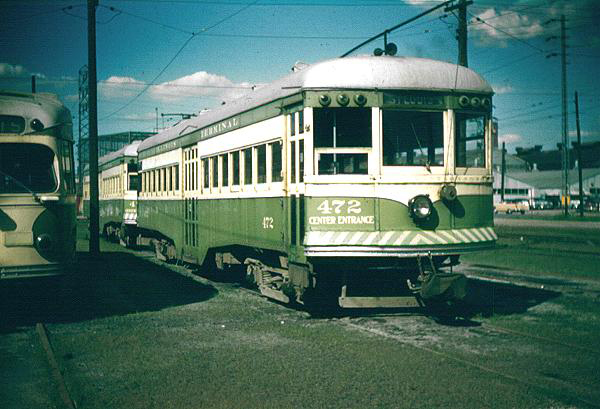
The East St. Louis & Suburban Railroad tacked on a 4-car order to PE’s 50-car order of cars 650-699. These cars were built from the Hollywood car plans, but sat on much bigger trucks and were considered “interurbans” as opposed to the Hollywoods which were “suburban” cars.
Ralph Cantos Collection

By Ralph Cantos
Pacific Electric stunned the American Transit Industry when the Railway took delivery of 30 double end PCCs in November of 1940. Not only were PE’s PCCs the first double enders, but were the FIRST MULTIPLE UNIT PCCs built up to that time. Many PCC fans consider the PE PCCs the most beautiful ever built in the pre-war era . Only the 25 postwar all electrics built new for Louisville Railways come close to the esthetic beauty of PE’s PCCs.
So it was that Americas most revolutionary PCCs should make their debut on two of PE’s most important Western District lines, the heavily patronized Venice Short Line, and the Glendale-Burbank Line. PE rebuilt the Glendale – Burbank Line from top to bottom, end to end, in preparation for the new cars. It was no secret that PCCs’ “temperamental” riding characteristics required top notch rail infrastructure. The new cars did extremely well on the rebuilt Burbank Line.
HOWEVER…the VSL was an other matter. By 1940, the rail and roadbed on the VSL were nearing 45 years of age. By the time the PCCs arrived , there was enough of the “modernized” Hollywood cars on hand to almost completely eliminate the need for the wood bodied 950s that had served the line for decades.
BUT as often is said, “the best laid plans of mice and men often go astray.” The PCCs tenure on the VSL was brief, maybe a year or so. As beautiful as the PCCs may have been, they could not deal with the rough track. With the out break of World War II, a decision was made to reassign the 13 VSL PCC’s to the Burbank Line. Thirty one of the big handsome 950s, then in the midst of being scrapped, were rescued from the fire, run through Torrance Shops and returned to service in early 1942 in “better than new” condition.
The classic 950s along with six 1000s and several two-man Hollywood cars rendered fast dependable service on the VSL all during the War, carrying crush passenger loads.
Even after the War ended, patronage on the VSL continued at high levels. Three-car trains were a common sight in the post war years. I am sure that the PE management did not run three car trains for the benefit of rail-fan photographers, three car train were a necessity to carry the high passenger volumes.
The 30 PCCs now settled down to a life on the Burbank line. By 1954, the Pullman built cars that had been such a sensation in 1940/41 were nearing the end of the career in a span of just 15 years. The PCCs continued to render excellent service into 1955 when the abandonment of the Glendale – Burbank line, with DECADES of service life remaining in its rebuild infrastructure, was announced.
All PE passenger service had been sold to Metropolitan Coach Lines in Oct 1953. MCL’s greedy, self-serving management did not give a DAMN about the welfare of the traveling public, air pollution, the importance of travel time, or anything else except inflating the Company coffers at the expense of EVERYONE AND EVERYTHING . And so it was that on June 19, 1955, despite vigorous opposition from the City of Burbank, the line was abandoned.
The 30 near perfect PCCs were “stuffed” into the Subway tunnel, just inside the portal opening. It did not take long before vandals reduced the first eight to ten cars into piles of rubble. Only the pitch-black darkness of the deep recesses of the tunnel kept the vandals from destroying the entire fleet of Americas most beautiful PCCs.
After four years of storage and vandalism, the PCCs were sold to Buenos Aires, where they joined 27 Hollywood cars. Unfortunately, the TEMPERAMENTAL riding characteristics of the cars caught up with them once again and the service life in Buenos Aires was a short 3 years.
Sadly, none of these revolutionary PCC’s was preserved.
In this photo taken in April 1941, car no. 5010 (Craig Rasmussen collection) is stopped at Culver City Station to entrain a lone passenger for a fast, if bouncy, trip to Santa Monica. The decade of 1940 to 1950 was a financially great time for the PE and Southern California commuters.
HOWEVER, the next decade of 1950 to 1960, would see the complete destruction of “The Worlds Greatest Interurban Railway” starting right there at Culver City in September of 1950 with the abandonment of the World Famed Venice Short Line, the first of a decade long string of rail abandonment that would virtually wipe out the entire rail system.
And now, 60 years later, commuters that drive the I-5 “Golden MISTAKE Freeway” and the I-10 Santa Monica “Freeway” more like a parking lot, are paying dearly for the short sighted decision that were made by greedy business men and the Highway Department so many years ago!! .
By Ralph Cantos
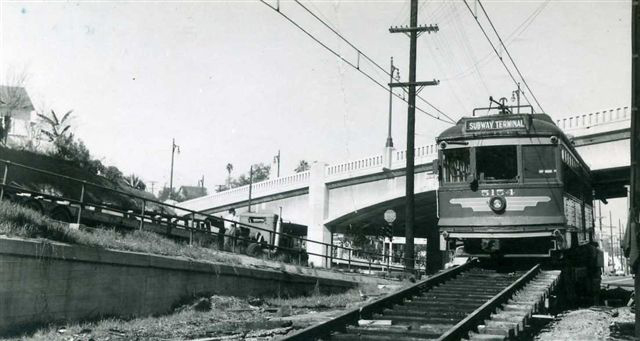
This very sad photo was taken in November of 1955 at the entrance of PE’s Subway Tunnel. Car 5154, the former no. 704 (BRILL 1925) is being made ready for its trip to National Metals & Steel on Terminal Island for scrapping.
What makes this photo so sad is that the 5154 had several decades of serviceable life remaining in its car body. In 1939-40, the PE spent hundreds of thousands dollars, all of it private capital, to completely re-manufacture the 160 Hollywood cars to “better than new” condition. This rebuild brought the Hollywood cars up to PCC standards of speed, comfort and safety. Then in 1949-50, the PE again spent thousands of dollars per car to bring 131 Hollywood cars up to the highest and latest safety standards.
When the last car (no. 5181) left Torrance Shops in mid-1950, its condition was so excellent, it was ready to render the traveling public three to possible four more decades of dependable, comfortable service. And yet, here we see car 5154 literally in prime, mint overall condition, and just five years from its last overhaul, being treated like so much scrap metal.
When the Glendale – Burbank line was abandoned on June 19, 1955, 15 Hollywood cars were working the line along side the 30 near new PCCs. Two cars, nos. 5166 and 5167, were mercifully saved from a trip to the scrap pile, and were trucked over to the Watts Line, where the two cars joined a ragtag assortment of low numbered 5100s (St. Louis Car Co. 1922). The two new arrivals at Watts became “the babies” of what remained of the last operable Hollywood cars. Not so fortunate was the 5154 and 12 other former 700s — they were DOOMED!
When the first Hollywood car was en route to Terminal Island, tied down to the back of the flatbed truck like some slaughtered animal, one of the trolley poles became dislodged from the hold down hook. The trolley pole reached up as if asking for help, pulled down phone wires as a result. So all the remaining cars making the final trip had both of their trolley poles spot welded to the roof guard. If you look closely, you can see that the trolley pole on the hapless 5154 is now welded down to the guard next to the pole hook. This was just the first of the horrors that awaited the 5154. And so this beautiful, handsome, 100%-complete and operable car, was just hours away from the end of its life — a sad, terrible waste of the finest suburban trolley cars this country would ever see.
And while this horrible scene was being played out at Toluca Yard, thousands of miles away in Buenos Aires, 27 other Hollywood cars would continue to roll along well into the 1980s.
Ralph Cantos Collection

By Ralph Cantos
Pacific Electric’s 160 Hollywood cars served the Railway above and beyond all expectations on the far-flung system. Except for the Northern Districts, San Bernardino Line, and the Southern Districts (Santa Ana, San Pedro, Catalina, and Long Beach Lines), the Hollywood cars roamed the PE rail system like a band of nomads.
As far and wide as the Hollywood cars roomed, there was ORDER to their diverse assignments, especially after World War II. The PE seemed to assign “blocks” of sequentially numbered cars to specific lines. Although there may have been exceptions, Hollywood car assignment seemed to go as follows, from what I have observed from years of photo research.
Cars 5050 through 5099 along with cars 732 to 759 were fixtures of the Northern District until abandonment on 9-31-51. After that date, most cars numbered from 5050 to 5099 entered a premature retirement.
After the Santa Monica Blvd. line abandonment, cars 5130 to 5144 were not seen in service very much, if at all.
THEN THERE WAS THE SAN FERNANDO VALLEY line with cars 5169 to 5181 regularly assigned. With the December 1952 abandonment of the SFV line, cars 5169 to 5181, the cream of the crop, basically vanished from service. That left cars 5145 to 5168 serving the Wests last two lines.
With the September 1954 abandonment of Hollywood Blvd. line , cars 5140 to 5153 were done. That left cars 5154 to 5168 serving with the PCCs on the Burbank Line.
Cars 5174 to 5181, were renumbered into various 5050 numbers to fill in the gaps left by the eight cars sold to Portland.
For reasons known only to the PE management, cars 5169 to 5181 were never seen again in service after the SFV line abandonment. The eight renumbered cars along with 5169 to 5173 were basically finished. The last 15 Hollywood cars assigned to the Burbank line were retired with that lines June 1955 abandonment. Two cars, 5166 and 5167 were transferred to the Watts line to bolster up that lines dwindling roster of serviceable cars.
And so in the nine years from 1950 to late 1959, the once great fleet of 160 Hollywood cars was whittled away, car by car, line by line, until the last nine battered and beaten cars serving the Watts line finally gave up the ghost. Five of the last nine cars were went to OERM with one car MTA #1805 being dismantled for parts.
Amazingly, two of the earliest Hollywood cars built wound up being the last to survive.
In this photo, car #5180, the former #730, is seen here at the Barham Boulevard stop in the last days of the SFV line, In just a few months, it will be renumbered II-5078 and vanish.
Ralph Cantos Collection

Pacific Electric PCC no. 5015 crosses Fletcher Drive’s trestle in this undated photo by Willis “Dutch” Hendrick, donated to the collection by his son Bruce Hendrick.
Willis “Dutch” Hendrick Photo, Donated by Bruce Hendrick to the Mount Lowe Preservation Society Collection
By Ralph Cantos
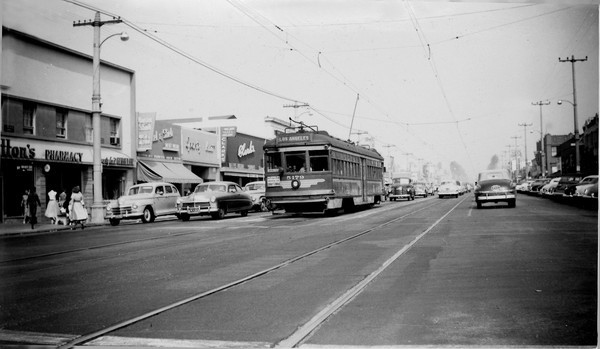
Ever vigilant and prolific photographer Alan K. Weeks snapped this photo of Hollywood car no. 5179 on Sept. 27, 1952. Time was running out for the San Fernando Valley Line, so Alan Weeks was out to document on film, the last months, weeks, and days of the line, and unknown to him at the time, the photo he took of 5179 on Van Nuys Boulevard would be one of the last times the 5179 (the former no. 729) would ever be seen alive and active with that number again.
The San Fernando Valley Line was abandoned on December 28, 1952, followed shortly thereafter by the abandonment of the Santa Monica Boulevard Line on May 31, 1953. In just 6 short months, about 45 Hollywood cars used on the two lines were made surplus. Only about 40 or so Hollywood cars remained in service on the Western District’s last two lines: Hollywood Blvd./Beverly Hills and the Glendale-Burbank Lines.
A few weeks before the Santa Monica Blvd. Line was abandoned, eight surplus 5050-numbered Hollywood cars already in dead storage were sold to the Portland Traction Co. The total rail abandonment of the Northern District in September of 1951 put about 77 Hollywood cars out to pasture. Cars 732 / 759 were sold to Buenos Aires in 1952. As previously discussed, eight randomly picked 5050s left gaps in the 5050 to 5099 numbering records. So PE took cars #5174 to #5181 and renumbered then into the missing 5050 numbers, car 5179 amongst them.
After the December 1952 SF Valley Line abandonment, the 5179 just seemed to disappear, The 5179 became II-5076 and I do not believe the II-5076 ever operated again during the last two years of the Western District. The 5179, only 27 years old, with decades of service life remaining, simply disappeared bearing the number 5076. Just for the record, 5181 became II-5099. Any photos of the eight 5050-numbered cars operating on the Western District between June 1953 and June 1955, should be classified as “significant.”
Alan Weeks Photo, Alan Weeks Collection

The end has come for the San Vicente Viaduct. It was a cold, dark, and drizzly over cast day, when I snapped this photo with my little “Brownie Box Camera” in January 1963. An army of demolition exerts aided by bulldozers and two heavy crane mounted wrecking balls, finally did the mighty span in.
The job had been scheduled to take 8 weeks, but dragged on for more then 14 weeks. The bridge did not give up as easily as the contractor had thought it would.
Ralph Cantos Photo, Ralph Cantos Collection

UPDATE: A color shot taken in February 1962 by David Cameron showing the same demolition work underway. The perspective is San Vicente Boulevard looking west from Pico Boulevard.
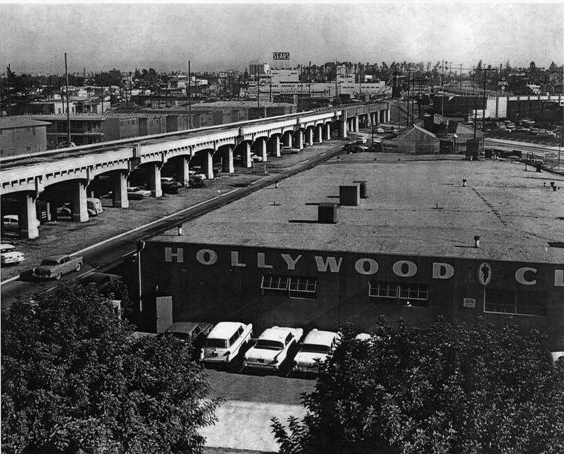
The end nears for the Pico and San Vicente Viaduct in this late 1961 view of the abandoned bridge.
Ralph Cantos Collection