An unidentified Pacific Electric interurban rumbles through the sleepy town of Playa Del Rey as a classic PE wig-wag tolls on the same street as the Del Rey Market and Del Rey Drugs. The PE station is visible just up ahead to the right, in this view looking north toward Venice. The date is December 24, 1939 and the image is by the incomparable Ralph Melching.
Ralph Melching Photo, Pacific Railroad Society Collection
Ralph Melching’s December 24, 1939, image at trackside of the small waterfront community of Playa Del Rey, with the Pacific Electric station to the left and housing development on the iconic bluff/hillside in the background.
Ralph Melching Photo, Pacific Railroad Society Collection
An inbound 800-class interurban car rolls along the shore line of the blue Pacific at an unknown location. It was a place where the line ran behind houses along the beach.
Charles D. Savage Photo, Donald Duke Collection, Pacific Electric Railway Historical Society Collection
When Metropolitan Coach Lines purchased the passenger operations of the Pacific Electric, the sale included several hundred buses from three manufacturers: GM, WHITE, and TWIN COACH. Not included in the purchase were the Western Districts 30 PCCs and about 45 Hollywood cars.
On the Southern District, about 50 Blimps and 15 Hollywood cars made up the balance of the 140 rail cars needed for the “short term” operation of both districts. MCL management anticipated a trouble free and quick abandonment of the remaining rail lines.
MCL chose to lease all 140 rail cars, turning them back to PE as the rail lines were scuttled. The Western District was gone in less then two years. The PCCs were stored in the Subway Tunnel, and the Hollywoods sold for scrap.
Two Western District Hollywood cars (nos. 5166 and 5167) along with tower car no. 00164 were transferred to the Southern District. In the early months of 1957 all Southern District rail cars were still displaying the PE logo and lettering, as they were still on lease.
Following a rather nasty grade crossing accident at the Del Amo Street crossing on the Long Beach Line, PE’s Legal Department, tired of being named chief defendant in numerous accidents, demanded that MCL purchase the remaining rail cars needed for continued service. The PE wanted their name OFF ALL equipment still in service.
The PE emblem on the 15 Watts Line Hollywood cars was painted over and replaced by the MCL winged logo. On the Blimps, METROPOLITAN COACH LINES replaced PACIFIC ELECTRIC on the letter board.
In early 1958, transit operations of LATL and MCL were merged into the first Los Angeles Metropolitan Transit Authority (LAMTA). The Blimps and Hollywood cars still in their, by now, 10 year old red paint, had the MCL logo and lettering painted over once again, replaced by the LAMTA “goose egg.” The lone MTA emblem on the huge Blimps looked ridiculous.
Back at the Subway Terminal, the PCCs slumbered away, still in PE paint and carrying the PE emblem on their flanks. So, in the summer of 1959, the PE PCCs were finally sold to Buenos Aires.
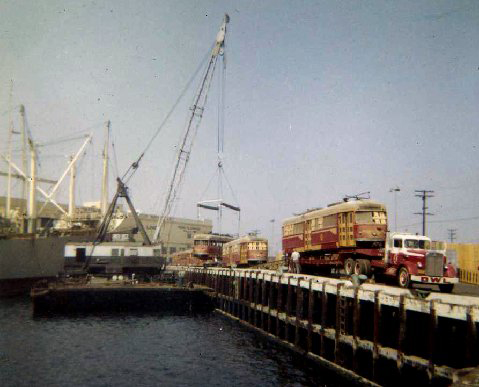
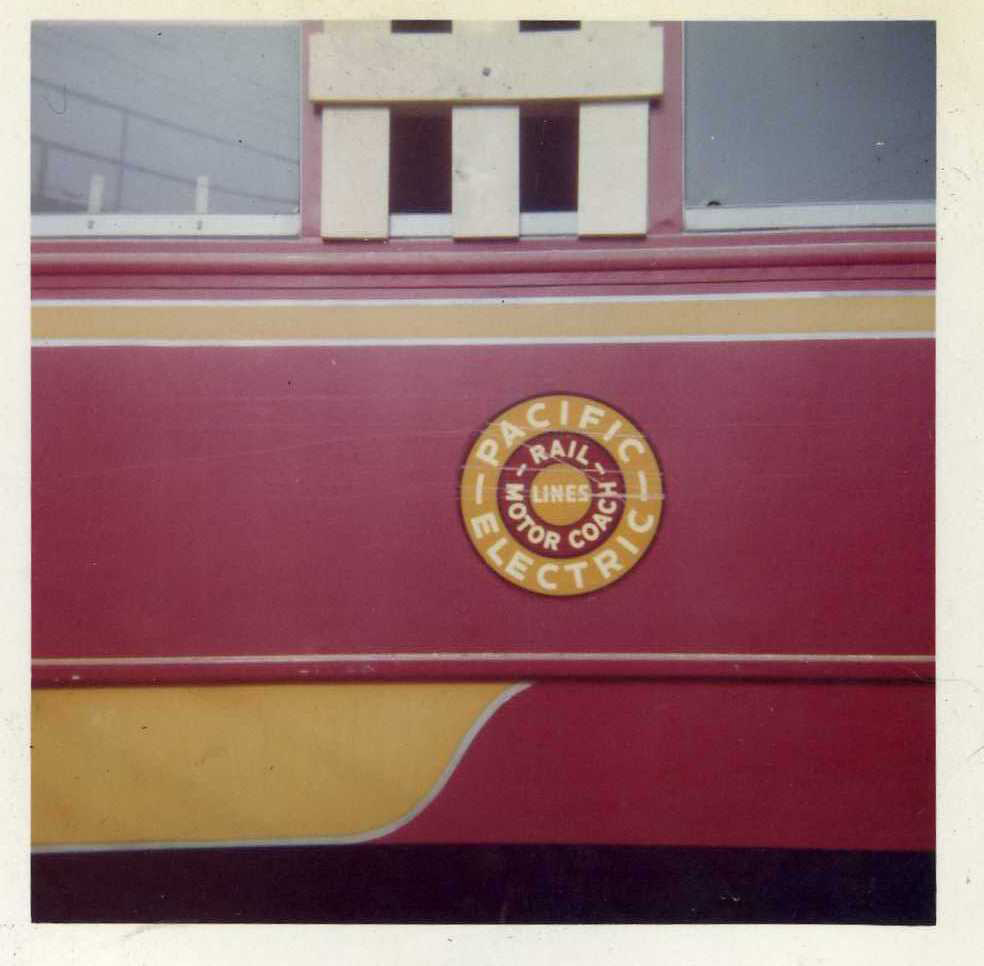
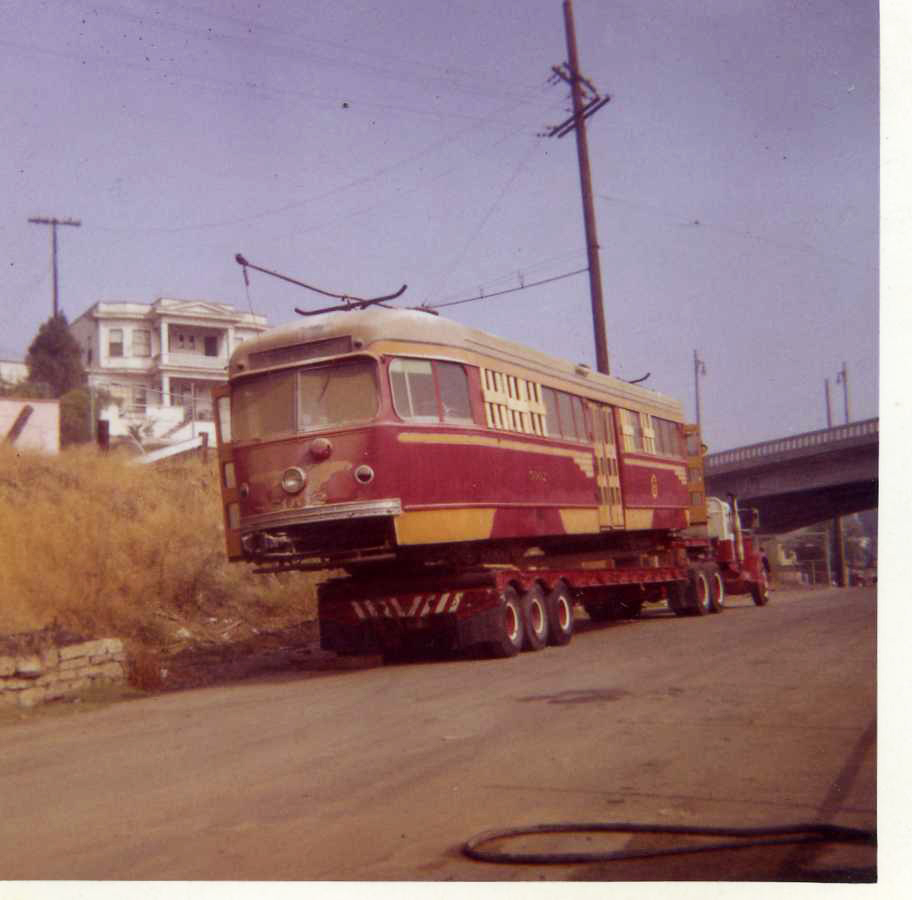
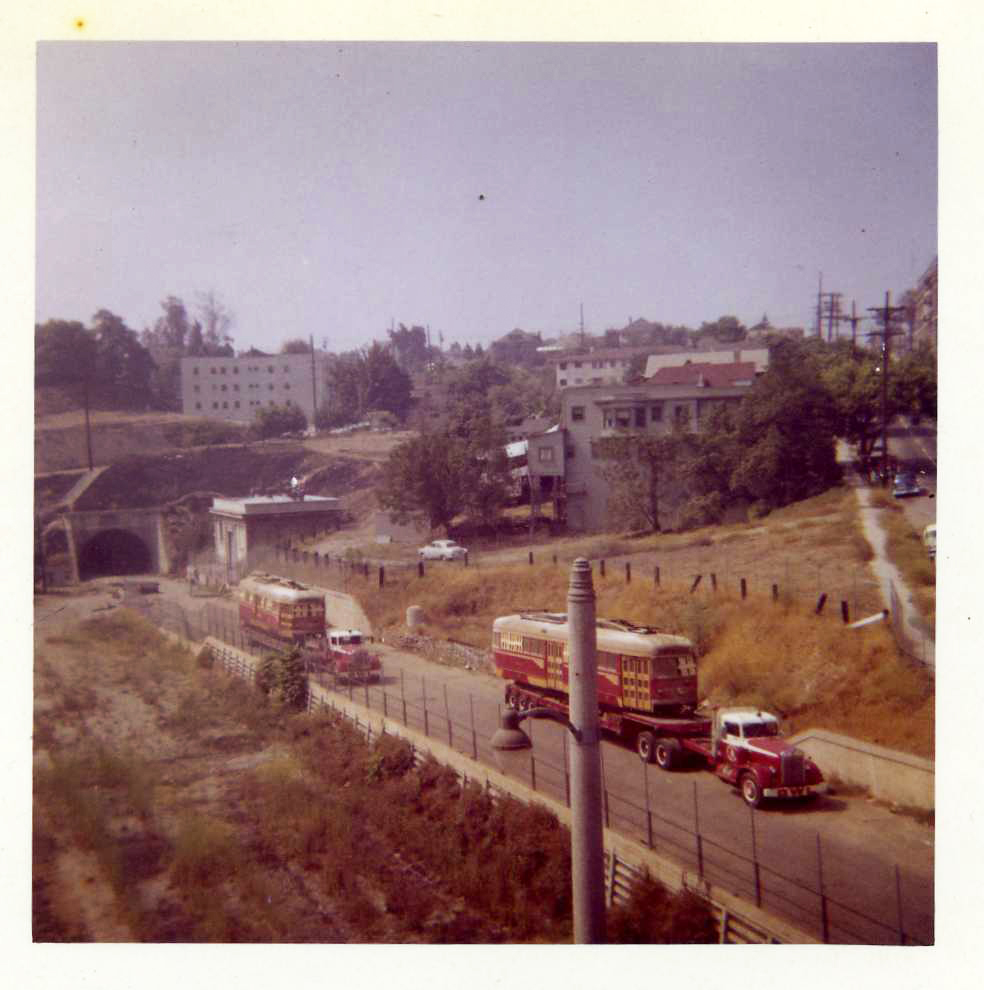
As I first reported on November 5th with both photos and text, Alan Fishel, James R. Baker and myself were on hand to witness cars 5002 and 5013 being winched out of the Subway and loaded onto flat bed trucks for their trip to the harbor. It was August 5, 1959, and there was the PE emblem so proudly displayed on PCCs 5002 and 5013. They were the last cars on the streets of LA , albeit on the back of flatbed trucks, to display the PE EMBLEM for all to see.
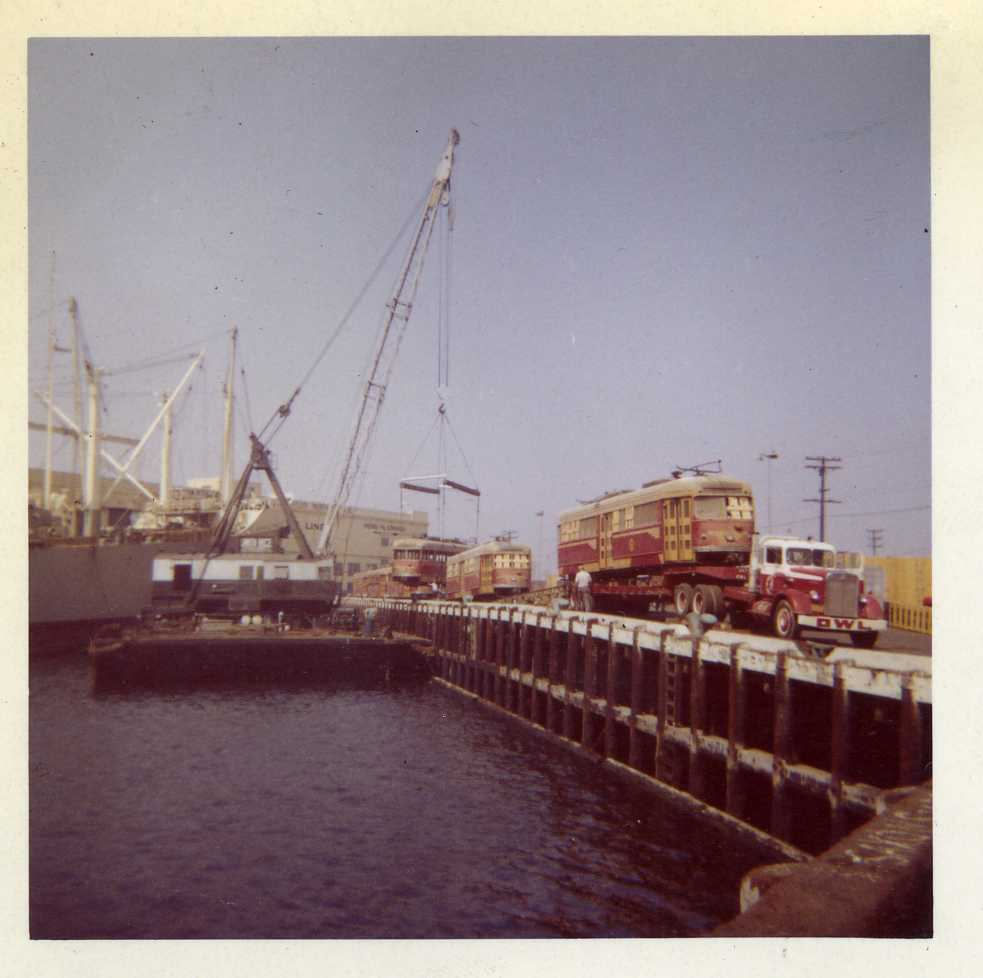
Later that afternoon, at the LA Harbor, we watched as car 5010 (so badly damaged and vandalized, that no wood boards were placed on its broken windows) was lifted by a crane, while car 5013 was lowered off the flatbed. The 5002 awaits its turn for unloading.
And so the PE Emblem made its last stand in the summer of 1959, ending what was once a common sight on the streets of Los Angeles.
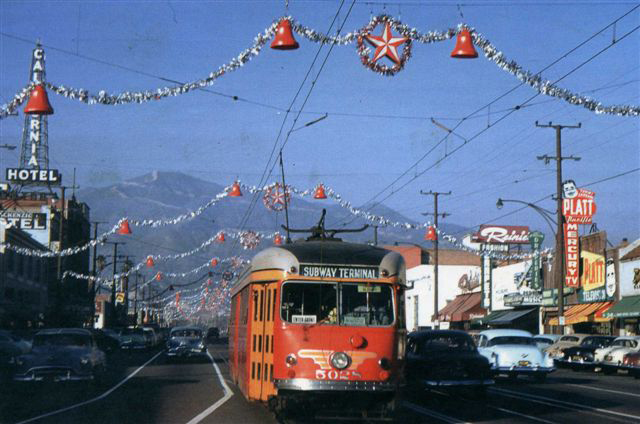
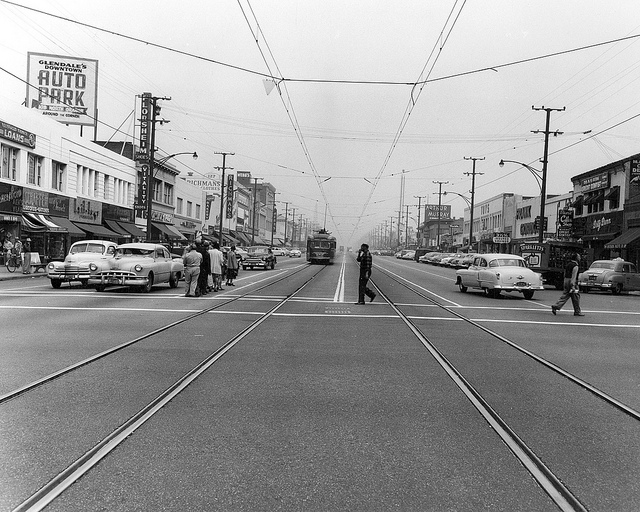
This picture-perfect photo was taken on Brand Boulevard in December of 1954 showing Pacific Electric PCC no. 5028 rolling inbound to the Subway Terminal. PE’s “industrial beautiful” SP-style catenary is bedecked with Christmas decorations. This was the only location on the Glendale-Burbank Line where the cars passed under Christmas decorations. This was as good as 1950s traction gets.
As the 1954 holiday season drew to a close, commuters and rail fans looked confidently and optimistically to the future of this viable rail line. Hopes were for many more years of Christmas scenes like this one to come. The euphoric optimism was fueled by the Cities of Glendale and Burbank’s united stand opposing the abandonment of rail service by bus-minded Metropolitan Coach Lines. MCL would stop at nothing until all of the former PE rail service was gone.
In spite of the common-sense opposition to rail abandonment by commuters, rail fans and the Brand Boulevard Chamber of Commerce, “we don’t give a damn” back room dealings by MCL management and Glendale City officials turned their backs on EVERYONE, and the line was scuttled. The line was gone just six months after this photo was taken.
Christmas along Brand Blvd. would never be the same again. Bus stop sign poles just do not provide ideal provisions for Christmas decorations.
In the years following the abandonment, vultures descended on the line in the form of scrappers (rail-overhead-steel bridges-and signaling equipment), real-estate developers (apartments at Monte Sano and Toluca Yard) and the Highway Department (the 2 Glendale Freeway). The line was picked clean. The once busy rail line, even in car-crazy Southern California, was reduced to a marginal bus line with lengthy running times and low passenger loadings.
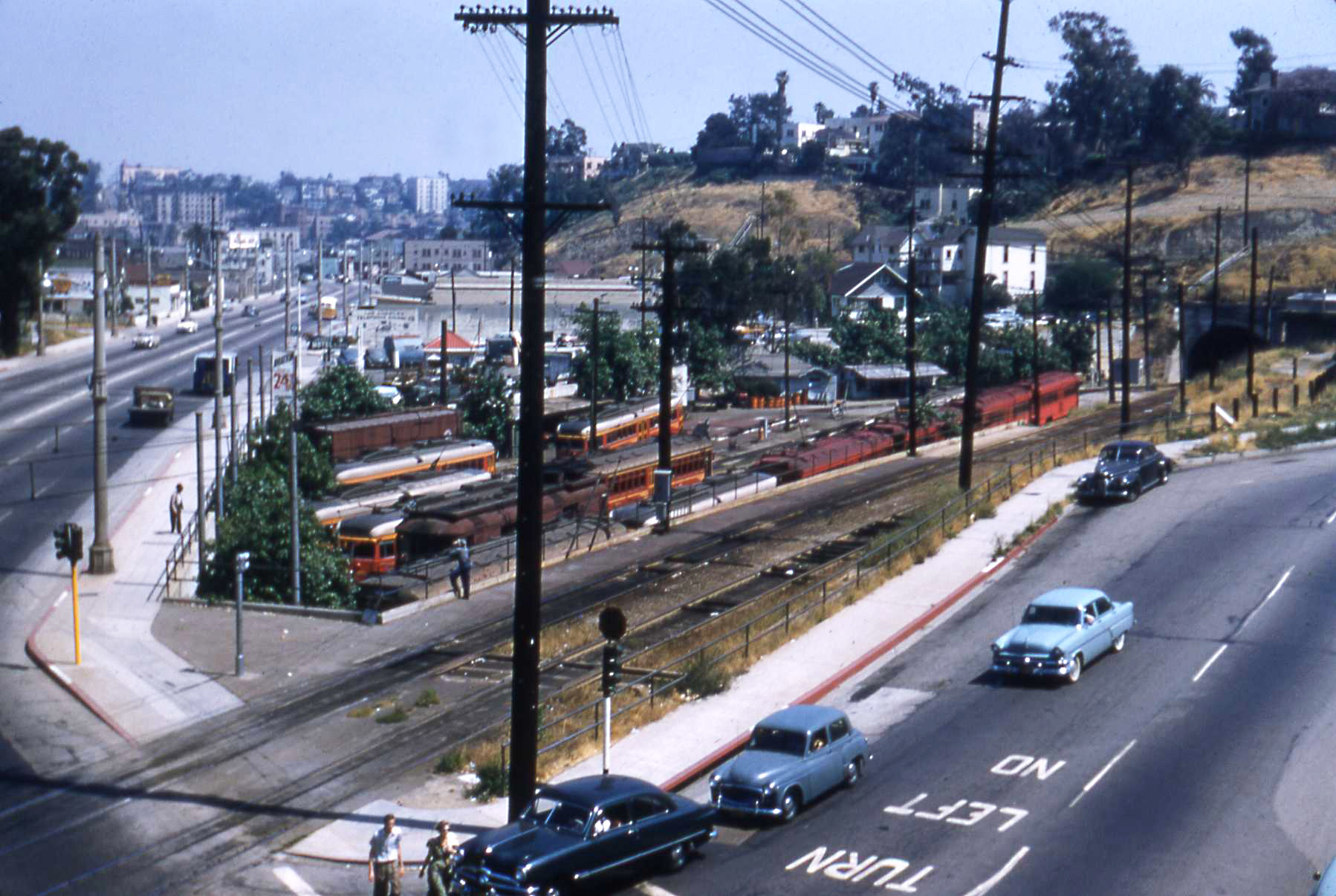
This beautiful photo of Pacific Electric’s Toluca Yard at the mouth of the Subway Terminal could have been taken anytime between June of 1952 and June 1955. But two important clues belie the fact that this photo was actually taken in June 1955, on the 12th to be exact.
Clue number one is the absence of numerous Hollywood cars that would be in use on the Hollywood Boulevard / Beverly Hills Line — about 40 cars, if this photo had been taken in the first half of 1954. By this time, all those cars were in dead storage at Torrance Shops and the West Hollywood Yard.
All is serene on this Sunday afternoon. A PCC sits on jack stands in the center of the yard, most likely undergoing some routine truck maintenance. Tower Car no. 00164 waits for a call if there is any trouble with the well-maintained PE overhead.
The most important clue as to the time frame of this photo is the 3-car train of Hollywood cars sitting on the storage track nearest the outbound main. All three cars are painted SOLID RED in preparation for their very last assignment as a New York City subway train. The three cars (one of which is no. 5161) have had all of their PE “Butterfly” graphics and PE emblem painted over. Only their numbers remained visible. They will be used in the big screen movie, “While The City Sleeps” starring Dana Andrews. A fight scene will take place in the Subway tunnel between Dana Andrews and the “killer” as subway trains pass them at high speed. The film was shot in the days AFTER the official abandonment of the Glendale – Burbank Line. The movie extras on board the cars were the VERY LAST passengers to ride through the PE Subway. In just seven days of this photo, it will be all over for EVERYTHING seen here.
It will take almost a year to clear out everything seen in the image. First thing on the agenda was to build a temporary loading ramp for the quick disposal of 13 of the 15 Hollywood cars that had been assigned to the line. They were loaded onto flatbed trucks and hauled away for scrap by November.
In February of 1956, the two remaining Hollywood cars (nos. 5166 and 5167) along with Tower Car 00164 and the old wooden boxcar loaded with precious Hollywood car parts were trucked over to the Southern District. The two well maintained cars, former fixtures of the Western District, were needed to bolster up the rag-tag remnants of the Watts lines’ low-numbered 5100s (nos. 5111 to 5125). The Watts Line Hollywood cars were suffering the ravages of the ZERO maintenance program imposed by the SOB management of Metropolitan Coach Lines…
After the 00164 and cars 5166 and 5167 were trucked away, the real destruction of Toluca Yard and the Glendale – Burbank line began in earnest. All the rails in Toluca Yard were lifted and most likely sold for scrap. Next, the rails were pulled up and PE’s beautiful catenary overhead was pulled down on the INBOUND side of the line only! The inbound track and catenary was removed from the SP Richardson crossing all the way to the Subway Terminal loading platforms. North of Richardson, EVERYTHING was scrapped. Toluca Substation and the outbound track along with the overhead remained somewhat serviceable.
PE management had initially hoped that a buyer could be quickly found for the beautiful well maintained PCCs. The idea was to keep the outbound track and overhead intact so the PCCs could be operated under their own power to the PE / SP interchange at Glendale Station. There, the PCCs would be loaded aboard railroad flat cars for shipment to the new buyer. The Shaker Heights Rapid Transit and the Newark Subway had shown some interest in the cars. But when the Twin Cities Rapid Transit suddenly abandoned their entire PCC-operated system (another dirty MCL / City of Glendale-type shady deal), three hundred 5- and 6-year old, near-new St. Louis Car Co. “all-electrics” came on the market at “give away prices” (even more dirty dealing) . Hopes for a quick sale of the 15 year old, air-electric PE Pullmans quickly evaporated. The Twin City PCCs were snapped up by Newark and Shaker Heights. What was left, were sold to Mexico City.
When those promising deals fell apart, what was left of the rails and overhead were removed with considerable disgust and anger. The beautiful PCCs were stuffed into the damp, dirty and unguarded Subway Tunnel at Toluca Yard and left to rot and be destroyed by sick vandals until a buyer could be found of what (if anything) was left of them!
And so this scene of functional beauty will in the the decades to come be turned into a graffiti-laden eyesore. Eventually, an up-cale apartment / condo complex will be built on the property. Toluca Substation and the Subway portal have been preserved for all time as a reminder of what dirty, backroom political dealings can do to a viable transit system here in LA and else ware in America.
The ever dependable no. 5002 rolls down Brand Boulevard as it approaches waiting passengers on June 10, 1955.
In just nine days all this PERFECT street trackage, the beautiful SP style catenary will, for all practical purposes, be scrap metal. The PCCs and Hollywood cars operating along Brand Boulevard must have provided the smoothest riding experience of any rail line in the United States at the time. How anyone in their right mind could have allowed the conversion of this excellent rail line to bus operation is anyone guess.
MY GUESS: a dirty, backroom political deal between Metropolitan Coach Lines management and city officials of Glendale.
When Jesse L. Haugh purchased the Pacific Electrics passenger service in October of 1953, the VERY FIRST thing he did was to announce his intentions to abandon ALL of the remaining former PE rail lines. The cities of Burbank and Glendale formed a united front to block any attempt on the part of MCL to convert the Burbank rail line to “stink buggy” operation. Then, without warning, the Mayor of Glendale, J. M. Lawson, stabbed the City of Burbank in the back, and dropped its opposition to the rail abandonment. HOW could something like this happen? The Burbank Line was in PERFECT condition. It was rebuilt from end to end, top to bottom in 1940.
The near-new PCCs had decades of service life remaining. The forever-young Hollywood cars were in virtually new condition. Had the line not been abandoned, it could have lasted well into the late 1980s in its 1955 condition. Today’s Red Line Subway passes within 50 feet of the PE Subway on Hill Street at 4th. The now building Downtown Rail Connector could have been incorporated into the Glendale Line.
It would have been a commuter’s utopia. All this wonderful excellent “might have been” commuter rail was flushed down the toilet by the “we don’t give a damn” mentality of the 1950s.
So now, transit experts, try as they might, must figure a way to put the Pacific Electric back together again at a cost of hundred of millions, if not, billions of our tax dollars.
Motorists and pedestrians go about their business on busy Brand Boulevard, oblivious to the historic scene playing out before their very eyes.
Pacific Electric PCC no. 5027 leads a two-car southbound train heading for the Subway Terminal.
But look closely at the head sign on the 5027, it reads OUT OF SERVICE, and there are no passengers aboard. This is the last of several “dead-heading” trains that have been making their way to the Subway Terminal. These out-of-service trains (with both PCCs and Hollywood cars sandwiched between regular-service, single-car trains) have been passing through Downtown Glendale all day and THIS IS THE LAST OF THE DEADHEADING TRAINS.
The Glendale – Burbank Line is on a “death watch” and time is running out fast. It is Saturday afternoon, June 18th, 1955, and the senseless destruction of this viable commuter rail line is just hours away. On a nominal weekend, several PCCs and Hollywood cars would be stored at Burbank Station nd the holding yard at Glen Oaks and Brand Boulevards, awaiting the Monday morning rush.
But on this day, the north end of Line is being “cleared out” in preparation for abandonment. Come Monday morning rush hour, Metropolitan Coach Lines will unleash an armada of stuffy 48-passenger GM buses, replacing the the smooth-riding, commodious, high-passenger capacity rail cars.
Newspaper press releases announced that The new Line #39 buses with “their smart new interiors, air-ride suspension, will closely follow the route of the former rail service.” Not mentioned in press releases was that travel time on the “meandering” line #39 would increase by 12 minutes from North Glendale and by almost 20 minutes from Burbank.
In the years following the rail-to-bus conversion, disgusted and frustrated commuters would forsake the Line 39 buses for their own cars (GM cars, most likely). The once very busy rail line that had required two- and three-car rush hour trains would be reduced to a marginal bus line with lengthily headways and service to North Glendale discontinued altogether.
The greedy, “public be damned” attitude of Metropolitan Coach Lines had brought air pollution and traffic congestion to Southern California in the name of progress.
By the end of this day, all unneeded cars would now be at Toluca Yard as the final runs were completed.
Pacific Electric / Metropolitan Coach Lines PCC no. 5002 and motorman pose at North Glendale on April 29, 1955. Four and a half years later, 5002 will be loaded on a flatbed truck along with 5013 for the trip to the LA Harbor in August of 1959.
On June 19, 1955, one of the most dastardly deeds ever perpetrated on the traveling public took place in Los Angeles.
The management of Metropolitan Coach Lines managed to scuttle the Glendale-Burbank rail line, one of the best commuter rail lines in Southern California. When MCL management purchased Pacific Electric passenger service (2 Western District – 5 Southern District), they knew full well what was involved from a financial standpoint.
In general, the infrastructure of the entire system, both rail and bus, was in good to excellent condition. I can not help but believe that MCL’s owner/president Jessie Hough may have had inside information that the State of California was in the early process of planning a consolidation of LA’s two transit systems into a unified agency. Jessie could have merely sat on the former PE passenger service as is, and cashed in on a very hefty financial profit in just 5 years.
But instead, he announced at the time he purchased PE’s passenger service that he intended to end ALL RAIL passenger service as soon as he could get permission. Hollywood Boulevard was gone in less than a year. Despite initial vigorous opposition by the cities of Glendale and Burbank to the abandonment of rail service, the city of Glendale stunned commuters by dropping its opposition to the rail abandonment. What “back room deal” between MCL and City of Glendale took place (not to mention the Highway Department) will never be known.
One thing was for sure: the line was sacrificed in the name of “modern curb service” …. what a bunch of “BS.” And so, with little or no regard to public opinion, and ANY regard to the value of travel time, comfort or convenience, the most revolutionary PCCs in America made their last runs and were put into “dead storage” in the dark recesses of the Subway tunnel at Toluca Yard . The 15 Hollywood cars that had also been used on the line (all in MINT CONDITION) were sold for scrap just a few months after the lines’ closing.
The 30 PCCs were placed in the tunnel with the first car just a hundred feet from the gated portal. Vandals soon began to exact their sick vengeance on the hapless and unguarded cars. It was not long before the first 5 or 6 cars were demolished wrecks standing on their own wheels.
Finally in August of 1959, the ruins of the still-standing cars were sold for further service in Buenos Aires, Argentina.
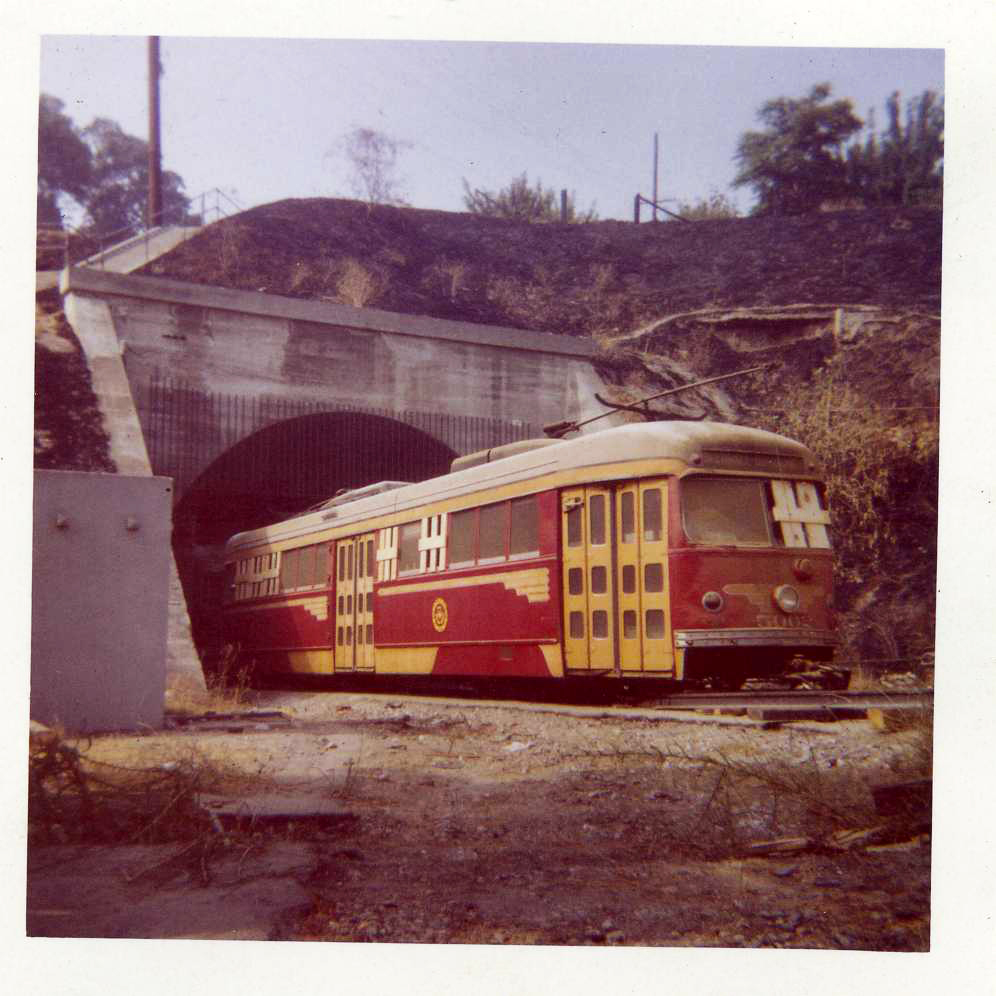
On the afternoon of August 5, 1959, my railfan friends Alan Fishel, James R. Baker and myself went over to the Subway portal to witness two of the once-beautiful PCCs being winched out of the Subway and loaded onto flatbed trucks for their trip to the LA Harbor.
I took these photos with my little KODAK box camera. The two cars, 5002 and 5013, were the 7th and 8th cars to be pulled out of “the hole” that was once the busy Subway Terminal. Damage to these two cars was confined to broken windows, unlike the first 4 or 5 cars which were in a very sad state, sustaining major vandalism damage.
Try as he did, Jessie Hough was not able to do in the Southern District; that was left to the wolf in MCL’s clothing, the first Los Angeles Metropolitan Transit Authority, LAMTA (AKA Many Trolley Abandonments).
And so, the most beautiful PCCs the world would ever see headed for South America and and sadly, a short five-year service life. None of them are known to have been preserved.
Ralph Cantos Collection Images
Ralph Cantos Collection ImagesRalph Cantos Collection ImagesRalph Cantos Collection Images