
LATL PCC Accident on the J Line (Santa Fe Avenue)
[vc_row][vc_column][vc_column_text]By Ralph CantosAlthough the car number if this LATL P-1 car is not visible, it is definitely a P-1, cars numbered 3001 to 3095. This photo must have been taken around 1947 to about 1950.
Notice that the car involved still has its first LATL paint scheme with the green paint coming to a “V” just above the headlight. That paint scheme ended when the cars were repainted for the first time in the early 1950s. Notice too, that this car still retains its full-length “streamlining” along the lower roof line, something LATL removed in the mid-1950s.
Also note that the car involved still retains its 4-blade “horizontal sweep” windshield wipers, another item that LATL removed in the mid-1950s. Those factory wipers were replaced with two “arc sweep” wipers mounted at the belt rail, and at the same time, the front windows were sealed shut.
This car was operating along south Santa Fe Avenue on the J line. On this section of the J line, hot shot operators could, and often did, open up the cars to to their full speed, which may have been the cause of this derailment.
This car was surely repaired, as only one Los Angeles PCC did not make it to the end of rail service, that car being no.3035 that was clobbered by a Santa Fe switcher engine just outside of Vernon Yard.
Ralph Cantos Collection[/vc_column_text][mk_image src=”https://www.pacificelectric.org/wp-content/uploads/2021/11/latl-3035-at-vernon-yard-rear.jpg” image_size=”full” title=”LATL 3035″ desc=”The poor #3035 is seen here in the dirt at Vernon Yard, a few days after the accident at the Santa Fe crossing just outside Vernon Yard. She was damaged beyond repair and was cut up for parts on the spot.” caption_location=”outside-image”][/vc_column][/vc_row]
READ MORE
LARY 357 in Troubled Waters: Navigating 7th Street
[vc_row][vc_column][vc_column_text]By Ralph CantosThis remarkable photo taken on March 1, 1938 shows LARY car no. 357 as the “skipper” navigates the streetcar in high water along 7th Street in Downtown LA.
During the last week of February and the first week of March 1938, rain amounts of biblical proportions fell on Los Angeles. Rain amounts of more then 10 inches fell on LA. Damage was widespread all over the city. Taking the hardest hits were the railroads. The Santa Fe, Southern Pacific, Union Pacific , and the Pacific Electric all suffered major damage to roadbed and bridges.
The rains of 1938 spelled the end of the Mount Lowe Railway. Large portions of the Alpine Division were washed away, never to be rebuilt. The PE lost two bridges; the most impressive of the two was a portion of the Puente Largo concert-arch bridge on the Monrovia-Glendora Line. The other, less impressive PE bridge was on the San Fernando Line.
For the most part, the LARY came out of the rains with little damage. As a result of these rains, new and sweeping flood control projects were implemented city-wide. Probably the most notable of these flood control projects was the major improvements to the LA River. As a result, the LA River is navigable by pedestrians most of the year.[/vc_column_text][mk_image src=”https://www.pacificelectric.org/wp-content/uploads/2020/06/pe-866-on-highland-ave-1938-2.jpg” lightbox=”true” title=”Pacific Electric no. 866; image by Ernie Leo” desc=”Pacific Electric no. 866 on Highland Avenue during the torrential rains of early 1938. Image dated March 6, 1938. Courtesy Craig Rasmussen Collection.” hover_image_overlay=”false”][mk_image src=”https://www.pacificelectric.org/wp-content/uploads/2020/06/pe-335-on-franklyn-ave.jpg” lightbox=”true” title=”PE 335 on Franklin Avenue, 1938″ desc=”PE no. 335 sits alone and abandoned on Franklin Avenue in Hollywood during the Great Floods Of 1938.” hover_image_overlay=”false”][vc_column_text css=”.vc_custom_1593179283455{margin-bottom: 0px !important;}”]PE car no. 335 sits alone and abandoned on Franklin Avenue in Hollywood during the Great Floods Of 1938. The high water was just too much for the little fellow. As a result of the damage done to the 335, the little guy was never returned to service.
The PE had a large surplus of Birneys, so the 335 was a goner. Of interest to “car guys”, a 1938 Cord and a 1937 Studebaker pass the stranded 335 on the other side of the street. The Western-Franklin Line was referred to by PE crews as “The Merry Go Round,” as it really went from no where to no where.[/vc_column_text][mk_image src=”https://www.pacificelectric.org/wp-content/uploads/2020/06/pe-puente-largo-1938-wash-out.jpg” image_size=”full” lightbox=”true” title=”PE Puente Largo 1938 Wash Out” hover_image_overlay=”false”][mk_image src=”https://www.pacificelectric.org/wp-content/uploads/2020/06/pe-puente-largo-bridge.jpg” image_size=”full” lightbox=”true” title=”PE Puente Largo Bridge in Better Times” hover_image_overlay=”false”][/vc_column][/vc_row]
READ MORE
May 9, 1938: J Line LARY Wreck
Historic Caption: Collide at Intersection – Thirty persons were injured in Los Angeles when two trolley cars crashed at a street intersection. The car at the left failed to make a boulevard stop and struck the other car.
Research suggests this accident took place on May 9, 1938 on Jefferson Blvd. at one of three possible intersections: McClintock Avenue, Maphe Avenue or San Pedro Street. The car numbers are not visible in the photo.
Steve Crise Collection
READ MOREDowntown Los Angeles in 1948: A Broadway Trolley Melody
By Ralph Cantos
This beautiful photo taken from atop the LARY-LATL building shows so well the dominance of streetcar transport that was once so prominent in Los Angeles. Here, looking north on Broadway at Broadway Place and Olympic Boulevard is a traction fan’s “Trolley Paradise.”
As a very young trolley fan, I would spend hours on end at 7th and Broadway watching the never-ending parade of LATL streetcars crossing the well-worn diamond at that fantastic intersection. The friendly, beautiful sounds of trolley bells echoed off the tall buildings. Not a harsh BEEP-BEEP of a GM bus could be heard at this wonderful place. I particularly loved the sounds as 2 or more heavy H-4s crossed the diamond in opposite directions; it was “industrial music” at its best. No sooner had an H-4 crossed, than a PCC would “tip toe” across the diamond with half the sound of the preceding H-4.
I was only 12 years old in 1955 and my only knowledge of the coming and goings of LA’s wonderful traction system is from what I saw with my transfixed eyes. It was therefore a traumatic shock to my young life when I went Downtown in the late days of May 1955. I could not comprehend what had happened to all the LATL streetcars that had dominated not only Broadway but Spring and Main Streets as well. I was actually short of breath as I witnessed buses in the Union Station Station Loop from the window as my #2 Trolley Coach emerged from the tunnel under the station tracks.
Even worse, the sight of buses on Main, Spring and Broadway was almost unbearable to me. As I staked out my spot at 7th & Broadway, some of my anxiety faded away as all seemed normal on 7th Street — R-S & J cars still rolled up and down the street with no buses in sight.
But Broadway was a different story.
Gone were the 5 and 9 cars. Now the 5 line was operated with GM buses. The 9 line was gone for good. It was with some relief when I saw W and P cars still rolling up and down Broadway. I did not know it at the time, but the days were numbered for the W line and soon, the P cars would be the only streetcars on Broadway.
Eight years later the wonderful sound of trolley bells echoing of the Downtown buildings would give way to the blasting sounds of hordes of Diesel buses that replaced LA’s beloved streetcars. The charm of Downtown and indeed, LA itself, was gone as far as I was concerned.
If you want to see and HEAR the CHARM that streetcars bring to a city, just head to San Francisco and stake out a spot on Market Street and you will see and HEAR for yourself what LA lost so many years ago…
Ralph Cantos Collection
READ MORELATL R, S & J Lines: The Charm of Downtown LA Died With Them

Ralph Cantos Collection
By Ralph Cantos
Many post-World War II postcards showing vibrant downtown business districts across America had a tendency to include streetcars. What would any great city be without streetcars?
The high point of most US city rail transit systems was the modern PCC. Los Angeles was no exception. This postcard from about 1956 looking west on 7th Street at Broadway shows Los Angeles Transit Lines PCC car lines R-J and the H-4 operated S line doing what they did best — moving people.
What really makes this particular post card interesting to me is the 1941 Buick Limited 90F limo making the right turn from Broadway to 7th St. By 1956, prewar cars were becoming rare and to catch a low production ’41 Buick Limo in this moment in time is really remarkable. By the looks of the Buick, its days of “high society and glory” are long gone. Buick produced limousines in direct competition with Cadillac. The last factory Buick limo left the Flint, Michigan, assembly line in February 1942. After the War, GM told the Buick Motor Davison “no more limos,” and that was that!
When the last of LA’s streetcar lines were abandoned on March 31, 1963, the charm of Downtown died with the last 5 car lines. Gone was the friendly sounds of streetcar bells resonating off the tall Downtown buildings — replaced by the loud, obnoxious, irritating standard BEEP BEEP horns used on most city transit buses at the time.
After 1963, only one major US city in the West where you could still enjoy the sounds of PCC bells was San Francisco. The decision by “Muni” (San Francisco Municipal Railway) to retain streetcars on Market Street was the best thing to happen to Downtown San Francisco.
And as the late Paul Harvey would say, “and now, you know the rest of the story.” May he and LA’s long-gone streetcars rest in peace…
Ralph Cantos Collection
READ MORELA PCCs at Christmas Time: Part 3
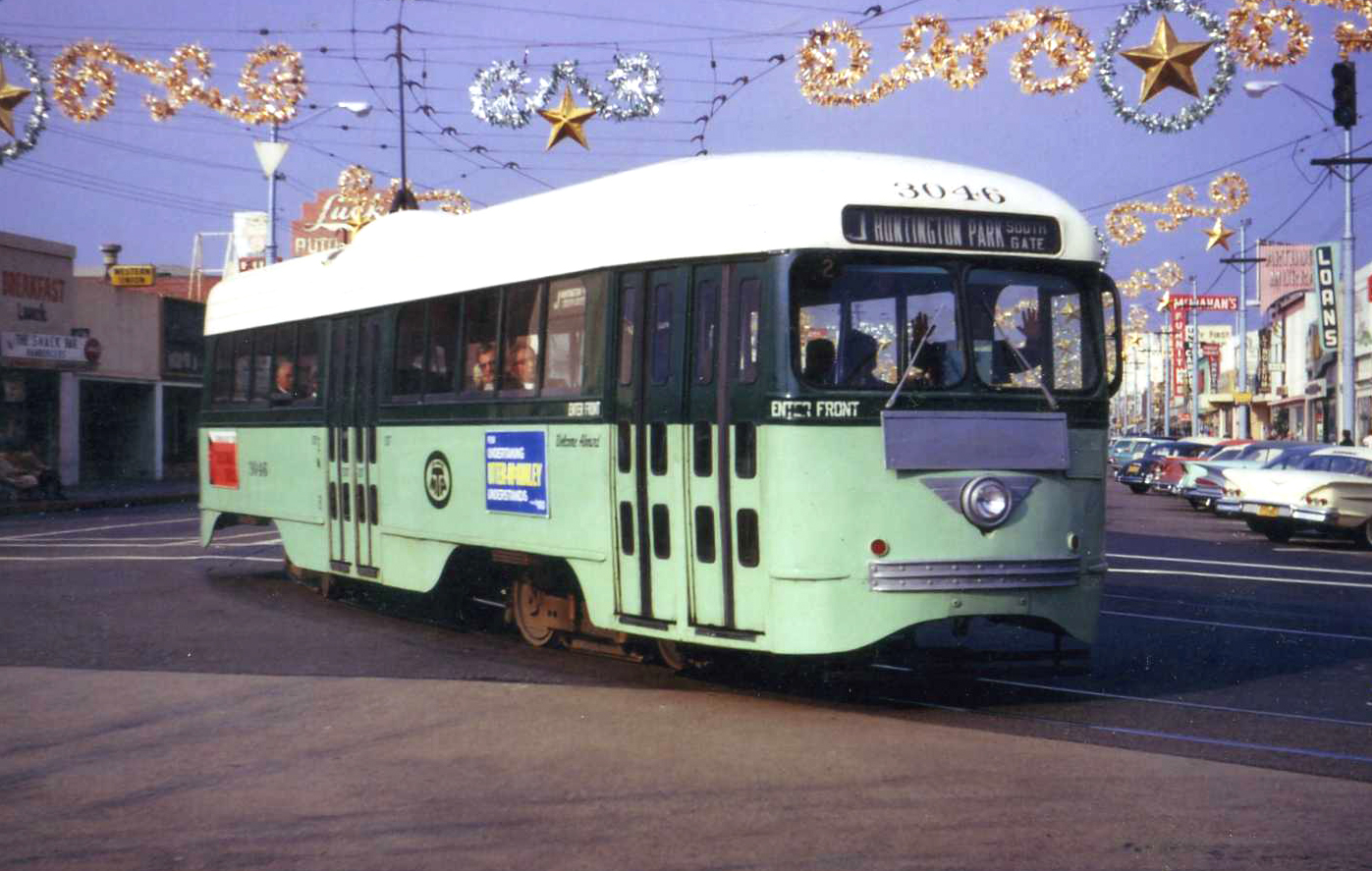
Harry D. Peat Photo, Ralph Cantos Collection
By Ralph Cantos
Los Angeles Metropolitan Transit Authority PCC no. 3046 swings onto Florence Avenue at the south end of Huntington Park’s central business district.
This beautiful photo taken by Harry D. Peat in December 1962 will be the last time such a photo can ever be taken again. This is the LAST Christmas for LA’s once-vast streetcar system. The excellent condition of the overhead and no. 3046 belies the fact that the end of its service life — along with 163 of its sisters PCCs — is a just four months away.
In most cases, the Christmas decorations that hung from streetcar overhead were paid for by an “small financial assessment” imposed on businesses along the street where such decorations were to be displayed. A private contractor would hang the decorations, all the while dodging the passing streetcars, in this case, the busy J line.
If the PE / LARY / LATL / or the MTA were ever paid a “small gratuity” for the use of their overhead span wires, this is lost to history. Even more important, such beautiful holiday scenes of LA’s streetcars passing below Christmas-decorated overhead has also been lost to history.
I don’t see Christmas decorations being hung from the catenary on today’s light rail lines such as the Blue, Gold and Expo Lines here in LA or anywhere else in America for that matter….
Harry D. Peat Photo, Ralph Cantos Collection
READ MORE3029 at 7th and Grand
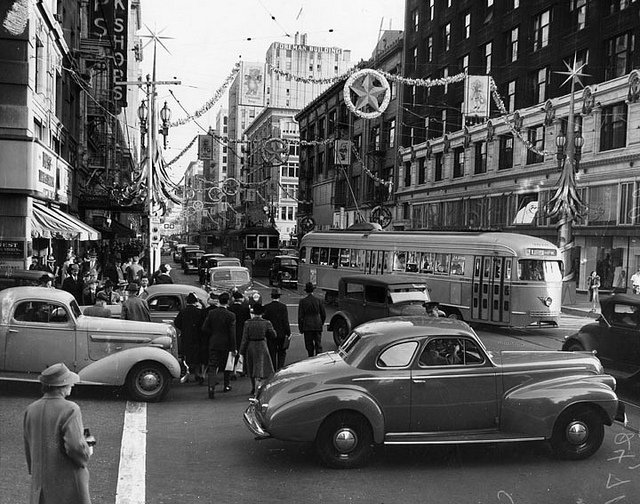
Ralph Cantos Collection
Los Angeles Railway J Line car no. 3029 turns off 7th Street and onto Grand in this image taken December 5, 1941, just before Pearl Harbor.
Ralph Cantos Collection
READ MORE3063 at the Tenth Avenue Loop
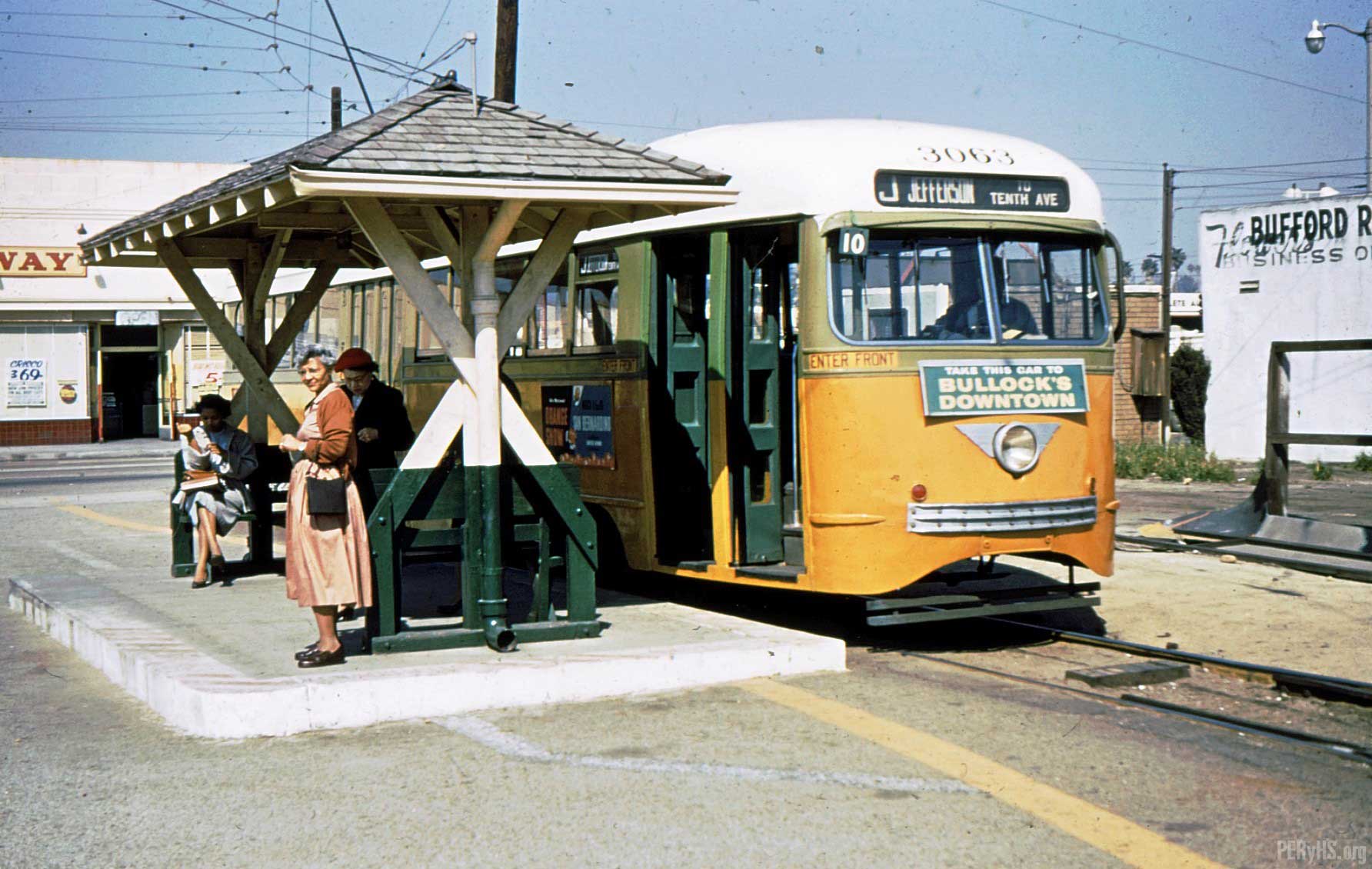
L. Swanson Photo, Andy Goddard Collection
Los Angeles Transit Lines PCC car no. 3063 rests at the Tenth Avenue Loop passenger shelter at the end of the J Line in this image dated March 10, 1956.
L. Swanson Photo, Andy Goddard Collection READ MORE
LATL 3165 in Huntington Park
Los Angeles Transit Lines J Line PCC car no. 3165 rolls through Huntington Park as part of the 20th Anniversary PCC event on March 18, 1957.
L. Swanson Photo, Andy Goddard Collection
READ MORELATL 3165 at the Palm Place Loop
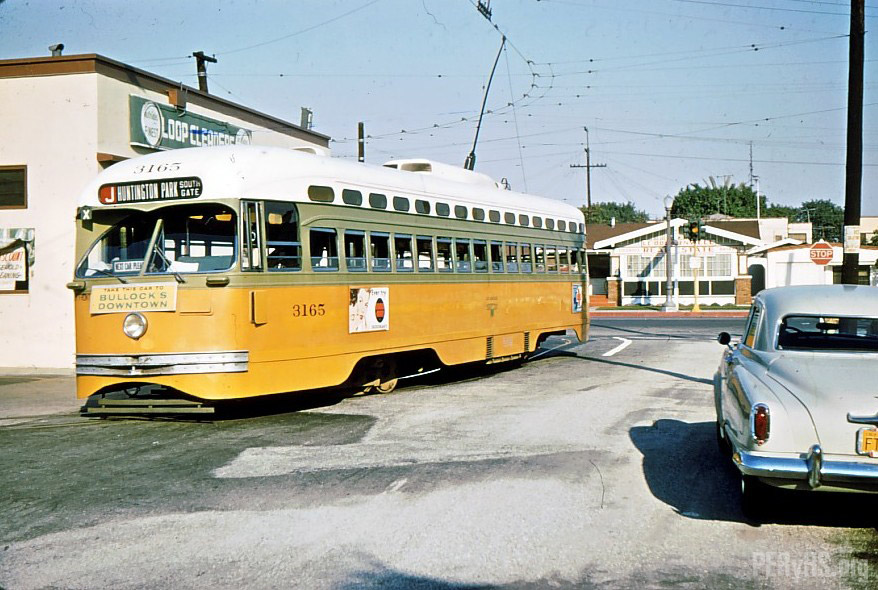
L. Swanson Photo, Andy Goddard Collection
Los Angeles Transit Lines PCC no. 3165 pauses at the Palm Place Loop in South Gate in this J Line image dated March 18, 1958. This was captured during an ERA fan trip.
L. Swanson Photo, Andy Goddard Collection READ MORE