In this 1906 postcard from the Pacific Railroad Society Collection, we are looking east on Oregon Avenue, which was the original name of Santa Monica Boulevard in this part of Los Angeles, California. The line going off the left of the frame could be the Westgate Line that ran down the middle of Burton Way through Brentwood Park. The exact location of this photo is somewhere near present-day Santa Monica Boulevard and Purdue Avenue.
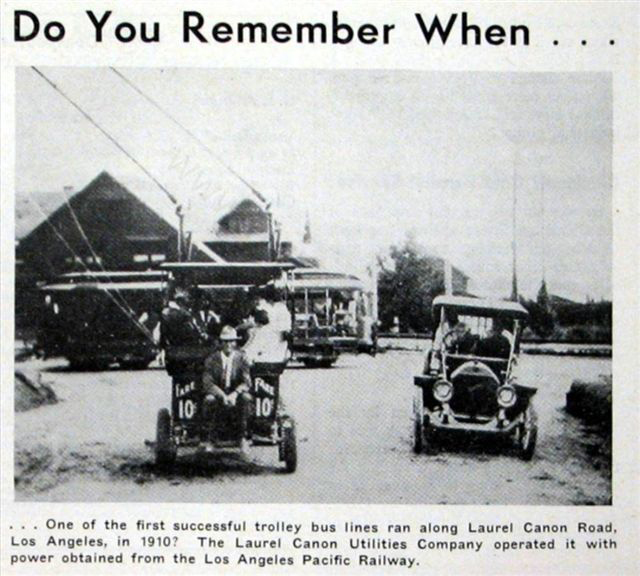
This remarkable old photo, taken around 1908-09, shows a Los Angeles Pacific trolley at the end of the single-track Laurel Canyon Line. The camera looks south as one of the two Laurel Canyon trolley buses begins its one-and-a-half mile journey up Laurel Canyon Boulevard to the end of the line at Lookout Mountain Avenue.
The trolley buses, made from modified 1915 Oldsmobiles, had an approximate 10-passenger capacity. After about 5 years of traveling up and down the treacherous narrow road, the poor old trolley buses fell apart.
The overhead wires came down and the service was replaced by Stanley Steamers about 1915. The line was operated as a real estate gimmick to a new housing development, known as “Bungalowland,” by one Charles S. Mann. He was a small-time Henry Huntington, and judging by his choice of convenience modes, must have been a glutton for punishment.
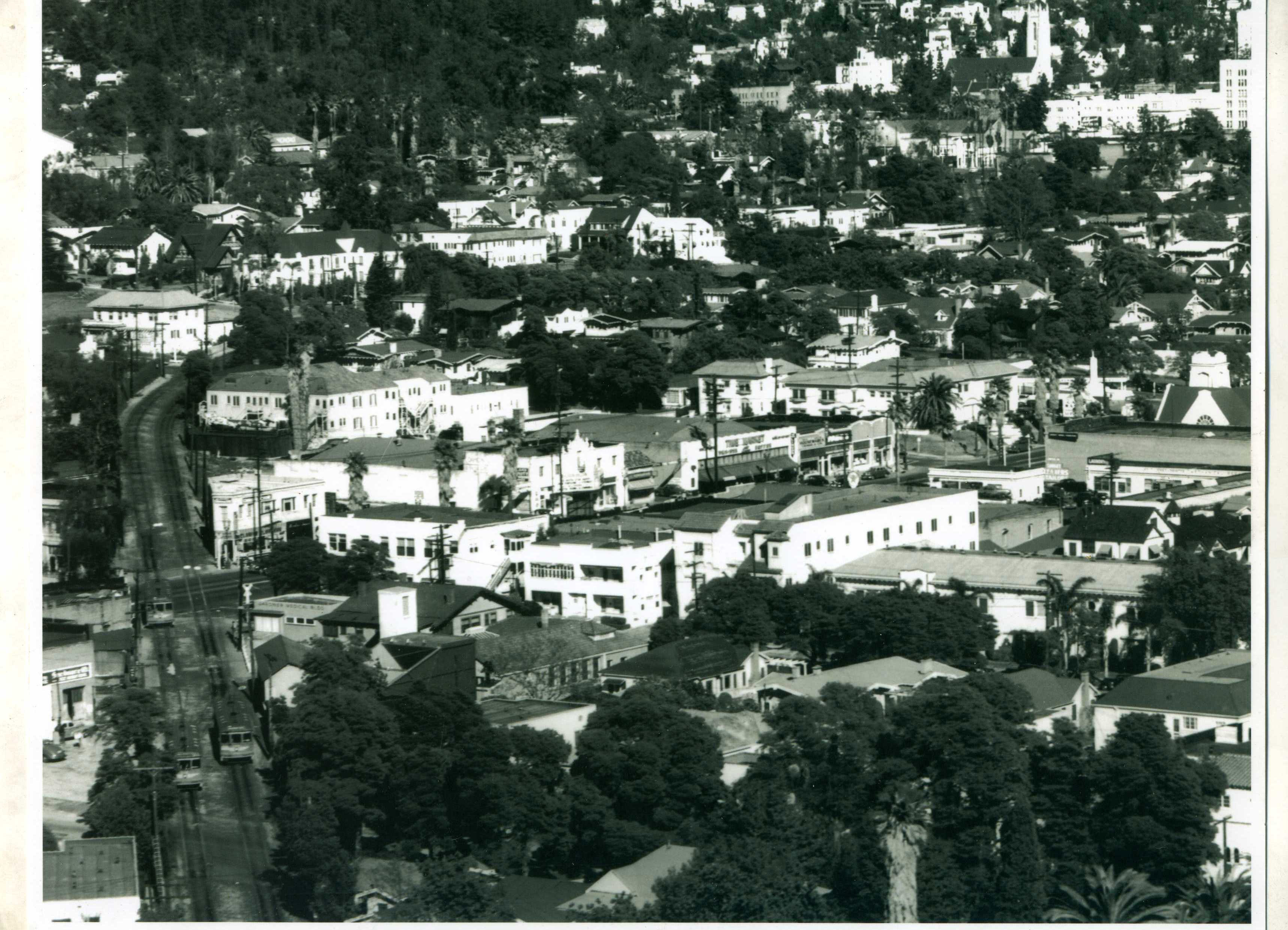
What a difference 30 years makes. It’s now 1954 and Gardner Junction is in the last months of its life. Three Hollywood cars can be seen in this photo.
For reasons lost to history, Pacific Electric management decided to discontinue two-car rush-hour train service on the Hollywood Boulevard/Beverly Hills line on June 1, 1953. Instead, 4-minute one-car service was provided to Gardner Junction.
At this point, every other car turned back, with 7-minute rush hour service to Beverly Hills…not bad at all.
This service continued until the line was torpedoed and sunk by Metropolitan Coach Lines on September 26, 1954.
Over the next 60 years, the “back yard” private right-of-way (PRW) (from La Brea to Fairfax Avenues) would be sold off, piece by piece, for development of large apartment houses. The very last piece of PRW to be sold for development was done just 2 years ago and it was the segment of PRW shown in these two photos: from Vista Street to just short of Sunset Boulevard.
This portion of abandoned PRW had sat, undisturbed, behind Gardner Street Elementary School for 58 years. Then in 2012, an enterprising developer removed the fences at each end of this historic piece of PE land, graded the property, and “shoe horned” a row of mobile home-sized “town houses” into the former PRW.
I wonder if anyone living in these mini houses wakes up in the wee hours of the night because he or she thought they heard a PE whistle while sleeping…stranger things have happened.
Gardner Junction was so named because of its location at Gardner Street and Sunset Boulevard.
At this point, the LAUREL CANYON line diverged from the Hollywood/Beverly Hills main line and headed west along Sunset Boulevard on single track to Laurel Canyon Blvd. where the cars made a connection with the “Laurel Canyon Trolley Bus Line”, the first such trolley bus service in the USA.
Until abandonment of this marginal line on March 10, 1924, Pacific Electric used this line for “short turn” rush hour service of some of the Hollywood Boulevard runs. The Laurel Canyon cars used the cross-over seen at the lower left of the beautiful 1924 photo.
This crossover remained in place, although unused, until it was removed around 1947. There was a crossover on the southwest side of Sunset Boulevard that was the normal turn back for the cars at this location.
Gardner Street Elementary School is at the top of the photo fronting Hawthorne Street. Its still at this location to this day.
The events of December 7, 1941 united this country like nothing ever — or since. Patriotism united Americans during World War II to levels that would never be seen again. Feature films and recordings (78 rpm) from Hollywood celebrities brought this entire country together.
Who will ever forget Kate Smith’s rendition of God Bless America, or Boogie-Woogie Bugle Boy from Company B by the Andrews Sisters? Even the Three Stooges got in some barbs at dear old Hitler.
Transit Companies across America did their bit for the war effort also. Streetcars and buses appeared in patriotic paint schemes promoting War Bonds and other wartime issues. Los Angeles was no exception. Both the LARY and PE painted PCCs in special war-themed paint jobs.
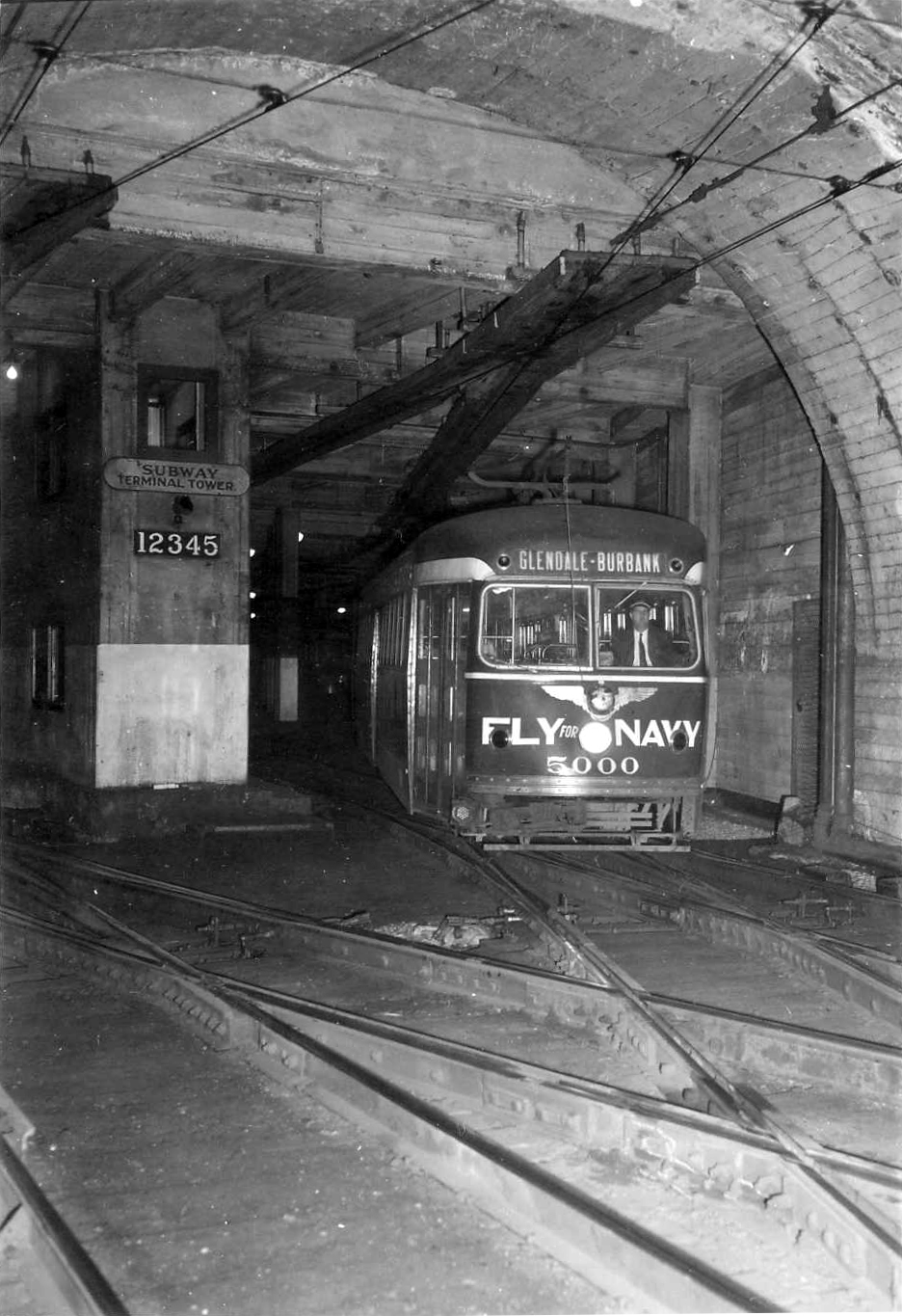
Pacific Electric selected car no. 5000 to be decorated in a special blue and silver paint job proclaiming “FLY for NAVY” It operated through the war in the very attractive paint scheme. In this 1943 photo, the 5000 departs the Subway Terminal for a fast and comfortable trip to Burbank. Even though World War II was a terrible chapter in world history, the manner in which it brought America together will never be seen again.
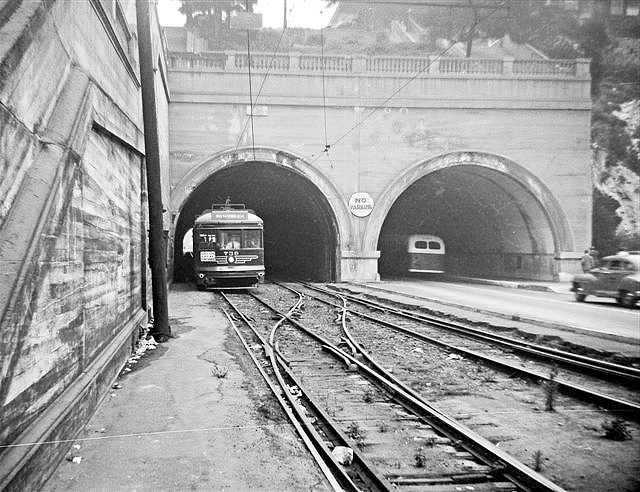
Hollywood car 736 burst into the morning sun as it approaches 1st & Hill Streets. The third rail was for the LARY / LATL A line that was abandoned on June 30, 1946. It was one of the first dirty deeds by the new LATL management. This photo probably dates to about 1946-47. The crossover in the foreground was removed when the A line third rail was pulled up.
By the end of 1950, all rail service on Hill Street was abandoned and the car tracks quickly paved over. About the same time, construction of the “space-age” Hollywood Freeway was well under way. EVERYTHING in the scene will be bulldozed into oblivion except the 736. It would be sold for continued operation in Buenos Aires, proving once again that “one cities junk, is another cities treasure.”
When the Pacific Electric Railway took delivery of their 30 new Pullman Standard MU PCCs in November of 1940, the Railway was the talk of the transit industry. The whole idea behind the development of the PCC was to mass produce a modern “standard” single-end transit vehicle that would be virtually identical in every respect. The only differences envisioned by the Electric Railway Presidents Conference Committee (ER-PCC) was to be in the various paint schemes of the transit companies that would be smart enough to order these streamline vehicles. This production practice held true for the first four years of PCC production. Then in the latter half of 1940, the Pacific Electric Railway re-wrote the PCC Production Manual.
From its introduction in 1936, the St. Louis Car Company was receiving the lion’s share of PCC orders. Indeed, by mid-1940, Pullman Standard had delivered only 61 PCCs to just three operators, while St. Louis Car Co. was building and delivering PCCs by the hundreds to several operators. The only mechanical differences in the cars produced was electrical equipment. The cars could be ordered with either WESTINGHOUSE or GENERAL ELECTRIC equipment. Other than that, all PCCs built up to the PE’s order were “off the shelf” models.
Pacific Electric’s PCCs broke the mold for damn sure. These 30 cars were the longest at over 50 feet; the standard to that time was 46 feet. PE’s PCCs were DOUBLE-ENDED; all PCCs built up to that time were single-ended. And the topper: the PE’s PCCs were built for Multiple Unit operation of up to 3 cars. The American transit industry was stunned, to say the least.
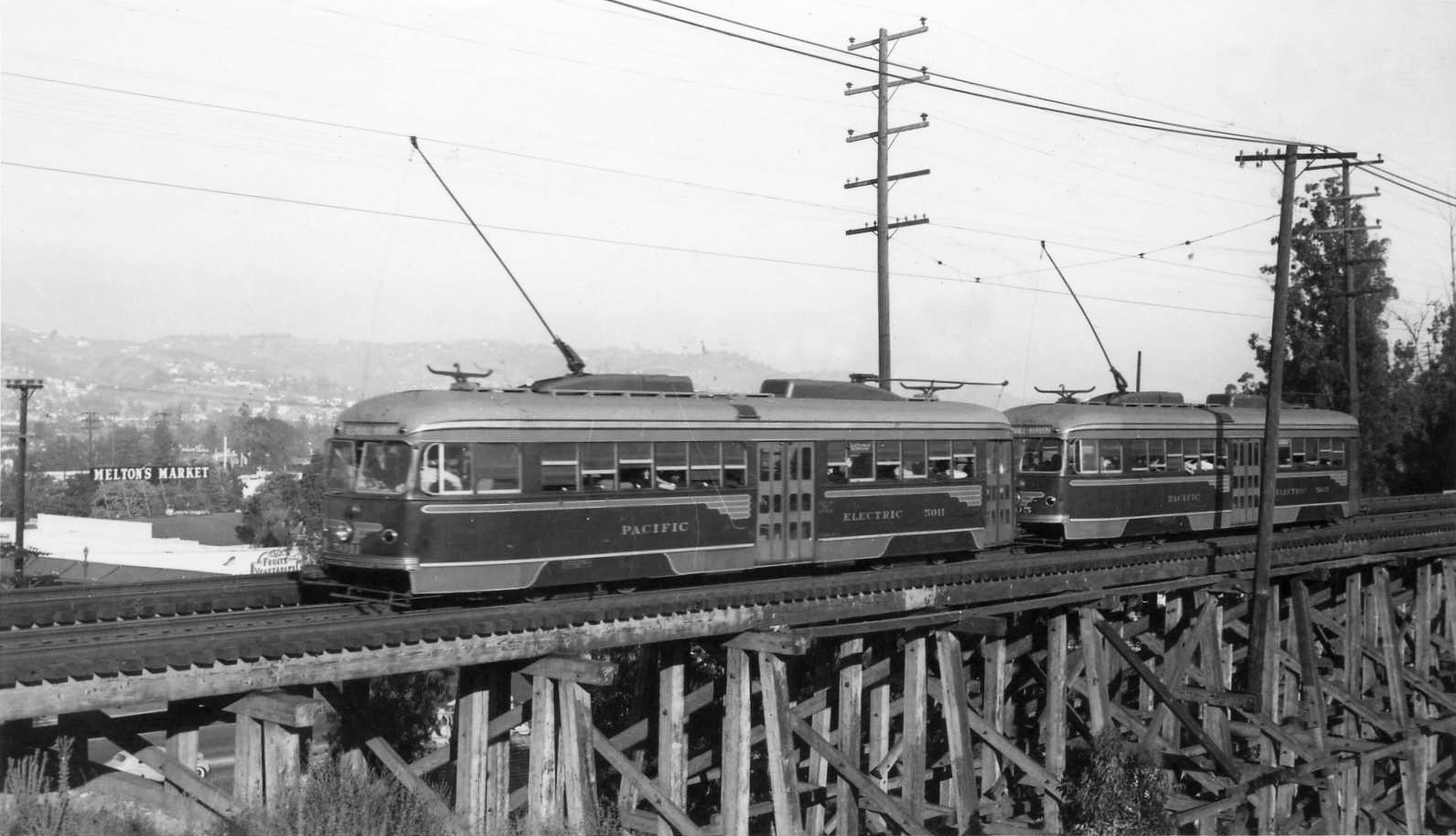
PE’s revolutionary PCCs set the stage for “Special Order PCC” production across the USA. The above photo of cars 5011 and 5005 was taken by the late Bob Burrowes in January 1941. The virtually new cars were the “Pride Of The PE” and the talk of the transit industry. With the outbreak of World War II, the 30 cars could not have come at a more opportune time. Their limelight would last just 15 years.
In late 1953, PE passenger operations fell into the evil clutches of Metropolitan Coach Lines, a private enterprise whose greedy practices mirrored that of National City Lines. After just 14 and a half years of operation, and with decades of service remaining, the most beautiful PCCs ever built were replaced by inferior bus service in June 1955. The cars were placed in storage, in the dank Subway Tunnel. There, they would rot until sold to Buenos Aires in the summer of 1959.
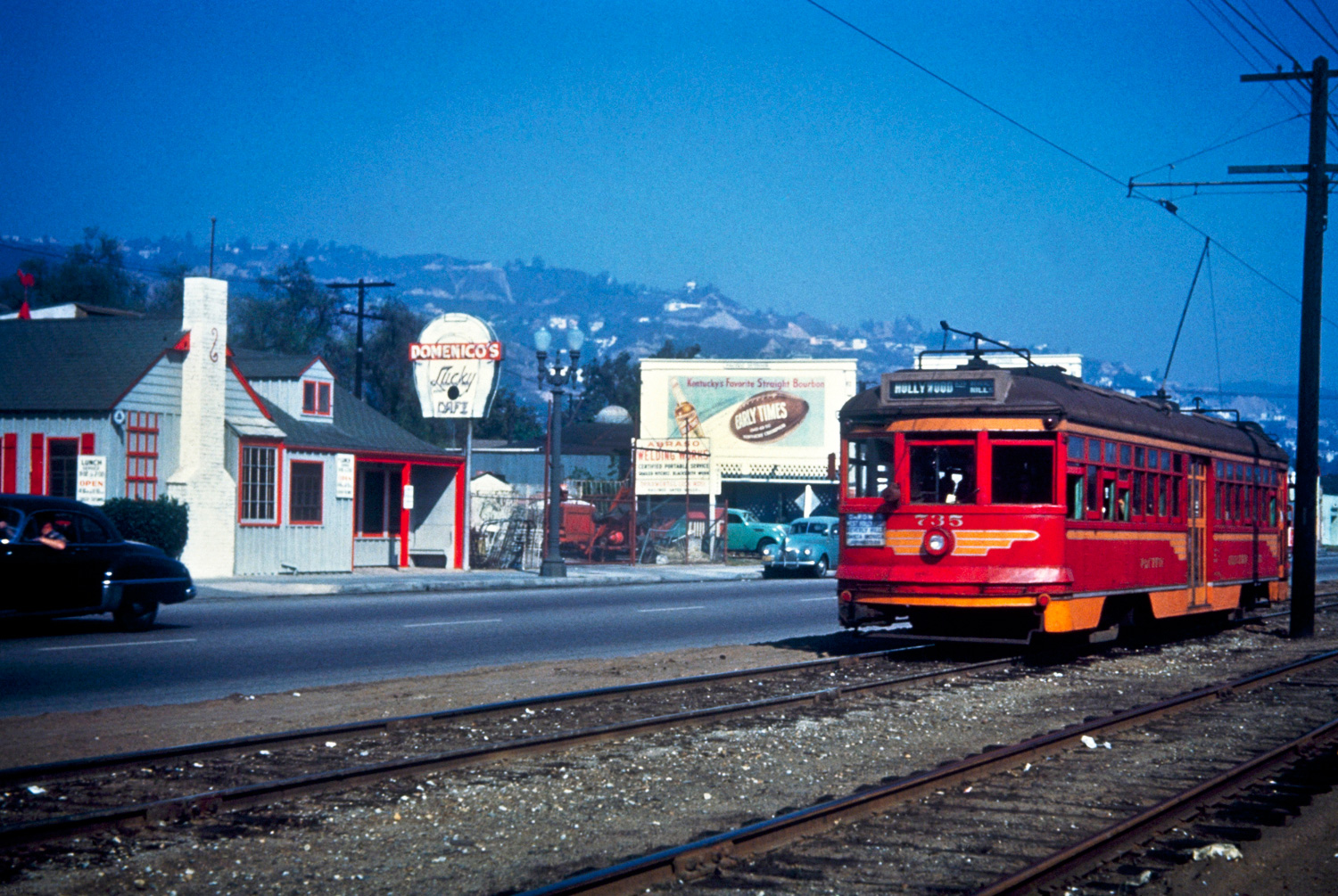
Pacific Electric Hollywood car no. 735 rolls through (what else?) West Hollywood near Robertson Boulevard in this circa-1950 image. 735 is headed west and approaching Robertson, with Domenico’s Lucky Cafe on the north side of the street.
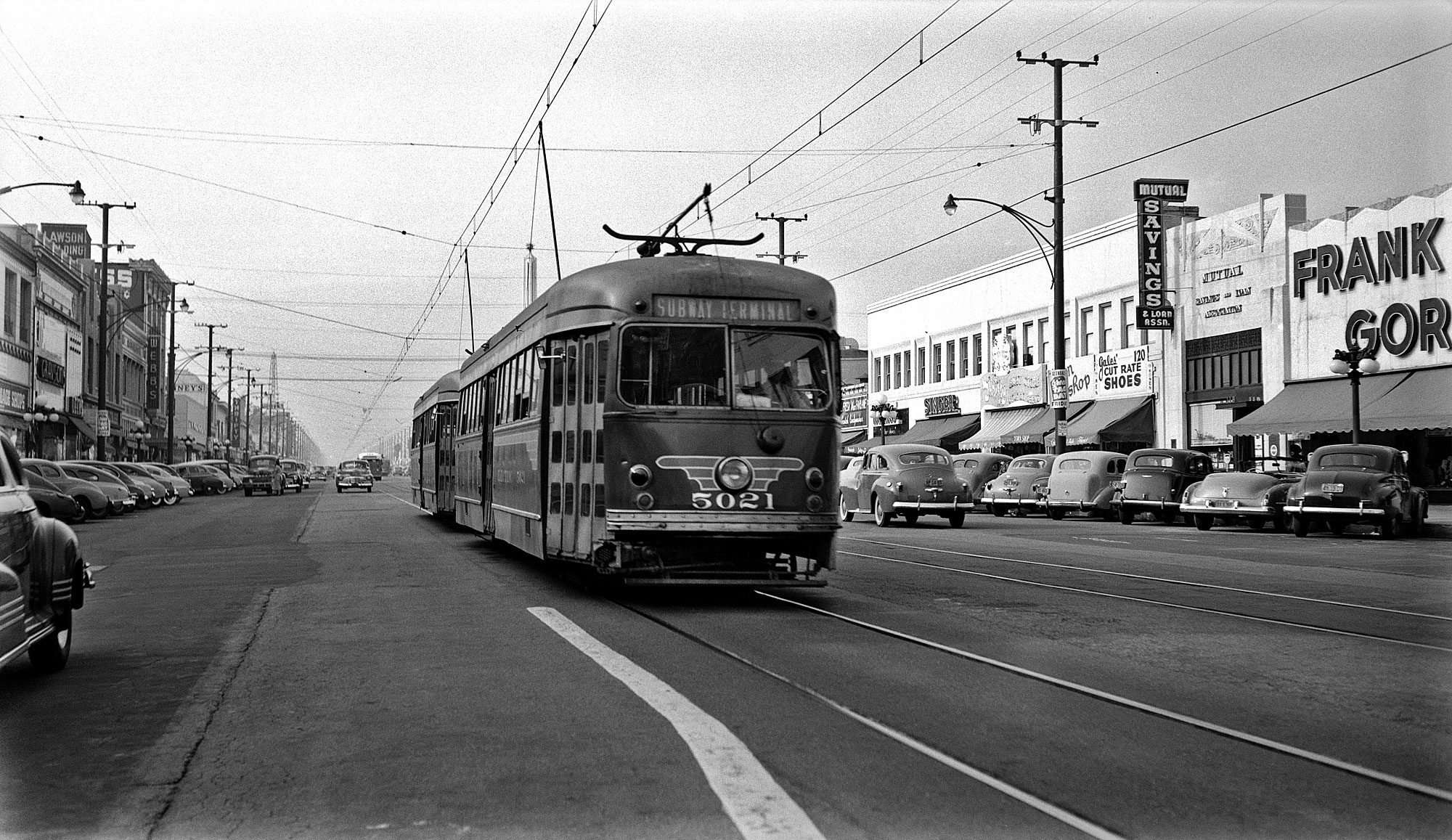
Pacific Electric PCCs nos. 5021 and 5028 are captured on Brand Boulevard at Broadway in Glendale. The cars are headed southbound; the Alex Theater obelisk is seen in the background, but not the hills that usually show up in these views. The date is May 26, 1949.