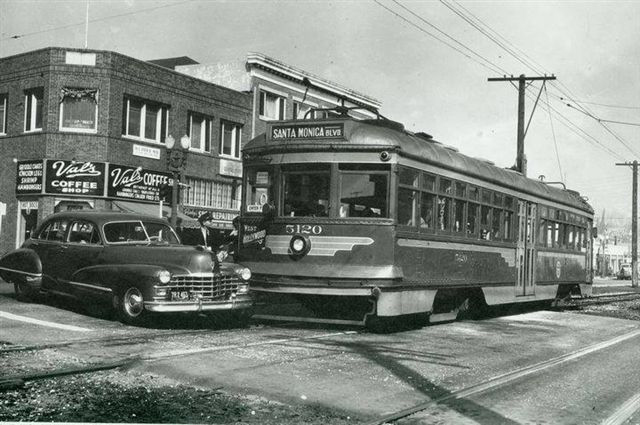
In a a scene all to typical in post-World War II Los Angeles, Hollywood car no. 5120’s “right of passage” is challenged by a 1947 Cadillac Fleetwood sedan. The motorman of 5120 looks over the damage to the Cadillac and will hand out “courtesy cards” to the few passengers that were still on the car so close to the end of the line, some 3 blocks to the west. It’s a minor 1952 accident, and both the Cadillac and the 5120 will live to fight another day.
But as more and more grade crossing accidents plague the Pacific Electric, City traffic officials looked upon the Red Cars as a scourge to the efficient movement of automobile traffic.
After the abandonment of the Santa Monica Blvd. Line in early 1953, the 5120 was transferred to the Watts Line. The 5120 would continue to render excellent service, despite operating with little or no maintenance to its body and solely under the ownership of Metropolitan ROACH Lines, and the LA Many Trolley Abandonments. Under LAMTA, the 5120 would be renumbered 1809 in March of 1958.
Sadly, in the early months of 1959, the 1809 was involved in another crossing accident on the 4 tracks. This time it was not a 1947 Cadillac, but a sizeable box truck. Damage to the 1809 was bad, but easily repairable if an adequate body repair shop still existed on the Southern District. The 1809, with a bashed-in front door and anti-climber, operated under its on power to Fairbanks Yard in Long Beach. There, the old girl would remain operable, but out of service until the Watts Line was abandoned in November of 1959. The 1809 would operate one last time from Fairbanks Yard over to Morgan Yard (about 1 mile) to join the last eight Hollywood cars awaiting sale to National Metals & Steel for scrapping.
Thirty-eight years of dependable service had come to an end…
Here’s a neat animation created by Eriks Garsvo showing a modern-day view of the old Los Angeles River Pacific Electric bridge pilings, with a Then-and-Now animation re-creation.
Pacific Electric PCC no. 5023 shows the the terrible effects of 4 years storage in the dank confines of PE’s Subway Terminal tunnel. Some of the cars looked somewhat better, but the 5023 really got hammered with the lime drippings from the roof of the tunnel.
This was a shameful chapter in LA’s transit history. About a year before, when the PE sold its passenger operations to Metropolitan Coach Lines in October of 1953, all 30 PCCs went through Torrance Shop for a complete cosmetic overhaul. When the PCCs rolled out the doors of Torrance Shops, they were in top condition. Included in the overhaul were a 4 new doors, new interior and exterior paint and new seat covers where needed. All 30 cars were now in better than new condition.
For all practical purposes, they were ready for another 15 to 20 years of service here in LA. It was not to be.
Metropolitan Coach Lines management informed the populace of Los Angeles that ALL 7 remaining rail lines would be converted to “gutter liner” replacement bus service as soon as possible. The new paint on the PCCs had barely cured when they were stuffed into the Subway Tunnel after the June 1955 abandonment of the Glendale / Burbank Line. And there these fine cars would rot with the resulting effects displayed by the 5023.
All 30 cars were pulled out of the Subway Tunnel in September of 1959 and trucked to the LA Harbor. The cars were loaded aboard freighters and sent to South America.
Once the PCCs arrived in Buenos Aires they were extensively modified. The PCCs were used exclusively on a short suburban line for about 3 years and when that line was abandoned, the 30 PCCs, the most beautiful PCCs the world would ever see, vanished with out a trace. As of this date, NO ONE living or dead, seems to know just what became of them.
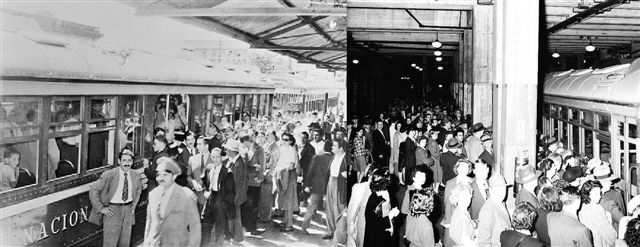
These two photos, taken about ten years and ten thousand miles apart, are remarkably similar in the fact that they both show the fantastic ability of PE’s Hollywood cars to move vast amounts of commuters in “comfort-speed-and-safety.” The photo on the left shows the inaugural rush hour run of the first set of second-hand PE cars in Buenos Aires in early 1953. The photo on the right shows a three-car rush hour train of Hollywood cars at the Subway Terminal in 1943.
In the Buenos Aires photo, the man in the tie looking at the camera is very smug and proud of this train. He must have wondered how those stupid Americans could have let such excellent commuter rail cars slip away. The Hollywood car would serve the commuters of Buenos Aires well into the 1970s.
Back here in Los Angeles as the decades passed, murals of Hollywood cars would dot the landscape as traffic chocked freeways became the norm.
Then in the late 1980s LA City planners finally “bit the bullet” and decided it was time to put the PE back together again — in short, one HELL of a Humpty Dumpty. So now, at a cost of hundreds of billions of our tax dollars, rail service is being restored to areas of Southern California once served by not only the PE Hollywood cars, but rail cars of the LARY / LATL. In every case, the public officials tout the fact that “superior rail service returns once again” One can only wonder if rail service was so good in the first place, WHY THE HELL did LA City officials sit on their asses while the likes of Metropolitan Coach Lines and California Division of Highways (today’s CalTrans) were allowed to destroy the original rail system in the name of “progress.”
This beautiful photo of former Pacific Electric no. 754 was taken in late 1952.
The 754 was the first Hollywood car to go into service in Buenos Aires. The photo was taken just outside the Railroad shops for the inspection by company officials. The 754 is a sight to behold. She is as good, or better then new. “Splendid” would be another word to describe the 754.
What makes this photo so interesting as that some changes in the appearance of the 27 Hollywood cars has yet to take place. Except for a darker shade of red applied to the Hollywood cars in Buenos Aires, the cars looked like they just rolled out of Torrance Shops some 12 years earlier.
Most notable is that the 754, now renumbered 1754, still sports 2 trolley poles. Not to long after cars 732 to 759 went into service, changes began to alter the appearance of the cars. The first thing to go was one of the trolley poles. The GENERAL URQUIZA Railroad began a conversion to 3rd rail operation a year or two after the cars went into operation. The only trolley overhead wire to be found on the system was in yard areas, where 3rd rail operation was deemed too dangerous. One trolley pole was all that was needed after this conversion.
The next and most drastic change to the handsome appearance of the cars came when the General Urquiza Railroad cut train doors into both ends of the cars. On the Pacific Electric, trains of Hollywood cars was limited to just 3 cars. The PE felt that the “response time” of the air-operated brakes beyond the 3rd car would be too slow in LA City traffic to allow for safe operation.
Not so on the GENERAL URQUIZA. With train doors cut into both ends of the cars, ONE conductor could pass from one car to another, collecting fares with no problems. Trains of 5 and 6 cars became the norm and with no city traffic to worry about, the Hollywood cars did just fine. Who the HELL needs brakes in South America anyway??
As the decades passed, more second-hand railcars from the United States — most notably ex-Key System articulated bridge units — would intrude on the domain of the Hollywood cars. Newer rolling stock from other countries would also join the roster of the GENERAL URQUIZA.
By the late 1980s most if not all of the Hollywood cars were out of service and retired. The lone exception being the former 758 which became the Railroad’s line car.
The beautiful PE PCCs would last just 3 years in service on the GENERAL URQUIZA . The former PE 1100s would do somewhat better. As the decades passed, most of the 1100s were de-motorized and used in locomotive hauled trains until they too were retired. Reports are that one lone derelict 1100 remains as of this date. Except for the PCCs, the 700s and 1100s operated 35 to 50 years longer because they had been sold to the GENERAL URQUIAZ RAILROAD, regardless of the unholy modifications that were made to the cars.
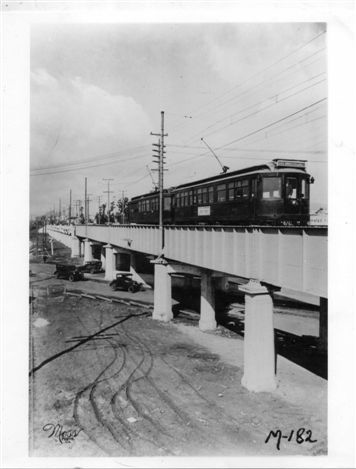
This beautiful photograph taken in November of 1927 shows a 2 car train of 950s with no. 955 on the head end. The occasion was the first test train over the newly completed viaduct over busy West Pico Blvd. Before the viaduct was built, the trains crossed Pico Blvd. at grade, resulting in numerous crossing accidents. Beneath the viaduct, much cleanup still remains. If you look closely at the left side of this photo, you can still see the cross buck and a portion of temporary track crossing Pico.
This is a very interesting photo in that it shows the two 950s in the middle of a 2 year upgrade and rebuilding program that started in late 1926 and ran through 1928. The 955 has had its former open section enclosed with deluxe brass sash windows, while the unidentified car behind the 955 still has its windowless open section. The installation of 2 PE pneumatic trolley bases has yet to be done on both cars.
The Pico / San Vicente viaduct was extremely well built structure. It should have lasted “forever.” But FOREVER would last a mere 37 years. The span was made useless after 23 years of service at the end of 1950 with the combined abandonments of the Venice Short Line and the San Vicente Shuttle. The span would remain standing, its rails and catenary long gone for another 14 years, providing a safe crossing over Pico Blvd. for a vast selection of 2, 4 ,and multiple legged creatures, until bulldozed into oblivion in 1964.
Today, no trace of the great viaduct remains. The only evidence that the PE was ever at this location, is the aliment of San Vicente Blvd.
In an ironic turn of events, the old PE right of way at this location still serves a public transit purpose as the new Rimpau Transit Terminal for both LAMTA and Santa Monica Blue Buses. Well…. as the old saying goes, “what goes around, eventfully comes around.”
Pacific Electric car no. 5111 poses for the camera of the late Jeff Moreau on this overcast day at Pico Boulevard and Main Street in Santa Monica. It’s a Sunday afternoon and the time is running out for the historic Santa Monica Air Line.
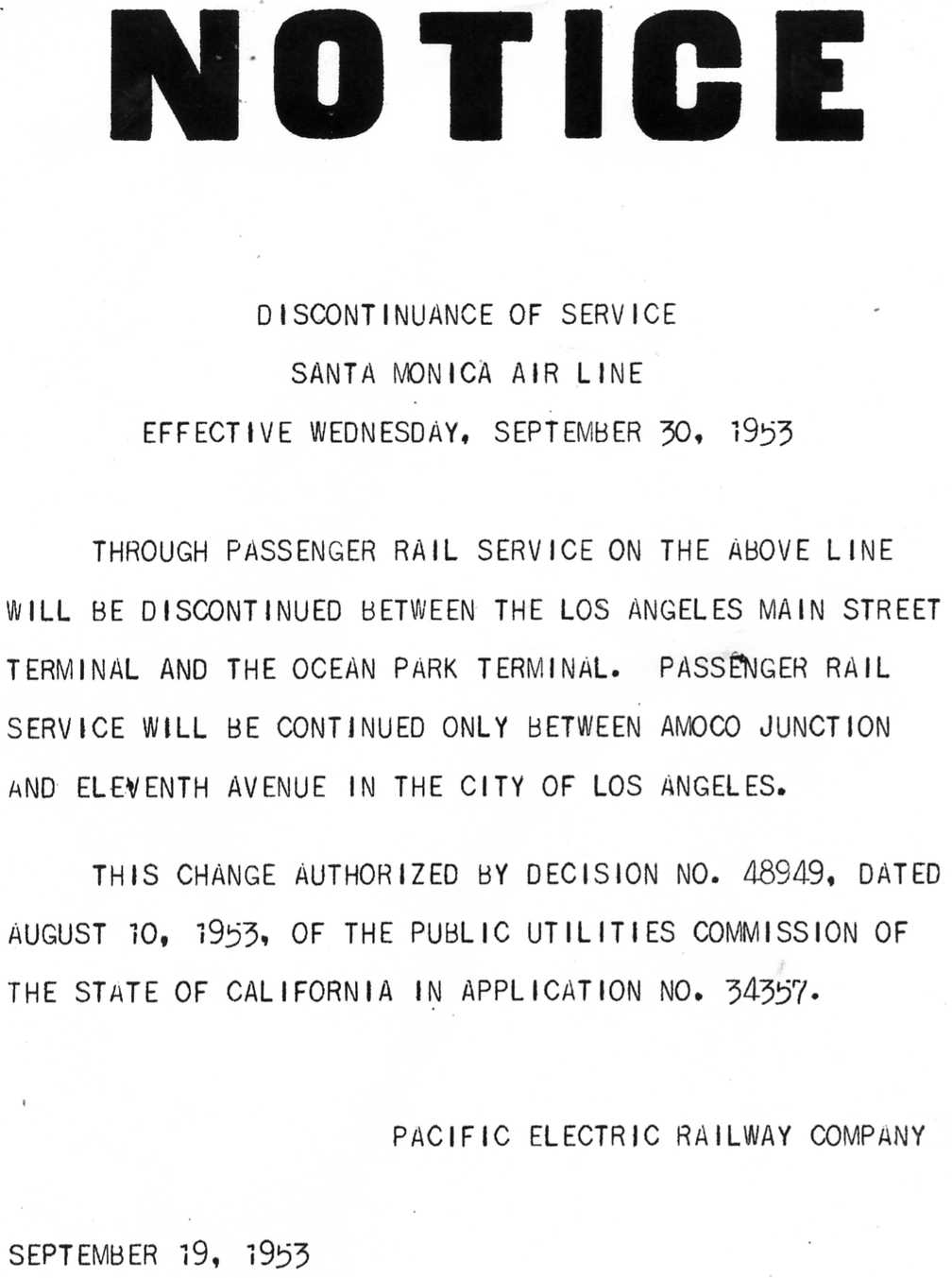
The Air Line was not included in the sale of PE’s passenger service to “cut-throat” Metropolitan Coach Lines on October 3, 1953. This fan trip was operated on July 26, 1953. Passenger service to Santa Monica and Ocean Park / Venice officially ended on September 30, 1953. On that date, passenger service only operated between 6th & Main and 11th Ave until October 26th, when that truncated service ended, bringing an end to almost 60 years of uninterrupted rail service on the line.
The Venice Short Line had been abandoned 3 years earlier and the Air Line WAS THE LAST PE passenger service to the Westside of LA. By the end of 1953, the overhead wires were removed and this section of track abandoned.
In the years that followed, this entire area of Santa Monica would be transformed into the SM Civic Center Complex. The spot where the 5111 was photographed is now occupied by an upscale hotel. The 5111 would become LAMTA 1800 in 1958 and stagger on in deplorable condition, servicing the Watts Line until mercifully scrapped in 1960.
Today, the “New Santa Monica EXPO line” follows the original historic Air Line for much of the way to Santa Monica. The new terminal is located just across the street from the Sears Department Store at 4th & Colorado which can be seen in the distance of this photo.
I have said it many times before, and I will say it again when it comes to the PE…. “what goes around, come around.”
This fantastic faded shot of Pacific Electric Box Motors Nos. 1457 & 1458 working MU on the Santa Monica Air Line was taken about 1948. The two units have just crossed the Venice Short Line’s high iron at Culver Junction and are outbound to the Santa Monica Freight Station.
Before 1947, these 2 Box Motors could not work together as an MU train. PE added MU receptacles to the doors of both cars in 1947, necessitating lowering the position of the headlight. Business must have been good to require a two-box-motor train on this historic line.
In the back ground can be seen a white building. It was the CULVER BUILDING MATERIALS CO. PE serviced this company for many years. It was still standing until bulldozed away about 5 years ago to make way for the “NEW SANTA MONICA AIR LINE” (also known as the LAMTA’s EXPO LINE).
As I have said many times on the website , “what goes around, comes around” (sooner or later).
By the mid 1930s, the Pacific Electric was operating a fleet of more than 500 rail cars. The newest of them, the 100s, had just arrived from St. Louis Car Company in 1930; all 160 Hollywood cars were in service; and the PCCs and the Blimps had yet to appear on the local scene. As of 1935, the PE still had more than 200 wood/steel interurbans on its roster in 3 classes: the 800s, the 950s and the 1000s.
It was around 1935 when the PE came under enormous pressure from various “Regulatory Agencies” to make very substantial and expensive changes to its day-to-day operations. Chief among the “changes” being demanded on the PE was to rid the streets and suburbs of Southern California of “antiquated” interurbans that was tarnishing the modern, progressive image of Los Angeles, such as it was. The PE was told to have all wood-bodied interurbans off the streets of SoCal by last days of 1939. The LARY was not overlooked either, but was doing its part by placing in service 95 PCCs with more promised as funds became available.
So as 1938 dawned, the mighty 800-class interurbans were doomed, as they were the oldest of the 3 wood-bodied cars still in service. In those days of yesteryear, the PE had a tendency to assign certain cars to certain lines. Hence, if a line was to be abandoned, the interurbans assigned to that line went down the “tubes” with it.
Such was the case of the Santa Monica via Beverly Hills / Sawtelle Line, the subject of these two photos taken in July of 1940. The mainstay of the line were the fast, heavy 800-class cars with 950s supplementing the lighter off-peak schedules. Even as late as 1938, the line still was a good performer, with well over 2.2 million passengers enjoying the fast, “breezy” interurban trips to the beach.
The PE abandoned the line on July 7, 1940. Even as the abandonment notices appeared at stops along the line, passengers briefly enjoyed the the comfort of a handful of “modernized” Hollywood cars that rolled along the line in its last days of operation. PE had saved the “best for last.” Had the line lasted for just another 17 months, the demands of World War II would have most likely kept the entire line in service, at least until 1946 and perhaps longer.
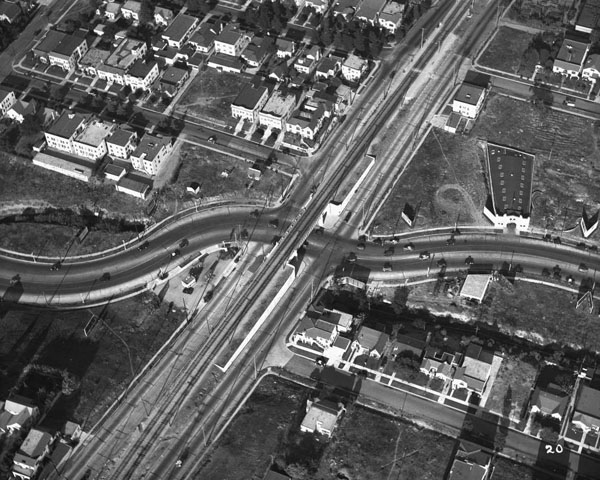
In the first image (above) from the Craig Rasmussen collection, a two-car afternoon rush hour train of 800s blast over La Brea Avenue at the western end of the “PICO-SAN VICENTE Viaduct”, as abandonment neared.
The second image (below) from the City of Los Angeles Public Works Department, shows the same location from the air.
After the 1940 abandonment of the through service to Santa Monica, this portion of the line remained in passenger service as the “San Vicente Shuttle” to Genesee Avenue, one block east of Olympic Blvd. Beyond Olympic Blvd, the line was single tracked and used for “back door” movements into and out of West Hollywood Car House via the “Sherman Cut-off” until early 1951 when the Venice Short Line was abandoned on 9-17-1950, leaving the historic Santa Monica Air Line as the only passenger rail service in this part of West LA. for the next 3 years.
As for the Pico-San Vicente viaduct, its service life was over after just 23 years. It would remain standing another 14 years until 1964, when it was bulldozed away, leaving no trace that it ever existed.
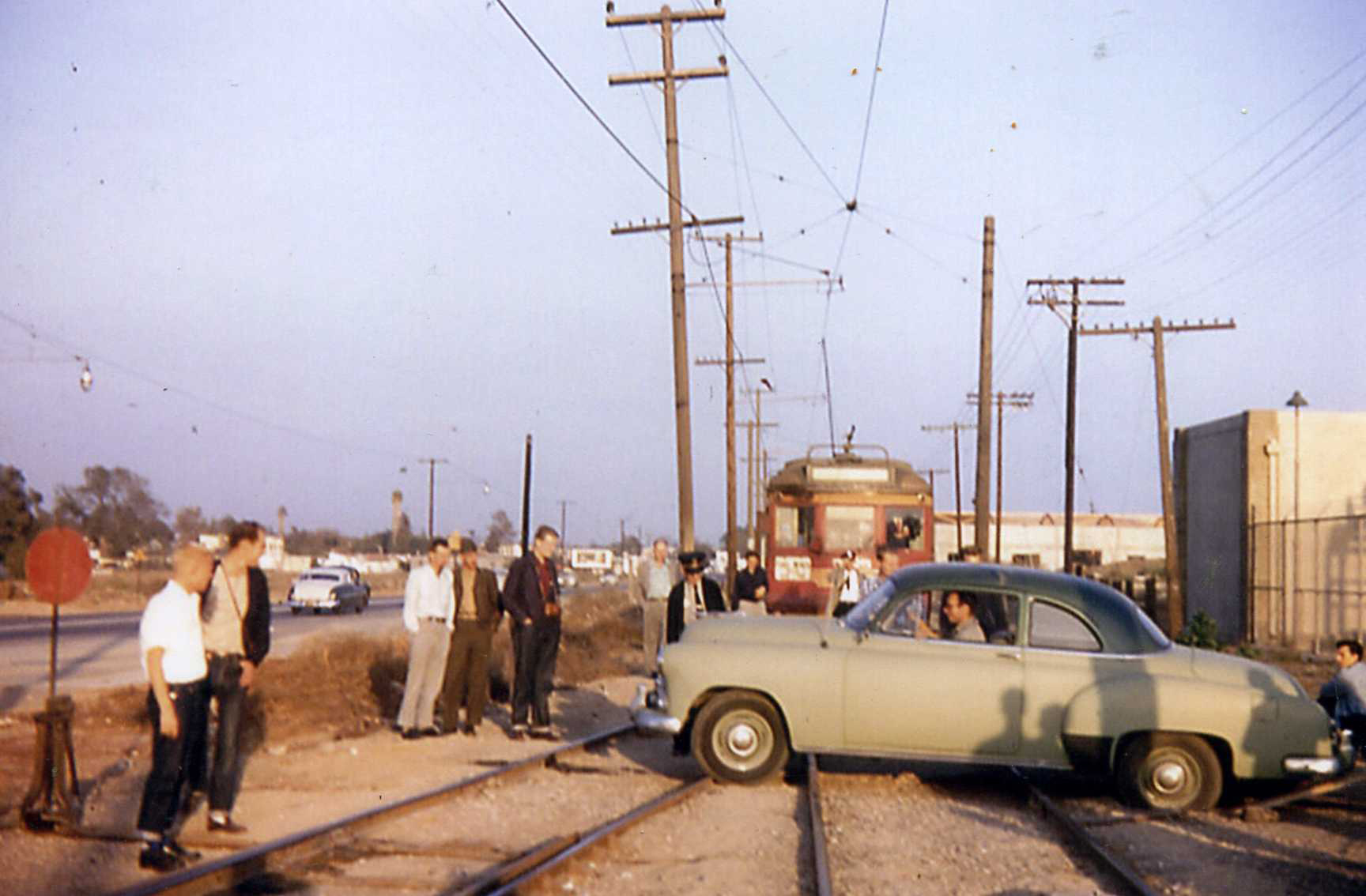
Last runs of any streetcar or interurban line is usually a sad, but uneventful occasion. However, that was not the case on Tuesday afternoon, September 29, 1953, when Pacific Electric car no. 5125 had the honor of making the last regular through run to Santa Monica and Ocean Park on the world famed Santa Monica Air Line.
As the 5125 and its merry band of railfans and a handful of regular riders approached the east end of Sentous Yard, the usually on-time run was abruptly brought to a halt by an idiot that had gotten his 1951 Chevrolet hung up on the Air Line’s 60 lb. “high iron.”
It seems that the guy was driving along La Cienega Blvd. when he spotted the RINGLING BROTHERS CIRCUS TRAIN stored on the tracks of PE’s Sentous Yard. The guy turned off of La Cienega =onto a narrow dirt along the south side of the yard. After doing a visual inspection of the long circus train, he found himself at the east end of the yard. With no room to turn his car around and not wanting to back down the narrow dirt road, he did what any nitwit with half a brain would do, and turned his car in the direction of Jefferson Blvd. which paralleled the yard on the north side of the tracks.
The spot he chose to make this maneuver was not a designated RR crossing. He soon found himself and his nice Chevy hung up on PE’s high iron. Then along comes the 5125 making its historic last run. The Hollywood cars could clip along at a brisk 45 mph, but on this somber occasion, the 5125 was roiling along at about 25 mph as nobody on board was in any hurry to get to Ocean Park.
The 5125 rolled to a stop and the two accompanying photos tell the “rest of the story.” It was “all hands on deck”, railfans and regular passengers alike. Railfans Ray Ballash and Jack Ferrier look on in the first image. With much grinding gears, spinning tires, dust, and heavy lifting, the Chevy was finally freed from its captivity.
Had something like this occurred on, say, the Santa Ana or Newport Beach lines with a magnificent “Buttefly 12” bearing down on this scene at 60 MPH-plus, the man and his Chevy might have had a far worse outcome to this situation other then just an embarrassing moment!
Roger Titus Photo, Ralph Cantos Collection
At length, the 5125 continued on to Ocean Park with out incident. Later that evening the 5125 and its crew and railfans returned to 6th & Main. The Air Line car usually spent the night on a spur across the street from the Ocean Park Car House (by now an all-bus facility). In happier days, the 5125 would return to LA on its early morning run.
But that was not to be. The following day, there was no morning run out of Ocean Park. The morning Air Line car departed 6th & Main instead and only operated to 11th Ave. and Exposition Blvd. just west of Vermont. The direction of the car was reversed and it returned to 6th & Main, The end had come to this historic operation.
On October 1, 1953, all of PE’s passenger service, both rail and motor coach, was sold top the “cut throat” cooperation, Metropolitan Coach Lines. The Santa Monica Air Line was not excluded in the sale, and so the truncated Santa Monica Air Line would become the very last PE passenger service, such as it was, and that ended on the last day of October 1953. The 5125 met its end a few years later in the mass Hollywood car scrapping of 1956.
In the image bwlow, there can be seen a square cement building. That building still stands to day in a Los Angeles Department of Water and Power (DWP) electrical switching and maintenance yard. LAMTA’s Expo Metro Rail trains now pass this location at 55 MPH.
The period photos were taken by a then-15-year-old Roger L. Titus. Abandonment notice from the Alan Weeks collection.