This publicity photograph taken on the north bound lanes of the Cahuenga Pass was staged for all to behold. Pacific Electric proclaimed that a new era in transportation had arrived in Los Angeles. Modern flexible motor buses could now be routed to meet the needs of the ever-changing San Fernando Valley.
I am sure that all the media text that accompanied the several photos, where produced by the Minister of Propaganda for General Motors. The propaganda department of GM had produced several films to be shown to civic leaders all over the USA. The most notorious of these films was titled “LET’S GO TO TOWN” (mid-1955). The film listed city after city across America that are “Going The Motor Coach Way.” The film showed PCCs in such cities as Detroit and Philadelphia as a slow, outmoded form of city transit. The film went on to say that streetcars (PCCs) operating on fixed guideways on narrow streets were as inefficient and outdated as the horse and buggy. The GM film also went on to say that bus routes could be changed at will, to meet the ever-changing needs of the City.
But in the decades that have passed since PE staged the “Modern Motor Coach Caravan” has proven beyond dispute, is that in general, the traveling public prefers rail transit over buses. To be sure, any transit system needs buses in their fleet as part of a balanced system. Buses have their place in such a balanced system. But, according to General Motors, all the needs of ANY major American City could be handled by fleets of buses.
Not mentioned in GM’s propaganda film is that what business man is going to invest assets built around a bus stop pole, that can be removed or relocated at the discretion of a City or Transit official. The film goes on to say, that major transit systems could sell off all out dated rail infrastructure. Not mentioned in the film is where are the buses to be stored and maintained. But sadly at this time in history, America ate up all the crap that GM could dish out and large scrap metal companies, Mexico City and Toronto would become the beneficiaries of this terrible waste.
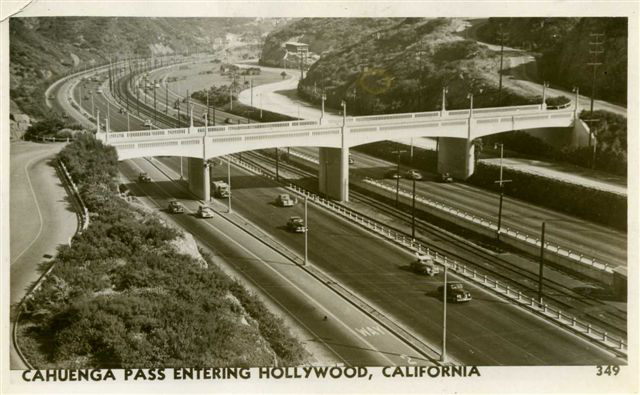
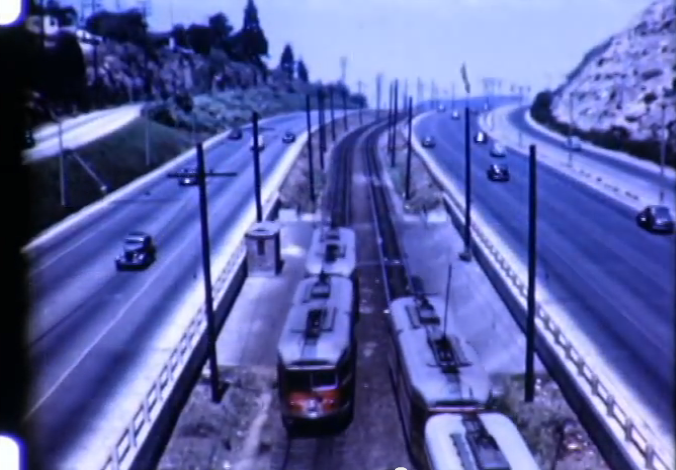
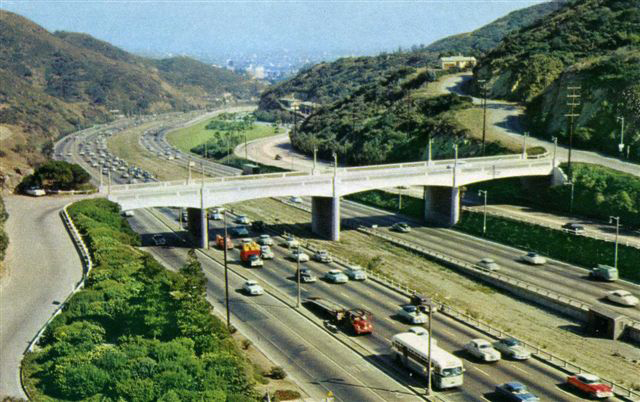
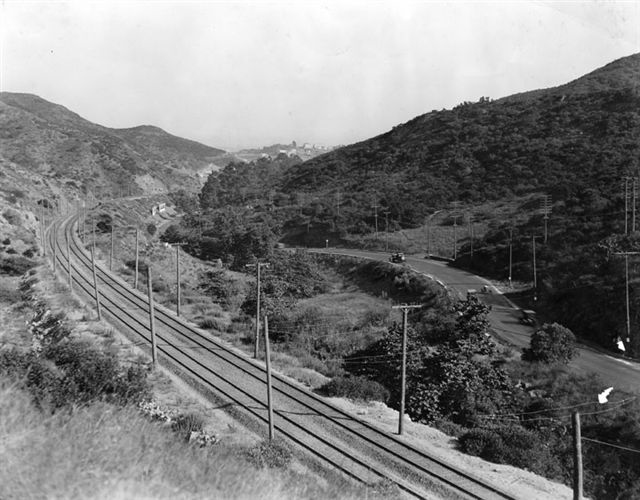
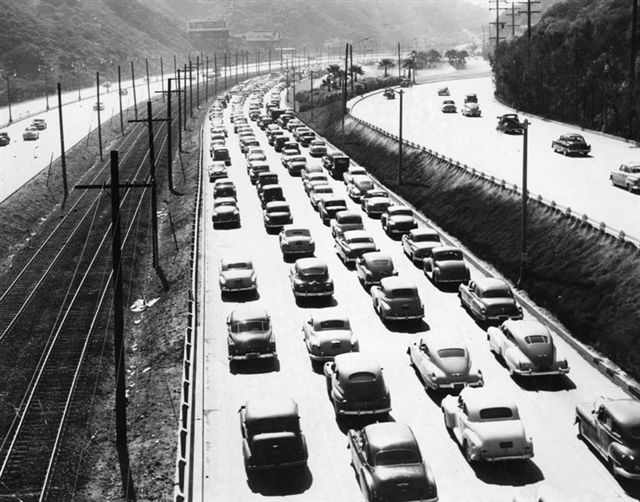
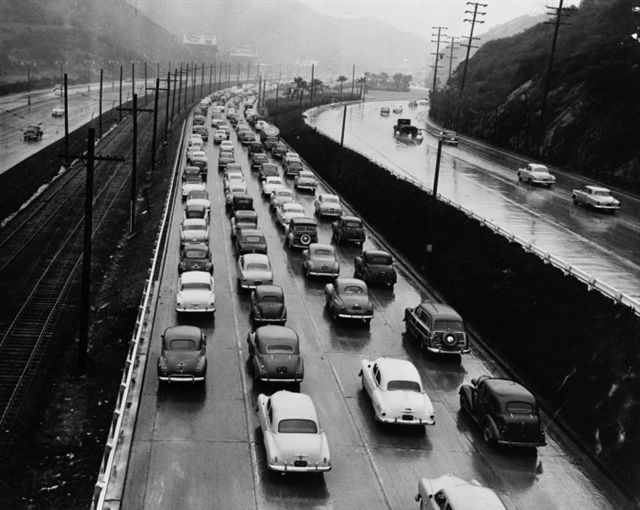
The postcard images depicted here show the Cahuenga Pass over a 45-year span.
Ralph Cantos Collection
The image above shows the Pacific Electric’s car tracks in the center of the then-called “Hollywood – Cahuenga Park Way”. This section of “Park-way” officially opened for traffic (both rail and automotive) on June 15, 1940, just a few months after the grand opening of the Arroyo Seco Parkway (now the 110 Freeway to Pasadena). This section of the Park-Way was given national media attention as the “Way of the Future” — that is, integrating rail rapid transit into new highway construction. Indeed, even the General Electric Company staged a filmed meet using two 2-car trains of PE PCCs rolling through the Pass. The short segment was used in a GE promotional film “Lifestream of The City,” which is embedded below. It was a proud time for both the PE and GE.
Advance to 9:45 to see the Cahuenga Pass PCC meet as described by the author
In 1940, the PE was still very much a “rail-oriented” company. PE management lobbied city, state and highway officials to consider integrating the PE rails into the ever-expanding Hollywood Freeway as it was extended towards Downtown LA. It was hoped the the PE rails would be included into new freeway construction. PE offered plans whereby the PE rails would be incorporated into the center of the new freeway. The rails would leave the freeway at Glendale Boulevard via an underpass and head directly to the Subway Terminal. It would have been fantastic convince for LA commuters.
But always, it was not to be. There was no way in hell that the powers then in charge of highway and freeway planning and construction would include a privately owned corporate rail line down the center of a freeway paid for by taxpayer dollars. It did not matter that the PE paid hundreds of thousands of tax dollars annually just to operate their system. The only reason that PE rails were placed down the center of the Cahuenga Pass was the fact that the PE rails was there long before anyone thought of the Park-Way. Let’s hope that the PE did not have to cough up any money for the relocation of their rails.
After World War II, most big US cities began to look at rail transit (city-suburban and interurban) as nothing more than an albatross, impeding highway construction. Private automobiles traveling on multi-lane highways through the urban landscape was the way of the future. City governments across this nation promised an “Automotive Utopia” for all Americans to enjoy.
And now, more than a half-century later, most US “Automotive Utopias” have turned into “Automotive Quagmires” … Hell on wheels. And now as America moves into the 21st Century, rail rapid transit has suddenly become the “in thing”, too late for the PE, but better late than never….
Ralph Cantos Collection
Ralph Cantos Collection
After little more than 12 years in service, the rail service through the Pass was abandoned. This 1955 photo shows the abandoned PE right-of-way. The waiting shelter in the center of the freeway was reached via a pedestrian subway from Caheunga Blvd west. It was sealed up after abandonment. It is possible that it still remains intact today, though plugged at both ends.
Ralph Cantos Collection
PE’s right-of-way as after erasure…gone and for the most part, forgotten.
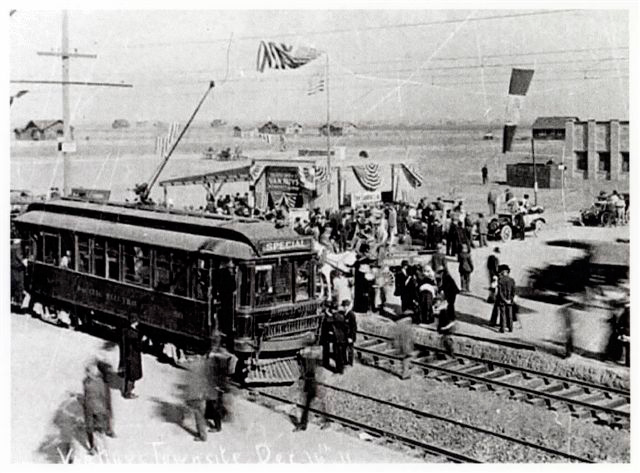
This tattered old photograph taken in January 1912 depicts the civic and cooperate pride in the grand breaking ceremonies associated with the extension of “modern light rail” service to an ever expanding San Fernando Valley.
In this case, the hoopla is at the then-end-of-rail-service terminus in the City of Van Nuys. Construction would begin from this point on two different destinations: Owensmouth (Canoga Park) along Sherman Way, and the City of San Fernando. With no environmental impact “BS” studies to worry about, the long extensions on both lines would be completed in just 15 months. Fast interurban service along to both lines would begin in July 1913.
As the years passed, the anticipated high passenger traffic loadings never materialized — loads that would have made both extensions profitable. On June 1, 1938, rail service on both branches was abandoned. The San Fernando Valley rail service now terminated at Van Nuys Blvd. at Sherman Way.
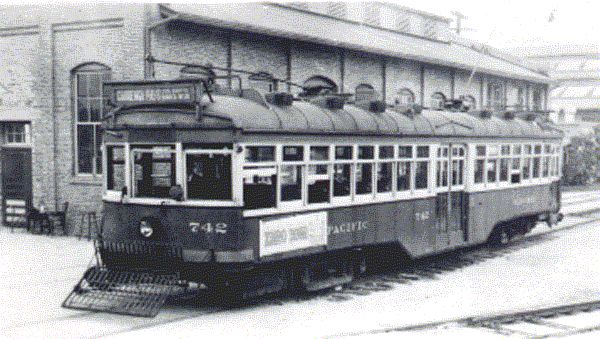
The PE seemed determined to improve the now-truncated service by replacing the older (if not faster) mighty 800-class wood interurbans with newer Hollywood cars that were given special paint jobs. The top speed of the spruced up cars was increased from 28 mph to brisk 45 mph. This group of 15 cars (735 749) would become known as the “VALLEY SEVENS.”
Try as the PE did to make it work, rail service to the San Fernando Valley would fall victim to the “rails to rubber revolution” that was sweeping this country in the early 1950s. Service on the “Valley Line” ended on December 28, 1952. It’s very possible that many of the jubilant people attending the ground-breaking festivities back in 1912 were there to witness the slow but relentless dismantling of Valley rail service.
Its also possible that the abandonment of the SFV line was made as part of “back room” negations for the pending sale of PE’s entire passenger operations to Metropolitan “Roach” Lines in October of 1953.
As the late Paul Harvey would often say, “the view through the rear view mirror is always so much better than through the front windshield.” What civic leader then in office back in those days would EVER believe that the population of the San Fernando Valley would become what it is today.
And so more than 60 years after the last PE car rolled over the Cahuenga Pass, the old PE rail service to the “Valley” has been replaced by the new Red Line Subway and the Orange line rapid bus service. Both lines now carry capacity crowds at all hours of the day and night.
In looking back, it might be safe to say that the exit of the PE from the San Fernando Valley was “a bit premature”…
Ralph Cantos Collection
Valley Seven #742 prepares to depart West Hollywood Yard in late 1938. Ralph Cantos CollectionPE Tracks in the Cahuenga Pass, 1922. Ralph Cantos CollectionMorning rush hour in the Cahuenga Pass, 1948. Ralph Cantos CollectionMarch 1953: Three months after abandonment, rails are rusted and auto traffic has gone from bad to worse. Ralph Cantos Collection
In this modern day and age of “low floor,” hermetically sealed, air-conditioned transit conveniences, who can dispute the classic, almost Victorian beauty of Pacific Electric’s 950-class interurbans.
The cars were built in 1907 for the Los Angeles Pacific’s proposed “Vineyard Subway” by the St. Louis Car Co. They were delivered to LAP in dark green color and numbered 700-749.
When the cars came into the PE portfolio of rail cars, their already good looks were improved by the addition of a second, air-operated trolley pole, and a large, roof-mounted destination roller sign. The cars were renumbered into the 950-999 range in 1925 with the arrival of the third order of Brill-built Hollywood cars.
In time, their open section was enclosed with brass sash windows. Although not particularly fast, the 950s could roll along at a respectable 48 mph if given the chance.
With the exception of car no. 999, the 950s stood out from the other PE wood interurbans in having a 3-window front end rather the PE’s traditional 5 windows. The 950s would render the PE dependable, if not spectacular service (when compared to the San Berdoo 12s) for more than 30 years.
But by 1937 with the Stare Railroad Commission and the City of Los Angeles demanding the retirement of ALL of PE’s wood-bodied interurbans before 1940, it looked like the end of the line for these handsome cars. Gone already were the mighty 800s, fastest of all PE interurbans. Scrapping of the 950s began when the last of the 800s were burned at Torrance Shops’ “back 40”. Nineteen of these wonderful cars had already met their demise by fire, when World War II broke out and EVERY transit vehicle, across the USA, no matter how old, be it rubber tired or steel wheeled, was saved from the scrap pile and returned to service.
PE put an immediate halt on the scrapping of the remaining 31 950s. The tattered and neglected cars were put through the Torrance Shops and emerged in 1942 in “better than new” condition. And so the 950s would roll on, mile after mile, all during the war, carrying capacity passenger loads. At war’s end, the 950s — now almost 40 years old — would continue on, day after day, month after month, year after year.
But by 1950, time had finally caught up with the Venice Short Line and the line’s mainstay, the 950s. The September 17, 1950, abandonment of the VSL brought an end to the career of the beautiful cars.
Noted rail fan Ira L. Swett made an attempt to purchase car no. 994, but with the Southern California trolley preservation movement several years into the future (no Travel Town, no OERM) and a lack of funds, Ira Swett gave up the effort and the 994 was lost. One car, no. 993, was set aside and used as a locker room for employees of National Metals & Steel Co. of Terminal Island, where the cars were being scrapped.
There the 993 would sit, minus its trucks, until replaced by all-steel Hollywood car no. 5094 around 1957.
In a moment of fate, railfan Richard Fellows, whose boat-building business bordered National Metals, purchased the body of the 993 in hopes of someday mounting it on rubber tires in the same way he did in the creation of no. 1058 (built from the body of retired 963). Richard also purchased the body of car 5094, when it was replaced by the body of a mint-condition LATL H-3 in 1960.
When Richard Fellows passed away, the 1058 was eventually purchased by the City of LA for use on the San Pedro Waterfront Red Car line, where it was restored as an operating rail car by the City with technical assistance from OERM members. The bodies of 993 and 524, which Richard had begun to rebuild, were purchased by the Museum and now sit on almost-correct trucks from the Chicago El lines, with both cars awaiting restoration. The 5094/655 was a gift to OERM by Mrs. Fellows for assistance by OERM members with the estate sale. It came to OERM still mounted on its rubbers tires, but now sits on motorless Hollywood car shop trucks. The body is immaculately restored, but it will need a lot of work to reinstall electrical and pneumatic gear to be operational again.
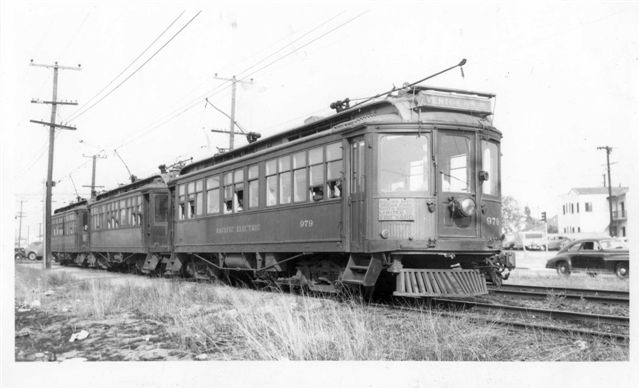
This beautiful photo taken in 1947 shows car 979 heading up an afternoon rush hour train at Hauser Blvd. This photo show well, the undeniable beautiful lines of the 950s. Given the opportunity, what LAMTA commuter in 2015 would pass up the chance ride aboard a breezy 950 instead of a modern day, air conditioned low floor bus with its jarring rough ride.
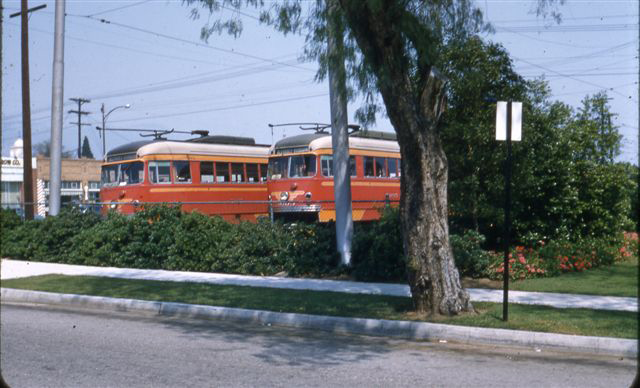
This beautiful photo taken on the morning of June 18, 1955 shows Pacific Electric PCCs nos. 5009 and 5017 laying over at Burbank Yard. On a “normal” weekend, at least 8 to 10 PCCs would be stored at Burbank Yard waiting for the Monday morning rush hour on the very busy Glendale- Burbank Line.
BUT, that’s not going to happen on Monday morning, June 20th, 1955. The management of Metropolitan Coach Lines has pulled off the “unthinkable:” 48 new General Motors passenger buses will begin service on a longer, meandering route form Burbank to the congested streets of Downtown Los Angeles, replacing the the PCCs and Hollywood cars used on the line.
The PCCs had a seating capacity of 59 passengers, and the Hollywood cars 63 passengers each. In multiple-unit operation, the trains could move passengers by the hundreds in a single operational unit.
And yet, MCL management did not give a damn about providing fast, efficient service to several thousand commuters that used the line daily. MCL purchased the passenger operations of the PE for one reason, and ONE reason only… to rape the commuters of LA for the sake of financial profit.
In the case of the Burbank, MCL gave away key portions of right-of-way for the monumental sum of one dollar.
Later on this 18th day of June, 1955, the 5009, 5017, and the other PCCs stored at Burbank will make their final non-revenue run back to the Subway Terminal and a uncertain future. The Glendale-Burbank Line is in preparation for abandonment. MCL management used every underhanded tactic to “pull off the unthinkable” .. the destruction of a fast, modern rail service in favor of a slow, meandering bus line on congested city streets in the “name of progress.”
All the while city officials of LA, Burbank, and Glendale looked the other way … what a disgraceful, shameful bunch of bull!
Ralph Cantos Collection
ADDENDUM:
Ralph Cantos Collection
I am so happy that folks are still interested in the PE. The cars entered and left the yard at Orange Grove Ave after the yard was rebuilt in 1949. Before 1949, the cars BACKED into the yard from PALM Ave. one block to the north. After abandonment, I believe a car wash was built on the property and was there for severl years. Then that was torn down and a Burbank Police sub-station built there. I am not sure what is there today, but one thing for sure, the nice park next to the yard is gone, along with the beautiful PCCs.. Ralph
June 19, 1955, will live in infamy among Los Angeles rail fans and commuters.
On that day, the most dastardly deed ever perpetrated on Los Angeles commuters was enacted by Metropolitan Coach Lines management. MCL management single-handedly scuttled the Glendale-Burbank Line and in so doing, set the rapid transit movement in Los Angeles back into the “stone age.”
The Glendale-Burbank Line was the “poster child” for modern rapid rail transit. The lines’ infrastructure was in PERFECT condition, employing ultra-modern PCC rail cars, operating on several miles of grade-separated right-of-way, all of which had been completely rebuilt in 1940.
The line entered and exited downtown Los Angeles via a mile-long subway, saving commuters valuable minutes, compared to buses and autos mired in traffic on Downtown streets. All this magnificent infrastructure was scuttled by a management that did not give a damn about the traveling public they were supposed to serve.
The PCCs used on the line were leased by MCL from the PE. After abandonment, the PCCs were turned back to the PE and placed into storage in the dank confines of the Subway Tunnel. A security guard watched over the 30 PCCs for just over a year. The PE had hoped for a quick sale of the cars, all of which were in good to excellent condition, having been completely refurbished in late 1952. With hope of a fast sale fading with every passing month, the security was dismissed and a gate of marginal quality hastily erected across the Subway portal.
It did not take long before sick, demented vandals gained entry into the Subway Tunnel and proceeded to destroy many of the unguarded PCCs. The first few cars nearest the portal were nearly completely destroyed. But the cars that were further back in pitch black darkness escaped major damage.
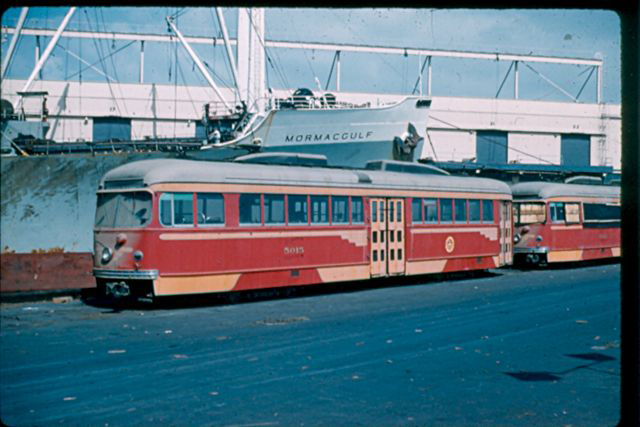
This photo taken by Ray Ballash in August of 1959 is from the James R. Baker collection. The 5015 sits at the LA Harbor awaiting its turn to be loaded aboard a freighter that will take it away to far-off Buenos Aires, and a new life.
What makes the 5015 so special is that it is in perfect condition, untouched by the sick, demented bastards who had nearly destroyed many of the 5015’s sister cars. It’s just a damn shame that THIS car could have been saved by LA rail fans and preserved at the Orange Empire Trolley Museum where generations of traction fans could have enjoyed seeing and riding the 5015.
But alas, it was not to be. The PCCs were sold for $2500 each, a rather large amount of money for teenage rail fans of the time that had already saved several LATL streetcars selling for around $200.00 each in scrap value. The price of $2500 was far beyond the reach of LA’s young dedicated rail fans.
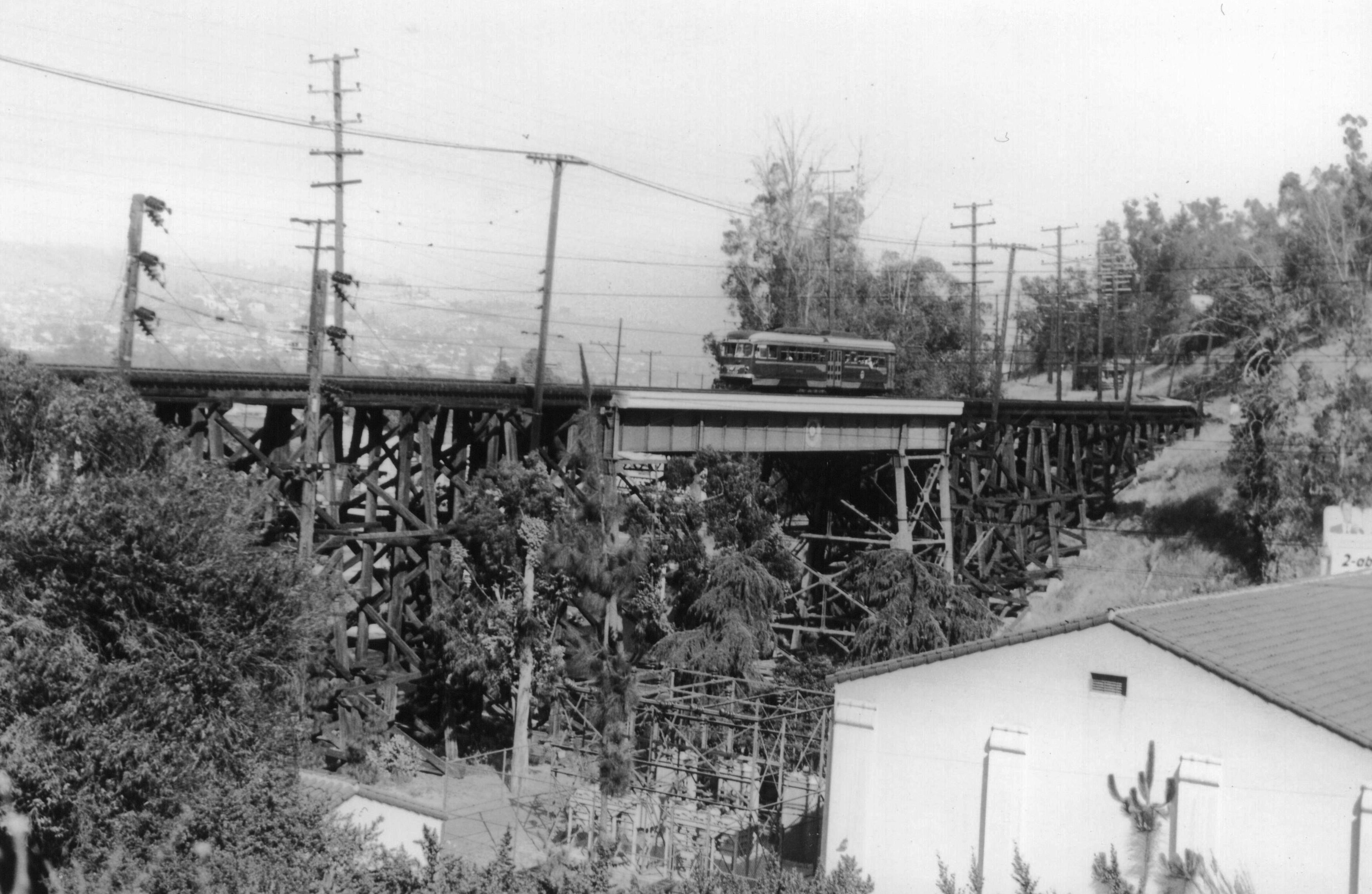
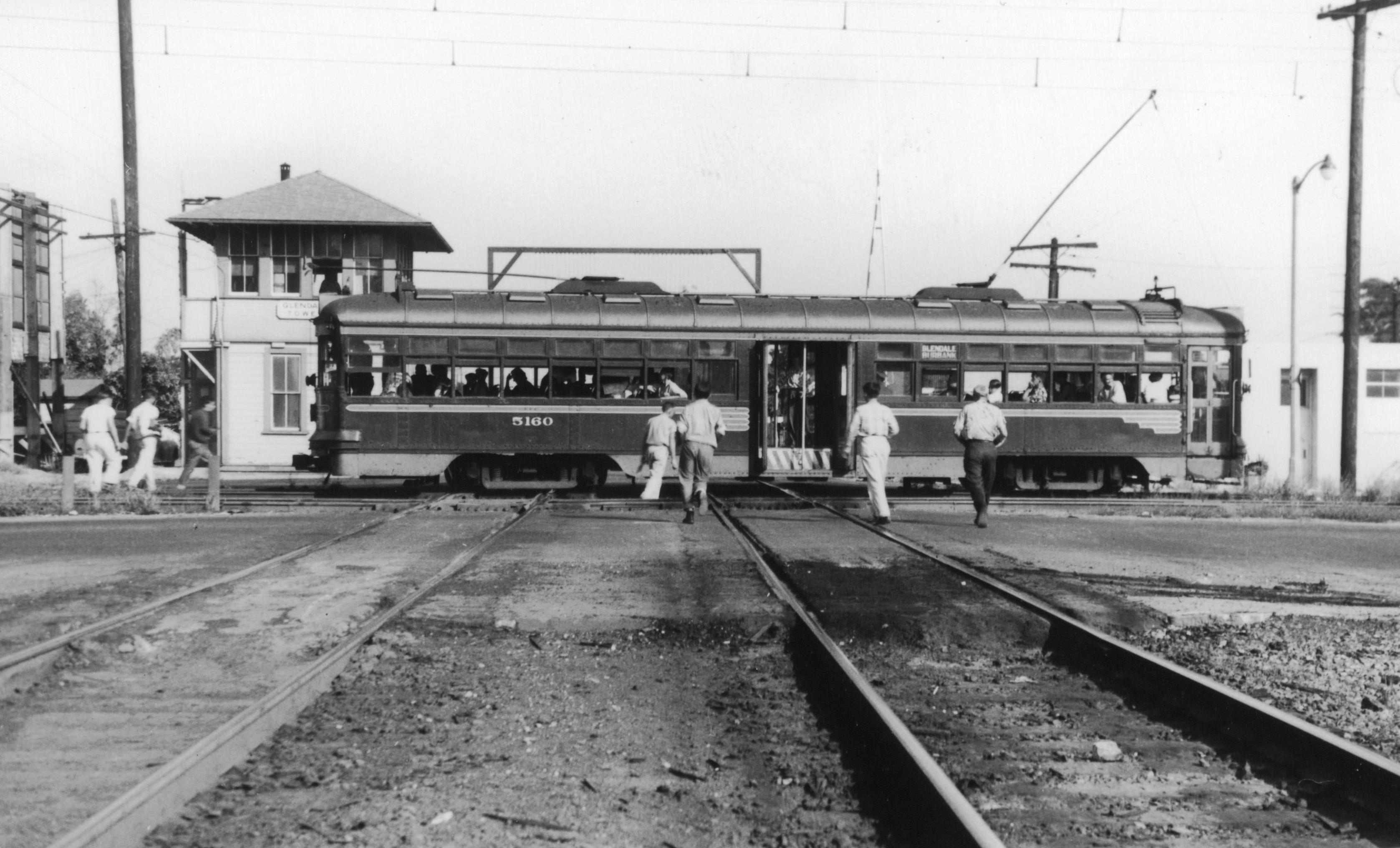
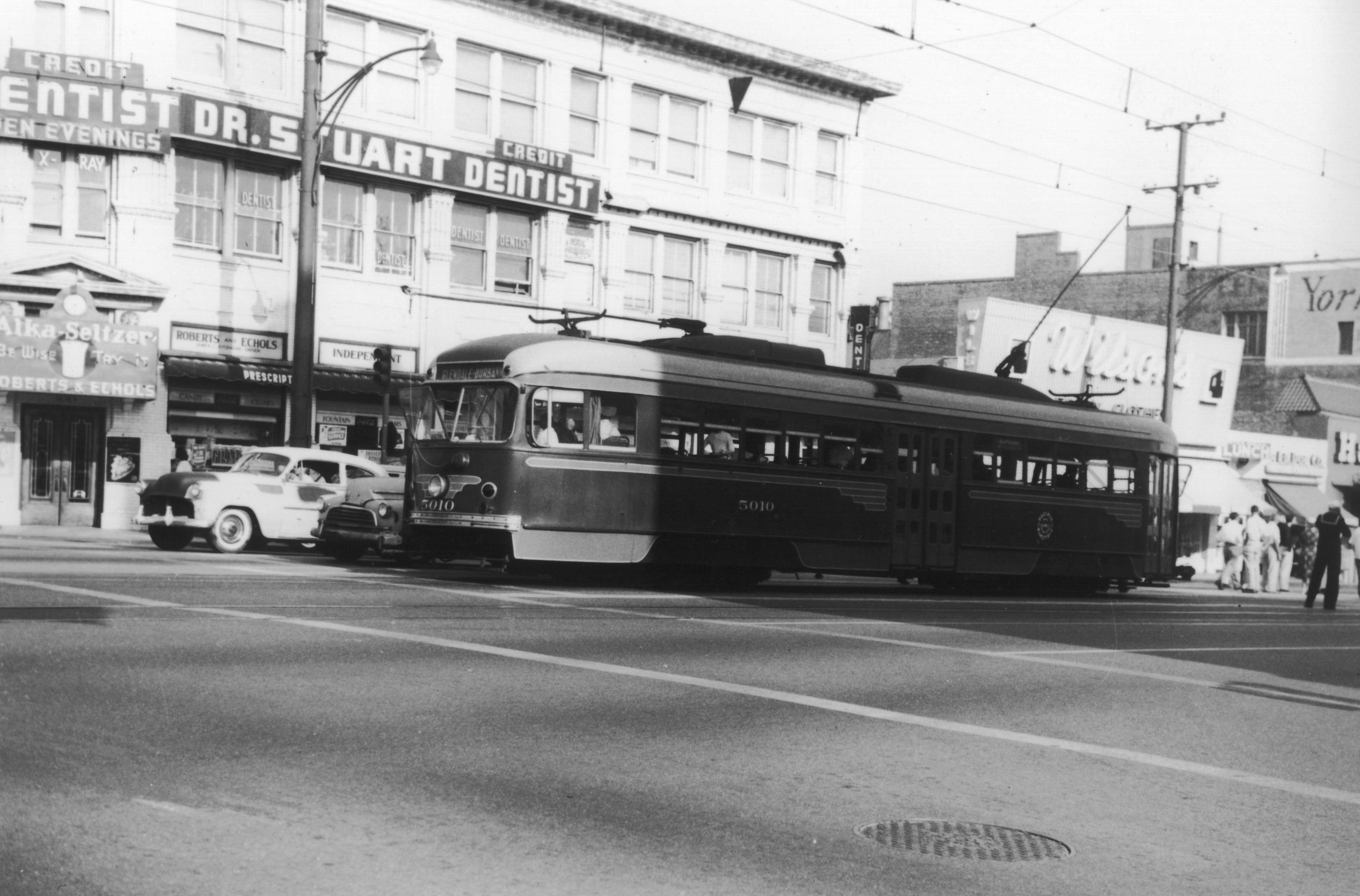
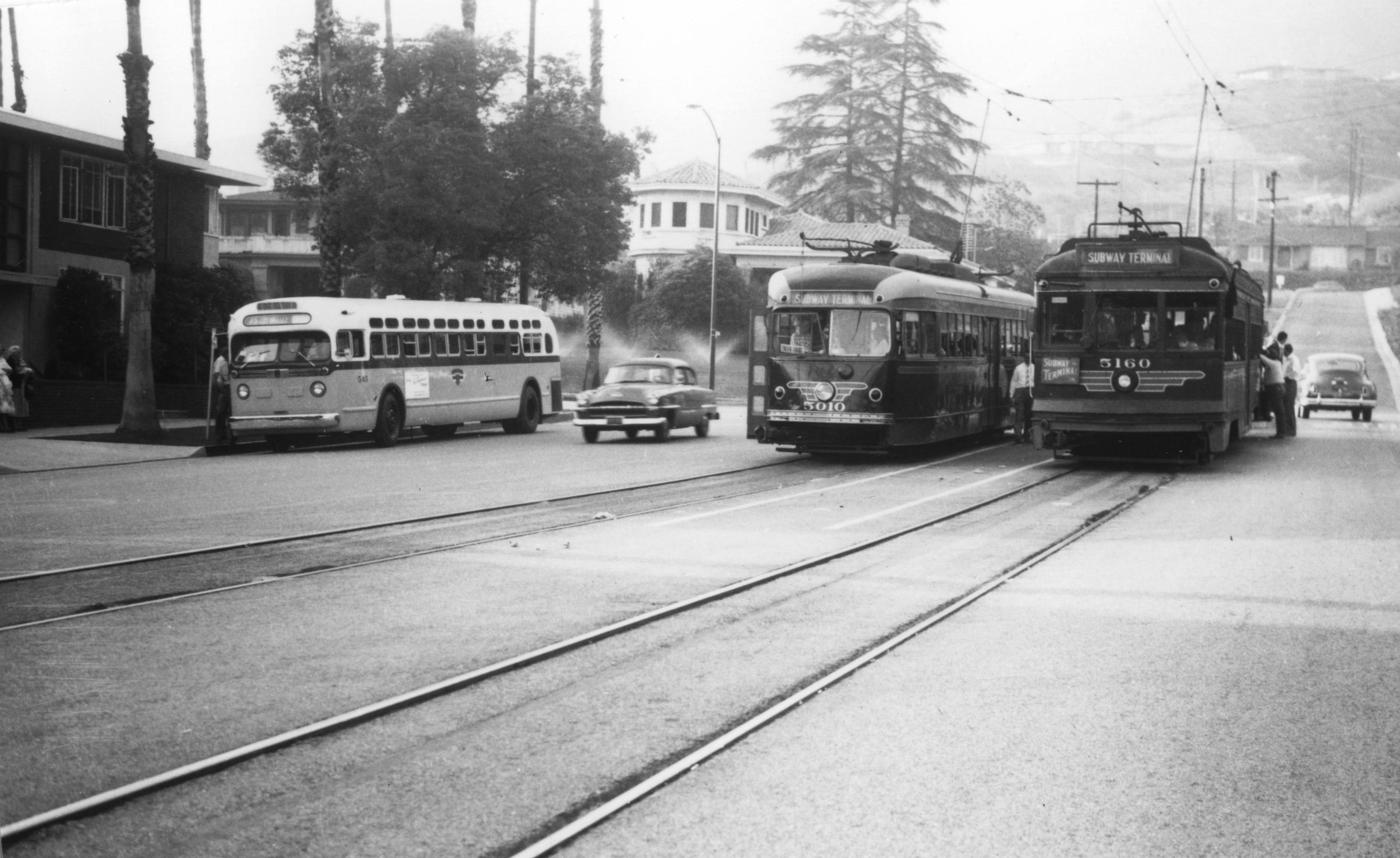
My father, Ray Ayers, and my uncle, Loren Ayers, were serious railfans; Loren was the photographer of the two. They somehow learned of a railfan special scheduled for the last day of operation of the Glendale-Burbank Line, June 19, 1955, and arranged to participate.
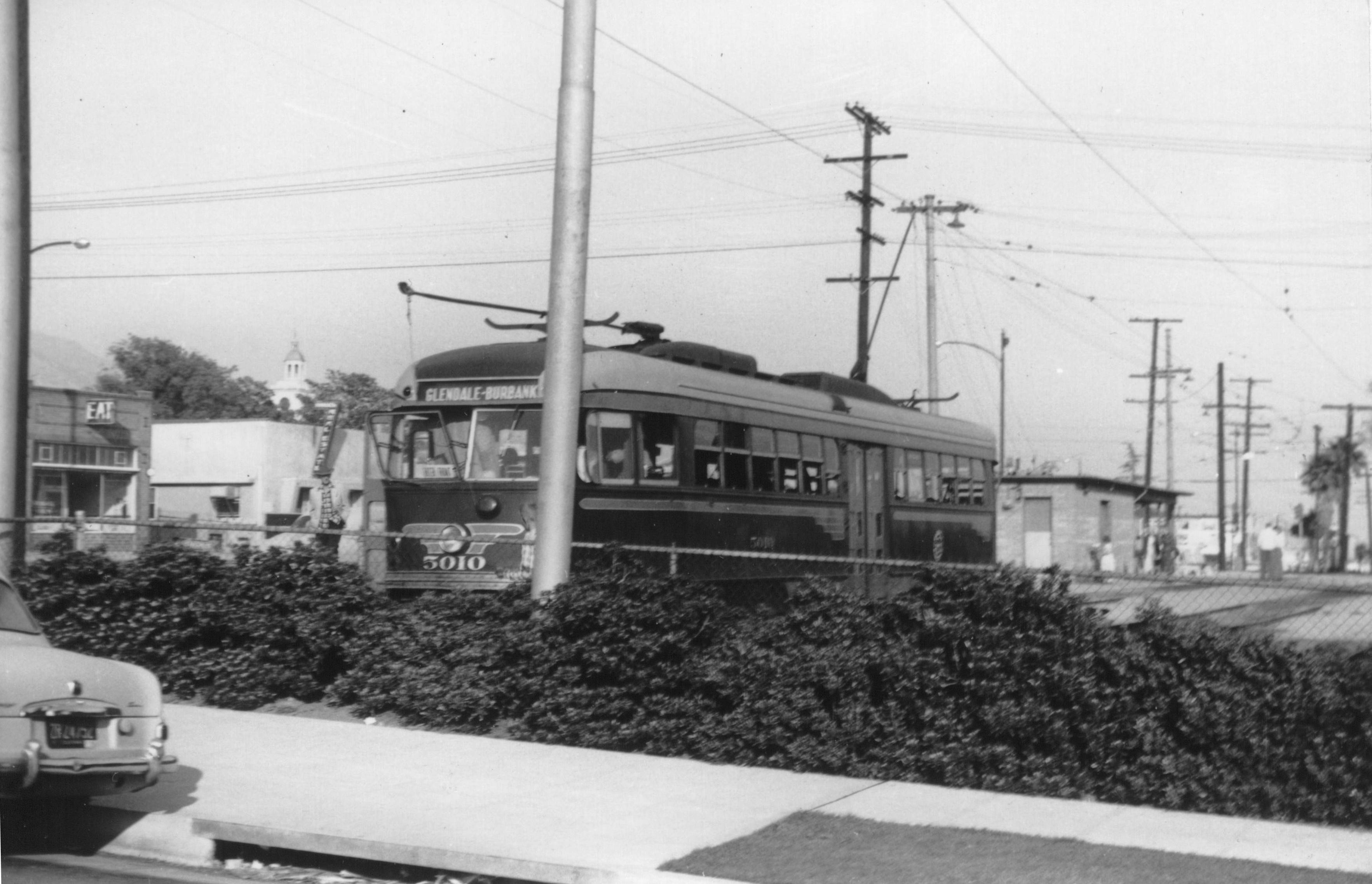
Included in our party was my father, my sister Veronica, age 9, me, age 3, my uncle, and his son Allan, age 12. The equipment used for the special was PCC 5010 and Hollywood Car 5160. The only thing I remember from the trip was how much the PCC rocked as it went up Brand Blvd. in Glendale.
The prints and negatives were given to me by my cousin Andrea, Loren’s daughter about 15 years ago.
Loren Ayers photo, Ayers Family Collection
Location: North end of Toluca Yard, A portion of the First Street-Beverly Blvd. Viaduct is seen at rear. Based on negative order I always thought this was the first shot in the roll. The trolley pole indicates, however, that the car is inbound. It’s a mystery. At any rate I have no memory and there are no photos indicating where the special started or ended; for some reason I always thought it started at Toluca Yard not Subway Terminal; as I said, a mystery. Loren Ayers photo, Ayers Family Collection.Location: Whitmore Ave. My sister Veronica looks out a rear window of PCC 5010, followed by me with my arms hanging out of the car and my father, sticking his head and shoulders out. Comparing this photo with the Bill Whyte one already on your site, it appears the Whyte photo was also taken at Whitmore; note the shadow of the pole, the tumbleweed at the front of the car. Loren Ayers photo, Ayers Family Collection.Location: India St. My cousin Allan Ayers is at left with camera [wish I had his roll.] I believe my father and sister can be seen in the rear windows of 5010 but cannot be positive. Grade of area has changed dramatically by removal of dirt for use in construction of the Glendale Freeway. Loren Ayers photo, Ayers Family Collection.Fletcher Drive Viaduct; 5010 on bridge and 5160 at rear. Loren Ayers photo, Ayers Family Collection.Location: Best guess, spur track off Glendale Ave. This is something of a mystery shot. I think it depicts movement onto the old Glendale SP-PE transfer spur south of Richardson. Loren Ayers photo, Ayers Family Collection.Location: SP Main Line at Richardson looking south. The idea of parking a car on the main line is so wrong it boggles the imagination. Loren Ayers photo, Ayers Family Collection.Location: Brand Blvd. at Broadway, Glendale, CA; view is towards the southeast corner of the intersection. Loren Ayers photo, Ayers Family Collection.Location: North Brand. The house with the sprinklers on at center rear housed either the fourth or fifth Casa Verdugo. Loren Ayers photo, Ayers Family Collection.Location: North end of Burbank Station. Spire seen at background marks Bellarmine-Jefferson High School. Loren Ayers photo, Ayers Family Collection.
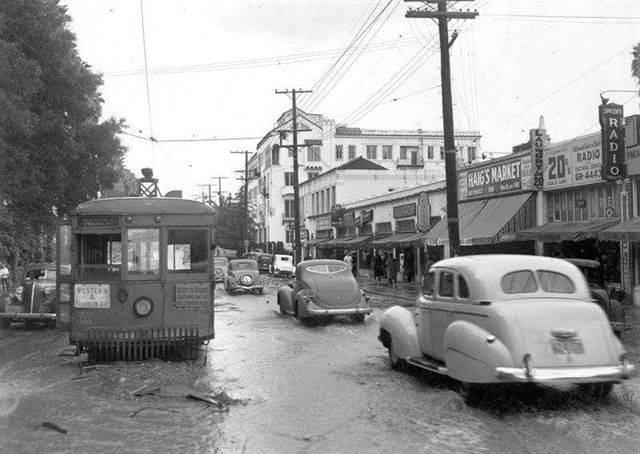
Heavy rains in 1938 caused havoc all over Los Angeles and Southern California.
Here, Pacific Electric Birney no. 335 sits in traction motor-high rain water on Franklin Avenue in Hollywood. The door is open, the trolley pole is pulled down and the motorman is nowhere to be seen. The high rain water was just to much for the little car. The 335 was working the WESTERN – FRANKLIN Line, known to PE crews as “The merry go round.”
Time was running out for PE’s fleet of Birney cars by this time. The 335 is listed as being sold for scrap in 1939, so this may have been the “end of the line” for the hapless little fellow.
Most of PE’s Birney’s were built between 1918 and 1920. By 1941, all of PE Birneys were all out of service and sold off for a variety of uses such as storage sheds, chicken coops and in the case of Birneys 331, 332, and 337 as movie props.
Sadly, most of the little cars were scrapped. Thankfully, both the 331 and 332 are alive and well at OERM, more than 90 years after they were built. Sadly, 337 was cut down the middle length-wise for interior shots and later “disposed with.”
Pacific Electric’s double end PCCs were arguably the most beautiful PCCs ever built. Unfortunately for PE’s Pullman built PCCs, beauty did not translate into longevity.
Depending on the city system where the PCCs operated, the service life of the cars was about 20 yeas in such “rust belt” cities as Pittsburgh to almost 35 years in Mexico City and more than 50 years in Newark, New Jersey. Good maintenance was the key to long service life.
Even in Toronto, where snow- and salt-covered streets cut the average life of automobiles to about 15 years (if that long), the TTC’s fleet of PCCs lasted into the late 1980s with the last PCCs still in operation into 1991.
On the other hand, some PCCs did not do as well. The San Diego Electric’s twenty-eight PCCs were retired after just 12 years of service. After about 5 years of dead storage, 20 of them were sold to El Paso City Lines where they saw service into the 1970s. Six of the San Diego were scrapped and 2 preserved, at this time both cars 508 and 528 at OERM.
PE’s beautiful, well-maintained double-enders served the Glendale-Burbank Line for all of 15 years before being put into “really dead storage” in the damp PE Subway tunnel. After four years, the cars were sold to Buenos Aires for further service. However, that tenure lasted just about three short years before the cars were once again retired. All 30 of the car disappeared with out a trace, with no photo record of their final disposition.
In these two photos from the Jeffrey Marinoff Collection, the “dawn” photo shows the 5023 at the Pullman Standard factory in all her splendor and beauty being made ready for shipment to Los Angeles in November 1940. Just twenty-one short years later, the “dusk” photo shows the same car , now renumbered M1523 in the final year of service during its short second career.
One car, no. 1528 (PE no. 5028) was never modified with train doors and remained a true double-ender. It was used as a training car to the end. How wonderful it would be if some rich Buenos Aires rail-fan could have purchased this car, stashed it away for posterity, just waiting to be discovered and returned to Los Angeles. It does not hurt to dream, as some dreams do come true.
The shortest distance between two points is often described “as the crow flies.”
So it was in 1897. That’s when the Pasadena & Pacific Railway wanted to link parallel rail lines and one common destination with a crossover rail line. And the P & P Rwy. decided to go as the crow flew.
The object and reason for this crossover line was to provide a faster running time from Downtown LA to the cities of Santa Monica and Venice. Using the faster portion of the Venice Short Line to Vineyard Junction and then heading in a northwesterly direction, the Railway could link up with their rail line on Santa Monica Boulevard in the tiny town of Beverly (better known today as Beverly Hills).
From that point, their interurbans could roll along at mile-a-minute speeds in the open fields west of the Beverly Station, bypassing the horse and buggy congestion of Hollywood and Sherman, until reaching Santa Monica and Venice.
As was always the case in those early days of yesteryear, where ever the trolley rails went, a wagon trail was sure to follow. And as time passed, horse-drawn wagons turned into motor cars, and lots of them.
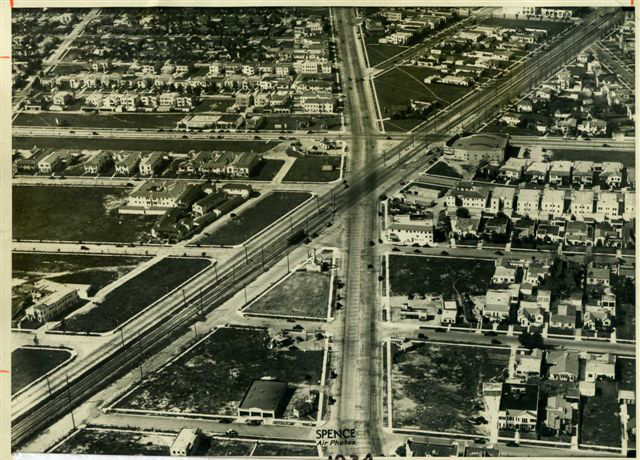
In this 1934 photo, a Pacific Electric 950-class interurban rolls towards Beverly Hills as it approaches the three-way intersection of San Vicente and West Olympic Boulevards at Fairfax Avenue. Auto traffic is light on this Sunday morning, and the 950 will not slow down as it blasts through the crossings with whistle blowing.
All of the apartment buildings shown here are still standing today, as is the “Green Spray Market” building in the upper right portion of this photo. Today, it’s a Hebrew School. The beautiful Carthay Circle Theater seen at the very top of the photo is long gone, replaced by a low rise office complex.
Today, the ghosts of interurbans past have come back to haunt this now very busy three-way intersection. Those once-peaceful wagon trails have turned into automotive quagmires. Thousands of daily commuters passing through this intersection in their modern autos must wonder “what the HELL were they thinking when they laid out this intersection?”
I doubt that any of them have a clue that many years ago, fast, efficient PE interurbans passed through this intersection. All they can do is admire the large trees in the grassy center divider through the dark-tinted windows of their 500HP BMWs as they crawl along at 5 MPH.
That grassy center divider with its beautiful trees don’t do jack to move auto traffic as did the rail line that once occupied it.





![Location: India St. My cousin Allan Ayers is at left with camera [wish I had his roll.] I believe my father and sister can be seen in the rear windows of 5010 but cannot be positive. Grade of area has changed dramatically by removal of dirt for use in construction of the Glendale Freeway. Loren Ayers photo, Ayers Family Collection.](http://www.pacificelectric.org/wp-content/uploads/2015/02/AYERS-PE-6-19-1955-3.jpg)