Pacific Electric’s San Fernando Station location at the intersection of Brand Boulevard and Columbus Ave. Note that the rails have been removed but the ties have not been salvaged. In the distance on the left can be seen the entrance to Mission San Fernando. This view looks northwest. The date is November 1964.
Pacific Electric Railway Company, Culver City. The date is March 26, 1964. This is the south side and west end of the Culver City depot. The baggage / freight room is in the foreground. The agent’s office is in the center with the passenger waiting room at the far end of the building. A spur off the Venice Short Line served the dock on the side of the building. This view looks northeast.
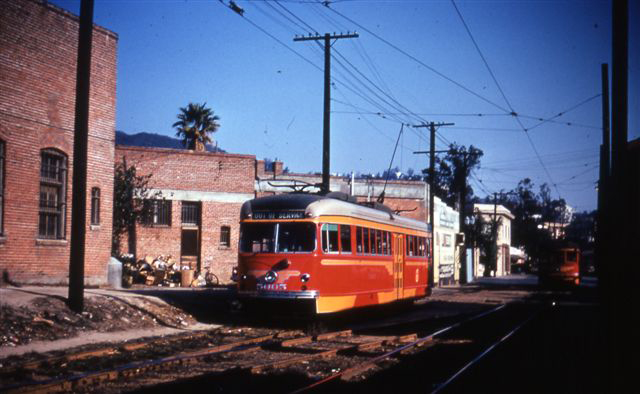
This tranquil scene at Pacific Electric’s Burbank Yard belies the sad fact that the end has come, prematurely I might add, to PE’s Glendale-Burbank modern light rail line.
It has been more than 60 years ago, June 18, 1955, to be precise, that this photo was taken. For most of this day, PCCs normally stored at Burbank Yard over the weekend for the Monday morning rush hour, have already departed to the Subway Terminal for the final time. Only the 5024 and another PCC await an operator that will dead-head the two cars as an “out of service” train back to the Subway. Behind the two cars, a single trolley pole can be seen of another PCC awaiting a regular service departure.
The scrapping of the Glendale-Burbank Line can only be descried as “shameful.” Every underhanded tactic was used by Metropolitan Coach Lines management to scuttle this line whose entire infrastructure and its basic rolling stock was just 15 years old. By today’s standards, it would be like scrapping LA’s Metro Blue Line and replacing the trains with buses. A bunch of greedy, selfish, uncaring SOBs did not give a damn about anything or ANYONE. Their only interest was to line their pockets with quick cash, and leave LA commuters to deal with the consequences. MCL management and Glendale City officials should have been put on trial for corruption. But back in those days, most Americas were more concerned about “THE BOMB” than a trolley car line.
And so the Glendale-Burbank Rapid Transit Line passed into history and no one was ever held accountable for the dastardly deed….
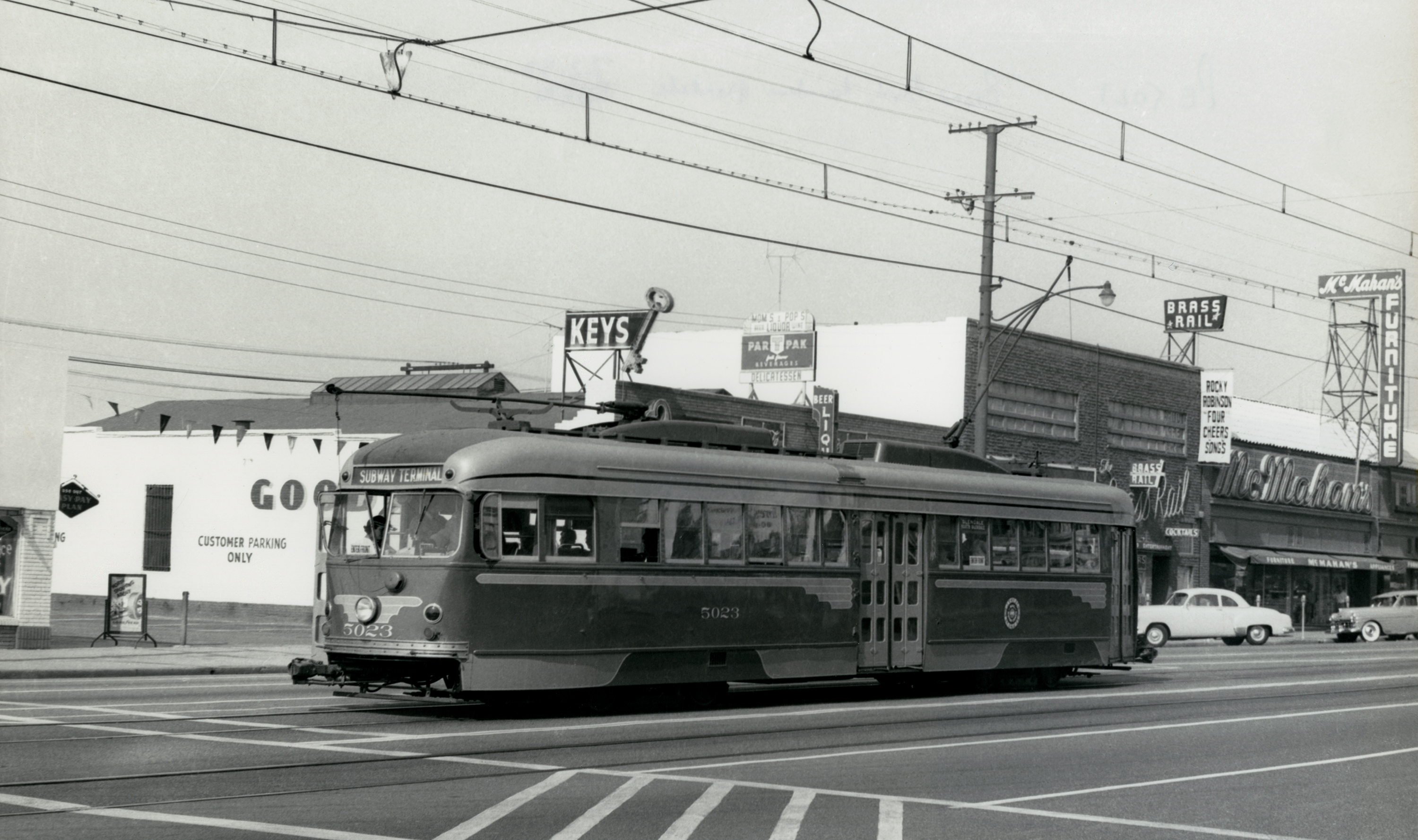
Pacific Electric PCC no. 5023 heads southbound on Brand Boulevard, passing just before the McMahon’s Furniture store, which this Los Angeles Times article details as having been at 225 South Brand Boulevard, between Caruso and Colorado.
Pacific Electric’s 100-class cars built in 1930 were often referred to as “double-truck Birneys.” The late Ira L. Swett described them as “several cuts above” actual double truck Birneys in every respect.
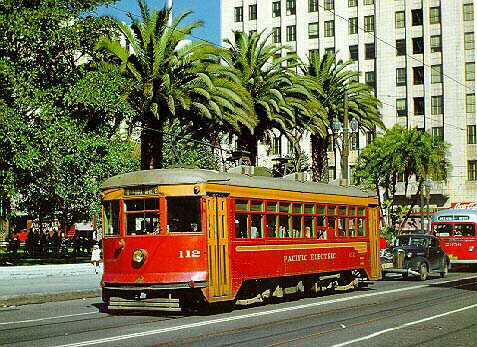
The cars numbered 100 to 114 were first used on local lines around Riverside and in Long Beach. The 100s were never equipped with eclipse fenders. By the time they were assigned to the “cushy” Echo Park Avenue Line, eclipse fenders were no longer required on PE cars.
When all 15 of them emerged from Torrance Shops in late 1942, they were a splendid sight. For unknown reasons, the 100s never were painted with “Butterfly head-light wings” found on the Hollywood cars and the PCCs. It would have been a nice touch, but after just eight years of service on Echo Park Avenue, the line was abandoned on October 1, 1950, and the 100s faced an uncertain future.
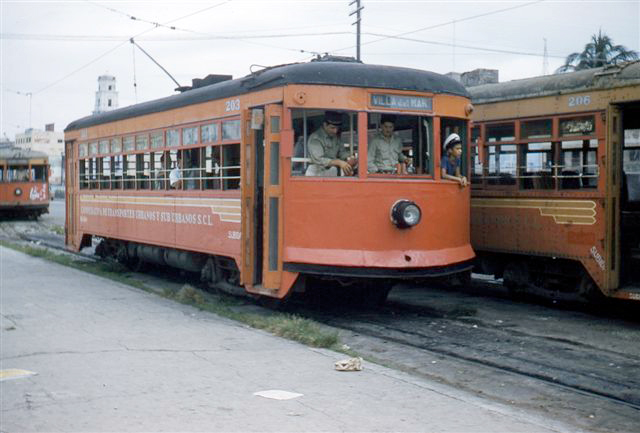
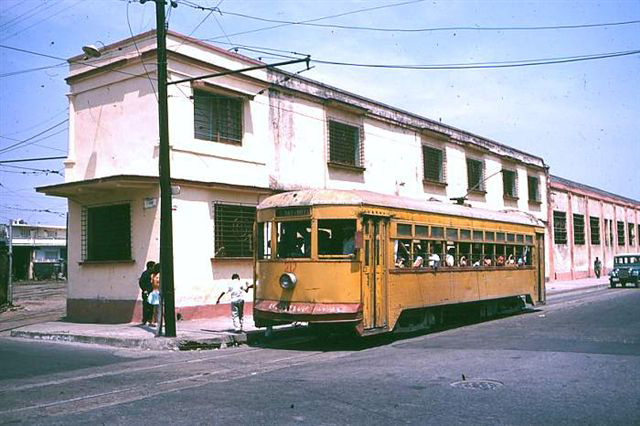
The ever-watchful officials of the Vera Cruz (Mexico) tramway system pounced on the 100s and they were on their way south before the end of the year. All 15 cars were in service in Vera Cruz in the early months of 1951.
Jerry Squire Photo, Andy Goddard Collection
This photo, taken in 1955 by the late Jerry Squire is from the Andy Goddard collection. It shows Vera Cruz no. 203, the former PE no. 102. When the 100s arrived in Mexico, they were in excellent condition having only been in local service around LA for just 8 short years.
Several changes were made to the cars before they went into service in Vera Cruz. Among them, the cars were made single ended, life guards were tossed, marker lights trashed, and a more simple K-35 controller installed.
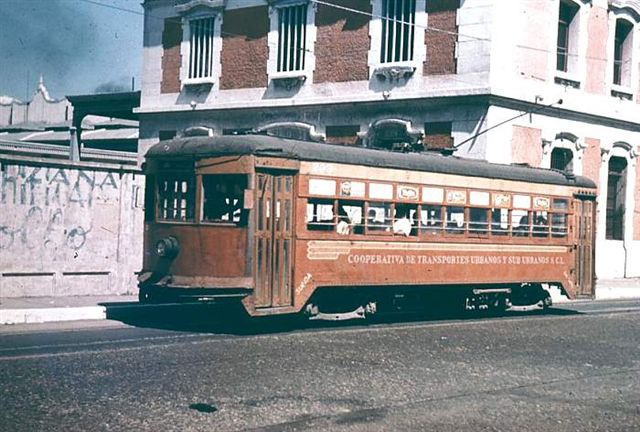
Since the PE paint on the 100s was barely dry, the cars entered service with the PE paint job basically intact.
As time passed, the once-pristine condition of the 100s begin to “fade.” Starting about 1965, the 100s (what was left of them) began to appear in a rather tacky yellow paint job and things went down hill from there.
The remarkable fact that the Vera Cruz trolley system lasted into 1981 is a miracle in itself. But by that time, the entire system simply fell apart. The 100s lasted 30 years in that unforgiving service.
On April 14, 1912, just after the RMS Titanic struck an iceberg, Captain Smith was informed by the Titanic’s builder Thomas Andrews that the Titanic was doomed and was going to sink.
In October of 1953, when Jessie L. Hough purchased the passenger operations of the once-great Pacific Electric, he informed everyone involved with the PE’s rail operations that all remaining rail lines (2 in the Western District, 5 in the Southern District) were “DOOMED.”
And like the Titanic’s brave chief engineer, whose men worked selflessly down below decks to keep the steam up, so electric lights and water pumps worked as long as possible, keeping Titanic afloat long enough to give some passengers more time — the PE crews of the Western District continued to provide top-notch service, despite their looming terminations.
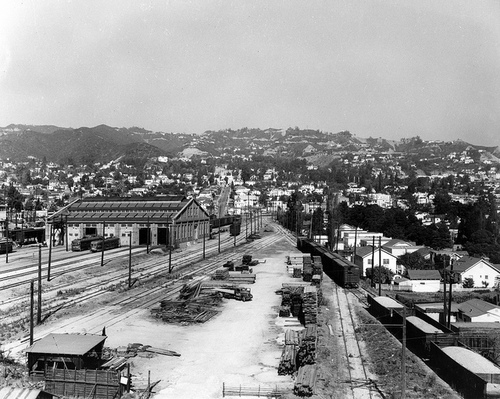
And so it was during the last weeks of August 1954 that the dedicated and hard-working “Toluca Yard Shop Force” would do everything possible to keep the Glendale-Burbank Line alive and fully operational, knowing full well that the line was doomed.
The September 26, 1954, abandonment of the Hollywood Boulevard Line meant that West Hollywood Shops would be unreachable by electrified rail cars of the Glendale-Burbank Line. All maintenance for the remaining 30 PCC and 15 Hollywood cars would be performed under primitive conditions in Toluca Yard.
This photo by the late, great Ira L. Swett was taken at Gardner Junction just a few weeks before the Hollywood Boulevard Line abandonment. It was now time for any and ALL usable parts at West Hollywood to be gathered up and moved to Toluca Yard.
And like the Titanic, the Glendale-Burbank line, PE’s most modern and technically advanced rail line, was doomed. Toluca Yard’s shop men would keep the cars and infrastructure in good working order until the very end, just 9 months later.
In this photo, the 5005 is deadheading to West Hollywood Shops to load up everything usable, and then return to Toluca Yard. According to Ira, several of these “box-motor” trips were made with various PCCs loaded with valuable parts to prolong the inevitable.
The Glendale-Burbank line went down with trolley poles held high. All 45 cars, track, overhead and signals were in perfect working order to the very end.
Ralph Cantos Collection
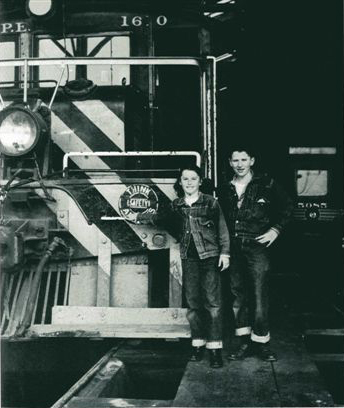
PE’s vast West Hollywood Shops in about 1946. A Hollywood car and PCC can be seen in front of doors #2 and #3. The shops did “running repairs” for Western District cars for decades. With the September 1954 abandonment of the Hollywood Bouleard Line , the shops were no longer accessible by Glendale -Burbank Line cars. By the end of 1954, the Glendale-Burbank Line was an “electrified island” in a sea of asphalt, under siege by a pro bus / anti-rail MCL management. Ralph Cantos Collection.Rail fan and book publisher Jeff Moreau and his sister Stefanie pose for the camera in 1951 at West Hollywood Shop along with juice jack 1620 and Hollywood car 5085. Stefanie would go on to fame as actress Stefanie Powers. This photo is from the book “Growing Up With Trains” from long gone Interurban Press. Photo from the Jeff Moreau collection.It’s 1960, and this is the former Pacific Electric West Hollywood Shops and Yard, now 100% bus. Ralph Cantos Collection.
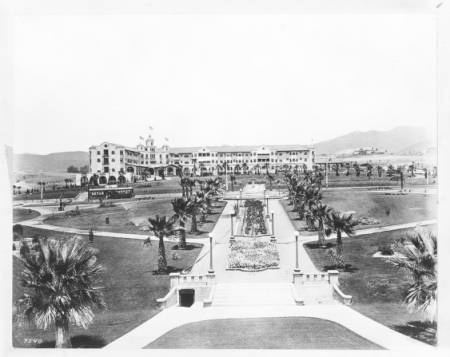
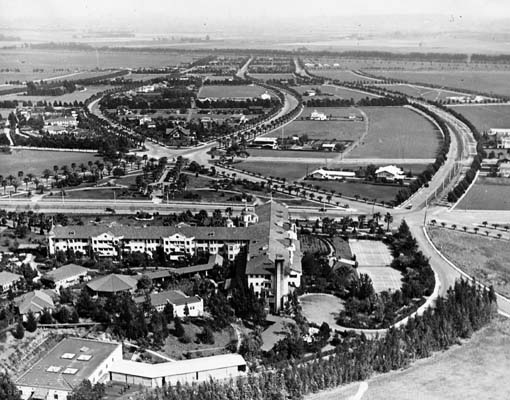
This interesting photograph taken in January of 1923 shows Pacific Electric no. 175 (AKA “Submarine”) awaiting its departure time in front of the Beverly Hills Hotel.
The life of this line was about as short as the line itself. Sometimes referred to as the Rodeo Line, it was just over a mile in length, stretching from Santa Monica Boulevard on the south along Rodeo Drive to Sunset Boulevard on the north.
The line opened for business in 1907, five years before the famed Beverly Hills Hotel opened its doors in mid-1912. Someone at the Los Angeles Pacific Railroad must have had some “inside information” regarding the construction of the hotel, to have built this line five years in advance of the hotel’s grand opening.
Regardless of the circumstances, the line became more of a nuisance to the Pacific Electric than anything else. By 1915, the City Of Beverly Hills was fast becoming the home of the rich and famous. The Pacific Electric took over the line about 1911 and thereafter was “requested” to maintain the line and cars to a “much higher standard” than the PE was accustomed to. The cars were kept in spotless condition. The wooden line poles that ran the length of the single-track right-of-way in the center of Rodeo Drive were painted white, and the right-of-way itself, kept neat and clean.
All this for a line that never carried a standing load of passengers.
By January of 1923, the PE had enough of this nonsense and pulled the trolley pole down on the line on the 15th of the month.
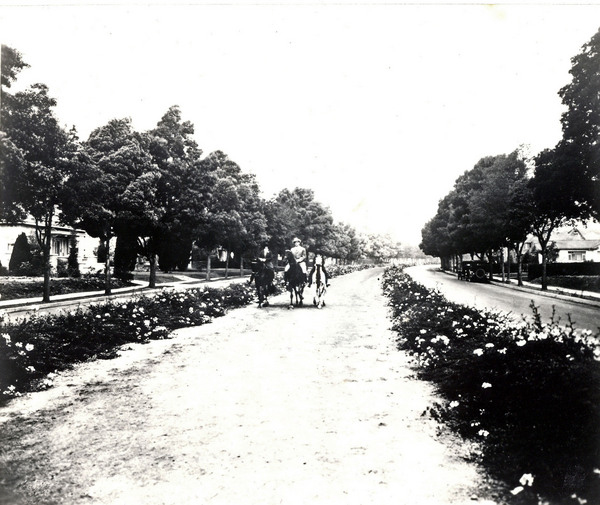
After the rails and line poles were removed with all possible dispatch, the abandoned right-of-way became a bridle path for the elite of Beverly Hills. The life of the bridle path was almost as short as the life of the PE rail line. By the late 1930s, the elite of Beverly Hills were trading in “Dobbin” for Duesenbergs and the bridle path was abandoned.
The now twice-abandoned right-of-way was narrowed to about 6 feet in width and decorative shrubbery planted where Pacific Electric cars and horses once roamed. Rodeo Drive itself was repaved to accommodate the ever-increasing numbers of Duesenbergs, Packards and Pierce-Arrows now using the street.
Today, Rodeo Drive remains the only north-south street in Beverly Hills between Santa Monica and Sunset Boulevards with a center divider.
I doubt that ANYONE living on Rodeo Drive today would believe that a trolley line, much less a bridle path, ever passed in front of their multi-million dollar houses.
As a final note, a very nice waiting shelter was built out front of the Beverly Hills Hotel for the trolley line passengers that is still in use today by LAMTA buses.
Ralph Cantos Collection
PE’s curving right of way along Rodeo Drive looking south, with its white painted line poles in 1921. Ralph Cantos CollectionPE’s right-of-way along Rodeo Drive in 1932, where horses now carry “passengers” that once rode the PE cars. Ralph Cantos CollectionTwo hores riders in the center of Sunset Boulevard pull up to the former trolley waiting shelter in front of the Beverly Hills Hotel. It remains in service to this day for LAMTA bus riders. Ralph Cantos Collection
By the mid-1940s, more than 600 single end PCCs had been delivered and were in service across the USA. Most of the nearly identical air-electric PCCs had been built by the St. Louis Cars Co. Only 11 new PCCs built by Pullman Standard had been delivered to just one city, that being Baltimore. But that was about to change.
Pacific Electric’s 30 first ever, double-end, coupler-equipped, multiple-unit, and in my opinion, the MOST BEAUTIFUL PCCs EVER, were built by Pullman Standard, their largest order up to that time. The 600 or so PCCs built up to that time varied in length, width, seating, door arrangements, and electrical equipment. But in general, all 600 of those first PCCs were identical.
PE’s 30 double-enders literally stopped the PCC show. PE was thrust into the national public transportation spotlight. The cars broke with all existing established PCC tradition. Except for the 5 Market Street Railway hybrid PCC lookalikes, known as the “Magic Carpet Cars” or “One Arm Bandits”, virtually all PCCs were single enders.
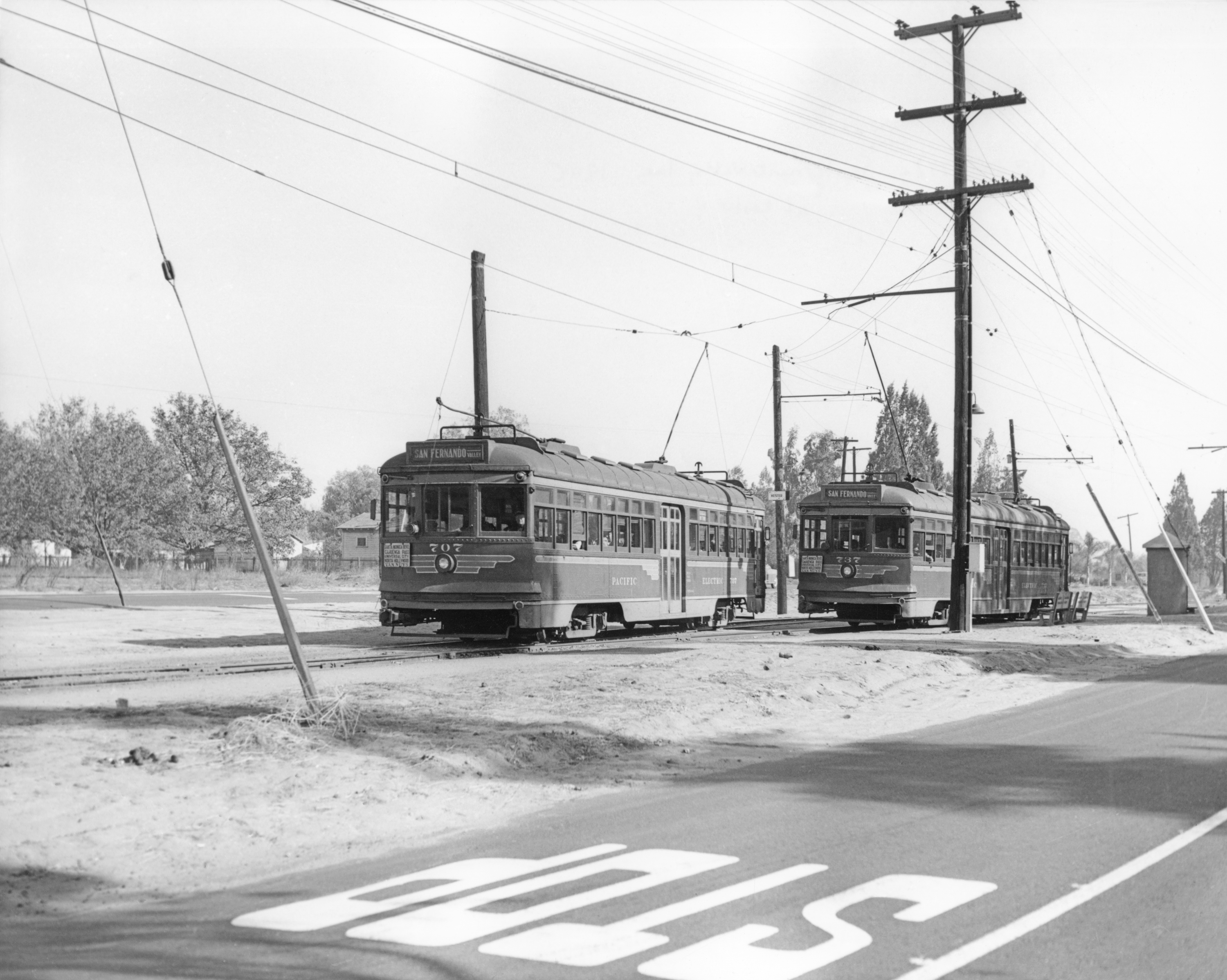
Not only were the PE’s PCCs long and wide, they were able to operate in trains of up to 3 cars. This photo taken in early 1941 shows the “Pride Of The PE” in all their glory.
Orders for Pullman Standard built PCCs increased dramatically after the introduction of PE’s PCCs.
The General Electric Company — always the champion of electrically powered public transit vehicles — was eager to showcase the PCC. GE produced at least three lavish films featuring the latest types of electric transit, including the Trolley Coach. The first of these films produced in early 1937 (in black & white) was titled “Modern Electric Transit”. This film put a heavy emphasis on new trolley coach installations across America. Also featured were the new PCCs delivered to the Brooklyn and Queens Transit, Union Pacific’s M10000, ocean liners Queen Mary and Normandy. Even the Hindenburg was shown as the “Luxury liner of the Skies.”
The second film, “Life Stream Of The City” (in color, above) was produced around 1946-47 and showcased various rail operations both rapid transit and PCCs (surface cars) and trolley buses. PE’s PCCs were shown in a positive spotlight.
The last of these GE films to feature PCCs was tilled “GOING PLACES” and was produced about 1952-53. It once again showcased PE’s PCCs as well as LATL’s near new P-3s at Rimpau Loop. Most of this film was made on the Shaker Heights Rapid Transit featuring new Pullman Standard MU PCCs.
Unfortunately, by the mid-1950s, General Motors had begun an unstoppable campaign in print and film media to sell America on buses, Chevys and Buicks. One film “Lets Go To Town” (above) showcased GM’s latest buses “with their smart new interiors.”
Not content to sell America on buses, GM produced still another film titled “Give Yourself The Green Light” (above). This film encouraged the construction of interstate highways across America. This particular film hit below the belt in showing the Pacific Electric’s abandoned and destroyed right-of-way at the Barham Boulevard bridge in the Cahuenga Pass, stating the placement of rail line tracks in the center of “Expressways” was a waste of taxpayers’ money. The space occupied by rapid transit tracks would be better used for motor vehicle traffic lanes.
GE produced at least one more transit related film titled “Rapid Transit – 1964”. This film showed no PCCs, but rather showcased new rapid transit operations in Chicago and Toronto. From then on, GE concentrated on jet engines and diesel locomotives.
General Motors had won the battle and the war. Too bad for everyone.