PE 5008 at the LA River: A crime against traveling humanity

Alan Weeks Photo, Alan Weeks Collection

By Ralph Cantos

This breathtaking photograph, taken by master photographer Alan K. Weeks, shows the Pacific Electric Glendale-Burbank Line at is best. At the time Alan took this photo, the end for the G-B Line was just days away.

The line a was a showcase for modern light rail rapid transit in the late 1940s and early ’50s. The PE had invested hundreds of thousands of of private capital in 1940 to completely rebuild the line, top to bottom, end to end. The line was equipped with 30 ultra-modern MU PCCs built to PE’s own specs. The PCCs were augmented with a like number of rebuilt suburban Hollywood cars. The Hollywood cars were considered by transit experts to be the finest “standard” rail cars to ever grace the streets of any American city after their 1940 modernization. No other rail cars in the country could equal their smart, handsome appearance, fast acceleration and smooth ride.

And yet after only 15 years of all this investment into providing commuters of the Glendale-Burbank Line the finest transportation possible, the line was scuttled in favor of INFERIOR buses, in the name of curb service and flexible routing. City officials stood by and did not to a DAMN thing. Their take? The line’s commuters could all “take a hike.”

Fast forward to 1990. The LA Metro Blue line opens on a completely rebuilt former interurban rail line that was foolishly abandoned some 29 years earlier, while City officials stood by and again, did not do a DAMN thing. The “new” Metro Blue Line was equipped with the latest light rail cars of LA’s own design, much the same way the Glendale-Burbank line was in 1940.

As the year 2005 dawned, the Blue Line was now 15 years old. Suppose you opened your morning newspaper and read that the Blue Line was to be abandoned in favor of more flexable buses and curb service. This is the shock that greeted commuters of the Glendale-Burbank line when they were informed that the line was to be abandoned. Who in their right mind would look at such a conversion as anything but insane?

And so, the Glendale-Burbank line , just 15 years old, fell victim to “we don’t give a damn” and greed by those in charge of the line’s fate. Had the line somehow managed to survive into the late 1980s it would have been given top consideration for conversion into modern, high-speed light rail service. But unlike the Blue Line’s right-of-way that had remained largely intact for almost 30 years after abandonment, the Glendale-Burbank Line’s infrastructure was demolished and its valuable rights-of-way carved up like a Christmas turkey.

In my humble opinion, an UNFORGIVABLE act of vandalism.

The entire line, everything, wiped out as fast as could be done, a costly lesson for all of us to remember.

Alan Weeks Photo, Alan Weeks Collection

PE’s Toluca Yard, 1941: The Calm Before The Storm of World War II

Ralph Cantos Collection

By Ralph Cantos

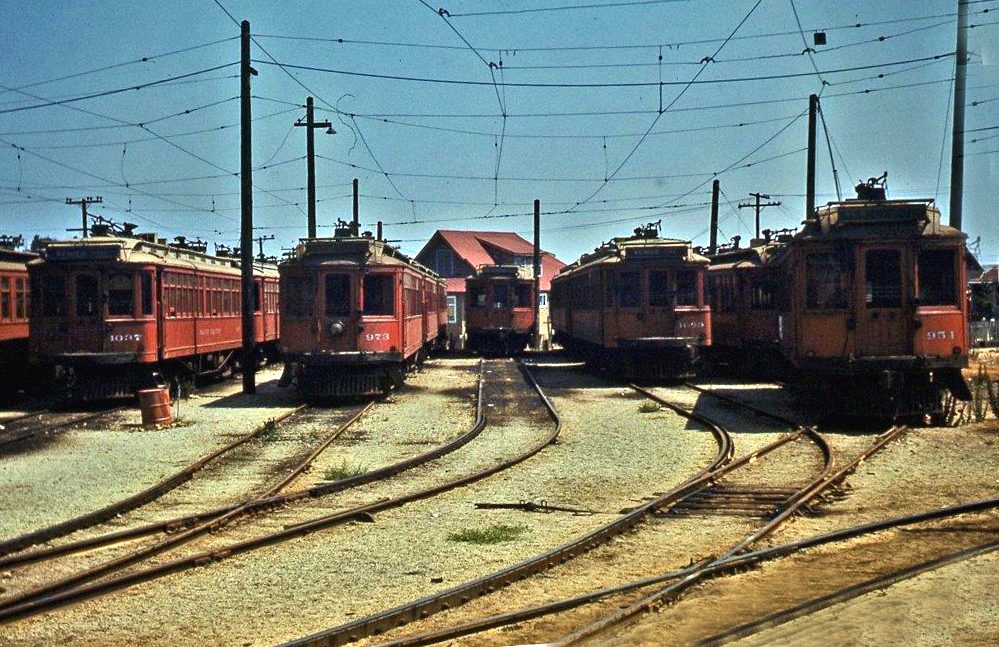
This beautiful photo taken by Ralph Melching from the Beverly Boulevard viaduct looks down on Pacific Electric’s Toluca Yard in the summer of 1941. The freshly modernized Hollywood cars are still adorned with their very attractive silver roofs as are the “new kids on the block,” PE’s revolutionary double end-MU PCCs. Hollywood car no. 659 will be heading for West Hollywood via busy Santa Monica Boulevard.

This was the Western District at it finest. The modernized Hollywood cars were the equal to the modern PCCs of the day. They were exceptionally smooth and quiet-riding cars. Braking was about the only performance area where a Hollywood car could not match a PCC head to head.

All was tranquil on the PE in the summer of 1941. The PE was still very much an “interurban system” despite some recent rail abandonments in 1938. Those abandonments, brought on more by demands of state and city regulatory bodies demanding the PE rid the streets and right-of-ways of all wood bodied interurbans, than a lack of patronage of the effective lines.

But in just a few months of this photo, all HELL would break loose and the PE (and the LARY as well) would be put to the test. The venerable 950s and 1000s were saved from the fire and served LA’s commuters with distinction in a time of crisis.

The PCCs had only been in service little more than a year and the Hollywood cars were in top condition. The PCCs and Hollywood cars – along with virtually every rail car on the system – would be put to the test of wartime passenger traffic demands that had never been seen on the PE since its inception.

Soon the bright silver roofs on all recently modernized rail cars would give way to a more sedate gray color as a safety precaution, less a PE car be spotted by enemy aircraft that could result in catastrophic results. Fortunately, all of PE’s rail cars made it through World War II in great shape, only to face the scrapper’s torch in the coming decade.

The PE had proved its worth to the City Of Los Angeles in time of crisis, only to be given the shaft in time of peace.

Ralph Melching Photo, Ralph Cantos Collection, Pacific Railroad Society Collection

Division 6 – Ocean Park Car House Memories

Ira Swett Photos, Alan Fishel Collection

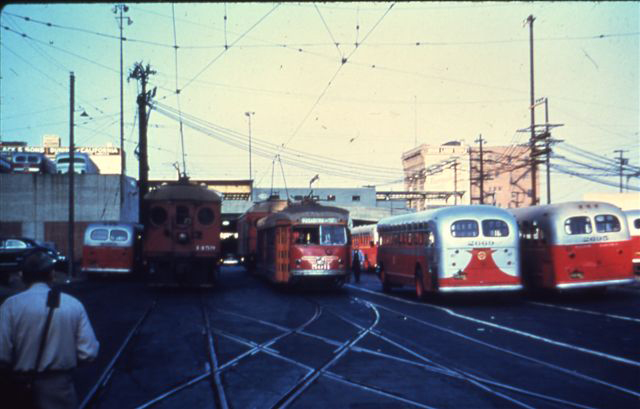
From the collection of Alan Fishel, who graciously allowed us to reprint these images here, come this small collection from the camera of traction documentarian and legend Ira Swett.

As you may know, Metro just closed the old Ocean Park Car House facility, today known as Division 6. These images capture how vibrant the facility has been for decades, including its heyday during the time of the Pacific Electric.

Ira Swett Photos, Alan Fishel Collection

Ira Swett Photos, Alan Fishel Collection

Merry Christmas from PERYHS

Jack Finn Collection, Pacific Electric Railway Historical Society Collection

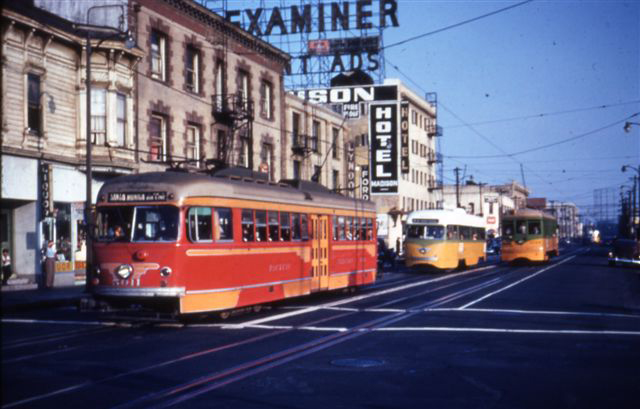
From the Jack Finn collection comes this original, blue-border Ektachrome slide that hasn’t totally faded: Pacific Electric Hollywood car no. 5114 eastbound on Hollywood Blvd. at Whitley Avenue, sometime between 1952 and 1953 (corrected).

Merry Christmas from all of us at the Pacific Electric Railway Historical Society.

PE 913: Destined for Immortality

Harold F. Stewart Photo, Craig A. Rasmussen Collection

By Ralph Cantos

This photo from the Craig A. Rasmussen Magna Collection was taken by the late Harold F. Stewart at Culver Junction in late 1940. The 913 is westbound on the evening Santa Monica Air Line run.

By this late date, almost all the mighty 800s had entered retirement and were being burned for scrap at Torrance Shops. By 1941, all the 800s were off the PE active roster. Four car bodies were donated to the Boy Scouts Of America for use as Summer mountain cabins, and five cars were converted to Express Motors and given numbers 1495 to 1499.

All the rest of the fast heavy 800s were gone as America and the PE entered World War II. The five Express Motors were retired in 1950 with one car, the 1498, being donated to the “Children Of Los Angeles” and moved to Travel Town. There the 1498 would be displayed open to the weather for almost 4 decades until the elements finally made the car unsuitable for continued display.

What was left of the 1498 was moved to OERM, but unfortunately, was destroyed in a disastrous brush fire in OERM’s “outback.” Only its trucks survived.

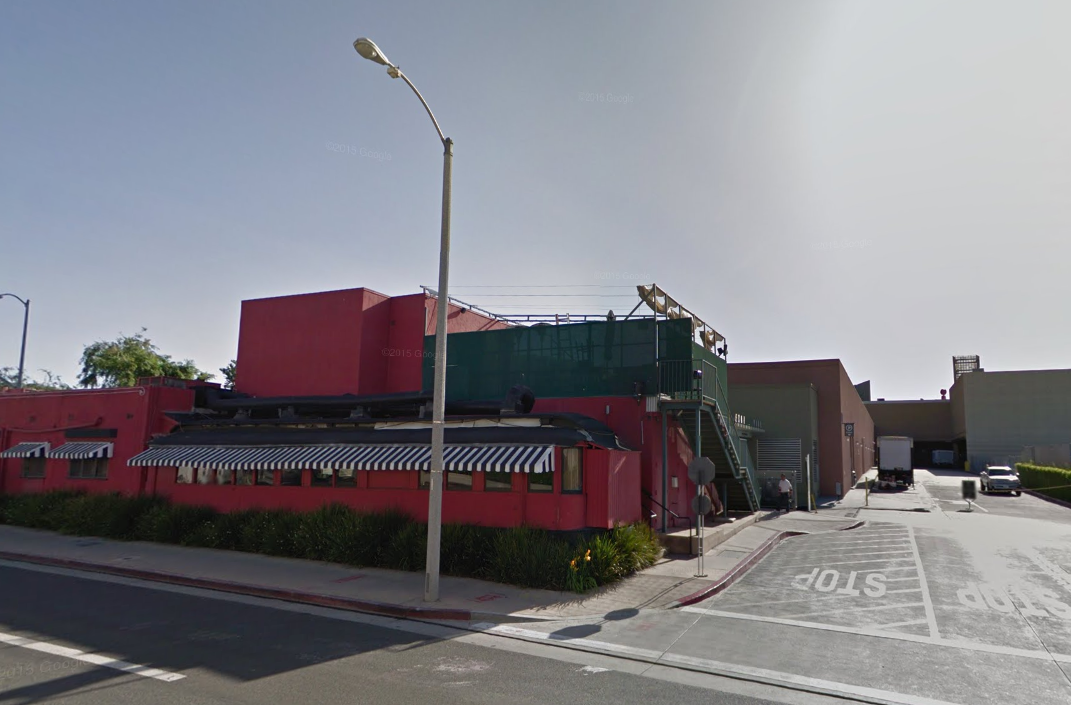
But this was not the end for at least one 800. Car 913, originally built as a control trailer, and later motorized with GE electrical gear in 1912, would live on. Just after retirement, the body of 913 was sold to a private party and moved to West Hollywood. There, the 913 would become part of the legendary “Formosa Café” where she still remains (in part) to this very day.

Back in the early 1960s her number was still discernible under a few coats of paint, But over the decades, her number was covered over by repeated repainting until it could no longer be recognized. And so the trucks of one 800 and the partial body of another survive more than 100 years after their construction.

Harold F. Stewart Photo, Craig A. Rasmussen Collection

Image Courtesy Google Maps Street View

Here’s a view of the carbody built into the Formosa Cafe, courtesy Google Maps Street View. Click here for a full-screen presentation.

PE 656 At Work

Ralph Cantos Collection

By Ralph Cantos

Pacific Electric Hollywood car no. 656 heads up a 2-car morning rush hour train at Vineyard Junction. It’s a cold, overcast February morning, and these World War II Los Angeles commuters will board this train for a smooth and warm trip to downtown LA. The Hollywood cars were just a year or two out of a major rebuilding and modernization that made them attractive and comfortable. They were as good or better in performance as the newest PCCs. The Hollywood cars did the PE proud.

Vineyard Junction was a very busy place on the Western District. It’s difficult to believe now, that in little more than eight years after this photo was taken, all this commuter rail infrastructure would be scrapped and sold for junk in favor of buses, road widening and freeways.

The September 17, 1950, abandonment of the world-famous Venice Short Line marked the real “beginning of the end” for what we knew as the Pacific Electric Railway. From that day in 1950 until April 9, 1961, a vast and viable interurban rail system would virtually disappear as though it never existed.

Today, the West Boulevard bridge still stands, its future uncertain. The bolts that once held up the wood trolley wire guards remain as a reminder of what was once the Pacific Electric that served LA so well in a time of transportation desperation brought on by the Second World War.

Ralph Cantos Collection

Ralph Cantos Collection

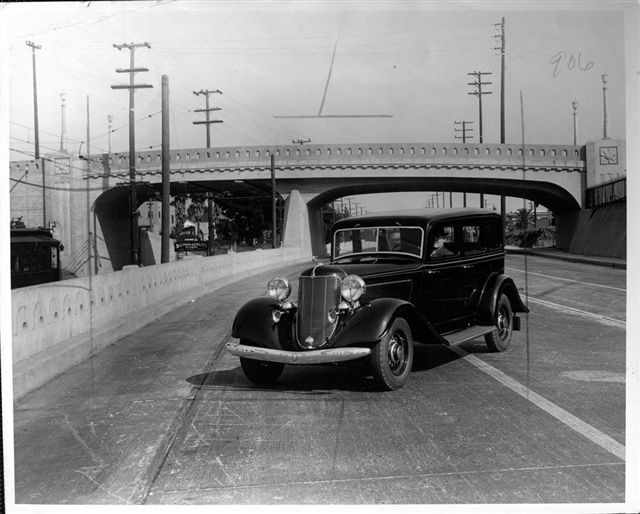
The West Blvd Bridge that was built in 1933 now faces an uncertain future. Los Angeles City Engineers are looking at the bridge, but not with any kind of admiring eyes. The City of LA has this bridge on its “hit list.” The City feels that the bridge would not hold up in the event of a 12.5 earthquake, and so it must come down and be replaced by some type of multi-billion new bridge, perhaps something resembling the Vincent Thomas suspension bridge. The City is looking for donations. After the 6th Street bridge is rebuilt, the days for the West Blvd. Bridge will be numbered.

This photo was taken just before the bridge was open to auto traffic. I am not sure, but I think the car is a 1933 Chrysler.

Pacific Electric 5011: PCC High Jinks Part 2

Ralph Cantos Collection

By Ralph Cantos

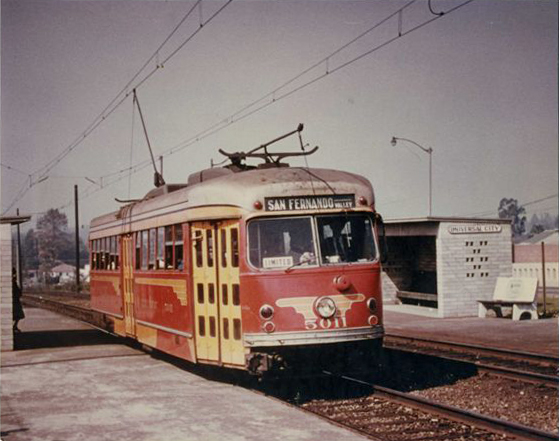
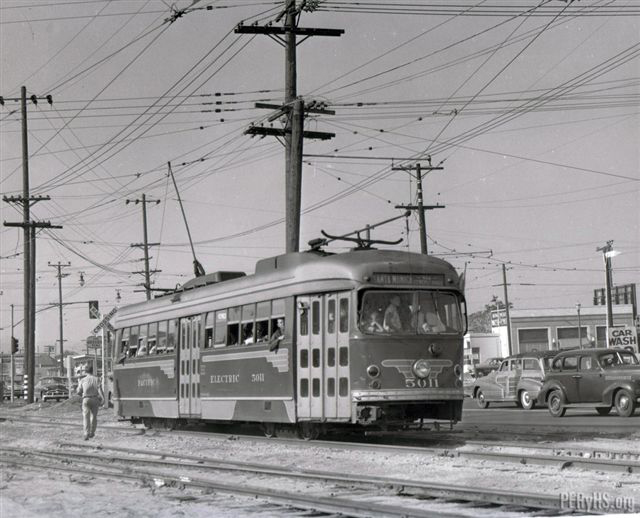
As part of a day long fan trip using Pacific Electric PCC no. 5011 on October 12, 1952, the 5011 made a trip over the Cahuenga Pass, the first time a PE PCC made the run over the pass since 1946 when scenes for the General Electric promotional film “Life Stream Of The City” were filmed.

Time was ticking away for the San Fernando Valley Line. Indeed, by October 12, 1952, just little more than eight weeks after this modern convenience made the run to North Hollywood and Van Nuys, the Valley line was abandoned on Dececember 28, 1952.

In the photo above, the fan trip car has just arrived at the Sherman Way terminal of the Valley Line where Hollywood car no. 5124 was waiting its departure time. The 5124 would later be transferred to the Southern District’s Watts Line, and operate until late 1959 as LAMTA no. 1806.

Ralph Cantos Collection

Later that afternoon, the fan trip made a stop at Universal City in the center of the Hollywood Freeway. The 5011 is inbound on perfect, flawless infrastructure, little more than 10 years old. Soon, all this perfection will be trashed by scrappers and sold for junk.

The final insult, PE’s “Dream Right Of Way,” will be replaced by one additional traffic lane resulting in the “Cahuenga Quagmire” we know today.

The memory of the missed opportunity for rapid transit is represented by a few bits and pieces of the line’s infrastructure that survive into the 21st Century.

Ralph Cantos Collection

Pacific Electric No. 5011: PCC High Jinks in the Western District

Ralph Cantos Collection

By Ralph Cantos

This very interesting photograph was taken on October 12, 1952. The location is the middle of La Cienega at San Vicente Boulevard looking north. The fan trip operated around points of interest on the Western District. The high point of this trip was a stop at the former PE’s 7th Street Surface yard accessed by dual-gauge tracks on 7th St between San Pedro and Main Streets.

Ralph Cantos Collection

A photo stop on 7th Street produced a fantastic of the 5011 and a LATL PCC on the same street. This was the ONLY location in the entire USA where two PCCs of two transit systems, of two different gauges, and two different builders could be taken.

Ralph Cantos Collection

Later that day, the fan trip came down the Sherman Cut-Off from West Hollywood Car House to Sherman Junction. The 5011 pulled into the center of La Cienega Boulevard, which was the “end of wire” by this time. This track was still in use at this late date to service an oil well behind what would be today’s Beverly Center. The oil well still exists to this day, but delivery to the refinery is by pipeline rather then by a PE-hauled tank car.

Later that day, the fan trip stopped at Culver Junction for more photographic memories. The electrification of this end of the Western District was in slow decline and would be gone altogether in a few years.

Ralph Cantos Collection
Donald Duke Photo and Collection

The choice of the 5011 as the fan trip car might have been that it was the last PE PCC still sporting the “as delivered” paint scheme with the name PACIFIC ELECTRIC proudly displayed on her flanks. Soon, the 5011 would be “refreshed” with a new paint job sporting the PE Emblem and the Pullman green “Mohawk” roof paint job, something I personally never liked.

Pacific Electric 5146 After the End of Service

Unknown Photographer, Caesar Milch Collection

By Caesar “CJ” Milch

On December 29, 1952, the day after the last regularly scheduled cars ran to the Valley, there was a special car run by the PE for a group of local politicians and Valley socialites (including Monty Montana the cowboy).

I recently purchased these original Kodachrome slides (unfortunately, no indication of the original photographer) and wanted to share them with the PE community. I missed two great shots from this same series to other bidders – one on the Chandler right-of-way and another at North Hollywood with Monty Montana clearly visible. I had to buy them, because I’d never seen pictures of this day, but I knew it had happened!

The first one is looking north from the south side of the Chandler Blvd. right-of-way as Hollywood car 5146 rolls toward the North Hollywood station. Not sure of the exact location as there is no notation on the slide other than “Chandler Blvd.”

Unknown Photographer, Caesar Milch Collection

The second shot is at North Hollywood station where there was a brief layover and walk around session. The motorman doesn’t look too happy.

Unknown Photographer, Caesar Milch Collection

The third shot is 5146 rolling down the private right-of-way that will soon be gone. Note the construction at left which I believe to be connectors to Mulholland Drive. I’m of the thought that this was taken from the Pilgrim overpass just north of the Hollywood Bowl stop.

Unknown Photographer, Caesar Milch Collection

Fourth shot is 5146 from same location, but closer. Note the PE bus heading up to the valley!

Unknown Photographer, Caesar Milch Collection

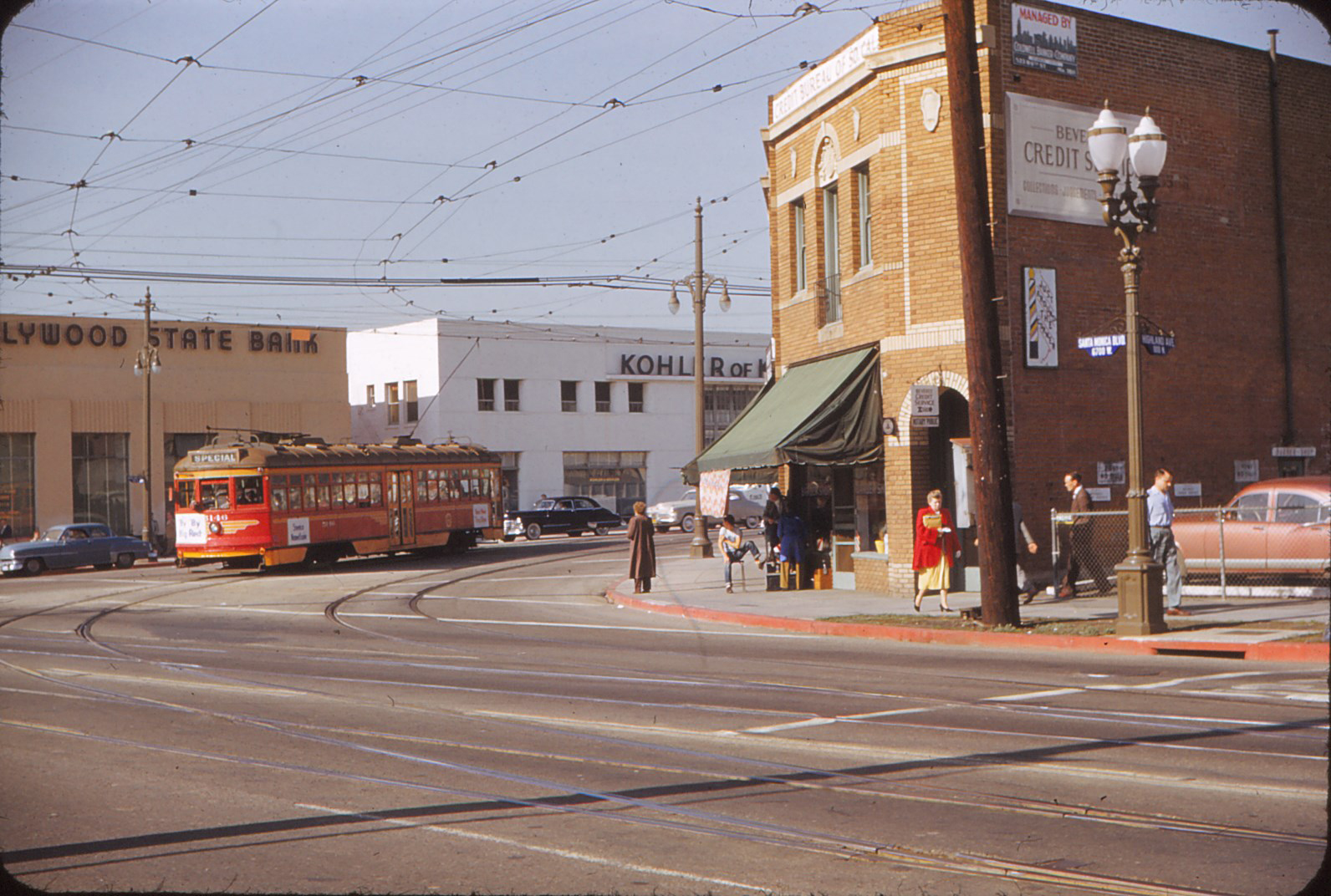
Last shot is 5146 rounding the curve from Highland onto Santa Monica Blvd. The people in front of the corner store seem to know something is afoot and may not know that they will never see another car turn that corner ever again. 5146 was sure polished up for the last run and performed her duties in fine and high style.

Unknown Photographer, Caesar Milch Collection

EDITOR’S NOTE: Ralph Cantos previously had submitted the image on this article, which to date, has been the only image he had seen of this event.

Pacific Electric 990 and Train: Poetry In Motion

Jim Stubchaer Photo, Jim Stubchaer Collection

By Ralph Cantos

Pacific Electric’s roster of “modern” wood-bodied interurbans peeked at about 335 units. These wood-bodied beauties consisted of 4 distinct classes: the 500s, 800s, 950s and 1000s.

The number of wood interurbans on the PE system probably reached its high point around 1922-23. PE began to retire the cars 500 – 599 as new 600-class Hollywood cars began to arrive from St. Louis Car Co. The last of the 500s operated until 1937, at which time they were stored at Torrance Shops. By 1939, those cars not sold to private parties were gone. A few years later, the mighty 800s followed the 500s into history, save a few that were converted to light duty box motors, such as no. 1498 that was displayed at Travel Town for several decades.

The handsome 950s were next on the list for extermination. Nineteen of these classic beauties had already meet their fiery fate at Torrance Shops when World War II put a stop to the scrapping of anything that could roll and carry passengers. Indeed, World War II extended the service lives of hundreds, if not thousands of streetcars and interurbans across the USA. The PE put the surviving 31 950s through Torrance Shops, and when they rolled out the door in mid-1942, the big cars were in better-than-new condition.

The bigger 1000s were also refurbished at the same time. Both classes would render excellent service for the Pacific Elecxtric throughout the war and beyond.

But all good things must and did come to an end. The September 1950 abandonment of the Venice Short Line and the demise of the Northern District spelled the end for all wood-bodied interurbans on the PE.

In this beautiful 1948 photo by Jim Stubchaer, car 990, now 41 years young, leads an afternoon VSL rush-hour train just west of Vineyard Junction. A close examination of this photo reveals that the second car in the photogenic train to be none other than car no. 999. You can just make out the 5 window front and the different side window arrangement left over from its days as a deluxe car, El Viento.

By November of 1950, the 950s had gone to their final resting place at Terminal Island. The body of one car, no. 993, was set aside as a locker room. A few years later, Hollywood car no. 655 replaced the 993 as a newer locker locker room. In time, both cars would be saved by Richard Fellows and find their way to OERM where the body of 993 awaits restoration.

As a final note, “The Dean of PE History” Ira L. Swett tried to save car no. 994, but due to a lack of funds, the lack of any location to store the car, and the lack of any significant trolley preservation movement, he was forced to give up on the effort, and the 994 was lost.

Jim Stubchaer Photo, Jim Stubchaer Collection