PE’s El Segundo and Santa Monica Air Line: Two of a Kind

By Ralph Cantos

This very rare photo taken in 1914 shows Pacific Electric car no. 214 southbound on the new El Segundo Line, just after leaving Watts.

Like the Santa Monica Air Line, passenger service on the El Segundo Line seemed to be an “afterthought” to the PE brass. The big money on both lines, was FREIGHT, and in the case of the El Segundo, lots of it. While the Air Line handled all manor of general freight, on the El Segundo Line, it was BLACK GOLD….OIL that kept the green money rolling into the PE revenue books and lots of that too.

Passenger revenues on both lines — that was another matter.

Passenger service to El Segundo was inaugurated when the line opened in August of 1914. And again like the Air Line, passengers were not packing the cars in sufficient numbers to make the line as important to the PE’s Passenger Department as other Southern District Lines, chief among them, of course, the Long Beach Line.

After just 15 years , PE pulled the plug on El Segundo passenger service; it was gone by the end of October 1930.

The El Segundo Line did not have the legions of loyal passengers like the Santa Monica Air Line did (all 75 of them), and so passenger service on the Air Line was whittled away until the final, one-car-a-day schedule went into effect in 1933 and lasted to the bitter end in October of 1953. Both Lines continued and thrived as freight lines for decades after the last passenger services made final runs on both lines.

Today, the Santa Monica Air Line has been reborn as the LACMTA Metro Rail-Expo Line. And someday, thanks in part to the passage of Measure M , passengers wishing to travel from Los Angeles and points in-between to El Segundo by rail, might again do so via an extended Metro Green line.

Only time will tell.

Ralph Cantos Collection

The Life and Times of Pacific Electric 1260

Here are a collection of images of Pacific Electric no. 1260, its many adventures and even a prominent mishap, all captured by photographers back in the day.

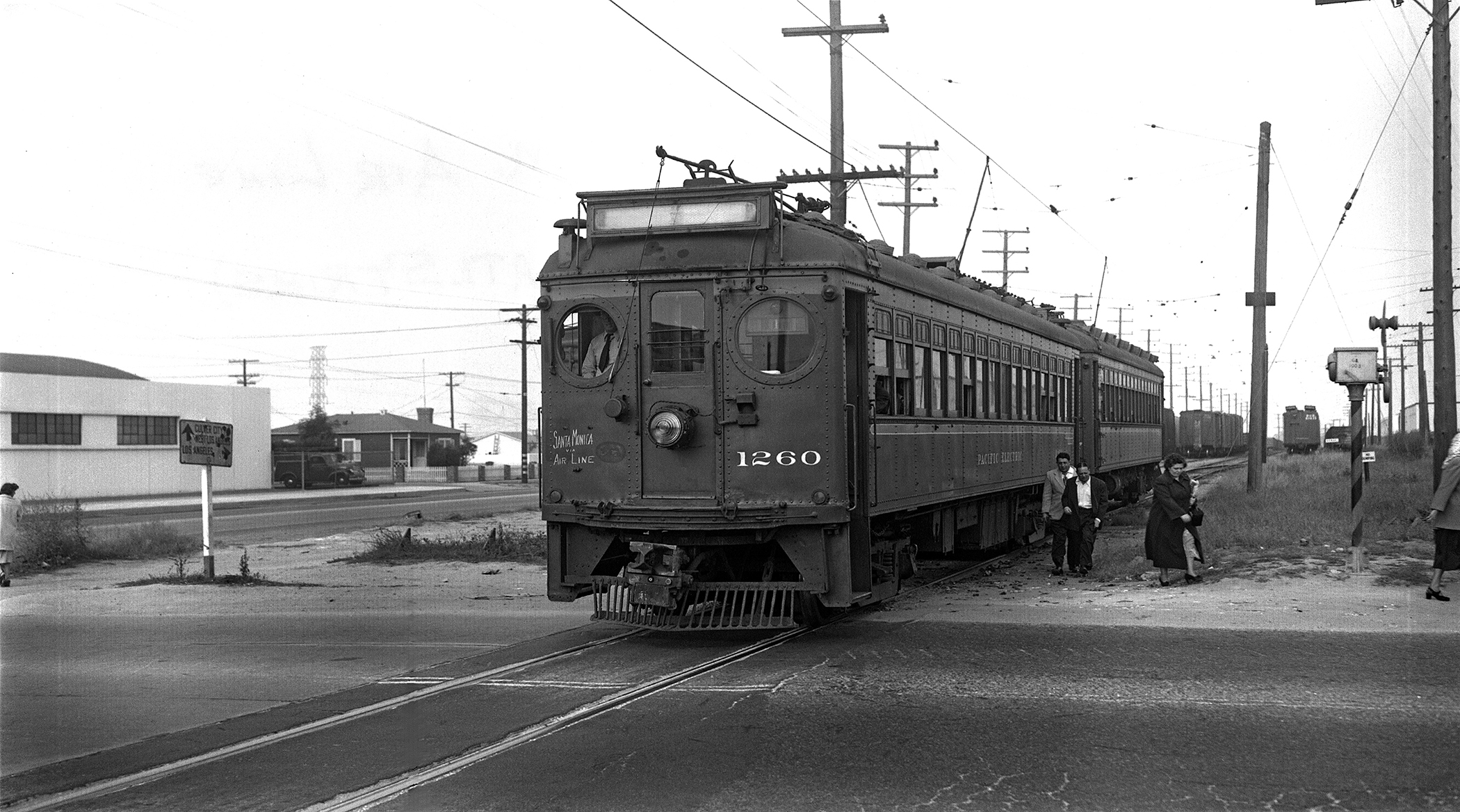
Jack Finn Print Collection. Craig Rasmussen print. From the PERyhs.org archive. Photographer: Unknown Location: Westbound on the Santa Monica Air Line crossing Vermont Ave. Date: 1949 Railroad: Pacific Electric Line: Air Line Car#: PE 1260 PE 1227 Notes on back of print: Santa Monica Air Line: 1260 - 1227, W.B. at Vermont Ave, 1949 LATL Strike Collection of Craig A Rasmussen Image notes: Photo appears in Interurbans Special Western District page 53. Photo credited to Magna Collection.
Jack Finn Print Collection. Craig Rasmussen print. From the PERyhs.org archive.
Photographer: Unknown
Location: Westbound on the Santa Monica Air Line crossing Vermont Ave.
Date: 1949
Railroad: Pacific Electric
Line: Air Line
Car#: PE 1260 PE 1227
Notes on back of print: Santa Monica Air Line: 1260 – 1227, W.B. at Vermont Ave, 1949 LATL Strike
Collection of Craig A Rasmussen
Image notes: Photo appears in Interurbans Special Western District page 53. Photo credited to Magna Collection.
Image from the Jack Finn collection. Photographer: Unknown Date: Unknown Location: San Pedro Street in downtown Los Angeles. Notes on back of print: PE 1260 J 734 Image Notes: Scanned from a 3 /14 x 5 3/4 inch print
Image from the Jack Finn collection.
Photographer: Unknown
Date: Unknown
Location: San Pedro Street in downtown Los Angeles.
Notes on back of print: PE 1260 J 734
Image Notes: Scanned from a 3 /14 x 5 3/4 inch print
Steve Crise Archive - Acme Photo - Photographer unknown Photographer: Acme Photo - Photographer unknown Location: San Pedro Street south of 6th Street, Los Angeles, California Date: November 28, 1943 Railroad: Pacific Electric Locomotive: PE 1260 Notes on back of 8x10 print: LA 23697 (Los Angeles Bureau) TWENTY-TWO ESCAPE INJURY - LOS ANGELES - Twenty-two passengers of this Pacific Electric car miraculously escaped without even a scratch when it jumped the tracks and overtuned. Faulty brakes were believed to have been the cause of the accident. Bureaus Coast CREDIT LINE (ACME) 11-28-43 From Acme Newspictures, Inc Los Angeles Bureau, 1257 So. Los Angeles Street. Please credit Acme Photo. This picture is sold to you for your publication only and must not be loaned syndicated or used for advertising purposes without written permission from Acme. Purchased from Historic Images 6073 Mt. Moriah Ext Memphis TN 38115 historicimages.com ney01237 October 2016
Steve Crise Archive – Acme Photo – Photographer unknown
Photographer: Acme Photo – Photographer unknown
Location: San Pedro Street south of 6th Street, Los Angeles, California
Date: November 28, 1943
Railroad: Pacific Electric
Locomotive: PE 1260
Notes on back of 8×10 print: LA 23697 (Los Angeles Bureau) TWENTY-TWO ESCAPE INJURY – LOS ANGELES – Twenty-two passengers of this Pacific Electric car miraculously escaped without even a scratch when it jumped the tracks and overtuned. Faulty brakes were believed to have been the cause of the accident. Bureaus Coast CREDIT LINE (ACME) 11-28-43 From Acme Newspictures, Inc Los Angeles Bureau, 1257 So. Los Angeles Street. Please credit Acme Photo. This picture is sold to you for your publication only and must not be loaned syndicated or used for advertising purposes without written permission from Acme.
Purchased from Historic Images
6073 Mt. Moriah Ext
Memphis TN 38115
historicimages.com ney01237 October 2016
Robert X Loewing photo, Craig Rasmussen collection. Steve Crise Archive Photographer: Robert X Lowing Date: April 1949 Railroad: Pacific Electric Railray Car#: PE 1260 Location: Sentous Yard, La Cienega Blvd at Jefferson Blvd, Los Angeles, California. Present day location of the La Cienega Expo Line station. Notes on back of 8 x 10 print: 1260 -1227 W.B. on Santa Monica Air Line at Sentous; 1949 (LATL Strike) Rob't X. Loewing Photo. Image notes: Photo taken during the 1949 Los Angeles Transit Lines strike. This explains the use of the 1200's on the Air Line.
Robert X Loewing photo, Craig Rasmussen collection. Steve Crise Archive
Photographer: Robert X Lowing
Date: April 1949
Railroad: Pacific Electric Railray
Car#: PE 1260
Location: Sentous Yard, La Cienega Blvd at Jefferson Blvd, Los Angeles, California. Present day location of the La Cienega Expo Line station.
Notes on back of 8 x 10 print: 1260 -1227 W.B. on Santa Monica Air Line at Sentous; 1949 (LATL Strike) Rob’t X. Loewing Photo.
Image notes: Photo taken during the 1949 Los Angeles Transit Lines strike. This explains the use of the 1200’s on the Air Line.

Pacific Electric 578: Post Cards and the PE

Ralph Cantos Collection

By Ralph Cantos

This nice post card dating from about 1923-25 shows Pacific Electric car no. 578 westbound on the East Broadway Line in Glendale.

The HOTEL GLENDALE dominates the intersection of Glendale Avenue and East Broadway. This was a very important intersection in the City of Glendale. It was here that the PE interchanged with the struggling Glendale & Montrose Railway. The G&M operated along the center of Verdugo Road from downtown Montrose on the north to an interchange with the Union Pacific Railroad in south Glendale. A short branch to connect with the Los Angeles Railway E Line diverged off the Verdugo Main line via Wilson Avenue-Broadway-and-Colorado Streets where the LARY connection was made in Eagle Rock. (The 5 Line)

PE’s 500s were the backbone of the railway’s suburban operations until the coming of the Hollywood cars in 1922-23. Even though the Hollywood cars were designed and built specifically for service on the Hollywood Boulevard line, the PE brass soon realized that they had a winner in the Hollywood cars, and the 600s began to replace the 500s en masse.

Today, except for the G&M car house in Montrose, most all traces of the little railway are gone. The building at East Broadway and Glendale Avenue that was once the HOTEL GLENDALE still stands today, although repurposed as another enterprise.

The PE equipped the East Broadway Line with its beautiful Pullman PCCs in 1941. A dubious distinction befell the PE PCCs when in 1946, the East Broadway line was abandoned. It was the first PCC-operated car line in the USA to be abandoned. But as history would soon prove, abandonments of PCC-operated streetcar lines in the 1950s would become all too commonplace. After the East Broadway Line, all of the San Diego Electric Railway’s PCCs were replaced by buses in 1949. The annihilation of the PCC had begun, but thankfully, complete annihilation was never achieved . To this day, fifty-plus-year-old PCCs still ply the streets and right-of-ways of several cities across the USA, the buses that replaced many of these same PCCs having been scrapped decades ago.

Ralph Cantos Collection
Editor’s Note: here is what appears to be the old Glendale & Montrose Railway carhouse in the back area of the current Anawalt Lumber location. It resembles the peaked roof design of the old Pacific Electric Watts and Ocean Park car houses.

PE’s Santa Monica Air Line: From obscurity to rising star

Ralph Cantos Collection

By Ralph Cantos

For the last 20 years of the Pacific Electric Santa Monica Air Line’s existence, about 50 or so loyal regular commuters enjoyed a variety of equipment. The 1930s saw the mighty 800-class of heavy interurbans providing most of the “service” on the line, that being one morning inbound and one afternoon/evening westbound trip. The 1940s saw a mix of 950s and 1000s holding down the runs. For the last three years, a single Hollywood car provided the service to the dwindling passenger loads.

In this side-by-side photograph, just about 63 years separate the views taken at almost the exact same location in Cheviot Hills. On the left, Hollywood car no. 5112 is seen making the afternoon westbound trip in the last weeks of September 1953. Some 63 years later, an LACMTA test train passes the same location, known today as the Cheviot Hill Trench, in the weeks before the line’s opening in May 2016.

The success of the LACMTA’s EXPO RAIL LINE has been spectacular. The new line follows the original alignment for much of the way, starting at Exposition Park. The new line leaves the original route at 17th Street in Santa Monica and runs down Colorado Avenue parallel to the original right-of-way just 100 feet north of the original line. Numerous dangerous grade crossings have been replaced by spectacular aerial “fly overs.” The terminal at 4th & Colorado is built over the original right of way.

Passenger loadings have surpassed expectations by a large margin. Currently two- and three-car trains provide 12 minute service for much of the day, seven days a week. The EXPO line is a winner by all accounts.

After the Air Line was abandoned in October 1953, the 5112 was transferred to the Southern District’s Watts Line. From that last run in 1953 to the last run on the Watts Line in November 1959, the 5112 (now renumbered 1801) would provide gallant service along the famous 4 tracks under the most deplorable maintenance conditions imaginable. Finally in 1960, the 5112 was rescued from the scrappers torch and now resides at OERM.

Ralph Cantos Collection

Pacific Electric’s Santa Monica Air Line: From Toonerville Trolley to Metro Rail

Ralph Cantos Collection

By Ralph Cantos

Pacific Electric car no. 994 rounds the curve at Overland Avenue in the spring of 1950. This is the westbound afternoon / evening trip. Hollywood cars provided service for the last three years of the line’s existence.

PE’s Santa Monica Air Line was something of an “institution.” The line was built in 1875 by the Los Angeles and Independence Railroad. Just 2 years after the line opened, the LA & I RR decided to sell the line to the Southern Pacific Railroad. The SP, hoping to build up a lucrative freight business, built at its own expense the world famous “LONG WHARF” in hopes of beating out Long Beach and San Pedro as a major shipping port. When that did not work out, the SP leased the line and Wharf to the Los Angeles Pacific Railroad around 1908. A few years later, all LA&P holdings and infrastructure were taken over by the “New PE” in the Great Merger of 1911.

The Santa Monica Air Line was essentially built as a freight line. Passenger service along the line tended to be an annoyance to the PE. Passenger schedules along the line reflected the PE’s annoyance with the line. The best service (what there was) was provided between Downtown LA and Culver Junction. West of Culver Junction, the service was “sparse” at best. After several unsuccessful attempts to abandon passenger service altogether, a “compromise” was reached with the Public Utilities Commission (PUC) around 1932-33: a grand total of ONE in-and-outbound passenger trip was provided for the “convenience” of about 50 die-hard regular passengers who cherished the rail service.

Meanwhile, the world-famous Venice Short Line that provided much more frequent service to essentially the same destinations, was abandoned on September 17, 1950, leaving the Air Line as the lone passenger service on the Westside of LA, Santa Monica, and Venice.
This wonderful passenger service was cut back to 11th Avenue on October 27, 1953, leaving those faithful Air Line passengers high and dry.

This was done in preparation for the sale to Metropolitan Coach Lines of all remaining PE passenger service, both rail and bus. When MCL took over PE’s passenger service, the Air Line was not included in the sale. And so for about 30 days in October of 1953, the Air Line would become the LAST passenger service on the PE.

Today, rail service along the Air Line has been reborn as the LACMTA’s EXPO Line. Two- and three-car air-conditioned trains run along the line at 12 minute intervals with standing-room-only passenger loads, a far cry from the 50 faithful passengers that kept the line going for so many years, riding aboard 800s, 950s, 1000s and finally, Hollywood cars to the bitter end in 1953.

Ralph Cantos Collection

Alan Weeks Collection

Regarding Pacific Electric 5063

Ralph Cantos Collection

By Ralph Cantos

Pacific Electric no. 5063 was one of the first 5050-class Hollywood cars to go into service. It’s seen here on the first day of one-man service on the Glendale-Burbank Line. The date is July 1, 1950. Just eight weeks later, the world-famous Venice Short Line would be abandoned. The year 1950 was “the beginning of the end” for the “World’s Greatest Interurban.” By the end of 1960, the entire system was wiped out, along with hundreds of magnificent pieces of rolling stock. Only the Long Beach Line would make it into 1961 and it was gone on April 9th. It was a last-run trip that I will never forget…

Ralph Cantos Collection

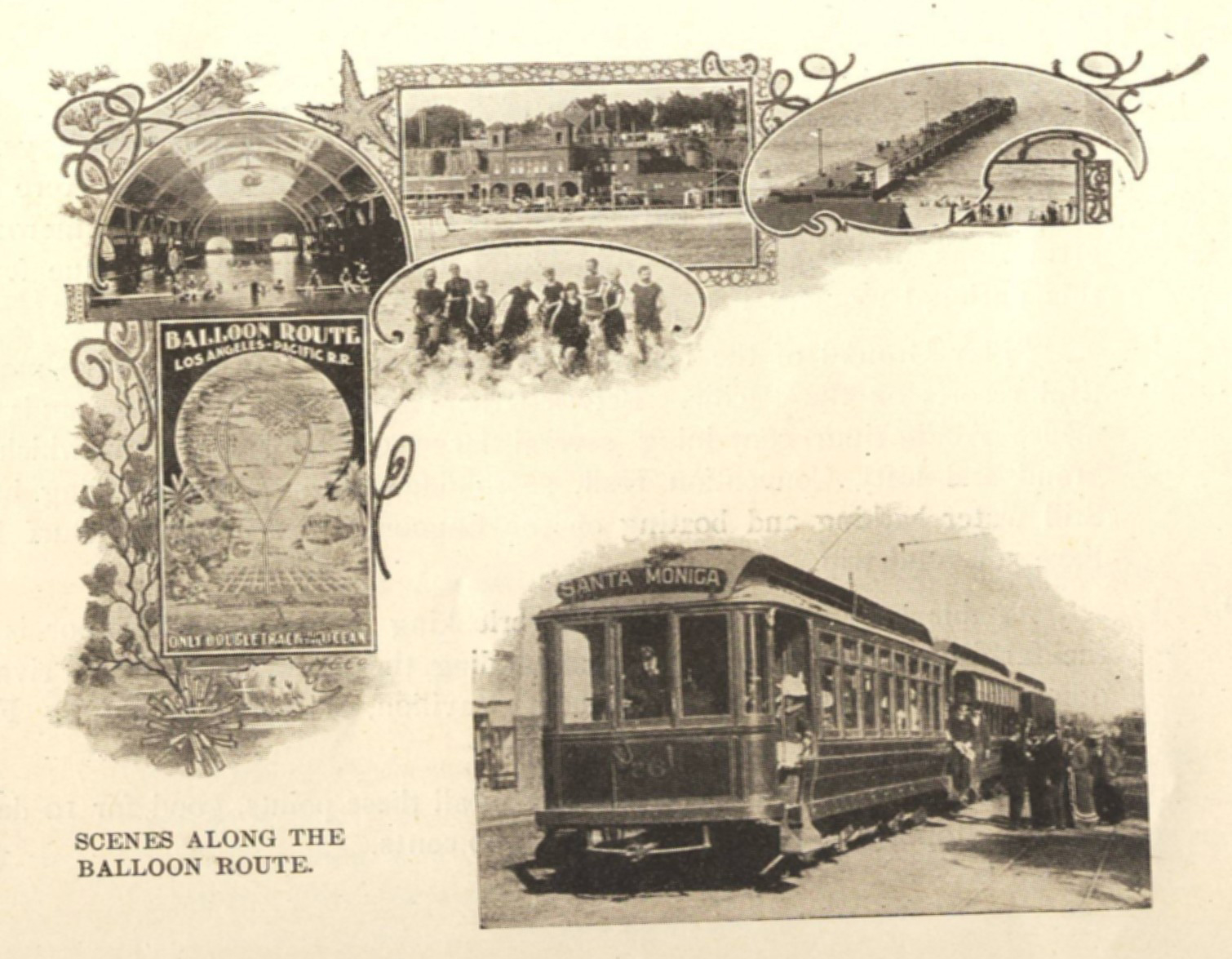
Los Angeles Pacific Railroad Balloon Route “Scenes Seen From An Electric Car” Brochure

Michael Patris Collection

From the brochure:

The Lines of this Company form a far more important railway system than can be judged from the number of trains arriving at and leaving Los Angeles each day. From a single track line of 18 miles in 1896 the Los Angeles-Pacific Railroad has grown to a double track system with a total of 185 miles of electric road, of which about ten miles are in Los Angeles.

Connections are made at Los Angeles with railroads diverging; at Sawtelle with Southern Pacific Company, at Inglewood with Santa Fe Railroad, at Hollywood with daily stage for Tolucca (sic), and at Redondo with Los Angeles & Redondo Railway, and with steamers for San Francisco and Coast points.

In addition to numerous intermediate points, the Company’s service reaches Hollywood, Colegrove, Sherman, Sawtelle, National Soldiers’ Home, Santa Monica, Ocean Park, Venice, Playa del Rey, Manhattan Beach, Hermosa and Redondo.

Nowhere are the elements conducive to expansion more pronounced. But the far-sighted management has not been slow in taking advantage of every point of strategic importance; so that any hope of successful competition in their territory must meet with failure.

Special Round Trip Tickets, taking in all these points, good for 10 days, and good to stop off at any or all of them, 80 cents.

Michael Patris Collection

Michael Patris Collection

995 on the Air Line

Jack Finn Collection

Pacific Electric no. 995 captured on the Air Line in this undated image.

Jack Finn Collection

Los Angeles & Pacific to Santa Monica Tickets

The Los Angeles Pacific Railroad was both a steam locomotive railway as well as an electric railway. It began in 1899 when “General” Moses Sherman and Eli P. Clark filed articles of incorporation. Clark would serve as president and a facsimile of his signature is on the top ticket. On June 16, 1903, the Los Angeles Pacific Railroad merged with the Los Angeles-Santa Monica Railroad Company and the Los Angeles, Hermosa Beach and Redondo Railway Company. The new name after this merger was the Los Angeles Pacific Railroad of California, but everyone still just called it the Los Angeles Pacific Railroad. The Los Angeles-Santa Monica Railroad Company was incorporated on December 2, 1902.

Over time there would be nearly 200 miles of track from the beach communities of the South Bay, including Redondo, Hermosa, Manhattan, El Segundo, Playa del Rey and Santa Monica. The lines headed eastward from the beach through the west side of Los Angeles, downtown Los Angeles, Sawtelle (The Soldier’s Home) and even through to Pasadena.

Rolling stock, in the heyday of 1906, included more than 400 pieces broken down as follows: 221 freight cars, 144 passenger cars, 17 electric locomotives, 12 repair service cars, 6 parlor cars and 5 mail cars.

From Terry Salmans: According to Interurbans Special 63 “Trolleys to the Surf” by Myers and Swett, LAP was sold to the Southern Pacific Railroad in 1906. The Los Angeles Pacific would be merged into the Pacific Electric in 1911.

By 1911 the PE could discontinue use of the steam locomotive lines, but continue to haul freight for decades.

Top ticket undated, blank on reverse. Bottom ticket back-dated 1908.

Michael Patris Collection

5028 in Atwater

Alan Weeks Photo, Alan Weeks Collection, Courtesy Ralph Cantos

Pacific Electric PCC no. 5028 glides in the Atwater district on June 10, 1955, in this classic Alan K. Weeks photo. The PCC is unhampered by auto traffic.

Just days later, the line would be abandoned, and buses would be mired in auto traffic below this line’s former right of way.

Alan K. Weeks Photo, Alan K. Weeks Collection

Image courtesy Ralph Cantos