Pacific Electric 680: A Remarkable Tale of Survival

By Ralph Cantos

Some ninety-five or so years after they were built, seven of the Pacific Electric Railway’s world-famous Hollywood cars survive in various stages of condition. The Orange Empire Railway Museum is home to five of the seven survivors. The 717 remains the only one of seven that is still operable. Car 655 (5094), though beautifully restored to its 1939-40 appearance, is not currently operable. The other three Hollywoods at OERM are stored in need of major restoration.

Ralph Cantos Collection

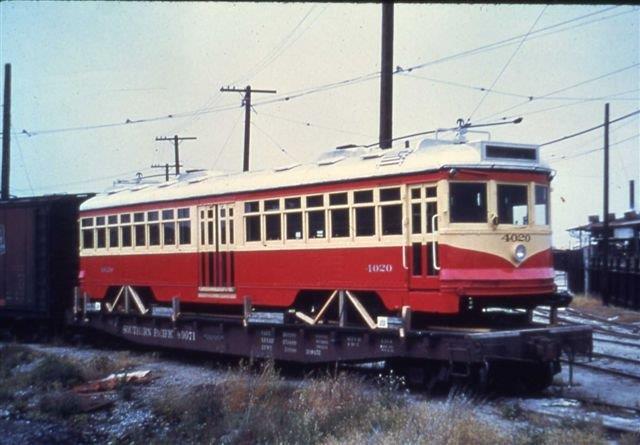
The former PE 758, sold to Buenos Aires along with 26 of her sisters in 1952 for passenger service, was converted to a line car many years ago. The other 26 Hollywood long since retired and presumed, scrapped after decades of service. The 758 is reported to be in poor condition at this time. One last car, PE 680 (5069) was sold to Portland Traction Co. in mid-1953 as their 4022 for continued passenger service.
Ralph Cantos Collection

The #680 and seven other Hollywood’s were repainted at Torrance Shops before being shipped to Portland. Sadly, their service life in Portland lasted only about 5 years.

One of the Portland Hollywoods was involved in a serious crossing accident with a log truck shortly after entering service, and was severely damaged beyond repair. Of the remaining seven cars, one car, the former PE 680 escaped scrapping and would be moved to the Oregon Electric Railway Museum, its 4 motors having been removed before being saved. After decades of storage at the Oregon museum, the severely rusted and weathered 4022 was sold to the Seashore Trolley Museum were it remains today in need of a major, multi-thousand-dollar restoration.
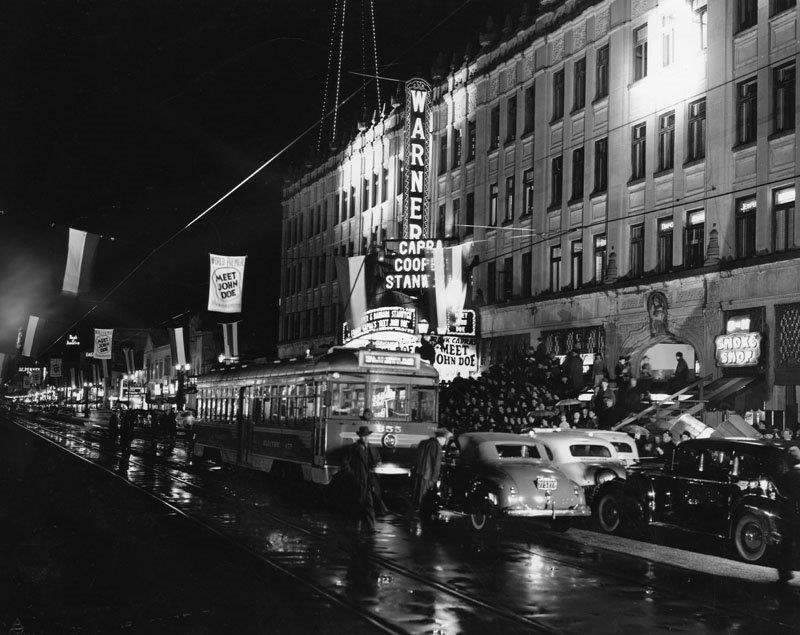
PE 655 on Hollywood Boulevard in 1941. Ralph Cantos Collection.

Ralph Cantos Collection

Southern Pacific 2452 at Overland in Culver City

Southern Pacific SW 1500 no. 452 is captured in this shot headed eastbound along Culver Boulevard. The small freight train is about to cross Overland Avenue in Culver City, circa 1970.

This one-time Pacific Electric line once ran as far south as Redondo Beach. The PE tracks were built along the sandy shoreline between Playa Del Rey and Redondo Beach and were only a few feet from the Pacific Ocean. The Redondo Beach Line lost its passenger status on May 12, 1940 due to its inability to compete with road improvements and the growing use of automobiles. The line was cut back to Alla Junction, a location known today as the busy intersection where Culver Boulevard crosses the 90/Marina Freeway.

For many years after passenger service ceased, the remaining portion of the route provided both the Pacific Electric and then the Southern Pacific with a modest freight business until the late 1970s when the line was cut back again to the Air Line at Culver Junction.

The old Culver Junction today is very close to where the Metro Expo Line’s Culver City station is now located.

The white fence running along the north side of the track, seen here on the left, is protecting the MGM backlot where many of the classic films of the Golden Age of Hollywood were filmed. Ben-Hur, The Philadelphia Story, The Three Musketeers, Little Women and Gone with the Wind are just a few of the features that were shot at this location. By the time this SP train was passing the lot, it had long since been abandoned by MGM for all practical purposes and the site would soon be sold and developed into condominiums.

Steve Crise Collection

PE 748: Last Days of the Venice Short Line

By Ralph Cantos

This photo of Pacific Electric no. 748 and train was taken in the last days of the world-famous Venice Short Line. The scene is at the foot of Venice Blvd. at Pacific Avenue in Venice. Behind the 748 is a new GM 2700-class Diesel bus, most likely on a training run. And like a scene out of the jungle, the GM Diesel bus is stalking the hapless 748 and train hoping to pounce on the train for the kill.

The September 17, 1950, abandonment of the VSL WAS THE BEGINNING OF THE END for the Pacific Electric Railway as a large-scale commuter rail system. The VSL had great potential for upgrade to a fast and efficient light rail route. But the thinking of the day was to eliminate all forms of suburban and city rail transit in Southern California in favor of “more efficient” freeways.

And so, the VSL passed into history. The wide right-of-way down the center of Venice Blvd. would lay abandoned and weed-grown for more than a decade after abandonment. Finally, in 1963, the “improvement” of Venice Blvd. began. The right-of-way was removed and ONE auto traffic lane was added in each direction. The massive La Cienega / Venice Blvd. bridge was demolished and at the same time, and the long Pico / San Vicente viaduct went with it.

From the September 1950 abandonment of the VSL, to the last run on the Watts Line on November 2, 1959, the entire PE rail system was wiped out except for the Long Beach Line. Finally on April 9, 1961, the massive job of destroying a fantastic commuter rail system was complete. Modern freeways now moved the masses with far more speed then any of PE’s trains.

Then in the 1980s, as auto traffic had reached intolerable conditions, transit experts came up with a brilliant idea. Why not built a light rail line between Long Beach and Downtown LA? I am sure some of these experts wondered why no one had come up with that idea before. As a result, the METRO RAIL BLUE LINE was born. And so now, decades after the PE was destroyed in the name of progress, the LACMTA is faced with rebuilding “HUMPTY-PE-DUMPTY” once again.

If I had not seen this transit fiasco with my own eyes, I would never believe that something this stupid could have ever taken place….

Ralph Cantos Collection

1260 at Vermont

Ralph Cantos Collection

Here is another photo of Pacific Electric no. 1260 working the Santa Monica Air Line as an EXTRA. The train is west bound at Vermont Avenue.

Ralph Cantos Collection

Fatal Accident for Pacific Electric 654 in Hollywood

Steve Crise Collection

Historic Caption: Mrs Loyce Newton, 44, was killed here today (4/10) when here car skidded on wet streetcar tracks and crashed headon into a streetcar. She was thrown from her car and under the streetcar, dying before a wrecking crew and two ambulance teams could extricate her. Workmen are shown holding a blanket over Mrs. Newton while policeman comforts her.

Research suggests that the date of this photo is April 10th, 1948, and this accident possibly took place somewhere on the Hollywood Line along Sunset Blvd. The car number is PE 654.

Steve Crise Collection

Pacific Electric 5021 Under Gray Skies: A Dark Omen of Things to Come

Ralph Cantos Collection

By Ralph Cantos

In this October 1949 photo, Pacific Electric PCC no. 5021 rolls to a stop on Brand Boulevard at Broadway. This was urban rail transit at its finest. The Glendale-Burbank Line was perfection in every respect. The infrastructure was completely rebuilt just 10 years earlier, and the revolutionary double-end MU PCCs were nearing their 10th birthday.

And yet the dark gray skies above the perfect catenary signaled the fact that the Pacific Electric Railway as an interurban rail system would soon begin to disappear. As News Year’s Day 1950 dawned, the PE still operated about 450 rail cars over 15 major lines. Three-car Rose Parade Specials would again take thousands of passengers to the Rose Parade in Pasadena as they had done for decades. The popular Venice Short Line would provide worry-free, dependable transportation to the beach at Santa Monica and Venice aboard the breezy, venerable 950s and 10s. But all this wonderful, trusty rail transportation was at death’s door.

On September 17, 1950, the world-famous Venice Short Line was converted to motor bus operation and from that day forth, the rail abandonments came fast and frequent. Cities along many of PE’s routes and the Highway Department could not destroy the remains of the PE fast enough, as the lines were abandoned. Just 10 years after the last run of the VSL, New Years Day 1960 saw just one line remaining, the Long Beach Line utilizing about 35 battered and neglected rail cars dating back almost 50 years. With the PE rails and rights-of-way gone, city planners could now move forward in building a futuristic freeway system that would make automobile travel across Los Angeles a happy and joyous experience. (How joyous was your trip on the I-10 or 405 yesterday?)

And today, the ghost of the PE past has come back to haunt the very cities that were so quick to see the last PE trains gone. So now, the cities that were so quick to put an end to urban rail service, must come up with unmanageable hundreds of billions of dollars to rebuild something that was allowed to be destroyed as City officials looked the other way. A very painful lesson has been learned…the hard way.

Ralph Cantos Collection

5181 at Universal City

A very austere Universal City stop is seen in this October 11, 1952 shot. This stop was located at the Lankershim Boulevard overpass near the world-famous studio and has since been absorbed into the US 101 Hollywood Freeway.

Fred V. DuBritz Photo, Steve Crise Collection

1299 on a Fan Trip

Looking north on Van Nuys Boulevard from Gault Street, PE 1299, their official business car, is preforming duty on what appears to be a fan trip. This Fred V. DuBritz photo was taken on May 3rd 1952. Note the incorrect destination roller sign reading “San Bernardino”. Displaying incorrect destination signs was a favorite trick of railfans to confuse unsuspecting travelers.

Fred V. DuBritz Photo, Michael Patris Collection

PE’s Double-End / MU PCCs : The customization revolution had begun

By Ralph Cantos

From their 1936 introduction until the end of 1939, almost 900 air-electric PCCs had been built and delivered to several US cities. While St. Louis Car Co. built the majority of the cars, Pullman Standard did manage to land a few orders. Until the end of 1939, all 900 cars were nearly identical. There were some minor differences in length, one- or two-piece head signs, the deletion or addition of rear marker lights and head light wings, lift or crank windows, and so on. But by in large, the cars were all the same. Then came 1940!

In early 1940, the St. Louis Public Service took delivery of 100 “all-electric” PCCs, six years before this equipment would become almost standard equipment on post-War PCCs. There were some postwar exceptions, but all-electric operation was almost standard unless otherwise ordered by the purchasing transit system.

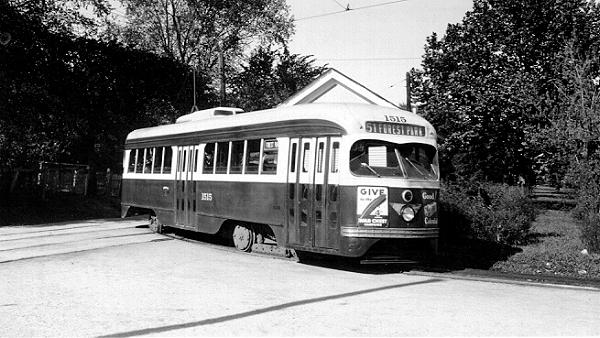
The St Louis Public Service 1500s (nos. 1500 to 1599) had several new features such as a deeply slanted front windshield, new “super-resilient” wheels, built-in, factory-installed rear round marker lights (as opposed to the “PEP BOYS “tear drop” truck markers), and the longer trolley base shroud with air intake.

The new unproven all-electric 1500s, as beautiful as they were, proved to be very troublesome cars. Retirement of these handsome cars came early and by 1954, they were all scrapped save for 50 cars that had been pawned off to Philadelphia Transportation Co., and there too, all were gone by 1955.

Then came PE’s revolutionary Pullman Standar-built MU-double-enders. They entered service in November of 1940. The PE PCCs were a sensation at the time. Trade publications gave the 30 cars full page coverage, like the one pictured above. I believe it is from RAILWAY AGE. Regardless, this was the beginning of “PCCs built to order.” The first 25 all-electric postwar PCCs ordered by Louisville Railways looked nothing like the hundreds of standard “off the shelf” PCCs that were to follow such as LA’s P-3s.

The service life of PE’s beautiful PCCs fell victim to the “rails to rubber” hysteria that befell this country in the 1950s and after just 15 years of splendid operation, they were out of service.


This is St. Louis Public Service car no. 1515 just after entering service in 1941. Notice the new wheels, trolley shroud, and recessed windshield, features that would become standard on postwar PCCs six years later. It was also one of the first to sport a full width anti-climber.

Ralph Cantos Collection

PE 913: Forever Part of the Formosa Cafe

Editor’s Note: News upon the sudden closure of the West Hollywood architectural icon Formosa Cafe, whose exterior features former Pacific Electric car no. 913, prompted transit historian and frequent PERYHS contributor Ralph Cantos to pass along this image and information.

By Ralph Cantos

There is only one PE car at the Formosa Café, and it’s the 913, part of it anyway. It was one of the last 800s still in service when this photo was taken, but the end was near. By the end of 1940, they were all gone, except for the four 800s that were made into box motors: cars 1495 to 1498. They lasted until about 1950. The trucks from the 1498 are out at OERM, and the 913 could be restored. That would be fantastic.

Harold F. Stewart Photo, Craig A. Rasmussen Collection