Pico and San Vicente Boulevards in 1927

Ralph Cantos Collection

By Ralph Cantos

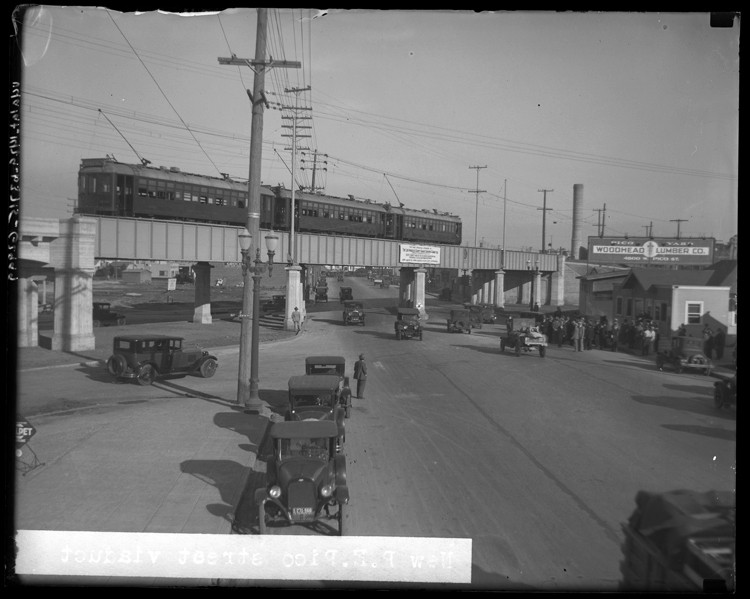
This old, faded photo taken in December 1927 is very unusual and historic. The camera looks in an easterly direction as a 3-car train of Pacific Electric 1100-class suburban cars crosses Pico Blvd. on the new San Vicente Viaduct along the VERY busy Santa Monica via Beverly Hills line.

The new viaduct replaced a very dangerous, at-grade crossing of the line with Pico Blvd. There is a banner hanging on the bridge over Pico, one can only guess that the banner was touting the safety aspects of the new span.

What really makes this photo unusual is that the 1100s were not nominally used on the Western District. For the most part, the 11s were fixtures of the Northern and Southern Districts. The 11s were still nearly new at the time, so PE may have thought it would be good promotional advertising to show off the new viaduct with some of their newer, all-steel cars, rather than the wooden 800 and 950s that would become fixtures of the SM via BH line. Modernized Hollywood cars would close out the last two years of the line. To be sure, the PE must have thought the 1100s would look good on the front pages of LA news papers, a real “PR” cue.

The importance of the great viaduct was short lived. After just 13 years as an important asset to the SM via BH line, through service to Santa Monica was abandoned in about December of 1941. Thereafter, the viaduct served as a back door entry to the West Hollywood Car House and maintenance complex, and for rush hour service on the W. 16th Street local service.

After 23 years of service, the rail service using the span was abandoned at the same time as the Venice Short Line in September of 1950. The viaduct would stand, unused, for another 14 years. Then in 1964 the mighty span that could have lasted more the 100 years was bulldozed away with none of the pomp and circumstance as its opening some 37 years before.

Ralph Cantos Collection

Redondo Beach End of The Line

Harold Stewart Photo, Craig Rasmussen Collection

The south end of Catalina Avenue at Avenue I in Redondo Beach marked the end of the tracks for the PE Del Rey Line, when this area was called Clifton or Clifton by the Sea. This is also the north end of what is today known as the Hollywood Riviera with great shops and eateries. PE 890 has just arrived and is being switched to head back north to Hermosa Beach, Manhattan Beach, El Segundo and Play Del Rey and the trolley pole is yet to be changed over. The dash sign has all these destinations listed and on the top line it reads, “Local to Vineyard.” Llewellyns Cafe can be seen in the background to the left of the car. Photo by Harold Stewart (1940), Collection of Craig Rasmussen

Harold Stewart Photo, Craig Rasmussen Collection

Going Down with Trolley Poles Held High

Ralph Cantos Collection

By Ralph Cantos

Like the mighty ocean liner “Titanic,” the once great Pacific Electric Railway struck and iceberg in the form of the Highway Department, a City that didn’t give a damn, and Jessie Haugh.

The PE was taking on water and was sinking fast. Like the brave men that worked below the brightly lite decks of the Titanic trying their best to keep the ship afloat, so did the shop forces of what remained of PE’s rail infrastructure.

PE’s Southern and Western District maintenance personnel gallantly kept the the deteriorating fleet of Blimps, Hollywood, and PCC cars operating under the most primitive conditions. Torrance Shops were gone, and what little maintenance the West Hollywood car shop provided, was also gone by the end of 1954.

As 1955 dawned on the Western District, all “maintenance” on the 15 Hollywood cars and the 30 PCCs was being performed by dedicated shop men with tools that were barely sufficient to keep a 1941 Chevrolet running.

In this photo taken on Friday afternoon, June 17, 1955, Pacific Electric PCC no. 5004 prepares to make a run to Burbank. Maintenance personnel have managed to keep the PCCs and Hollywood cars in respectful condition, given what little they had to work with. The 5004 still shines as it awaits departure time for this last rush hour. Another PCC sits on track 2, its interior lights aglow.

The Subway Terminal shop men gave it all they had, they kept Glendale / Burbank afloat for as long as they could. When the Glendale / Burbank line sank, it took the beautiful Hollywood cars with it. The PCCs waited four years to be rescued, but were saved to run another day in Buenos Aires.

A Bleak Future Awaits

Ralph Cantos Collection

By Ralph Cantos

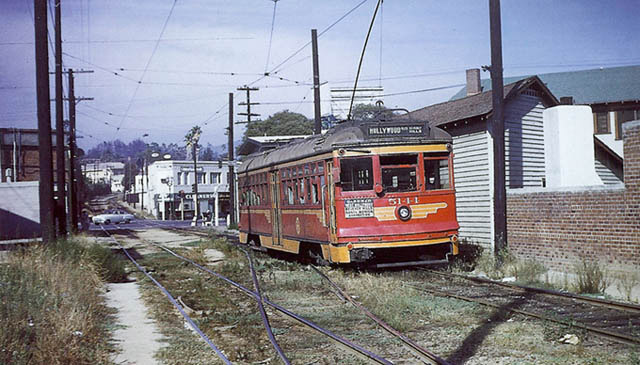
Like some animal or human being caught up in a slave labor situation, PE no. 5144 (now operated by “slave masters” Metropolitan Coach Lines) is beginning to show the effects of a 100% lack of cosmetic maintenance policy. It’’s the summer of 1954, and the once-lustrous red and orange paint on 5144 is starting to fade. The entire infrastructure of the once well maintained Pacific Electric Railway is now going completely to HELL, as evident by the condition of the right-of-way here at Gardner Jct.

Every piece of rolling stock on both the Southern and Western Districts was now on an “RTF” (run til failure) operational policy. If any Hollywood car or Blimp had any mayor mechanical or body calamity, its days as an operational vehicle were over! Only the PCCs on the Burbank line were given any type of body repair by the shop forces at the Toluca Yard “Central Maintenance Facility”.

MCL’s owner Jessie Haugh was Hell bent on destroying the last remnants of the once great Pacific Electric Railway. Try as he did, he could only scuttle the Western District. As hard as he tried, the Southern District held on under dire “maintenance” conditions. The final death blow to the Southern District was left to the first LAMTA.

After the abandonment of the Hollywood Blvd line in September of 1954, the service life of 5144 was over, with the front gate of National Metals & Steel on Terminal Island awaiting the arrival of 5144 and about 100 of its sister Hollywood cars. Only a hand full of Hollywoods still in service on the Glendale – Burbank and Watts lines remained in service. By the end of 1960, the days of most of those remaining Hollywood cars was over too.

Traction and the Enemy

Ralph Cantos Collection

By Ralph Cantos

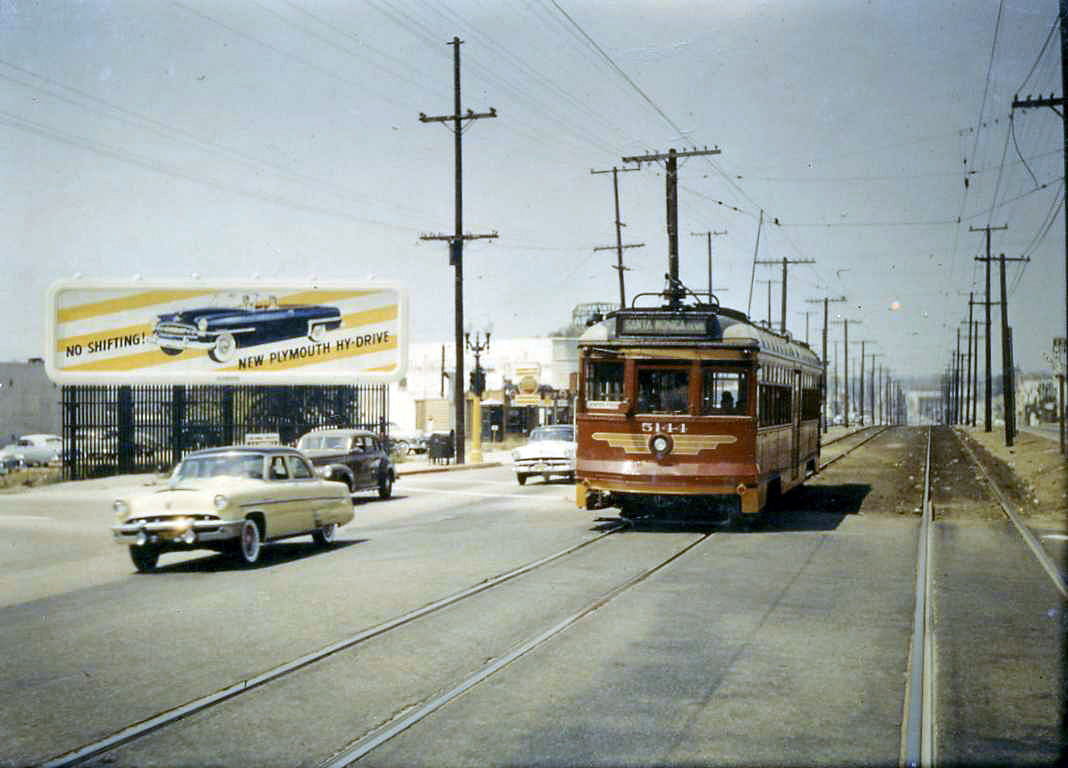
Pacific Electric car no. 5144 sparkles in the mid-day sun on this very sad day, May 31, 1953. This is the last day of rail service along Santa Monica Blvd. east of Fairfax Ave.

As evident by the billboard on the corner of Santa Monica and La Cienega Blvds. touting the 1953 Plymouth with NEW HY-DRIVE transmission, and the 1953 Mercury Monterey convertible racing no. 5144, times for traction lines all over America are only going to get worse, and it did!

Soon after the the Santa Monica Bl line abandonment, the #5144 would operate on the Hollywood Blvd, line for about another year. By the end of 1954, no. 5144 was in “dead storage” at Torrance Shops. By 1956, this beautiful Hollywood car, with years of productive service life left in its car body, would find its way to Terminal Island and be stacked like fire wood with almost 100 other sister Hollywood cars.

Ralph Cantos Collection

5010 on Brand Boulevard in 1948

Ralph Cantos Collection

Pacific Electric no. 5010 poses with its front doors wide open, beckoning passengers to board America’s most beautiful PCC.

From Ralph Cantos:

In this 1948 photo, PE’s fleet of 30 PCCs have weathered the heavy demands of World War II in good shape . The PCCs , with help of the ever trusty Hollywood cars, came through with flying “colors” as seen by the beautiful condition of the 5010. While PE’s Northern and Southern districts my have operated bigger and more glamorous interurbans such as the “Butterfly 12s”, the Western district did its share for the war effort. The PCCs did the Pacific Electric proud!

Ralph Cantos Collection

PCC on Brand Boulevard in 1955

Ralph Cantos Collection

A photo postcard from 1955 depicting a Pacific Electric PCC on Brand Boulevard in Glendale.

From Ralph Cantos:

955 POST CARD of Beautiful Brand Blvd. GLENDALE, CALIFORNIA: A city. any city, is only as great as the rail system that serves it! Glendale WAS such a great city until June 19,1955. On the black day, Glendale went from being a great city , to just being another town without a commuter rail service. The populace of Glendale lost one of the finest rail lines in the entire State Of California. Any city that is worth a damn, usually warrants electric rail transportation. So important was the Glendale / Burbank line, that the Pacific Electric spent hundreds of thousands of dollars to upgrade the infrastructure of the line in early 1940. The massive amount of private capital that PE pored into the Glendale / Burbank was done to prepare the line for the arrival of the most revolutionary PCC streetcars that were to grace the rails of ANY city in America. PE’s PCC cars were the first double enders, the first multiple unit. and the longest PCC car built up to that time. And if I am not mistaking, they were the first PCC to be equipped with Westinghouse dual trumpet air horns. In my opinion, the PE PCC’s WERE THE MOST BEAUTIFUL PCC car, the world would ever see. The stage was now set for the Glendale / Burbank to operate for 50 years efficiently, with magnificent infrastructure and ultramodern streamlined PCC equipment. But because of selfish , greedy, backward thinking individuals who did not give a DAMN about anyone but them self’s, the Glendale / Burbank Line was struck down and demolished literately in its prime. It was an inexcusable act of SELFISH GREED.

I spoke to the man who produced this post card. It was taken in April of 1955. The Line had just weeks to live. He wanted to record Glendale’s Brand Blvd. on film, before its downfall . HE WAS NOT A RAIL FAN. He was a concerned citizen. He was in disbelief that the abandonment petition had been granted. He waited until a PE PCC came into view and recorded the last great moments of Brand Blvd. In his opinion. this abandonment was A MONUMENTAL ACT OF VANDALISM, as the years pasted, he would be proven correct.

Ralph Cantos Collection

Electric Train Arriving at Venice, California (1911)

Ralph Cantos Collection

Wonderful Venice Beach station, about 1911, is seen here as a 4 car train of LAP / PE 700s bound for Santa Monica discharges passengers. The train will enter the “Trolley Way” at this point as it heads north to Santa Monica.

From Ralph Cantos:

Today, the only thing in this post card photo that is recognizable is the beautiful building with its elegant arches. After abandonment in 1950, the “Trolley Way” at this point would become an extension of Pacific Ave. and then become Neilson Way through Ocean Park. PE would later renumber the 700s into the 950 class with the arrival Hollywood cars which became the new 700 class cars. The Venice Short Line was always a money maker for the PE, but by 1948 with its infrastructure nearing 50 years of age, and plans for the Santa Monica Freeway finalized, PE took the easy way out and abandoned the rail service in favor of buses. If the Venice Short Line could have just held out for “a few more years” say to about the year 2000, I think retaining and rebuilding the rail service would have been a better choice. But as the late Paul Harvey would often say, “the view through the rear view mirror, always seems to be clearer, then that through the front windshield.” In the case of the VSL, he got that right!!

Ralph Cantos Collection

Fire at Vineyard Junction

Ralph Melching Photo, Pacific Railroad Society Collection

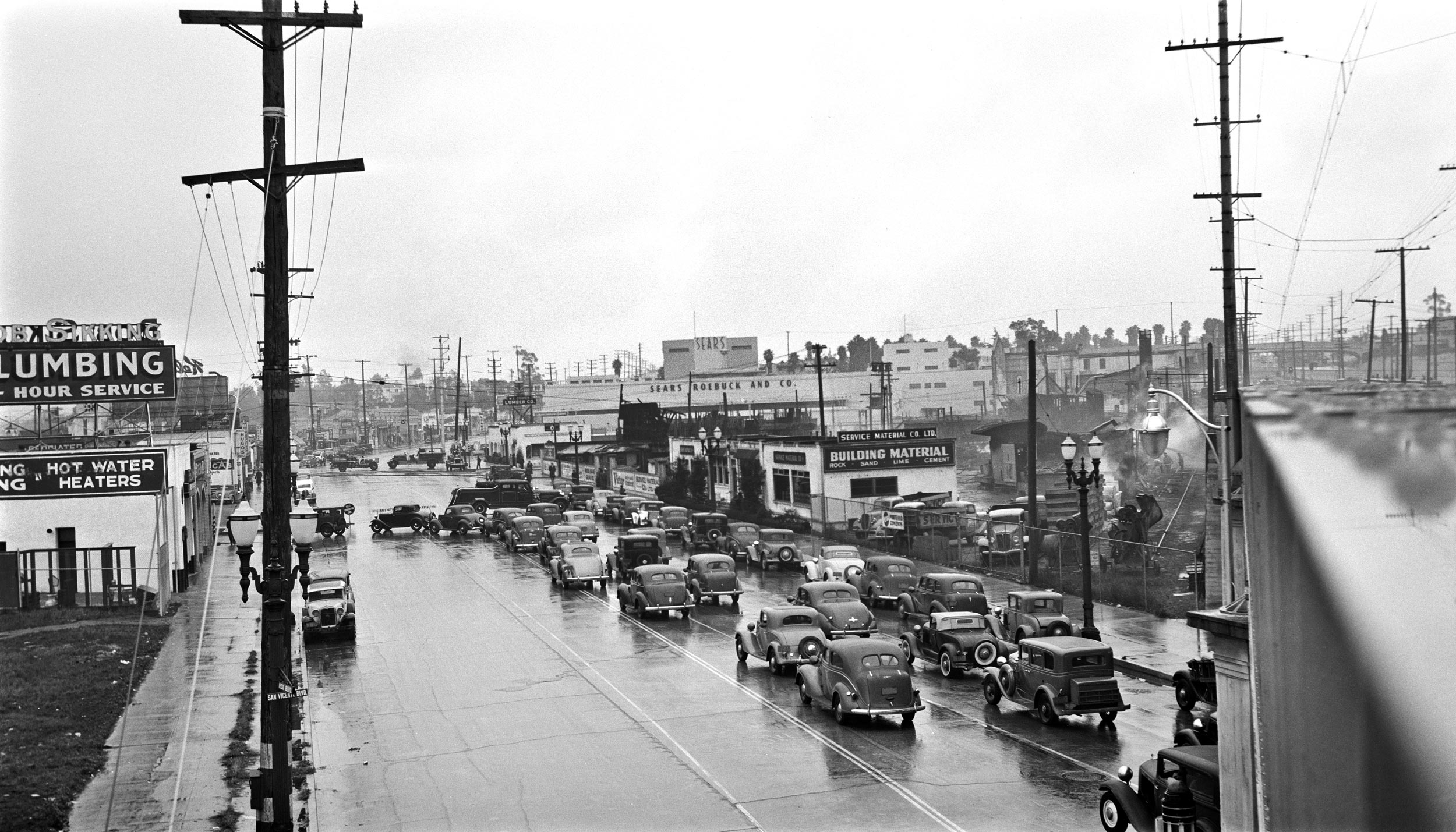
View of Vineyard Junction, Sears and Roebuck Pico store and the West Blvd Bridge. Cooper Lumber Company, the business located in the lower left hand area of the image, has just suffered a devastating fire as the rubble of destroyed buildings show. Cooper Lumber did rebuilt and survived into the late 70’s, when the property was sold to a chain of home improvement stores that was known as Builders Emporium. Today the tracks are gone and have become San Vicente Blvd, and Cooper Lumber property is a mixed use transit center.

Ralph Melching Photo, Pacific Railroad Society Collection

Ralph Melching Photo, Pacific Railroad Society Collection

View looking east from Pico Blvd Viaduct showing traffic detour at Rimpau on acct of fire at Cooper Lumber Co. on 1-6-40. Eastbound traffic on Pico Blvd is being diverted north on Hudson Ave. Westbound traffic is being diverted north onto Rimpau Blvd.

Ralph Melching Photo, Pacific Railroad Society Collection

675 at Hill and First

Tom Gray Photo, Pacific Railroad Society Collection

Pacific Electric car no. 675 waits at a stoplight at the intersection of Hill Street and West First Street, below a classic Foster & Kleiser billboard advertising the Admiral TV/phonograph/radio combination to watch the Rose Parade and Rose Bowl game on KTTV Channel 11 (now Fox 11). The image is undated.

Tom Gray Photo, Pacific Railroad Society Collection