
From the Jack Finn Collection comes this image of Pacific Electric Hollywood Car no. 5063 on Fair Oaks Avenue in Pasadena, south of Walnut. The image is circa 1945 but the cars may provide a more definitive date.
Jack Finn Collection

From the Jack Finn Collection comes this image of Pacific Electric Hollywood Car no. 5063 on Fair Oaks Avenue in Pasadena, south of Walnut. The image is circa 1945 but the cars may provide a more definitive date.
Jack Finn Collection

We’re thrilled to share this found footage from none other than Amsterdam, the Netherlands, by Frank M. Wiggers, who like us, shares a passion for anything railroad and mass transit.
He recently received a private film (likely 8mm) with Pacific Electric footage, and had it digitized and reached out to us for more information. We shared it with famed transit historian Ralph Cantos, who provided the following set of appraisals. Give it a watch and let us know what you think. And thank you to Frank for sharing with us!
From Ralph:
Please leave your additional comments below for us so that we can better document the entire clip!

Pacific Electric no. 304 is assigned to the East Colorado – Lincoln Avenue Line in Pasadena. Its exact location is unknown. PE no. 304 was built by J.G. Brill Company in 1913. It was a center-entrance, low-floor car nicknamed “Dragon” on the PE.
They were were equipped with maximum traction trucks and two General Electric 201 F motors. Their fatal flaw was that they had to operate with a two-man crew. There was no way to convert them to one-man operation. As the PE reduced its local operations in the depression, these cars became surplus. All were disposed of by 1934.
Note the this photograph appears on page 39 of “Cars of the Pacific Electric Vol I Interurbans Special # 29” August 1975.
Unknown Photographer, Robert Gaddie Collection

Pacific Electric Railway Dash sign showing Sierra Madre as its destination.
Courtesy Craig Rasmussen collection

By Ralph Cantos
As was always the case on New Years Day on the PE, it was “all hands and cars on deck.”
New Years Day 1940 was no exception. With the exception of the 100s (and, later, the PCCs), just about every class of PE’s vast assortment of interurban and suburban cars put in an appearance on the Northern District to handle the deluge of passengers headed to the Rose Parade.
Even the trusty fixtures of the Venice Short Line, the handsome 950s, would head to Pasadena.
The Valley Sevens were no exception to the migration of “out-of-towers” called upon for Rose Parade duty. In this photo taken on New Years Day 1940, Western District no. 742 heads up a three-car train as it rolls along the Northern District’s “4 track main line.”
Compared to the other as-yet-to-be-modernized Hollywood cars (nos. 600 to 734), the Valley Sevens were real speedsters. As built, the Hollywood cars had a breathtaking top speed of 28 miles per hour. You would have to drive a wooden stake into the ground with fluttering white flag next to an unmodernized Hollywood car to see if it was actually moving. The Valley Sevens could clip along at brisk 45 mph, so the passengers aboard this train will arrive at the Rose Parade in record time.
This would be the Valley Sevens’ final event in this configuration. All 15 Valley Sevens were modernized into the new “Butterfly” paint scheme in late 1940. The rest of the Hollywood cars were brought up to Valley Seven performance standards as part of the modernization program.
In later years, the 742 would become a fixture of the Northern District. With the September 1951 destruction of the Northern District by foolish freeway construction, the 742 and 27 of its sister Hollywood cars would head for Buenos Aires for further service where they would have a long and prosperous career.
Northern District passengers would have to settle for slow, pokey replacement bus service in the name of progress…yeah right!
Ralph Cantos Collection

By Charles Wherry
These three photos also deal with the last hours of rail passenger service on Pacific Electric’s Monrovia-Glendora line.
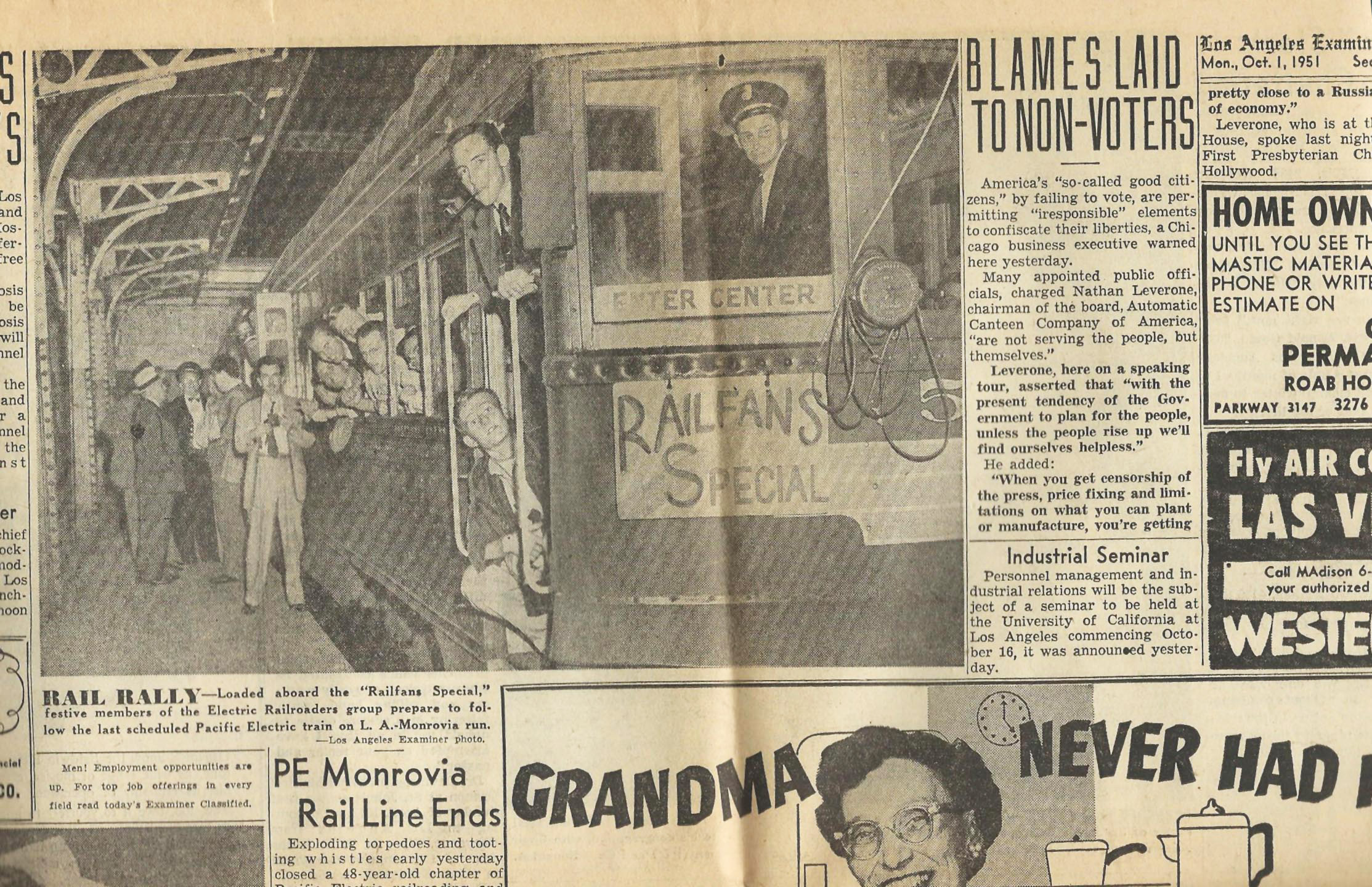
This image has previously been posted on the website but there was no accurate date given. I have included the Los Angeles Examiner’s page and date which is seen in the extreme right hand corner of the image as Monday, October 1, 1951.
And above is the accompanying text that went with the above photo. Notice that the text states:
“At 12:34 a.m., the last ‘regularly scheduled’ train on the Los Angeles-Monrovia run pulled out of the PE terminal at 6th and Main streets.”
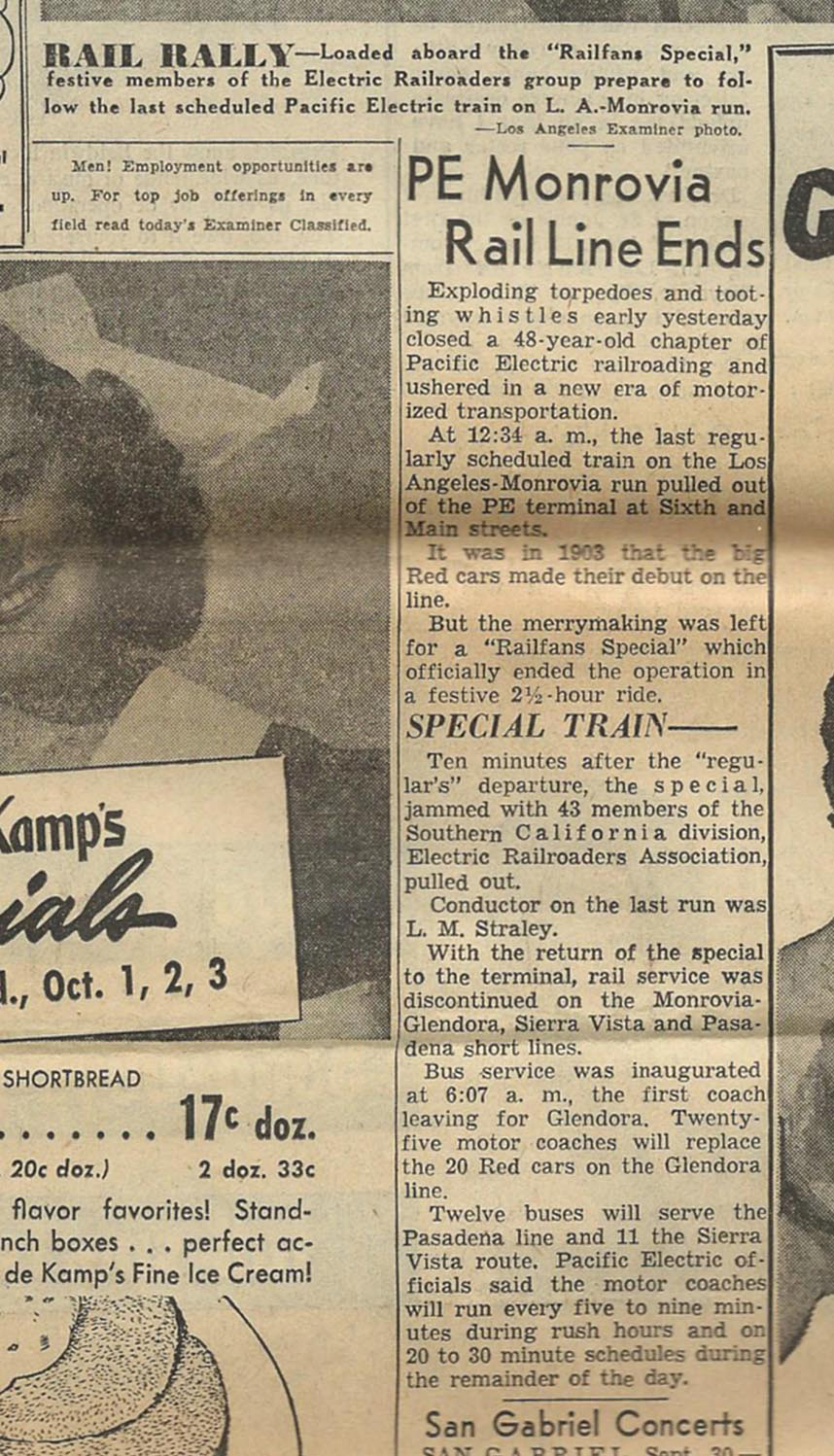
The special ERA car followed with its 43 members 10 minutes later. As a side note, I wonder if any of the members took advantage of the 17 cents a dozen cookies that Van De Kamp’s was offering in the adjoining ad.

The final image shows the last ‘regularly scheduled’ train referred to in the Examiner article.
I was aboard car no. 735 on this trip along with my brother and mother (seen in the window) and dad who took this picture.
I had just turned 7 years old and being up in the middle of the night was quite a thrill.
My PE employee timetable shows a scheduled departure of 12:35 a.m. from 6th and Main St. with a 1:24 a.m. arrival at Shamrock Avenue, which begs the question; how did we get back to L.A.? The same timetable shows the last inbound schedule from Monrovia on that long ago day to have departed 11:26 p.m. so we couldn’t have been on that. The only answer I can come up with is that we ‘hitched’ a ride with the SC-ERA folks on their inbound trip back to L.A. since theirs was not a regularly scheduled car and they had to get back home whereas we ‘regular’ riders were on our own.
I distinctly remember the explosions of the torpedoes mentioned in the Examiner piece. The noise reminds me to this day of popcorn popping in a skillet. Somewhere out in the murky dark, after a particularly loud and almost continuous barrage of torpedoes we stopped to pick up a passenger. It was Jack Farrier with a suspicious looking brown paper sack and an equally suspicious wide grin on his face. Someone asked Jack what was in the bag. “My lunch”, he responded. Everybody had a good time.
By Charles Wherry
The two photos on this page are from my collection and depict PE publicity and news accounts of the final day of service on the Monrovia-Glendora line: September 30, 1951. Interestingly, Pacific Electric publicity people tracked down and found two couples who had ridden the line on its opening day in April 1903, and had them re-create their ride on the final cars from 6th and Main Street Station in Los Angeles to mark the event.
The next day, interurban service would be replaced by General Motors buses.
The first photo is a newspaper article in the Los Angeles Examiner that was published on September 29, 1951. Note the text of the article mis-names the Pasadena Short Line as the ‘Pasadena Pacific Electric short line’.
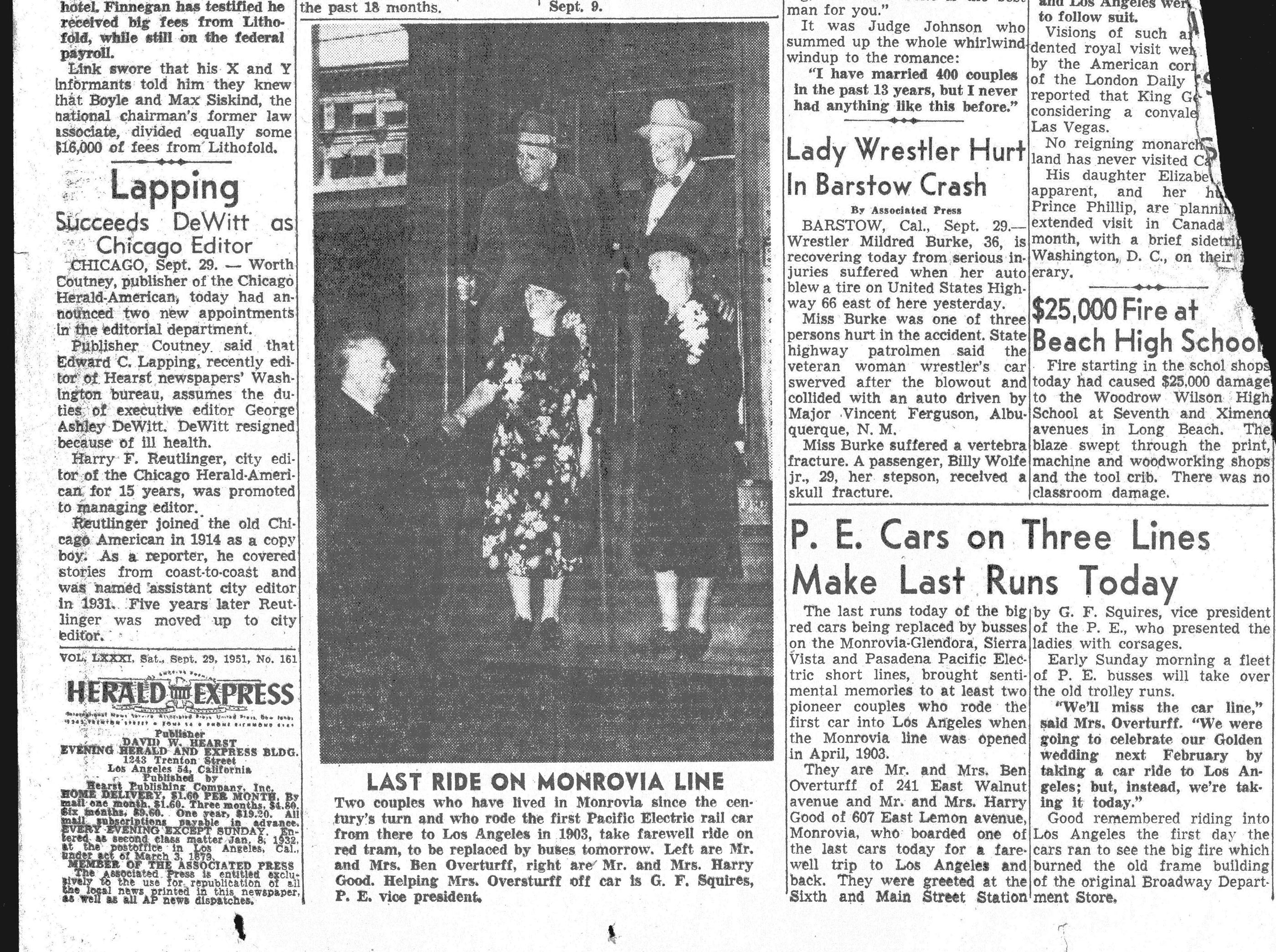
The next image was scanned from an 8×10 glossy print that my dad William Wherry, a PE employee, obtained from the Director of Public Relations of the PE. On the reverse side of the print is the following caption:
These two couples were passengers on the first electric interurban car to leave Monrovia, California for Los Angeles which service was inaugurated in 1903.
Left— Mr. & Mrs. Ben Overturf, Right—Mr. & Mrs. Harry Good. G.F. Squires, Vice Pres. P.E. Railway presenting corsage.
Picture taken Sept 29, 1951, last day of rail service for passengers, at 6th & Main station.
Motor coach at right one of fleet replacing rail cars.


Pacific Electric PCC no. 5019 is photographed while testing on the Pasadena via Oak Knoll Line inbound at Huntington Hotel. The date is February 25, 1941.
Phillips C. Kauke Photo, Phillips C. Kauke Collection, Stan Kistler Collection
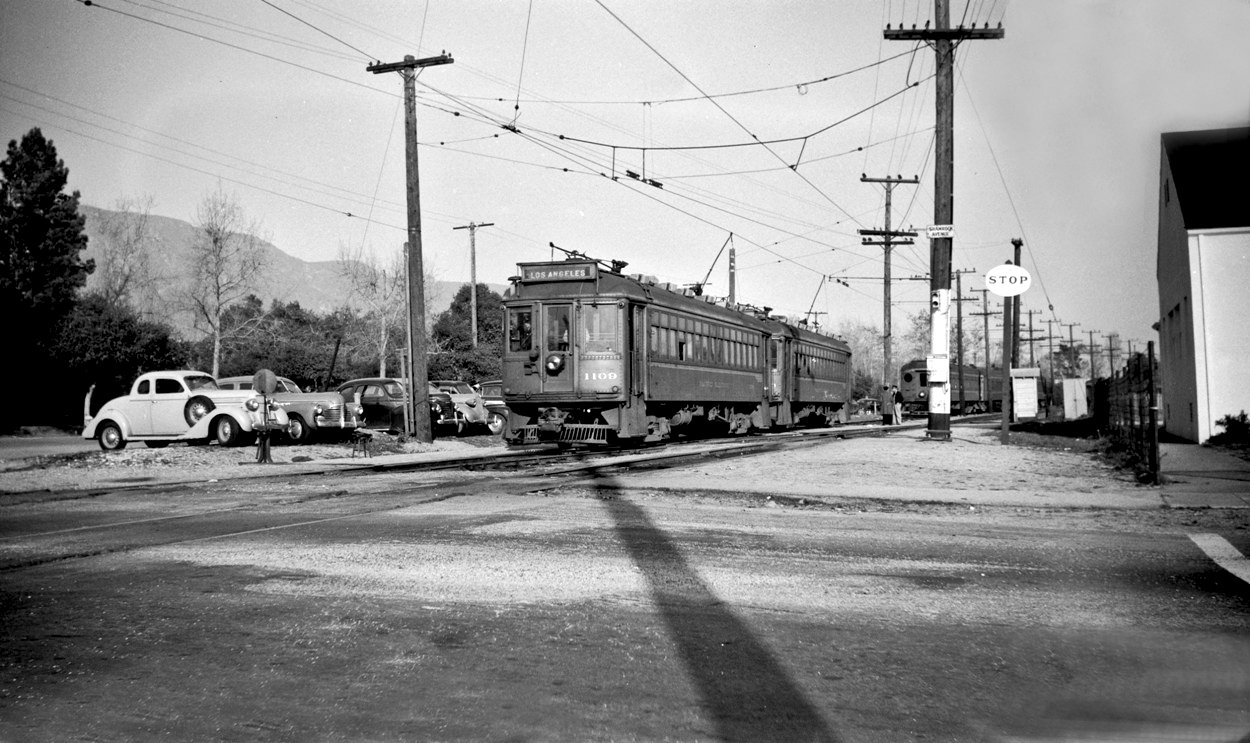
Pacific Electric interurban no. 1100 poses at Shamrock Avenue in Monrovia in this undated image by Alan Weeks.
Alan Weeks Photo, Alan Weeks Collection

By Ralph Cantos
Pacific Electric Hollywood Car no. 717 heads up a 3-car train on New Years Day, 1949. The train is north bound on the Oak Knoll grade just below the Huntington Hotel and will soon deliver its full load of passengers to the Pasadena Rose Parade. The photographer of the scene probably did not know it at the time, but just 10 years later in 1959, the 717 (now renumbered LAMTA 1815) would be among the last operating Hollywoods on US soil.
The fleet of Hollywood cars that once numbered 160 — the 8 Hollywood cars sold to Portland were gone by this time, and the cars in Buenos Aires had been drastically altered by train doors being cut into the cars once handsome front ends. The number of Hollywood cars operating in Buenos Aires would slowly dwindle away over the years. By the early 1980s, only one car, the former no. 758, would still be in service as a line car.
Back on the home front, a handful of Hollywood cars survived: one of the former Portland cars at a Museum in Oregon (now at the Seashore Trolley Museum); one car saved by Richard Fellows, and four cars at Orange Empire Railway Museum.
As time passed, only the 717 would still operate under its own power, the other 3 Hollywood cars stored unserviceable, but otherwise complete. The car saved by Richard Fellows #655 would find its way to OERM, beautifully restored, but inoperable at this time.
So, as of 2014, the 717 lives on at OERM in operating condition, to the joy of hundreds of visitors that ride aboard her every year. She is the last of her kind — a true testament to one of the finest suburban streetcars ever built.
Ralph Cantos Collection