PE’s Santa Monica Air Line: From obscurity to rising star

Ralph Cantos Collection

By Ralph Cantos

For the last 20 years of the Pacific Electric Santa Monica Air Line’s existence, about 50 or so loyal regular commuters enjoyed a variety of equipment. The 1930s saw the mighty 800-class of heavy interurbans providing most of the “service” on the line, that being one morning inbound and one afternoon/evening westbound trip. The 1940s saw a mix of 950s and 1000s holding down the runs. For the last three years, a single Hollywood car provided the service to the dwindling passenger loads.

In this side-by-side photograph, just about 63 years separate the views taken at almost the exact same location in Cheviot Hills. On the left, Hollywood car no. 5112 is seen making the afternoon westbound trip in the last weeks of September 1953. Some 63 years later, an LACMTA test train passes the same location, known today as the Cheviot Hill Trench, in the weeks before the line’s opening in May 2016.

The success of the LACMTA’s EXPO RAIL LINE has been spectacular. The new line follows the original alignment for much of the way, starting at Exposition Park. The new line leaves the original route at 17th Street in Santa Monica and runs down Colorado Avenue parallel to the original right-of-way just 100 feet north of the original line. Numerous dangerous grade crossings have been replaced by spectacular aerial “fly overs.” The terminal at 4th & Colorado is built over the original right of way.

Passenger loadings have surpassed expectations by a large margin. Currently two- and three-car trains provide 12 minute service for much of the day, seven days a week. The EXPO line is a winner by all accounts.

After the Air Line was abandoned in October 1953, the 5112 was transferred to the Southern District’s Watts Line. From that last run in 1953 to the last run on the Watts Line in November 1959, the 5112 (now renumbered 1801) would provide gallant service along the famous 4 tracks under the most deplorable maintenance conditions imaginable. Finally in 1960, the 5112 was rescued from the scrappers torch and now resides at OERM.

Ralph Cantos Collection

Pacific Electric’s Santa Monica Air Line: From Toonerville Trolley to Metro Rail

Ralph Cantos Collection

By Ralph Cantos

Pacific Electric car no. 994 rounds the curve at Overland Avenue in the spring of 1950. This is the westbound afternoon / evening trip. Hollywood cars provided service for the last three years of the line’s existence.

PE’s Santa Monica Air Line was something of an “institution.” The line was built in 1875 by the Los Angeles and Independence Railroad. Just 2 years after the line opened, the LA & I RR decided to sell the line to the Southern Pacific Railroad. The SP, hoping to build up a lucrative freight business, built at its own expense the world famous “LONG WHARF” in hopes of beating out Long Beach and San Pedro as a major shipping port. When that did not work out, the SP leased the line and Wharf to the Los Angeles Pacific Railroad around 1908. A few years later, all LA&P holdings and infrastructure were taken over by the “New PE” in the Great Merger of 1911.

The Santa Monica Air Line was essentially built as a freight line. Passenger service along the line tended to be an annoyance to the PE. Passenger schedules along the line reflected the PE’s annoyance with the line. The best service (what there was) was provided between Downtown LA and Culver Junction. West of Culver Junction, the service was “sparse” at best. After several unsuccessful attempts to abandon passenger service altogether, a “compromise” was reached with the Public Utilities Commission (PUC) around 1932-33: a grand total of ONE in-and-outbound passenger trip was provided for the “convenience” of about 50 die-hard regular passengers who cherished the rail service.

Meanwhile, the world-famous Venice Short Line that provided much more frequent service to essentially the same destinations, was abandoned on September 17, 1950, leaving the Air Line as the lone passenger service on the Westside of LA, Santa Monica, and Venice.
This wonderful passenger service was cut back to 11th Avenue on October 27, 1953, leaving those faithful Air Line passengers high and dry.

This was done in preparation for the sale to Metropolitan Coach Lines of all remaining PE passenger service, both rail and bus. When MCL took over PE’s passenger service, the Air Line was not included in the sale. And so for about 30 days in October of 1953, the Air Line would become the LAST passenger service on the PE.

Today, rail service along the Air Line has been reborn as the LACMTA’s EXPO Line. Two- and three-car air-conditioned trains run along the line at 12 minute intervals with standing-room-only passenger loads, a far cry from the 50 faithful passengers that kept the line going for so many years, riding aboard 800s, 950s, 1000s and finally, Hollywood cars to the bitter end in 1953.

Ralph Cantos Collection

Alan Weeks Collection

The Final Pacific Electric Timetable?

Charles Wherry Collection

By Charles Wherry

This Pacific Electric public timetable on thick card stock suitable for tacking to wood poles went into effect on August 31, 1953. A mere 31 days later, PE’s passenger operation was turned over to Metropolitan Coach Lines. This timetable covered rail service from Long Beach to Los Angeles and motor coach service from Long Beach to various destinations including San Pedro, Compton, Huntington Park, Pasadena, Santa Ana and Redlands.

It is likely that this edition was probably the last issue prior to the sale date of October 1, 1953. Long-time Pacific Electric Passenger Traffic Manager H.O. Marler’s name appears at the bottom right. I wonder if Mr. Marler chose to follow the passenger business with MCL or did he complete his career in some other capacity with PE?

Charles Wherry Collection

Mystery / Political “Bus Transfer”

Charles Wherry Collection

By Charles Wherry

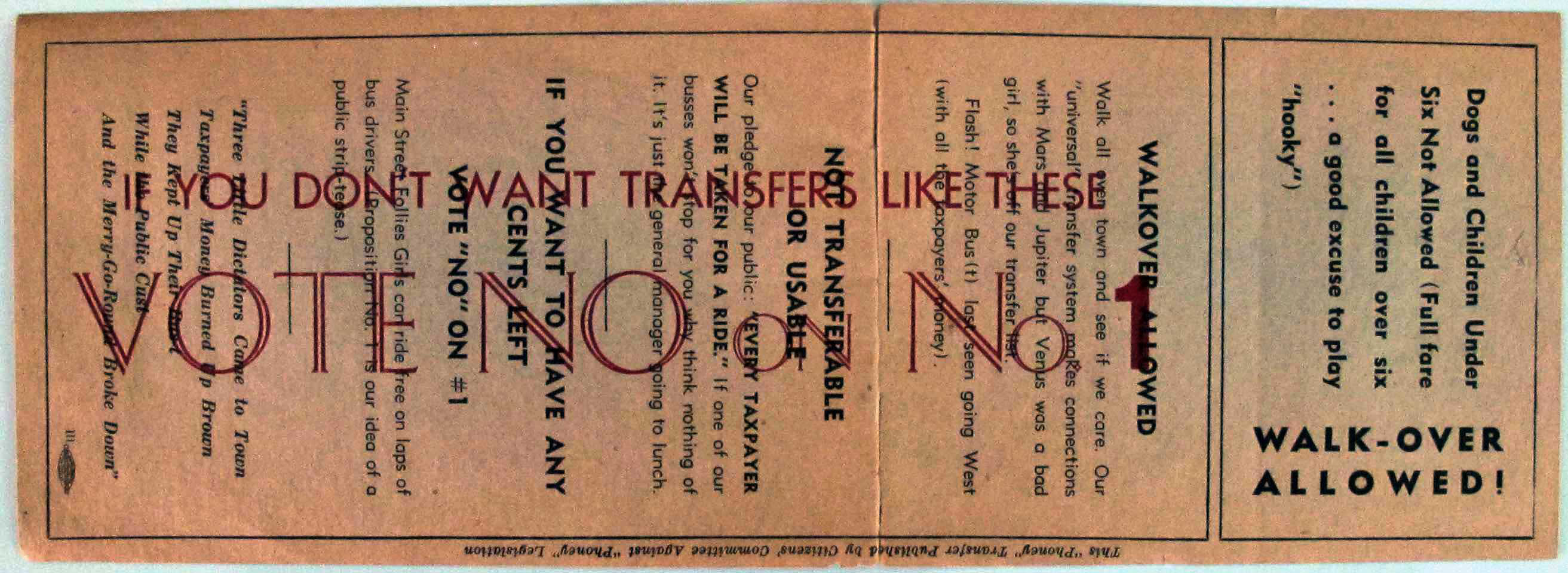
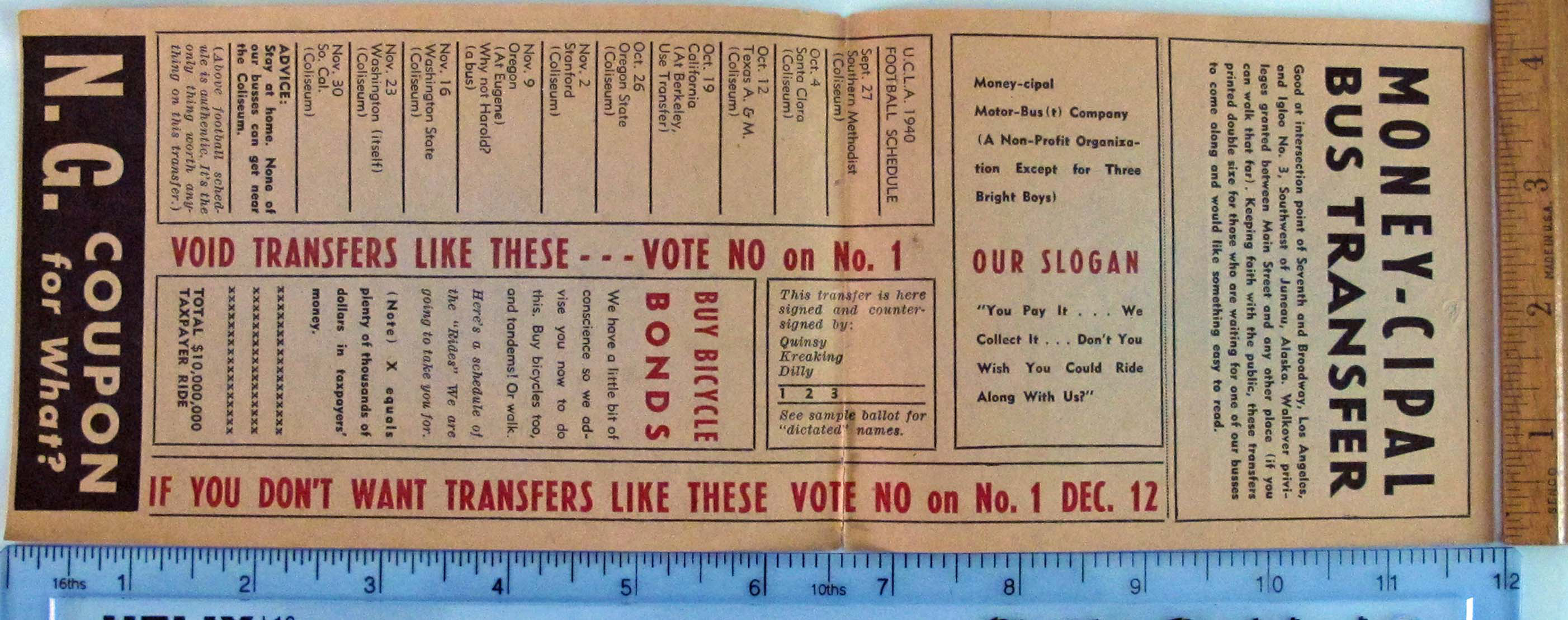
In going through some of my father’s collection, I found this interesting “bus transfer” and thought it should see the light of day.

Here are two (front and back) scans of what appear to be an effort to defeat ballot proposition No. 1 on the December 12, 1940, election in Los Angeles. Although there is no specific mention of Los Angeles, or the year, the fact that the 1940 UCLA football schedule is printed on the face leads me to this conclusion.

It is in a transfer format similar to that used by the Pacific Electric and I believe other transit companies of the time.

It was printed for a group calling themselves ‘Citizens Committee against “Phoney” Legislation”. The oversize dimension of 12” X 4 1/4” was apparently meant to emphasize this group’s alarm over what they believed was an effort by bus companies, (no mention of which company(ies), to create a …”universal” transfer system in Los Angeles. There is an allusion …”three bright boys”… and some names, possibly corrupted, of ….”Quinsy, Kreaking, Dilly”… .

What the results of the election were, if in fact there was an election, remain a mystery to me. Hopefully there are others that that can fill in the gaps.

 Charles Wherry Collection

Charles Wherry Collection
 Charles Wherry Collection

Charles Wherry Collection

Charles Wherry Collection

Los Angeles Railway 1941 Passes

Charles Wherry Collection

By Charles Wherry

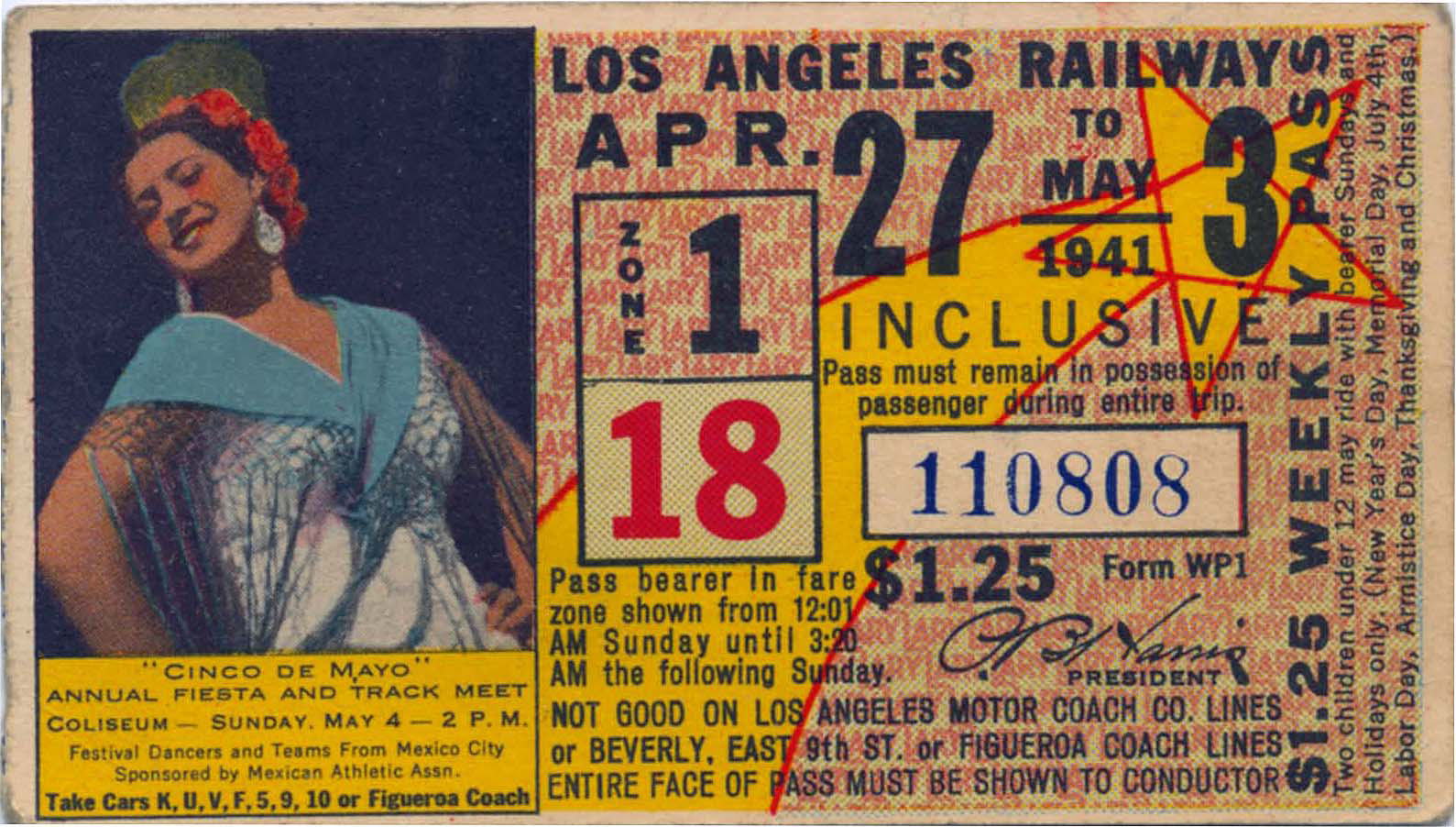
Here are two weekly passes issued by Los Angeles Railway in 1941. The $1.25 price seems quite a bargain especially when reading the fine print which allowed two children under 12 to ride along with the bearer on Sundays and holidays which included Armistice Day, now called Veterans Day.

Charles Wherry Collection


Charles Wherry Collection


Pacific Electric Restaurant Menu

Charles Wherry Collection

By Charles Wherry

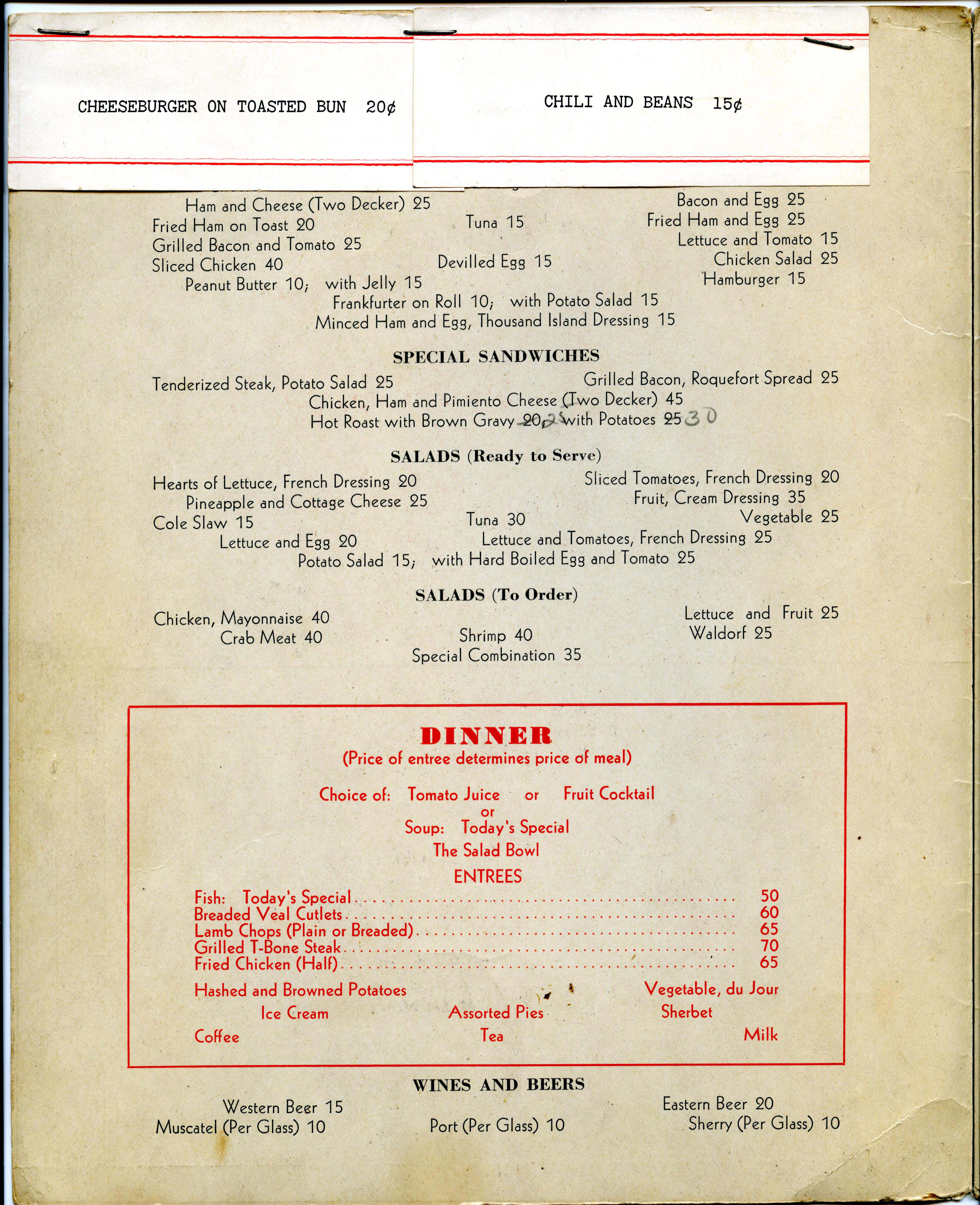
Here is another menu from Pacific Electric’s 6th & Main Street restaurant.

The same photo as on the breakfast menu returns, this time in red tint. PE might have made the color choice as a help
for the wait staff to readily pick the correct menu given the time of day. This offering included a dinner selection as well
as a few breakfast items a la carte. My guess is this red cover edition sufficed for lunch and dinner. Quite a selection for
what was essentially a lunch counter operation.

Charles Wherry Collection

Charles Wherry Collection

Pacific Electric Restaurant Menus, December 1941

Charles Wherry Collection

By Charles Wherry

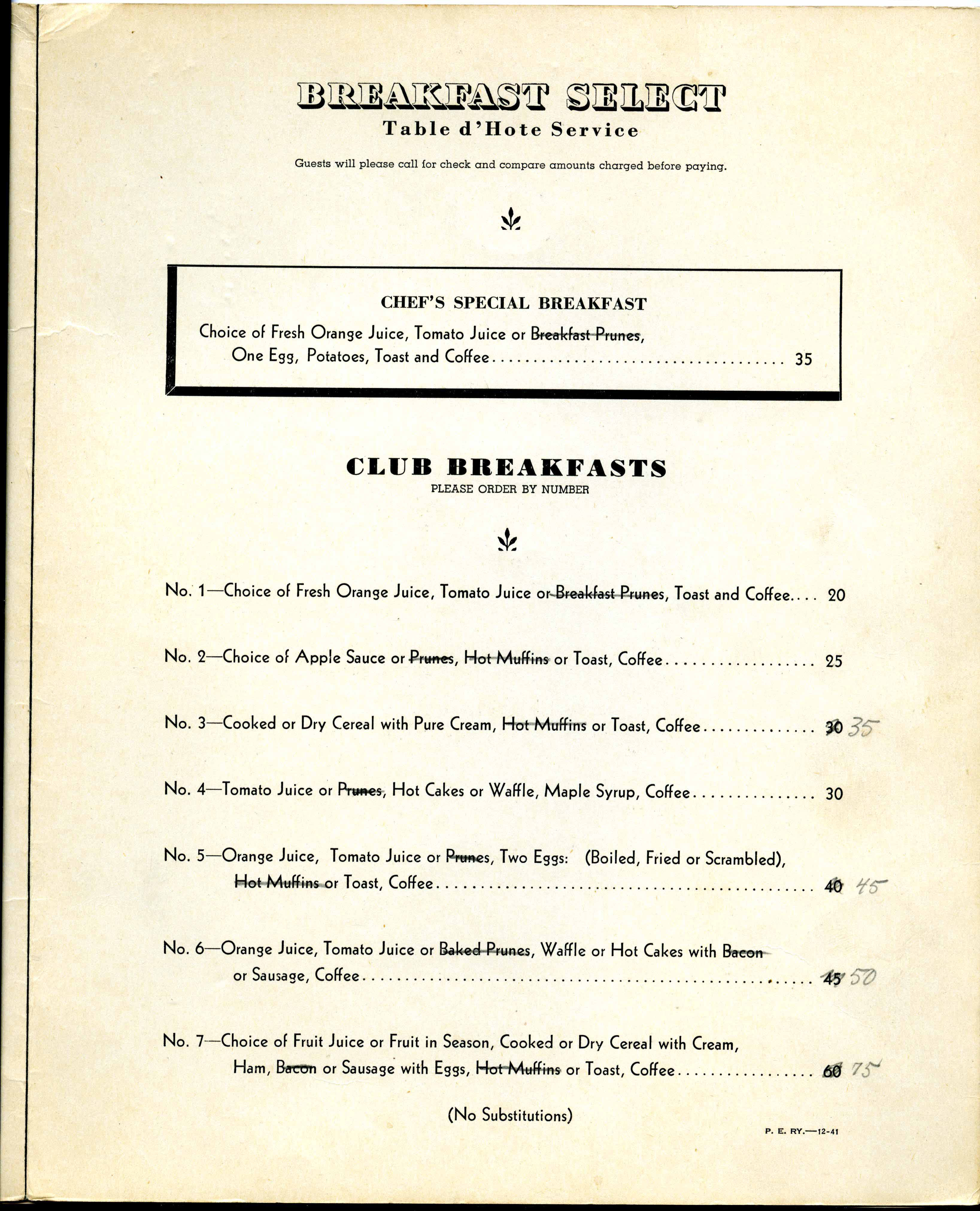
Here are three photos of a breakfast menu from the Pacific Electric Restaurant at 6th and Main Streets in Los Angeles. The date of 12-41 appears in very small print at the lower right hand corner of the third image.

The cover shows what appears to be a composite photo of Pacific Electric bus no. 1686 superimposed in front of a ‘Butterfly’ Twelve. The number of the 1200 is not discernable, however, a picture of Butterfly no. 1216 posed at a favorite location of PE company photographers just outside the Torrance shops appears to be the locale.

Donald Duke’s Volume 3, Pacific Electric Railway, Southern Division, 148 shows 1216 in an identical pose without the bus.

Reading the menu provides some interesting insights to life and dietary choices in pre WWII 1941. Notice the prices of most meat items have been penciled in and although they appear to be bargains by today’s standards, when adjusted for inflation, seem to be inline with today’s costs. The 10-cent cup of coffee equates to $1.63 in 2015. The 60-cent Breakfast Steak comes out to $9.76 today
and if you were really hungry the No. 7 Club Breakfast cost a whopping .75 cents, $12.20 today.

“(No Substitutions)“

Charles Wherry Collection

See also this link for more on the PE Restaurant.

The Interior of Pacific Electric 1216

Ralph Cantos Collection

By Ralph Cantos

This official photo from Arrow Studios beautifully illustrates the large, pleasing earth-toned, mohair-upholstered arm chairs that greeted passengers traveling on aboard the “Magnificent Six”, in this case, Pacific Electric no. 1216. Onboard water coolers and restrooms were also provided for the comfort of passengers. After passenger service to San Bernardino was abandoned in late 1941, the replacement service was provided by small, prewar gasoline-powered 35-foot White buses, something that loyal passengers on the San Bernardino line did not think highly of. I am told that one of these seats is preserved at OERM.

Ralph Cantos Collection
PE’s Butterfly 12s: The Magnificent Six

Craig Rasmussen Collection

By Ralph Cantos

This 8×10 photograph from the Craig Rasmussen collection shows “Butterfly 12” no. 1221 rolling along towards San Pedro Station on March 5, 1948. In as much as the Butterfly 12s numbered 1216 to 1221 were rebuilt in 1939-40 for “Deluxe” service for the 58 mile long San Bernardino line, passengers aboard the #1221 must have marveled at the 1221’s interior appointments and striking exterior appearance. Most post-World War II runs on the San Pedro line were usually handled by 1000s, so this run using the 1221 must have been an unexpected treat for those passengers on aboard.

I have examined this crystal clear photo with a high-powered magnifying glass, and it appears that the 1221 is in virtually PERFECT condition at 35 years of age. She could have lasted indefinitely. Say what you want about the PE, but when it came to car maintenance, most if not all of PE’s rolling stock from the venerable 950s to the Blimps were kept in A-1 condition. Sadly, little more than 2 years after this photo was taken, the entire 1200-class of high speed interurbans were sold for scrap and burned at Kaiser Steel in Fontana.

Officials from Buenos Aires looked at the 12s and liked what they saw, but the 1200 were so well built, that adding second passenger loading doors to the car ends was virtually and economically impossible. The slower 11s, with their double-loading passenger doors, went to South America instead, leaving the entire 12 class to face the scraper’s torch. A terrible loss to the traction preservation movement that was still several years into the future.

Pacific Electric business car no. 1299 is now preserved at OERM. It began as a Portland 12 trailer before being rebuilt and powered as Officers Car 1299.

Craig Rasmussen Collection