A Metropolitan Coach Lines blimp is oOutbound to Bellflower approaching Lakewood Blvd. Taken Friday, May 23, 1958, the last weekday for the Bellflower line to operate. The several tank cars on the freight siding suggest that this now-long-gone refinery was an important freight customer.
Metropolitan Coach Lines no. 435 and another unit are outbound to Bellflower approaching Alameda Street. This image was tken Friday, May 23, 1958, the last weekday for the Bellflower line to operate.
Metropolitan Coach Lines no. 318 is inbound from Bellflower and coming into Watts junction on the only double-track section of the line. Taken Friday, May 23, 1958, the last weekday for the Bellflower line to operate. Dark smoke in the background resulted from the long-lasting Hancock Oil refinery fire at Signal Hill.
Storage track at Bellflower – May 17, 1958. In this Saturday view just one week prior to the line’s abandonment, car no. 411 and others were stored for use during the inbound rush hour service. The 1915 Model T Ford automobile in the foreground belonged to the photographer and was an unintentional contemporary of some of the rails cars still in service.
Bellflower Station – May 17, 1958. This was a Saturday, one week before the line was abandoned. The additional cars needed for inbound rush hour service are stored on the siding in the distance. The Bellflower substation can be seen on the left.
This photo of Pacific Electric no. 748 and train was taken in the last days of the world-famous Venice Short Line. The scene is at the foot of Venice Blvd. at Pacific Avenue in Venice. Behind the 748 is a new GM 2700-class Diesel bus, most likely on a training run. And like a scene out of the jungle, the GM Diesel bus is stalking the hapless 748 and train hoping to pounce on the train for the kill.
The September 17, 1950, abandonment of the VSL WAS THE BEGINNING OF THE END for the Pacific Electric Railway as a large-scale commuter rail system. The VSL had great potential for upgrade to a fast and efficient light rail route. But the thinking of the day was to eliminate all forms of suburban and city rail transit in Southern California in favor of “more efficient” freeways.
And so, the VSL passed into history. The wide right-of-way down the center of Venice Blvd. would lay abandoned and weed-grown for more than a decade after abandonment. Finally, in 1963, the “improvement” of Venice Blvd. began. The right-of-way was removed and ONE auto traffic lane was added in each direction. The massive La Cienega / Venice Blvd. bridge was demolished and at the same time, and the long Pico / San Vicente viaduct went with it.
From the September 1950 abandonment of the VSL, to the last run on the Watts Line on November 2, 1959, the entire PE rail system was wiped out except for the Long Beach Line. Finally on April 9, 1961, the massive job of destroying a fantastic commuter rail system was complete. Modern freeways now moved the masses with far more speed then any of PE’s trains.
Then in the 1980s, as auto traffic had reached intolerable conditions, transit experts came up with a brilliant idea. Why not built a light rail line between Long Beach and Downtown LA? I am sure some of these experts wondered why no one had come up with that idea before. As a result, the METRO RAIL BLUE LINE was born. And so now, decades after the PE was destroyed in the name of progress, the LACMTA is faced with rebuilding “HUMPTY-PE-DUMPTY” once again.
If I had not seen this transit fiasco with my own eyes, I would never believe that something this stupid could have ever taken place….
This photo, taken on October 8, 1950, was in front of the Pasadena Car House on North Fair Oaks Avenue. The occasion for this embarrassing moment to 43-year-old car 969 was the “celebration” of the abandonment of the Pasadena via Oak Knoll line and the inauguration of the “NEW MOTOR COACH” service on that same Oak Knoll Line. The new General Motors 2700-class Diesels buses can be seen in the background.
The 969 was being pushed by famed car 999. The desecration of the 969 was a moot point by this date, as the 31 remaining 950s were retired a few weeks earlier with the September 17th abandonment of the world-famous Venice Short Line. For the 999 and 969, a bleak future awaited them at National Metals & Steel on Terminal Island. By the end of November 1950, all the 950s were off the PE, awaiting a fiery cremation at the scrap yard.
Ralph Cantos Collection
Only one car, 994, would escape destruction, at least for about 6 months. Rail fan and PE Historian, Ira L. Swett, had car 994 set aside for preservation. The PE had sold the 950s and 10s for an unheard of $1750.00 EACH. That was a hell of a lot of money in 1950. The trolley preservation movement was still several years away, and Travel Town was still in the planning stages. Most LA railfans were just teenagers at that time and $1750.00 dollars was just to much an obstacle to overcome.
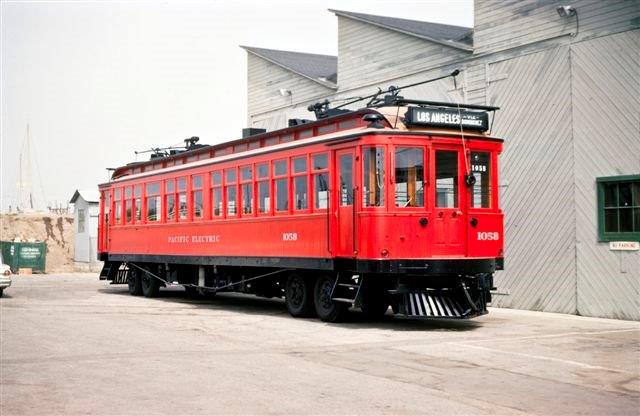
And so, sadly, the 994 was lost. Today, the body of 993 awaits a multi-thousand dollar restoration at OERM. It had escaped scrapping by being used as an employee locker room at the scrap yard. Richard Fellows purchased it, hoping to place it on rubber tires like his 1058 and 665. He passed away before before doing any type of restoration. One other 950 never made it to Terminal Island; that car being the 983. It was purchased from the PE for use as a storage shed in Compton. If you knew where to look, the body of the 983 could be seen from the windows of Long Beach Line Blimps just a few hundred feet behind Compton Station. Richard Fellows purchased the body of 983 and it would be “repurposed” as his rubber-tired 1058. An so, the 993 remains the only intact body of the beautiful 950s. Long live this fantastic survivor.
Alan Weeks Photo, Alan Weeks Collection, Ralph Cantos Collection
Ralph Cantos Collection
Richard Fellows built the 1058 from the body of PE 983. Terminal Island.
Ralph Cantos Collection
Here is another photo of the 1058, this photo shows the correct paint job. In the first photo of 1058, the lower body frame was painted black, which was incorrect. Richard soon painted the lower body red. In this photo, the 1058 is on its way to Downtown LA for the movie, WHO FRAMED ROGER RABBIT?
Steve Crise (right) stands next to a 1960 Marketeer all-electric cart owned by local enthusiast and participant in the 40th Occasional Doo Dah Parade, Lee Johnson. Michael Patris stands next to the Mount Lowe Preservation Society’s 1952 Autoette all-electric cart. Special thanks go out to MLPSI volunteer Scott Bowman for helping pull off this great event with carts from his own collection, the Lee Johnson collection and the Christian Boehr collection. Other participants who drove carts were Christian Boehr’s parents, Ernie and Judy Boehr, Christian’s friend Paige, Lee Johnson’s wife Diane. as well as a few others. The electric carts were once sold in Pasadena and have a tremendous local history which we will be sharing soon.