
From the Jack Finn Collection comes this image of Pacific Electric Hollywood Car no. 5063 on Fair Oaks Avenue in Pasadena, south of Walnut. The image is circa 1945 but the cars may provide a more definitive date.
Jack Finn Collection

From the Jack Finn Collection comes this image of Pacific Electric Hollywood Car no. 5063 on Fair Oaks Avenue in Pasadena, south of Walnut. The image is circa 1945 but the cars may provide a more definitive date.
Jack Finn Collection

From the Jack Finn Collection comes this image of Pacific Electric no. 1054 powering past Municipal Power & Light, possibly in San Pedro, in a photo that is circa 1945.
Jack Finn Collection

From the brochure:
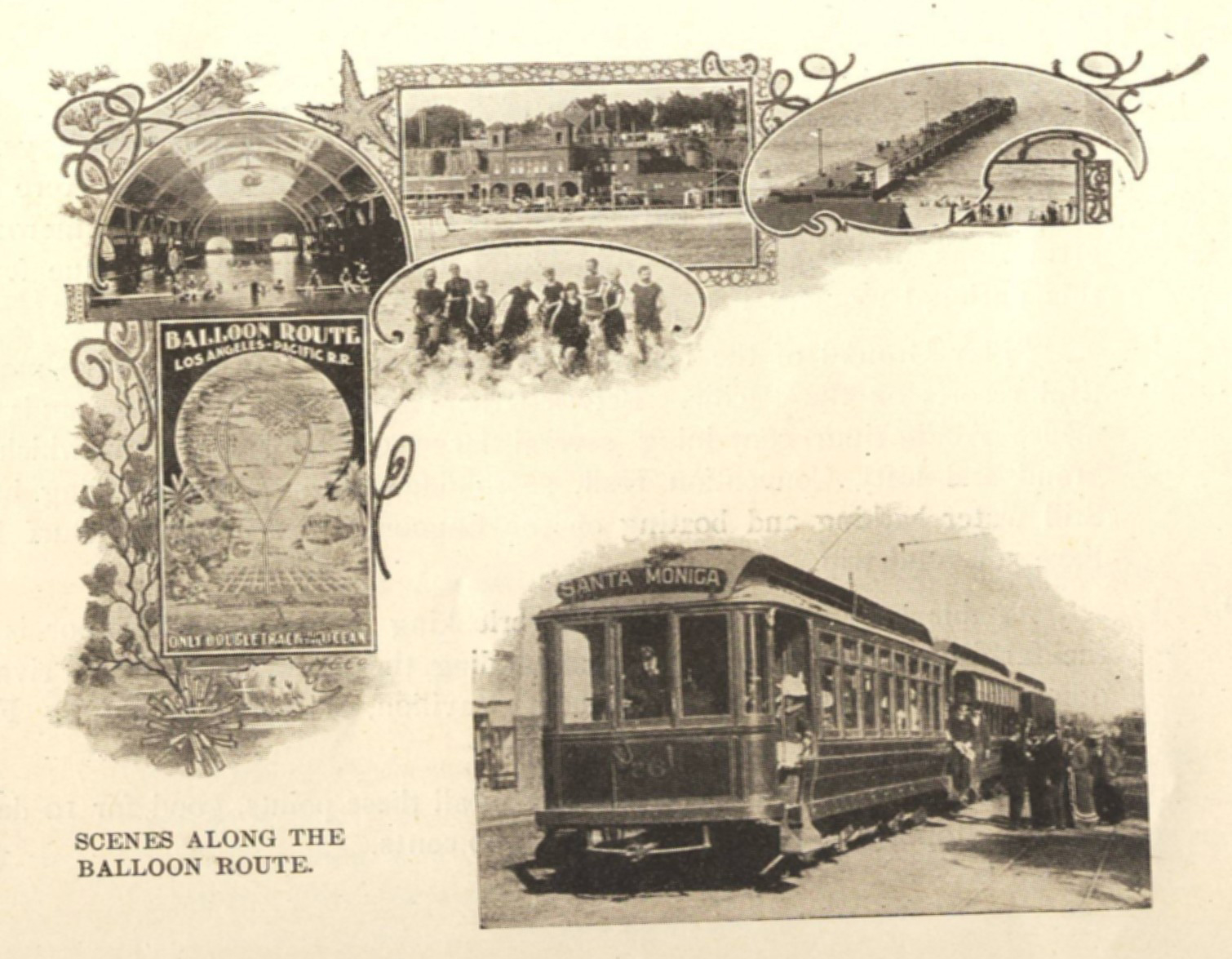
The Lines of this Company form a far more important railway system than can be judged from the number of trains arriving at and leaving Los Angeles each day. From a single track line of 18 miles in 1896 the Los Angeles-Pacific Railroad has grown to a double track system with a total of 185 miles of electric road, of which about ten miles are in Los Angeles.
Connections are made at Los Angeles with railroads diverging; at Sawtelle with Southern Pacific Company, at Inglewood with Santa Fe Railroad, at Hollywood with daily stage for Tolucca (sic), and at Redondo with Los Angeles & Redondo Railway, and with steamers for San Francisco and Coast points.
In addition to numerous intermediate points, the Company’s service reaches Hollywood, Colegrove, Sherman, Sawtelle, National Soldiers’ Home, Santa Monica, Ocean Park, Venice, Playa del Rey, Manhattan Beach, Hermosa and Redondo.
Nowhere are the elements conducive to expansion more pronounced. But the far-sighted management has not been slow in taking advantage of every point of strategic importance; so that any hope of successful competition in their territory must meet with failure.
Special Round Trip Tickets, taking in all these points, good for 10 days, and good to stop off at any or all of them, 80 cents.
Michael Patris Collection



Pacific Electric no. 995 captured on the Air Line in this undated image.
Jack Finn Collection

By Ralph Cantos
LAMTA PCC #3148 prepares to depart 6th & Main Street elevated station for a southbound trip to Long Beach. Except for the very first northbound test run from Long Beach to LA in the “forward position,” all the northbound trips were made in the “reverse position.”
At 9th & Hooper on that first “test run,” the 3148 was run into the 8th Street Yard, where it was “Y”-ed and then run in reverse the last mile or so to the 6th & Main Station, its makeshift rear headlight aglow. So, from then on, the southbound trips were operated in a normal fashion. There being no “Y” or loop at Long Beach, the runs back to LA were done in reverse all the way to the 6th and Main Street station.
All this “BS” in my opinion was for NOTHING. PE’s beautiful double end PCCs were gone by this time, and Toronto’s TTC had picked up every available surplus PCC in America (except for PE PCCs). There were NO “used” PCCs to be had. The TTC had gotten them all. And the MTA was not about to build a costly reverse loop at 6th & Main Station. With the “test runs” completed, the standard gauge trucks were returned to the SF MUNI, and the 3148 returned to its home turf on the P line. Little more than a year later, the Long Beach line was abandoned.
With the demise of the Long Beach Line, the MTA was no longer held hostage to the PE 6th & Main Street Terminal. So the terminal with its nice passenger amenities was closed and all of MTA’s “modern” bus operations moved to an empty parking lot about a block away. Bus passengers were now left to fend for themselves, sometimes in less than ideal weather conditions, until the BIG UNION BUS Terminal was built on the site the old elevated station. And that too was abandoned in time. After about eight years of this LAMTA fiasco, the Southern California Rapid Transit District was created to replace the LAMTA. The SCRTD was in turn replaced by today’s LACMTA, and the monumental task of rebuilding LA’s once great commuter rail system began all over again. One big Hell of a “Humpty Dumpty” to say the least, at a cost of hundreds of billions of dollars, simply to recreate what we once had. If I had not seen all this BS with my own eyes, I would never have believed anything like this could have happened, but it did and it was a DAMN SHAME that it was allowed to take place.
Ralph Cantos Collection

The Los Angeles Pacific Railroad was both a steam locomotive railway as well as an electric railway. It began in 1899 when “General” Moses Sherman and Eli P. Clark filed articles of incorporation. Clark would serve as president and a facsimile of his signature is on the top ticket. On June 16, 1903, the Los Angeles Pacific Railroad merged with the Los Angeles-Santa Monica Railroad Company and the Los Angeles, Hermosa Beach and Redondo Railway Company. The new name after this merger was the Los Angeles Pacific Railroad of California, but everyone still just called it the Los Angeles Pacific Railroad. The Los Angeles-Santa Monica Railroad Company was incorporated on December 2, 1902.
Over time there would be nearly 200 miles of track from the beach communities of the South Bay, including Redondo, Hermosa, Manhattan, El Segundo, Playa del Rey and Santa Monica. The lines headed eastward from the beach through the west side of Los Angeles, downtown Los Angeles, Sawtelle (The Soldier’s Home) and even through to Pasadena.
Rolling stock, in the heyday of 1906, included more than 400 pieces broken down as follows: 221 freight cars, 144 passenger cars, 17 electric locomotives, 12 repair service cars, 6 parlor cars and 5 mail cars.
From Terry Salmans: According to Interurbans Special 63 “Trolleys to the Surf” by Myers and Swett, LAP was sold to the Southern Pacific Railroad in 1906. The Los Angeles Pacific would be merged into the Pacific Electric in 1911.
By 1911 the PE could discontinue use of the steam locomotive lines, but continue to haul freight for decades.
Top ticket undated, blank on reverse. Bottom ticket back-dated 1908.
Michael Patris Collection

Michael Patris and Alan Weeks of the Pacific Electric Railway Historical Society are featured in this fantastic new video produced by Los Angeles County Newsroom to mark the opening of the final leg of the Metro Expo Line to Santa Monica, which traverses much of the original Pacific Electric Air Line. Alan was the last passenger to ride the old Air Line back in 1953, and here he is, riding the new Expo Line and sharing his memories. Great work by all!!!
Ridin’ the rail once more from Los Angeles County Newsroom on Vimeo.

By Ralph Cantos
When the first Los Angeles Metropolitan Transit Authority (LAMTA) took over the operations of the Los Angeles Transit Lines (ex-Los Angeles Railway) and Metropolitan Coach Lines (ex-Pacific Electric) in March of 1958, I (as a 15-year-old railfan) was foolishly optimistic to actually think that LA was on the threshold of a new beginning in public transit. LA newspapers published photos of abandoned PE rights of ways, proclaiming that rail rapid transit would make a dramatic comeback to LA under the guidance of the “transit experts” who were supposedly part of the first LAMTA.
But as all rail fans in Los Angeles soon found out, rail rapid transit was the last thing the LAMTA had in mind for LA commuters. First order of business was to finish what Metropolitan Coach Lines had failed to do — that being the abandonment of the Bellflower Line just two months after the MTA’s inauguration. Over the next two years, rail service on the San Pedro and Watts lines was abandoned in quick succession.
Then in February 1960, just two months after the Watts line an abandonment, the MTA conducted test with former Los Angeles Transit Lines PCC no. 3148 riding on standard gauge PCC trucks on loan from San Francisco Muni. The 3148 made test runs along the length of the Long Beach Line, sometimes in reverse.
In my opinion, this was all a bunch of “BS.”
In this photo taken at 6th & Main Station in February 1960, the 3148 departs under the watchful eyes of 50-year-old Blimp no. 1708. The MTA concluded that the test went very well. To convert the Long Beach Line to single-end PCC operation would have meant that reverse loops would have to be constructed at 6th & Main and in Long Beach. PE’s beautiful double-end PCCs were available, but the LAMTA did nothing and the double-enders were sold to Buenos Aires.
In one last bit of MTA “BS,” Blimp no. 1543 was given a hasty two-tone green paint job to show Long Beach Line commuters that the LAMTA really wanted to continue rail service on the line.
But even before the green paint job on the 1543 could fully cure, LAMTA announced that the line would be converted to bus operation on April 9, 1961. The MTA said the the Southern Pacific Railroad (who owned the tracks) would not renew the lease on the right-of-way. In my opinion, MORE BS. The LAMTA was a state agency that could have told the SP to stick it where the sun don’t shine. An so, that was that.
Next order of business, complete destruction of LA’s five modern, excellent PCC-operated car lines, and for good measure, the two clean electric trolley bus lines would be abandoned as well. So much for bringing rapid transit to LA, which in five short years became an all bus “town.”
Ralph Cantos Collection

By Charles Wherry
From the Charles Wherry Collection and William Wherry photographic archive comes more photos from Pacific Electric on tour over the Southern Pacific Covina Branch, being pulled by Southern Pacific steam locomotive 2701.

“Looking west at P.E. and S.P. Junction at Lone Hill, Calif. 1299 and 2701, 8-23-46. Road Foreman of Engines W.O. Baker just stepped off engine to replace staff in staff machine (booth behind pole). Before electrification of S.P. line”.
Both Pacific Electric and Southern Pacific utilized a staff machine system to authorize train movements on their respective lines. SP’s system began at Baldwin Park with a machine at the PE crossing. Additional machines were at Irwindale, Covina (East Switch), Lone Hill, (Junction Switch), San Dimas station, La Verne Jct. switch and Ganesha Jct.
PE’s staff system began at Monte Vista .058 miles east of P.E. Covina utilizing the same machines at Lone Hill, San Dimas, La Verne and North Pomona.
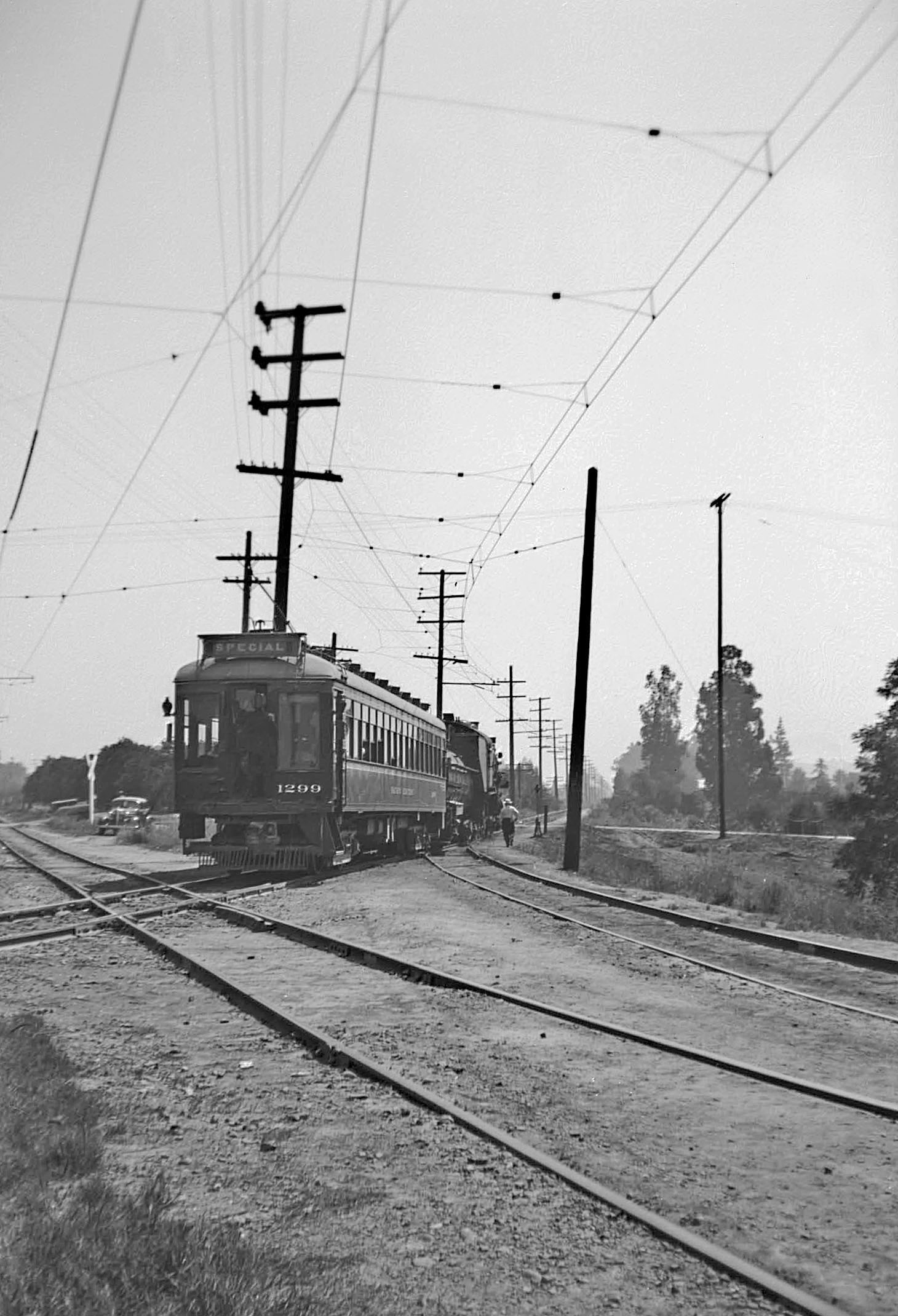
“Looking east at Lone Hill. Engine is pulling 1299 under trolley wire before uncoupling. Track to right of 1299 is connection between P.E. Covina line and S.P. line. Track behind 1299 is P.E. line to San Dimas P.E. line.” (Conductor Brocato is visible in the end door of 1299 trying to place trolley pole on wire).

“Lone Hill, Calif. Cond. Brocato and M/M A.A. Johnston after 2701 had uncoupled and was getting in the clear to permit 1299 to continue on to San B’dno”. (Conductor Brocato was still working into the 1970’s.)
William Wherry Photos, Charles Wherry Collection

By Ralph Cantos
On the subject of the very rare 9 line dash sign, here is Los Angeles Railway no. 881 sporting the very same colorful dash sign. The 881 awaits departure time in front of the old Santa Fe Railway station on Santa Fe Ave at 2nd Street. This image is from around 1938.
Ralph Cantos Collection