Last Hours on the Monrovia-Glendora Line

Los Angeles Examiner photo, Charles Wherry Collection

By Charles Wherry

These three photos also deal with the last hours of rail passenger service on Pacific Electric’s Monrovia-Glendora line.
Los Angeles Examiner photo, Charles Wherry Collection

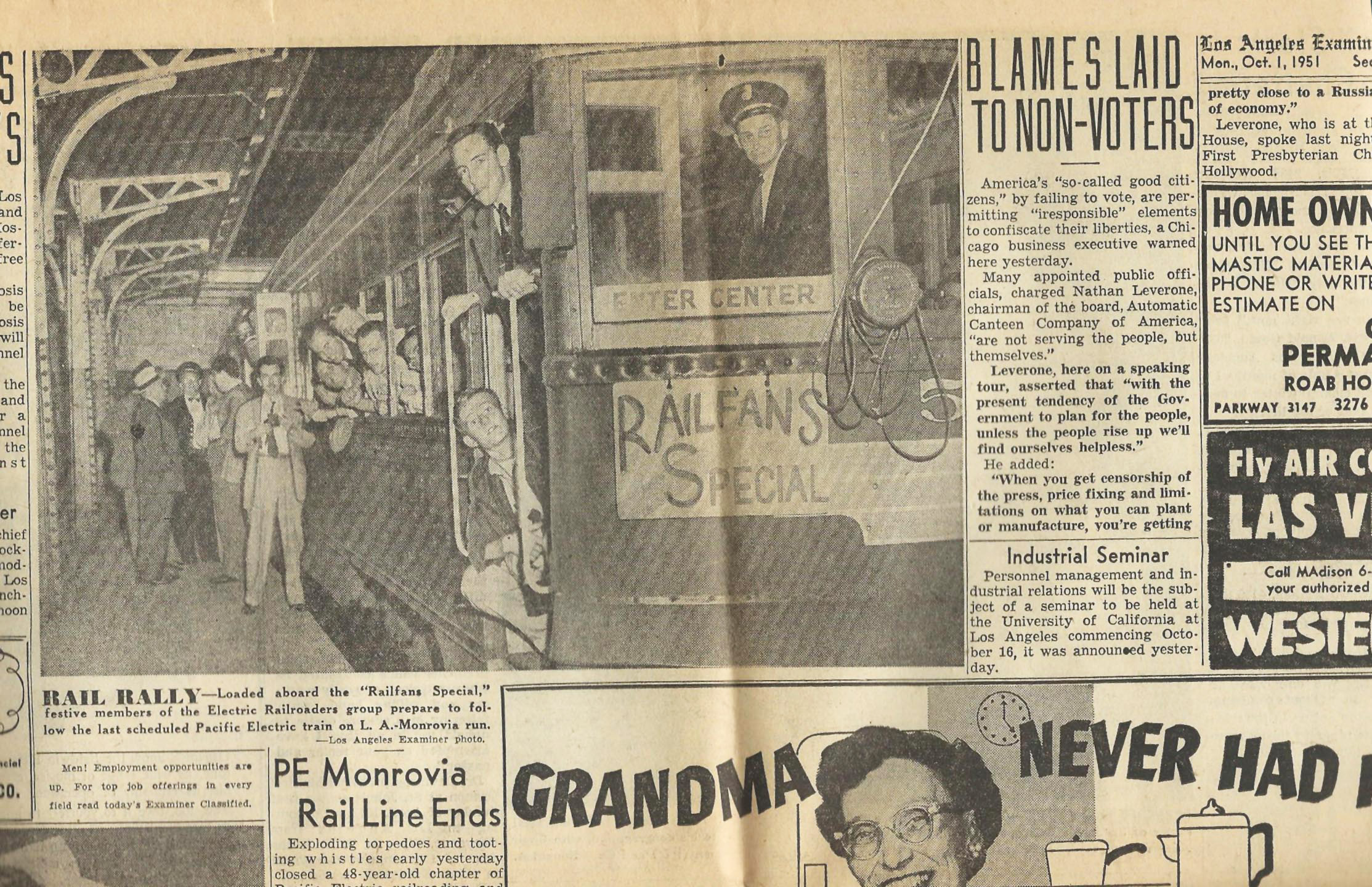
This image has previously been posted on the website but there was no accurate date given. I have included the Los Angeles Examiner’s page and date which is seen in the extreme right hand corner of the image as Monday, October 1, 1951.

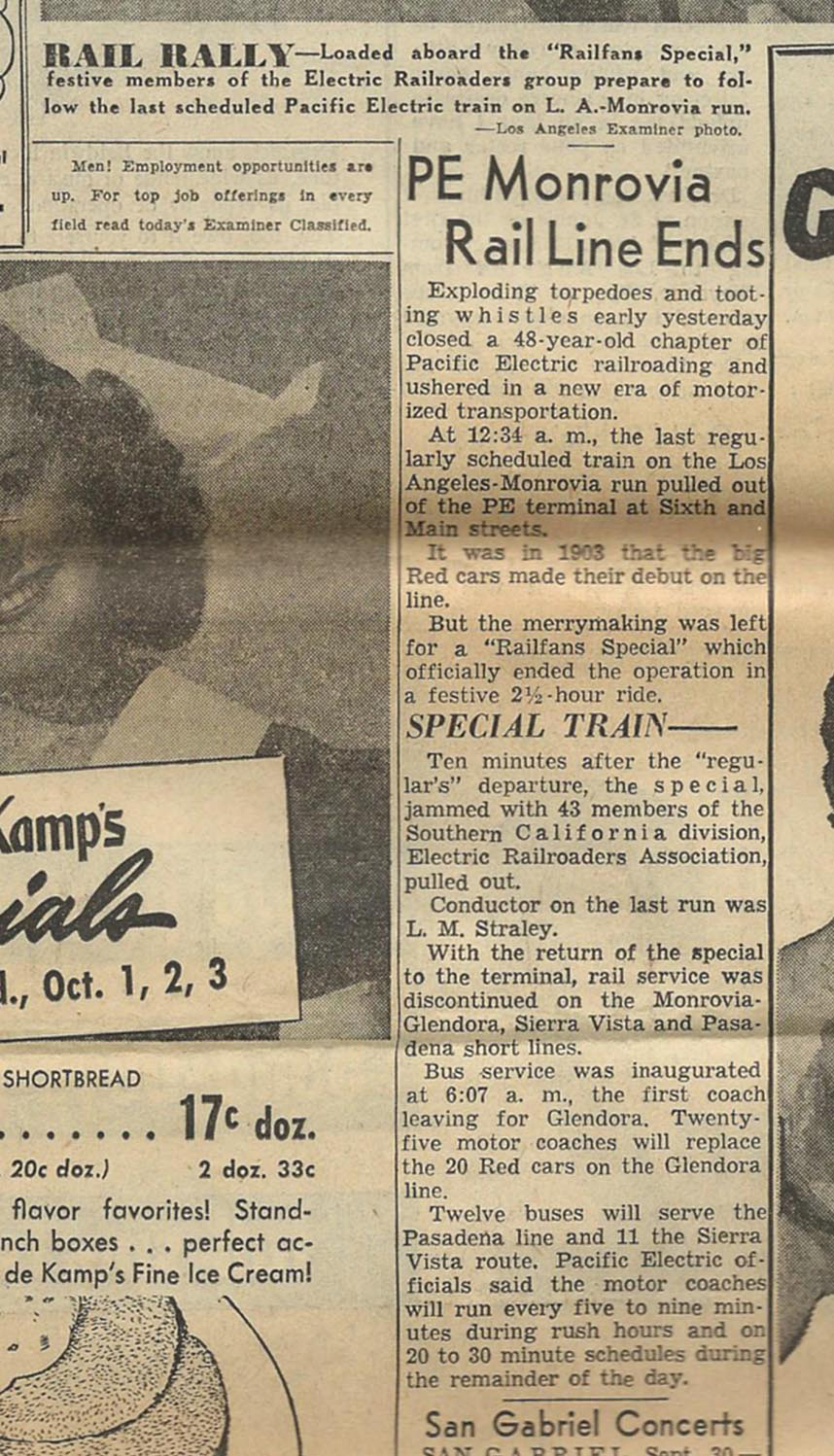
And above is the accompanying text that went with the above photo. Notice that the text states:

“At 12:34 a.m., the last ‘regularly scheduled’ train on the Los Angeles-Monrovia run pulled out of the PE terminal at 6th and Main streets.”
Los Angeles Examiner photo, Charles Wherry Collection

The special ERA car followed with its 43 members 10 minutes later. As a side note, I wonder if any of the members took advantage of the 17 cents a dozen cookies that Van De Kamp’s was offering in the adjoining ad.

William Wherry photo, Charles Wherry Collection

The final image shows the last ‘regularly scheduled’ train referred to in the Examiner article.

I was aboard car no. 735 on this trip along with my brother and mother (seen in the window) and dad who took this picture.
I had just turned 7 years old and being up in the middle of the night was quite a thrill.

My PE employee timetable shows a scheduled departure of 12:35 a.m. from 6th and Main St. with a 1:24 a.m. arrival at Shamrock Avenue, which begs the question; how did we get back to L.A.? The same timetable shows the last inbound schedule from Monrovia on that long ago day to have departed 11:26 p.m. so we couldn’t have been on that. The only answer I can come up with is that we ‘hitched’ a ride with the SC-ERA folks on their inbound trip back to L.A. since theirs was not a regularly scheduled car and they had to get back home whereas we ‘regular’ riders were on our own.

I distinctly remember the explosions of the torpedoes mentioned in the Examiner piece. The noise reminds me to this day of popcorn popping in a skillet. Somewhere out in the murky dark, after a particularly loud and almost continuous barrage of torpedoes we stopped to pick up a passenger. It was Jack Farrier with a suspicious looking brown paper sack and an equally suspicious wide grin on his face. Someone asked Jack what was in the bag. “My lunch”, he responded. Everybody had a good time.
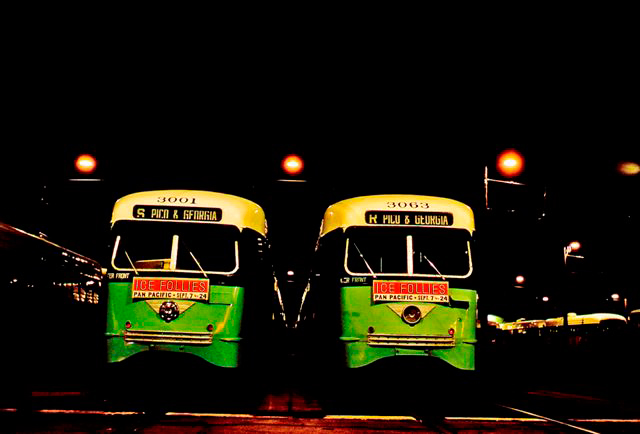
LARY-LATL-LAMTA 3001: Destined for Immortality

Ralph Cantos Collection

By Ralph Cantos

Of the 165 PCCs that roamed the streets of Los Angeles, almost all of them served LA’s transit system in obscurity.

But nine of the PCCs do stand out for one reason or another.

Car no. 3001, the first PCC delivered to the LARY, is pictured here in the fall of 1962 at Georgia Street. The thunder of the 3001 was stolen by no. 3002 by having Shirley Temple pose with it for the grand unveiling of the new streamliners. The 3002 would go on to fame as the “Crying PCC” decorated with crying eyes on it front dasher “GOODBYE OLD SWEET HEARTS and PALS!” plastered on it flanks as the end of LA’s PCC era came to an end.

PCC no. 3035, the only LA PCC to be scrapped after a “run in” with a Santa Fe Diesel switcher outside Vernon Yard.

Car no. 3062, the so called “Guinea Pig P,” was used to test various alterations to the standard LARY/LATL PCC design, most notably a single row of seats on the right hand side of the car’s interior forward of the center door.

Car no. 3075 was the first PCC to be painted in LAMTA’s two-tone green.

Car no. 3096 was the first of 30 “War Babies” to go into service in November of 1942. (The LARY wanted more than 30 PCCs, but because of war restrictions, was lucky to get the 30 P-2 class cars.)

All-Electric no. 3126 got all the press coverage upon its arrival in LA in September of 1948.

Car no. 3148 was the only LATL/LAMTA PCC to operate on the former Pacific Electric Long Beach Line using borrowed San Francisco Muni Standard gauge PCC trucks. (In my humble opinion, the experiment by the LAMTA using the 3148 was a total fraud, a white wash, by a corrupt management that did not give a DAMN about rail transit in LA.)

And last but not least, the no. 3165, the last new PCC delivered to the City of Angels.

The 3001 lives on today in all its splendor at OERM to the delight of thousands of visitors that ride aboard this legendary PCC for all eternity.

Of special interest: notice that both the 3001 and the 3063 display advertising cards for the “Ice Follies” at the historic Pan Pacific Auditorium. The Pan Pacific Auditorium would outlast LA’s PCC system by about 9 years, closing its doors in 1972 with the opening of the LA Convention Center complex, ironically on the very site of this photo. The Pan Pacific burned to the ground about 1988.

Ralph Cantos Collection

Last Day on the Monrovia-Glendora Line

By Charles Wherry

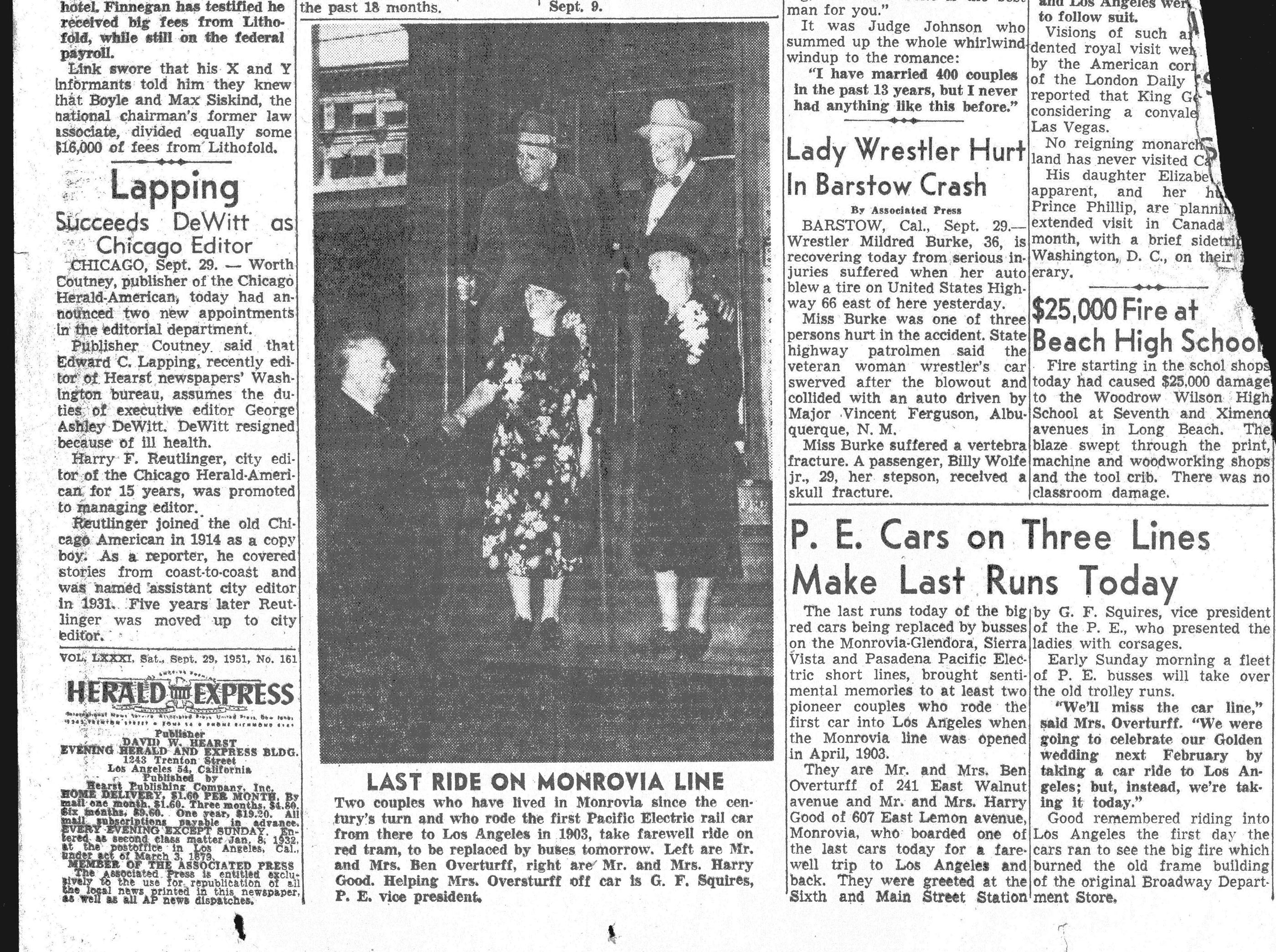
The two photos on this page are from my collection and depict PE publicity and news accounts of the final day of service on the Monrovia-Glendora line: September 30, 1951. Interestingly, Pacific Electric publicity people tracked down and found two couples who had ridden the line on its opening day in April 1903, and had them re-create their ride on the final cars from 6th and Main Street Station in Los Angeles to mark the event.

The next day, interurban service would be replaced by General Motors buses.

The first photo is a newspaper article in the Los Angeles Examiner that was published on September 29, 1951. Note the text of the article mis-names the Pasadena Short Line as the ‘Pasadena Pacific Electric short line’.

Los Angeles Examiner article, Charles Wherry Collection

The next image was scanned from an 8×10 glossy print that my dad William Wherry, a PE employee, obtained from the Director of Public Relations of the PE. On the reverse side of the print is the following caption:

These two couples were passengers on the first electric interurban car to leave Monrovia, California for Los Angeles which service was inaugurated in 1903.

Left— Mr. & Mrs. Ben Overturf, Right—Mr. & Mrs. Harry Good. G.F. Squires, Vice Pres. P.E. Railway presenting corsage.

Picture taken Sept 29, 1951, last day of rail service for passengers, at 6th & Main station.

Motor coach at right one of fleet replacing rail cars.

Pacific Electric Railway Photo, Charles Wherry Collection

Pacific Electric No. 5023: Buenos Aires-bound, for better or worse

Ralph Cantos Collection

By Ralph Cantos

Pacific Electric PCC no. 5023 shows the the terrible effects of 4 years storage in the dank confines of PE’s Subway Terminal tunnel. Some of the cars looked somewhat better, but the 5023 really got hammered with the lime drippings from the roof of the tunnel.

This was a shameful chapter in LA’s transit history. About a year before, when the PE sold its passenger operations to Metropolitan Coach Lines in October of 1953, all 30 PCCs went through Torrance Shop for a complete cosmetic overhaul. When the PCCs rolled out the doors of Torrance Shops, they were in top condition. Included in the overhaul were a 4 new doors, new interior and exterior paint and new seat covers where needed. All 30 cars were now in better than new condition.

For all practical purposes, they were ready for another 15 to 20 years of service here in LA. It was not to be.

Metropolitan Coach Lines management informed the populace of Los Angeles that ALL 7 remaining rail lines would be converted to “gutter liner” replacement bus service as soon as possible. The new paint on the PCCs had barely cured when they were stuffed into the Subway Tunnel after the June 1955 abandonment of the Glendale / Burbank Line. And there these fine cars would rot with the resulting effects displayed by the 5023.

All 30 cars were pulled out of the Subway Tunnel in September of 1959 and trucked to the LA Harbor. The cars were loaded aboard freighters and sent to South America.

Once the PCCs arrived in Buenos Aires they were extensively modified. The PCCs were used exclusively on a short suburban line for about 3 years and when that line was abandoned, the 30 PCCs, the most beautiful PCCs the world would ever see, vanished with out a trace. As of this date, NO ONE living or dead, seems to know just what became of them.

A traction mystery if ever there was one.

Ralph Cantos Collection

Dewbert L. Bourland and Los Angeles Traction Company No. 86

Guen Hodgson Sheets Collection

This absolutely stunning image was sent to us by Guen Hodgson Sheets, and here is her story:

Dewbert L. Bourland [conductor, standing on the steps] was my step great-grandfather and I know he worked for the Los Angeles Railway Co. in 1918. In this picture he looks much younger than 39 and is why I say it is early 1900s. At this time in his life he lived in Orange County.

We believe this image may actually date from the late 1890s, but we welcome any comments. And we graciously thank Guen for contributing this wonderful image to share with Los Angeles traction fans.

Guen Hodgson Sheets Collection

5019 Testing on the Oak Knoll Line

Phillips C. Kauke Photo, Phillips C. Kauke Collection, Stan Kistler Collection

Pacific Electric PCC no. 5019 is photographed while testing on the Pasadena via Oak Knoll Line inbound at Huntington Hotel. The date is February 25, 1941.

Phillips C. Kauke Photo, Phillips C. Kauke Collection, Stan Kistler Collection

1218 Surfside Near Huntington Beach

Phillips C. Kauke Photo, Phillips C. Kauke Collection, Stan Kistler Collection

Pacific Electric no. 1218 rolls south near omnipresent oil derricks in this immediate postwar image dated August 24, 1946. Note the “Newport Beach Limited” sign.

Phillips C. Kauke Photo, Phillips C. Kauke Collection, Stan Kistler Collection

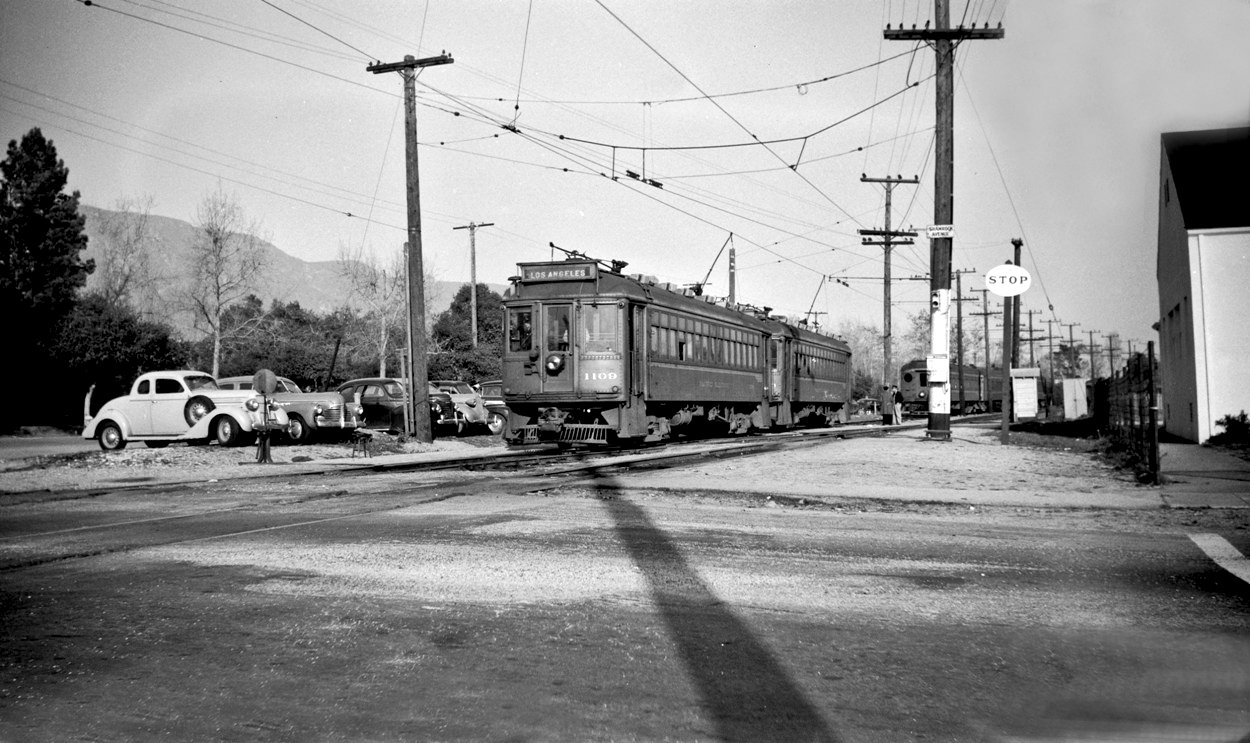
1100 at Shamrock Avenue in Monrovia

 Alan Weeks Photo, Alan Weeks Collection

Alan Weeks Photo, Alan Weeks Collection

Pacific Electric interurban no. 1100 poses at Shamrock Avenue in Monrovia in this undated image by Alan Weeks.

Alan Weeks Photo, Alan Weeks Collection

Pacific Electric Hollywood Cars: Doing What They Did Best

Ralph Cantos Collection

By Ralph Cantos

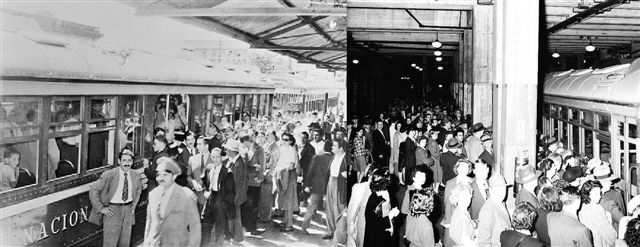
These two photos, taken about ten years and ten thousand miles apart, are remarkably similar in the fact that they both show the fantastic ability of PE’s Hollywood cars to move vast amounts of commuters in “comfort-speed-and-safety.” The photo on the left shows the inaugural rush hour run of the first set of second-hand PE cars in Buenos Aires in early 1953. The photo on the right shows a three-car rush hour train of Hollywood cars at the Subway Terminal in 1943.

In the Buenos Aires photo, the man in the tie looking at the camera is very smug and proud of this train. He must have wondered how those stupid Americans could have let such excellent commuter rail cars slip away. The Hollywood car would serve the commuters of Buenos Aires well into the 1970s.

Back here in Los Angeles as the decades passed, murals of Hollywood cars would dot the landscape as traffic chocked freeways became the norm.

Then in the late 1980s LA City planners finally “bit the bullet” and decided it was time to put the PE back together again — in short, one HELL of a Humpty Dumpty. So now, at a cost of hundreds of billions of our tax dollars, rail service is being restored to areas of Southern California once served by not only the PE Hollywood cars, but rail cars of the LARY / LATL. In every case, the public officials tout the fact that “superior rail service returns once again” One can only wonder if rail service was so good in the first place, WHY THE HELL did LA City officials sit on their asses while the likes of Metropolitan Coach Lines and California Division of Highways (today’s CalTrans) were allowed to destroy the original rail system in the name of “progress.”

Ralph Cantos Collection