Pacific Electric 969 Fan Trip: A scene unrecognizable today

Pacific Electric no. 969 on the Inglewood Line

[vc_row][vc_column][vc_column_text]By Ralph Cantos

Pacific Electric car no. 969 is seen here on the PE Inglewood line heading east, as it nears the crossing of La Cienega Blvd.

This line was originally built by the Santa Fe Railway in 1887, as their entry into Santa Monica. Revenue on this line never amounted to anything approaching a profit from either passenger or freight service. It was sold to the Los Angeles Pacific in 1902 and was electrified. The line came into the Pacific Electric portfolio in 1911.

Today, this scene is completely changed. For one thing, the photographer would be standing in the northbound lanes of the 405 Freeway and would be mowed down by a “hit-and-run” driver in a matter of seconds.

The rail line and open fields seen here are gone, replaced by urban sprawl, houses, factories, and apartments. I would bet that if Metro Rail was operating along this long-gone rail line, it would be well patronized. No use crying over pulled spikes.[/vc_column_text][mk_padding_divider][mk_image src=”https://www.pacificelectric.org/wp-content/uploads/2021/09/pe-969-fan-trip-crosses-the-venice-short-line.jpg” image_size=”full” title=”PE 969 Fan Trip crosses the Venice Short Line” desc=”969 as it crosses the Venice Short Line rails on the Inglewood Line heading eastbound. ” caption_location=”outside-image”][/vc_column][/vc_row]

PE’s Hill Street Tunnels: “Urban Ruin-all” will soon take take them

Aerial photograph of the Pacific Electric - 101 Freeway Temple Street crossing

[vc_row][vc_column][vc_column_text]By Ralph Cantos

[/vc_column_text][mk_image src=”https://www.pacificelectric.org/wp-content/uploads/2021/07/pe-101-crossing-temple-stl-1950-101-freeway-construction-2.jpg” image_size=”full” lightbox=”true” desc=”This remarkable color photo taken from the observation deck of LA City Hall looks west towards the the future FOUR LEVEL INTERCHANGE under construction around 1949. Also seen is a PE “Echo Park 100“ crossing Temple St. southbound. If you can, zoom in on the 100. Within two years , just about every dwelling seen here will be gone in the name of progress, both PE Hill Street Tunnels included. The rail tunnels were built in 1909, followed in 1913 by the twin automobile tunnel of Hill Street Tunnel #1.” hover_image_overlay=”false”][mk_padding_divider][mk_image src=”https://www.pacificelectric.org/wp-content/uploads/2021/07/pe-hill-st-tunnel-2-near-the-end.jpg” image_size=”full” lightbox=”true” desc=”About 2 years after the color photo was taken, another view from the City Hall observation deck shows a scene of total devastation. Rail service along Hill Street long gone.” hover_image_overlay=”false”][mk_padding_divider][mk_image src=”https://www.pacificelectric.org/wp-content/uploads/2021/07/pe-hill-st-tunnel-2-abandoned.jpg” image_size=”full” lightbox=”true” desc=”Another photo from the City Hall Observation deck, shows the last bit of the Hill Street Tunnel #2 awaiting its fate, looking more like some archeological artifact uncovered in a dig . The new Hollywood Freeway cut tunnel in half. The northern portion of the tunnel was “repurposed’ as a book storage facility for the LA City School District until 2014 when it too was destroyed in the name of “urban-ruin-all.“” hover_image_overlay=”false”][/vc_column][/vc_row]

Steve Griffis: Subway Terminal Building and Hill Street Station

A vintage map showing the Subway Terminal Building in Los Angeles

Why are they where they are, why are they the size they are and why does the building have an extension to 4th Street?

By Steve Griffis

Being a little obsessed with Los Angeles’s original rail mass transit (before Metro), I have long thought about constructing a model of a portion of it.  Oh, sure, I’d love to recreate the whole thing but I’m not that delusional yet.

The Pacific Electric Railway stretched from Canoga Park in the west to Redlands in the east.  From Mt Lowe way up in the mountains north of Los Angeles to Balboa in the South.  In its time the Pacific Electric was the largest electric railway system in the world.  It connected all the major cities surrounding Los Angeles.

The Los Angeles Railway covered what is now called the core of Los Angeles.  From almost Hancock Park in the west to Huntington Park in the east.  From Eagle Rock in the north to Inglewood in the south.  The Los Angeles Railway was enormous.

When I began seriously thinking of constructing a portion of the Pacific Electric and Los Angeles Railway, Hill Street in downtown Los Angeles immediately came to mind as a place to start.  Pacific Electric and Los Angeles Railway both operated on Hill Street.  There were two incline railways climbing Bunker Hill and two tunnels.

But the main feature of interest on Hill Street was the Hill Street Station.  Interurban cars left from the Hill Street Station to Hollywood, the San Fernando Valley, Beverly Hills, Culver City and every beach city from Santa Monica to Redondo.

And with increasing auto congestion, a subway was built from the Hill Street Station property to west of downtown to lessen automobile impact on interurban cars to Hollywood and the San Fernando Valley.  The Hill Street Station property and surrounding properties were reorganized to make room for a Subway Terminal Building and new integrated Hill Street Station.

Back to my goal of wanting to recreate a portion of the Pacific Electric and Los Angeles Railway.  The Subway Terminal Building and Hill Street Station seemed like a challenge and so I would there to first draw the important features in CAD (Computer Aided Design).  To do so I needed measurements.  I wanted exact measurements.  Or as close as I could get.  I hate estimating.

I found some dimensions for the Subway Terminal Building on erha.org, 141’ by 330’.  Why 141’?  I was curious.  I would have expected a multiple of 5 or 10.  And what about the Subway Terminal Building Wing that extends to 4th St?  Nothing I could find.

Then I discovered the architect’s description of the Subway Terminal Building.  The Subway Terminal Building is 140’ 8.5” wide on Hill Street and 324’ from Hill Street to Olive St.  The Subway Terminal Building has a wing along one side that is 121’ 11” long and 45’ wide (the wing contains the building’s mechanical equipment which I’ll bet wouldn’t fit in the main building).  I know the new Hill Street Station is 100’ wide, obtained from the Interurban Specials on the Pacific Electric.

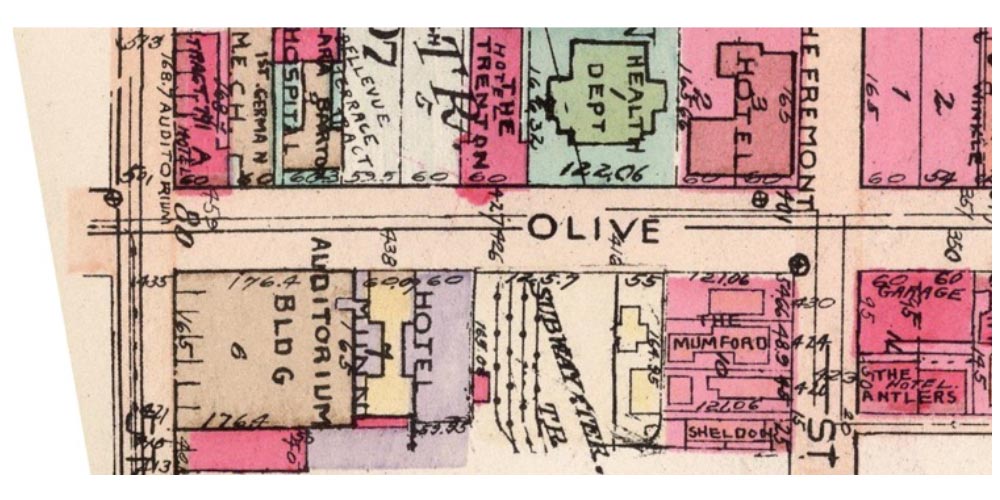
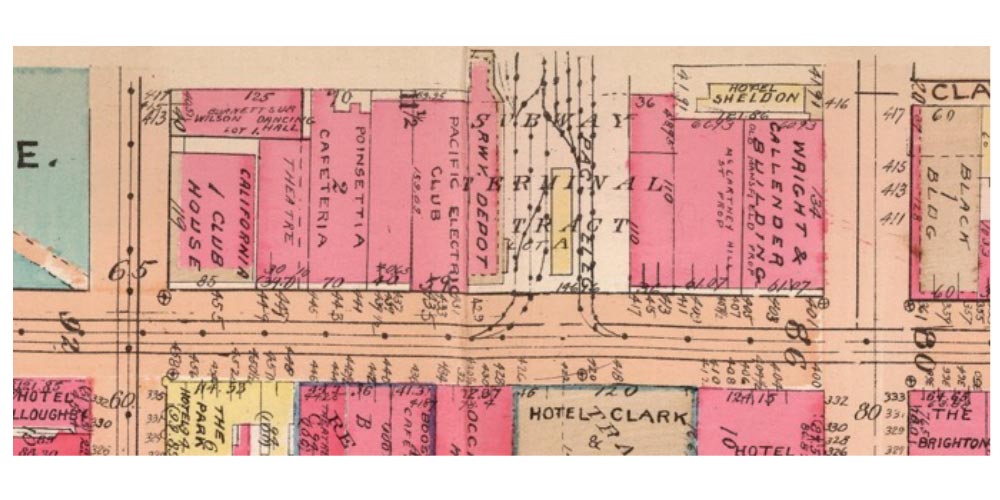
Okay, why these particular dimensions?  And then I discovered “Baist’s Real Estate Atlas of Surveys of Los Angeles, 1921.”  It’s amazing!  Page after page of maps of Los Angeles of the time showing every street, their widths, the sewer lines, fire hydrant locations and most importantly, the dimensions of every lot on every block and buildings on those lots!  And it’s all color coded!

The block which contained the Hill Street Station prior to the subway is shown unfortunately split across two different pages in the Atlas.  Because Atlas pages are not drawn exactly to scale I can’t easily join them together.  So the Hill Street Station block is shown as an upper half and a lower half.

The block is bounded by Olive Street on the top, 5th Street on the left, 4th Street on the right, and Hill Street on the bottom.  The Hill Street Station is down the middle of the block.  Railway tracks are lines with dots on them.

A vintage map of Olive Street in Los Angeles
A vintage map showing the Subway Terminal Building in Los Angeles

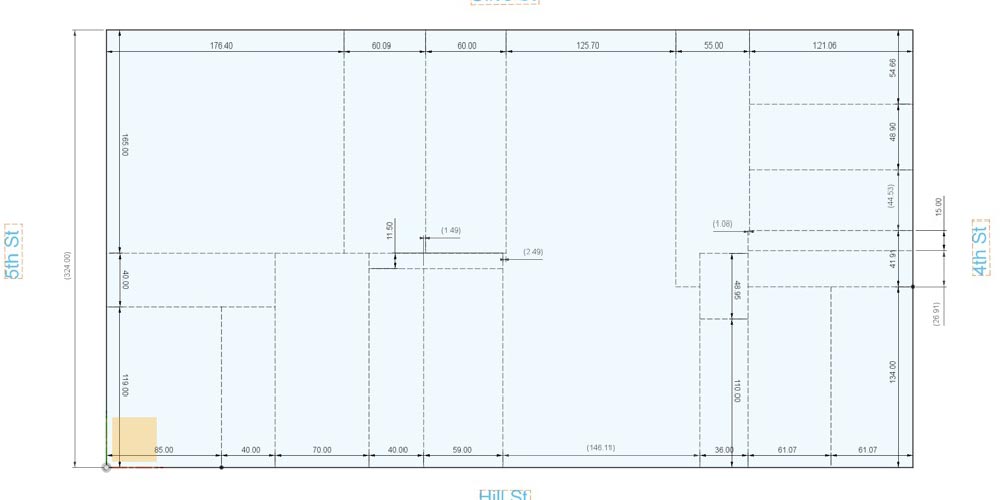
When I entered the individual lot dimensions into my CAD package I got the drawing below.  As a note, I don’t know how surveyors did measurements back in 1921 but some lot boundaries just don’t line up perfectly.  For instance, consider the 60’ lot on Olive St and the 59’ lot on Hill Street, surely the left and right boundaries must have actually lined up.  The 55’ lot on Olive St and the 36’ lot on Hill Street is even worse.  The big open area in the middle of the block is where the original Hill Street Station was located.  From pictures of the Station, its boundary sure looks rectangular.  So for the purposes of arguing how the Subway Terminal Building and Hill Street Station got their dimensions, I believe certain lot measurements are close enough.

If we add the 60’, 125.7’ and 55’ lots on Olive Street together we get 240.7’.  Subtracting 100’ for the new Hill Street Station leaves 140.7’ for the Subway Terminal Building.  Which is exactly 140’ 8.5”, the architect’s stated width.  The length is exactly 324’ which also matches.

The Subway Terminal Building’s Wing, I believe is right where the 44.53’ lot on 4th St is located.  The width is almost perfect, as is the length.  My conclusion is that the Hotel Munn, the Pacific Electric Club and other buildings were torn down to make space for the Subway Terminal Building and new Hill Street Station.  This must have been quite an undertaking for 1925.

I now had dimensions I felt were correct and when I finally build the Subway Terminal Building and Hill Street Station it’s as close as I can come to recreating the real thing as it was.

A contemporary CAD drawing of the Subway Terminal Building's dimensions
A vintage map showing the Subway Terminal Building in Los Angeles

Alan Weeks Collection: “This Is Pacific Electric” (1944)

Cover artwork for "This is Pacific Electric," a company brochure from 1944

[vc_row][vc_column][vc_column_text]From Alan Weeks’ collection comes “This Is Pacific Electric,” a 1944 brochure promoting the state of the system.[/vc_column_text][mk_button dimension=”flat” size=”medium” url=”https://www.pacificelectric.org/wp-content/uploads/2021/05/this-is-pacific-electric-1944.pdf”]CLICK TO DOWNLOAD PDF[/mk_button][/vc_column][/vc_row]

Alan Weeks’ Pacific Electric Railway: Santa Anita Race Trains and San Vicente Shuttle, 1949

[vc_row][vc_column][vc_column_text]By Alan K. Weeks

This is a small group but two different subjects. The Santa Anita Race track trains, and the San Vicente Shuttle.

The Race Track trains only ran on the days that they held races. The San Vicente shuttle was a small leftover piece of the Santa Monica Via Beverly Hills Line.

Vineyard Junction was where the two Santa Monica Lines separated. They both ran from the Hill Street Station to the Junction and then went different routes to Santa Monica.

The Beverly Hills Line was abandoned in 1940 or ’41 (not sure). The Venice Short Line continued on until September 1950.

The little Shuttle ran from 1940 until the Venice Line was abandoned in 1950. It ran from the Junction to Olympic Boulevard using a long viaduct.

There was a horrible wreck at Vineyard in 1913. I am also attaching a report made at the time of the wreck.

NOTES

Image 468 – A bad negative for what ever reason that I tried unsuccessfully to restore. lol
Was it a light leak ? We will never know. Note the Vineyard Sub Station in the background.

The Santa Anita Trains were taken at the Main Street Station or in Arcadia where
the track still is.[/vc_column_text][mk_gallery images=”15281,15282,15283,15284,15285,15286,15287,15288″ column=”4″ height=”300″ hover_scenarios=”none” orderby=”title”][/vc_column][/vc_row]

Alan Weeks’ Pacific Electric Railway: Substations, 1950s

Alan K. Weeks photo. All Rights Reserved. Domino6145@aol.com Photographer: Alan K Weeks Location: Azusa Sub Station, Azusa, California Date: September 1951 Railroad: Pacific Electric Car#: P.E. Azusa Sub Station # 19 Line: Monrovia Glendora Line Filed in Envelope 26 Image Notes: Scanned Steve Crise Photo 2014

[vc_row][vc_column][vc_column_text]By Alan K. Weeks

A book was published a few years ago about the P.E.R.y Sub stations. It sold out in months and I never got a copy. I did not take pictures of them all but did manage to get pictures of quite a few.

I am now able to compare the different stations in this content. I am surprised at the big variety of architectural differences. No two are exactly alike. They used both the power from the Los Angeles Department of Water and Power (DWP) and Southern California Edison, depending on location.

The two utilities supplied high-voltage electricity to each substation. Then the high voltage was converted from AC to DC 600V current. They either used a Rotary Converter or a Motor Generator sets. Today the aubstations are all alike but are now solid state and do a good job.

NOTES:

Image 441 – Funny I can’t remember where this Sub was located in Arcadia (Arcadia Sub no. 7).

Image 442 – Same problem. Note how wide-open the land is around the Azusa Sub no. 19.

Image 443 – Glendale-Burbank Line. Burbank Sub #no. 39 on Glenoaks Boulevard.

Image 444 – Venice Short Line. Note the three rails in the street, the Standard gauge Venice Short Line shared Venice Boulevard with LARY narrow gauge Yellow Car U Line for a few blocks. (Burlington Sub no. 36).

Image 445 – Ivy Sub no. 38 in Culver City on the Venice Short Line Junction with the
Redondo Beach Line.

Image 446 – Hawthorne Sub no. 16 on the El Segundo Line.

Image 447 – Ivanhoe Sub no. 28 on the Glendale-Burbank Line, Riverside Drive near Hyperion.

Image 448 – Whittier Line Los Nietos Sub no. 10.

Image 449 Newport-Balboa Line. Los Patos (Ducks) Sub no. 17. This substation was abandoned six years before I took the picture.

Image 450 – Newport-Balboa Line. Newport Beach Sub no. 18 This sub was also abandoned six years before I took the picture.

Image 451 – Van Nuys Line North Hollywood Sub no. 30.

Image 452 – Pasadena Short Line Pasadena Sub no. 2 Some of the building is still there. It is used by the Pasadena Power Light. On South Fair Oaks near Glenarm Street.

Image 453 – Pasadena Short Line Pasadena Sub no. 2 Some of the building is still there. It is used by the Pasadena Power Light. On South Fair Oaks near Glenarm Street.

Images 454-455 San Bernardino Line, Romona Sub no. 20.

Image 456 – San Bernardino Line. San Bernardino Sub no. 24.

Image 457 – Santa Ana Line, Santa Ana Sub no. 14.

Image 458 – Northern District Lines, Sierra Park Sub no. 52,  Huntington Drive in El Sereno.

Image 459 – Van Nuys Line, Van Nuys Sub no. 31.

Image 460 – Santa Ana Line, Stanton Sub no. 13.

Image 461 – Northern District Lines. Valley Junction Sub no. 3. Possibility this could be the second building here.

Image 462 – Van Nuys Line Vineland Sub #no. 21.

Image 463 – Venice Short Line Vineyard Sub no. 37 at Vineyard Junction.

Image 464 – Hollywood Boulevard Line, West Olive Sub no. 35 On Sunset Boulevard.  The building is still standing today.

Image 870 – MTA Expo Line, Clairington Sub (Don’t know if MTA uses numbers) in Mar Vista (First Sub on the New Extension of the Expo Line).

Image  877 – Different view of same sub.[/vc_column_text][mk_gallery images=”15252,15253,15254,15255,15256,15257,15258,15259,15260,15261,15262,15263,15264,15265,15266,15267,15268,15269,15270,15271,15272,15273,15274,15275,15276,15277″ height=”300″ hover_scenarios=”slow_zoom” orderby=”title”][/vc_column][/vc_row]

Alan Weeks’ Pacific Electric Railway: Box Motors

Alan K. Weeks photo. All Rights Reserved. Domino6145@aol.com Photographer: Alan K Weeks Location: Newport Beach, California Date: January 10 1948 Railroad: Pacific Electric Car#: PE 1451 Line: Newport Balboa Line Filed in Envelope 25 Image Notes: Scanned Steve Crise Photo 2014

[vc_row][vc_column][vc_column_text]By Alan K. Weeks

A few people have asked me what Box Motors were used for. Most of you know but for those that don’t, they were used to haul less-than-a-car-load of freight all over Southern California. Trunks, large boxes, bicycles and very importantly bundles of the Los Angeles Times.

More and more trucks were being used and this business dwindled down. The PERy carried millions of passengers in its heyday but not to be forgotten millions of pounds of freight were carried in Box Motors and trains with electric locomotives. Long trains of tank cars caring oil to and from the Harbor, and much more.

NOTES:
Image 430 – Baldwin Park was the terminus for the LA Baldwin Park Passenger service. The freight line continued on to Claremont and San Bernardino. Note both trolley poles have been removed. That tells me they might have ended up in the Indio scrap track.

Image 431 – This is the yard under Main St. Station Viaduct. Tracks ran between 6th & 7th Streets.

Image 432 – July 1, 1950 and the same yard as 431

Image 433 – The end of track for the Los Angeles-Newport Balboa line ended in Newport. Picture taken 1948.

Image 434 – Sad row of abandoned Box Motors. Driving East to Colorado I was shocked to see this sad row of cars on a Southern Pacific Siding in Indio. I have no idea where they were going. Most likely burned. 1953.

Image 435 – Sorry if this is a duplicate. Taken at Macy St. Shops 1950.

Image 436 – I should have thrown this one away but I tried to restore a photo 80% not there lol. I left it in because it is the only picture I have of Box Motors at the Main St. Station loading dock. 1950.

Images 437 & 438 Both taken in 1955. Abandoned cars at 8th St. Yard.

Image 439 – Taken at the Santa Ana Station on the L.A. Santa Ana Line 1950.

Image 440 – Taken in 1950 at the Surface tracks at Main St. Station Los Angeles,

Alan K. Weeks Images and Collection[/vc_column_text][mk_gallery images=”15234,15235,15236,15237,15238,15239,15240,15241,15242,15243,15244,15245″ column=”4″ height=”300″ hover_scenarios=”slow_zoom”][/vc_column][/vc_row]

Alan Weeks’ Pacific Electric Railway Tunnels in Los Angeles, 1950-51

Alan K. Weeks photo. All Rights Reserved. Domino6145@aol.com Photographer: Alan K Weeks Location: Hill Street Rail Tunnel at the Sunset Blvd Entrance. Los Angeles, California Date: March 5 1949 Railroad: Pacific Electric Car#: PE 110 Line: Echo Park Blvd Line Filed in Envelope 24 Image Notes: Scanned Steve Crise Photo 2014

[vc_row][vc_column][vc_column_text]By Alan K. Weeks

We now move back to downtown Los Angeles. The Pacific Electric had more than one line that ran on Hill St. Downtown. From 16th Street on the south, north to Sunset Boulevard. There were tracks going into the surface tracks of the Subway Terminal Bldg. between 4th and 5th Streets. The Venice Short Line terminated in that surface yard. The Echo Park Boulevard line ran from a turn back at 11th and Hill Streets north to Sunset Boulevard.

There were two Tunnels on Hill Street. Dual tunnels ran from about 100 feet north of 1st Street to 100 feet south of Temple Street. Automobiles used the adjoining tunnel. The LARY/LATL had a narrow gauge A Line that ran on Hill Street in dual gauge mode — 3 feet-6 inches — and they both shared three rails thru the first tunnel from 1st Street to Temple. The LARY A Line turned west on Temple Street.

The PE line crossed Temple onto private right-of-way and went through the North Tunnel to Sunset. The LARY also had a tunnel on Broadway that started north of Temple Street and continued north to Sunset Boulevard. They shared the tunnel with Auto traffic.

NOTE

Image 421 North end of the South Dual Tunnels near Temple St.

Image 422 North end of the South Dual Tunnels near Temple St.

Image 423 South end of PERy North Tunnel near Temple St.

Image 424 North end of PERy North Tunnel at Sunset Bl. Look to the wall to the right of the tunnel entrance and you see a faded paint advertisement for the World
famous Mt. Lowe Line. The line was abandoned fifteen years before I took this picture. Ironically the line never ran thru this tunnel.

Image 426 PERy North Tunnel after demolition. Looking South to Temple St.

Image 427 South end of the PERy North Tunnel looking to Temple St. NOTE this is the new Hill St. bridge over the Hollywood Freeway then under construction. The bridge was designed before the rail line was abandoned. You can see they left room to restore the ballast and rails on the bridge.

Image 428 Box Motor 1407 on the Alhambra Branch freight line. Alhambra

Image 429 PE / SP Interchange looking North from Mission Road.[/vc_column_text][mk_gallery images=”15222,15223,15224,15225,15226,15227,15228,15229,15230,15231″ column=”4″ height=”300″ hover_scenarios=”slow_zoom” orderby=”title”][/vc_column][/vc_row]

SGV Master Key Podcast: Michael Patris

Michael Patris of MLPSI

[vc_row][vc_column][vc_row_inner][vc_column_inner width=”1/6″][/vc_column_inner][vc_column_inner width=”2/3″][vc_video link=”https://youtu.be/vhTpfvwHJSs” custom_thumbnail=”true” thumbnail_image=”15217″][/vc_column_inner][vc_column_inner width=”1/6″][/vc_column_inner][/vc_row_inner][vc_column_text]Michael Patris of the Mount Lowe Preservation Society recently appeared on the SGV Master Key Podcast. Here is their introduction:

Michael Patris has always had an interest in history. Whether collecting antiques, collecting and working on antique cars, or restoring a 1923 California bungalow in Alhambra, pieces of the past always seemed too important to brush aside. After several years working in the news industry, and film industry, Michael speaks publicly about Southern California transportation, collecting antiques and, of course, Mount Lowe.

Michael is the President and founder of the Mount Lowe Preservation Society, Inc., President of the Pacific Electric Railway Historical Society, and past Sheriff of the Los Angeles Corral of Westerners (2010). Michael is also President and owner of Golden West Books, a publishing company focusing on the history of trains, trolleys, railroads and locomotive material.

One of Michael’s most well known projects is a Mount Lowe trilogy, beginning with Mount Lowe Railway, part of the History of Rail series for Arcadia Publishing. This came out in June of 2007 and already is in its ninth printing. The Barnes and Noble book signing was sold out in an hour and a half, a record for their chain. October 2010 another book for Arcadia Publishing Mount Lowe, which is part of their Postcard Series came out and more recently two more books for Arcadia Publishing have just come out, both co-authored by Michael Patris and Steve Crise, which are Pacific Electric Railway, Then and Now (December 2011) and Mount Lowe, Then and Now. (February 2012) Michael’s current projects include (sometime in the near future) another collaboration with Steve Crise on the Los Angeles Railway, Then and Now, and perhaps a book on Los Angeles Union Station featuring photos and collectibles rarely seen from this local landmark.

After wanting to share his passion for the Mount Lowe Incline Railway and Thaddeus Lowe, the man who was the leading force behind its creation, it was a natural progression to set up the non-profit Mount Lowe Preservation Society educational foundation back in 2000 which has fueled the renovation of a 14,000 square foot building in Pasadena to permanently house our collections and archives. This has led to the archives of the Pacific Electric Railway Historical Society being donated to the Mount Lowe Preservation Society as well as the gift of the publishing company, Golden West Books, donated by the late founder, Donald Duke.

Preserving the past for future generations is his way of giving something back to the community that seemed lost in history books and old photos. His drive and passion for collecting and displaying pieces related to local transportation history has been acknowledged by the Pasadena Museum of History where he has guest curated numerous displays for them and also loaned several items to the Huntington Library for the 300th Anniversary of the birth of Father Serra.[/vc_column_text][/vc_column][/vc_row]

Pacific Electric no. 1258: It’s still here (sort of)

Pacific Electric no. 1258

[vc_row][vc_column][vc_column_text]By Ralph Cantos

In this 1938 photo, Pacific Electric no. 1258 awaits departure time at the PE San Bernardino Station. The cars became known as “Portland 12s” to all that loved these elegant cars.

The Portland 12s came to the PE in 1929 from the abandoned Southern Pacific Railroad Portland-area operations. The cars were built in 1912 by the Pullman Car Co. On the PE, they were numbered 1252-1263. The Portland 12s served the PE well.

Only two of the big cars did not make it to the end. Car nos. 1254 and 1258 were both retired in 1947. The 1254 suffered extensive fire damage and the 1258 had a very unfortunate collision with one of PE’s own mighty 1200s. PE’s 1200s were much better built than the Pullman-built Portland 12s. Both cars were scrapped at the Torrance Shops, or so it seemed…

The 1254 was scrapped, BUT fate stepped in, and the body of the 1258 was purchased by a private party for use as part of a commercial business in the City of Lomita where she remains to this day. It takes a little “detective work” to spot the remains of the 1258, but she is there.[/vc_column_text][mk_image src=”https://www.pacificelectric.org/wp-content/uploads/2021/03/pe-1258-accident.jpg” image_size=”full” title=”1258 at Torrance Shops” desc=”This photo from the Ira Swett Collection, shows the 1258 at Torrance Shops awaiting “scrapping.“”][mk_image src=”https://www.pacificelectric.org/wp-content/uploads/2021/03/pe-1258-at-torrance-shops-stripped.jpg” image_size=”full” title=”1258 During Scrapping” desc=”1258 awaits delivery to Lomita; image courtesy Southern California Railway Museum.”][mk_image src=”https://www.pacificelectric.org/wp-content/uploads/2021/03/pe-1258-2020.jpg” image_size=”full” title=”1258 Today” desc=”And here is where the 1258 resides today. She is there, you just have to do some detective work to spot her.”][mk_image src=”https://www.pacificelectric.org/wp-content/uploads/2021/03/pe-1258-2020-lomita-lock-key.jpg” image_size=”full” title=”1258 Today” desc=”Look close, that’s the 1258’s belt rail and rivets.”][mk_image src=”https://www.pacificelectric.org/wp-content/uploads/2021/03/pe-1258-inteerior-vent-lomita-lock-key.jpg” image_size=”full” title=”1258 Today” desc=”Unbelievable, ceiling vents and light fixture bases unique to the Portland 12s still survive in 2021.”][mk_image src=”https://www.pacificelectric.org/wp-content/uploads/2021/03/pe-1299-at-san-bernardino-station.jpg” image_size=”full” title=”PE 1299: The last of her kind” desc=”Not widely known is that PE Business car no. 1299 was rebuilt from a SP Portland trailer. When the PE decided to replace aging business car no. 1000, a Portland trailer was plucked from the rows of SP Portland motor and trailer cars stored at Torrance Shops. Being a trailer, she was a very tight and low mileage car. She became 1299 and survives today at OERM, 100 percent complete as the last time she operated on the dwindling PE rail system.”][/vc_column][/vc_row]