
Los Angeles & Redondo Railway
[vc_row][vc_column][vc_column_text]By Steve CriseThe Los Angeles & Redondo Railway is one of the earliest railroads to be constructed in the Los Angeles basin. As its name suggests, it ran from the southwest corner of Jefferson and Grand to roughly Catalina and Diamond Streets in Redondo through the mostly vacant fields between the two cities. From its meager beginnings as a section of railroad right of way constructed by “The Rosecrans Rapid Transit Railway” in 1887, the LA&R eventually grew into a system of about 95 miles of 3’6” narrow gauge trackage.
To service and construct its fleet of coaches, steam locomotives and then its fleet of electric cars, the LA&R built a shop and car house in Redondo Beach on a trapezoidal piece of property bordered by Diamond Street at the southern tip of the property with N. Elena Avenue on the southwest side, Beryl Street bordered the northwest end and N. Francisca Avenue on the northeast side. The section of the road slicing on the southeast corner of the lot was Camino Real, present day Pacific Coast Highway, California State Route 1.
The location of the car house in the photo above was rumored to be in several different locations on or near this property. I set out to see if I could find the exact location of the huge structure or at least come within a few feet of where it once stood until it was destroyed by fire in 1921.[/vc_column_text][mk_image src=”https://www.pacificelectric.org/wp-content/uploads/2025/04/crc_lar_55_redondo_map-003d.jpg” image_size=”full”][vc_column_text css=”.vc_custom_1743772585885{margin-bottom: 0px !important;}”]I found a very helpful clue in the form of a map drawn by Raymond E. Younghans in Ira L. Swett’s 1957 publication of Interurbans Special No.20 “Los Angeles & Redondo,” on page 65. It places the car house at the top of the property boarding N. Elena Avenue and Beryl Street. Using this information from the Younghans map I estimated its location on a Google Map capture as to where the building would be resting atop the shopping mall that has occupied the property since the early 1960’s.
My next point of curiosity was the three cars shown in the photo. Of the three cars, only two were identified by traction expert Craig Rasmussen, the provider of the image. He noted that the car on the left was LA&R #55, the center car was not identified but the car on the right was easily identified as LA&R #15, the prestigious Redondo parlor car and the pride of the railway.
I was not able to find any specific car being numbered as 55 on the railroad. There is a mention of cars 52-56 being rebuilt steam coaches that were made into interurbans after the railroad was electricized. These second-hand steam coaches were known as the “New York” cars because their being purchased used from the Third Avenue Street Railway in New York City in 1902. It is also assumed that LA&R car #3, one of the cars from New York, was renumbered to 55. With this being the case it is reasonable to assume that there was indeed a car 55, just no record of it in any books. The closest match I could find to the car in the photo was LA&R #50 (original LA&R #10), also purchased from New York, which is seen on page 40 of the aforementioned LA&R book.[/vc_column_text][mk_image src=”https://www.pacificelectric.org/wp-content/uploads/2025/04/ilsc_pe_1400_drawing-002.jpg” image_size=”full”][mk_image src=”https://www.pacificelectric.org/wp-content/uploads/2025/04/ilsc_pe_1727_special_37-001.jpg” image_size=”full”][vc_column_text css=”.vc_custom_1743772660357{margin-bottom: 0px !important;}”]About 1907, LA&R #55 was converted into a box motor with a freight door cut into the side for easier handling of freight. After the Great Merger of 1911 Pacific Electric renumbered the car to 1400. It was again renumbered to P.E. 1727 when it was again reborn as a tower car. One more renumbering would take place in 1931. It then became P.E. #00156 before the venerable car was finally scrapped on October 5,1934 after serving three different railroads on two different coasts. And as if that wasn’t enough, it also had the distinction of operating on two separate gauges of track during its lengthy career.[/vc_column_text][mk_image src=”https://www.pacificelectric.org/wp-content/uploads/2025/04/ilsc_pe_450_class-003.jpg” image_size=”full”][mk_image src=”https://www.pacificelectric.org/wp-content/uploads/2025/04/sjcc_pe_464_rubio_sta-002.jpg” image_size=”full”][vc_column_text css=”.vc_custom_1743772720252{margin-bottom: 0px !important;}”]LA&R #204, also known as the “Redondo” parlor car likewise made the transition to the P.E in 1911 and was renumbered into PE’s #400 – #465 series cars and became PE #453. These were Los Angeles & Redondo’s final car-building product and had a very productive life on different lines throughout the system including the Glendale – Burbank Line, Rubio Canyon Line and on occasion in service for Santa Anita racetrack trains when heavy passenger traffic required their service. The entire class of the #450 – #465 cars were scrapped just a few months before the start of WW II. PE #453 had an earlier date with the scraper than most of the other cars in the series and in 1933, after 25 years of service, was discarded by the Pacific Electric and removed from the roster.[/vc_column_text][mk_image src=”https://www.pacificelectric.org/wp-content/uploads/2025/04/mapc_lar_ainsworth-06.jpg” image_size=”full”][vc_column_text css=”.vc_custom_1743772761315{margin-bottom: 0px !important;}”]The J.C. Ainsworth, a 3’6” gauged Baldwin 4-4-0 seen in the above photo was named after one of the original founders of the Redondo Railway, Captain J.C. Ainsworth. Captain Ainsworth and his business partner Captain R.R. Thompson were heavily involved in the Pacific Northwest’s lumber trade. Their goal was to develop Redondo Beach into a major Southern California port for their lucrative lumber business. The success of their efforts soon eclipsed the steam locomotives’ capabilities, and it was decided to completely abandon steam power and modernize and eclecticize the entire road to a 600-volt DC system. This is when the New York cars, once pulled by the steamer, were converted in the LA&R shops to suburban electric cars. During the long service record of the J.C. Ainsworth for the LA&R it bore no less than three different numbers; #2, #23 and #421. Incredibly, the J.C. Ainsworth survived long enough to become a piece of Pacific Electric’s rolling stock. After the 1911 merger, Pacific Electric assigned this locomotive to be #1501, appropriately fitting into the PE’s steam locomotive classification numbering system. However, the 3’6” gauged engine was never used on the PE because of its incompatibility with the standard gauge 4’ 8.5” track that the PE operated on. The ancient engine was sold in 1913 to the San Fernando Rock Company.
As this exercise aptly demonstrates, there can be countless stories buried within these historic photographs. Here at the Pacific Electric Railway Historical Society, we endeavor to seek out as many facts and stories that to the average viewer are not necessarily obvious and research and share them with the world on this site. If you have a rare or interesting image from the bygone era from one of the many early transit systems in the Southern California area, please send your image and story to us and we will do our very best to decipher and post it on PERyhs.org for all to enjoy.[/vc_column_text][mk_image src=”https://www.pacificelectric.org/wp-content/uploads/2025/04/lar_logo-003.jpg” image_size=”full”][vc_column_text css=”.vc_custom_1743772866559{margin-bottom: 0px !important;}”]Source material:
- Interurbans Special 20, Los Angeles & Redondo Railway.
- Interurbans Special 28, Cars of the Pacific Electric Vol.1 City & Suburban Cars.
- Interurbans Special 37, Cars of the pacific Electric Vol. III Combos, RPO’s, Box Motors, Work Motors, Locomotives, Tower Cars, Service Cars.
- Pacific Electric Railway Historical Society image archives. PERyhs.org
- Craig Rasmussen Collection
- Michael Patris Collection
- Steve Crise Archive
Remembering the Big Green Cars of the Los Angeles Inter-Urban Railway
Foreword by Steve Crise
Often times we acquire artifacts that are in less than desirable condition and are quite literally ready to disintegrate. This was the case with this Pacific Electric / Los Angeles Interurban Railway map seen above. Fortunately it was not a large map, only about 8 x 12 inches which made it very easy to scan it on a regular flatbed scanner before it completely gave up the ghost. With only a few hours of intense Photoshop therapy, we ended up with a really nice and informative map.
There was no written information about the date of this map, but if you study it closely you can see a few interesting clues. For example, the San Bernardino Line has only made its march towards its namesake city as far east as Covina, as indicated by dotted lines. The construction of the San Bernardino Line began in 1906 and arrived in Covina in 1907, and finally to San Bernardino in 1910, suggesting this map to have been published between 1906 and 1907.
I thought that another interesting feature of this map is the mention of the Los Angeles Interurban Railway, a property that few if anyone in Los Angeles had ever heard of. Like many of the early electric lines in Southern California, their individual stories have been lost to history and shrouded in darkness by the huge shadow cast by the world famous Pacific Electric Railway. Everyone had heard of the “Red Cars”, but had you heard of the “Green Cars” of the LAIU?
I was aware of the LAIU’s existence but knew very little about its short but important history. A little searching around the internet brought me to the website of The Electric Railway Historical Association of Southern California where they had a good deal of information on this early electric railway. The LAIU history first appeared in Timepoints, the journal of the Electric Railway Historical Association of Southern California.
In this posting we have brought together the story of the LAIU with the map of the railway. I think you will agree that these two items needed to be paired with each other in order to better appreciate the details they both have to offer regarding the unique history of LAIU Railway.
So sit back a take a short ride on what may be the only memory still left of the upstart Los Angeles Interurban Railway and its “Big Green Cars” that eventually turned Red!
…
If you lived in or near Los Angeles between 1903 and 1910, you depended upon the LAIU for a good portion of your transportation. Suppose you wanted to go to Glendale: you boarded a big green LAIU interurban car on Sixth Street. If you wanted to go out to Westlake Park to enjoy the band concert, you hopped on a smaller green car and rattled out West Eighth Street. Or if you had to see a friend off at the Arcade Depot or at the Santa Fe Le Grande Station, you depended on the LAIU’s East Third Street Line. Perhaps you had to embark at San Pedro; you boarded a green car and were rushed off down Vermont Avenue through Gardena. Maybe you were a laborer on a Pacific Electric section gang busily laying steel for the new Whittier Line; your paychecks were signed by the LAIU. If you were the cashier of the St. Louis Car Company, the checks to pay for those ninety big interurban cars to be shipped west to the PE were also from the LAIU. Whether you were a millionaire with a resplendent mansion on West Adams street or a white-collar worker in a humble cottage on West Jefferson street, the LAIU brought you home at night. Yes, the LAIU was a mighty power hereabouts in that eight-year period of long ago. And yet you say you’ve never heard of this electric traction enigma; not many have.
The Los Angeles Interurban Electric Railway Company or LAIU had other distinctions besides a jawbreaker name. It was a ten-million-dollar corporation operating interurban lines and city lines, both standard and narrow gauge. It constructed extensions to several Pacific Electric interurban lines and furnished the major part of that company’s most modern cars. In spite of all this, the LAIU is today known only to historians and an unknown quantity entirely to most railfans. With this in mind, plus a desire to give credit to an outfit that richly merited commendation, we bring you know the story of the LAIU.
In the period from 1896 to 1903 electric railways in Los Angeles enjoyed boom times. Competition between them was fierce and unrelenting. In the City of Los Angeles Henry Huntington’s Los Angeles Railway was king, but there was fierce competition from the mushroom growth of the Hook family’s Los Angeles Traction Company. Indeed, the aggressive Traction Company was enough to worry any electric railway. Starting from scratch in 1894, the Hooks had built up an extensive well-run system based out of the Georgia Street car barns, shops and powerhouse. Not content with being the sand in LARy’s shoe, the LAT went after the interurban business through a subsidiary outfit, the California-Pacific Railway. In the interurban field operating out of Los Angeles, the Los Angeles-Pacific Railway was the dominant company. It operated 150 miles of narrow-gauge line grid ironing the territory between the city and the west beaches. The LAP’s Sherman and Clark were well entrenched and could afford to look leniently on the ambitious plans of the California-Pacific, especially as it seemed that the object of the later company’s most malignant machinations was Huntington’s stripling Pacific Electric. Between the city and Redondo, the Los Angeles & Redondo Railway was busy converting its steam line to electricity, while L. C. Brand and associates, entirely independent of the larger companies, were grading their line to Glendale. The year 1910 is usually regarded as the most notable year in the history of the local electric railway railways, but the foundations of the Great Merger were laid in 1903.
In the early days of 1903, the Southern Pacific Railway’s business was considered fair pickings for any traction executive worth his salt. By the end of that year, the S.P. was the biggest single factor in the local electric railway situation. Henry E. Huntington first gained prominence as a trained executive of the S.P. Under the reign of his uncle, the great Collis P. Huntington, Henry rose rapidly in the councils of the mammoth corporation. He grew intimately familiar with all of the ramifications of the S.P. and knew every one of that railroad’s methods of crushing competition. Perhaps more than any other man, HEH knew how successfully to compete with the Octopus of the West. With the death of Collis P. Huntington and the rise to power of Edward H. Harriman, Henry E. Huntington was on his own, free to become a very irritating and persistent thorn in the side of the supposedly impregnable S.P.
Huntington believed firmly in the ability of electric railways to supplant steam trains. He came to Southern California with millions in his pocket and set out to prove himself. Huntington had had ample proof of the ability of the electric interurban to compete with steam railroads. He had seen the Pasadena & Los Angeles Electric Railway blitz the S.P., Santa Fe and Terminal railroads out of the Pasadena picture and was so impressed he immediately purchased that line. He saw the Los Angeles Pacific repeat this annihilation of steam when its Santa Monica Line was opened. So it happened that the S.P. woke up one fine morning and found its lines out of Los Angeles to the east and south being paralleled by a new electric railway with its own bright young man, Henry E. Huntington, leading the onslaught. No one ever accused Harriman of avoiding a fight when challenged; immediately the power of the S.P. millions was lined up against Huntington ready to crush him when the first opportunity offered itself. The opportunity was not long in coming; the first move was to send Senator W.A. Clark of Montana to Los Angeles to ask the City Council for a blanket franchise for a new electric railway to cover all parts of Los Angeles at a 3-cent fare. This was followed at the proper moment by rumors that the S.P. would electrify its local service throughout Southern California. Then in April 1903, came a telling blow, the S.P. purchased the Los Angeles Traction Company outright from the Hooks family. With that franchise gained, plus the California Pacific, which was by this time operating its narrow gauge cars to San Pedro and projecting lines to Whittier, Pasadena and Venice-Santa Monica, the S.P. now held a dominant local position. Henry Huntington faced the fight of his life. The sensational skirmish, which bashed Huntington’s PE juggernaut, attracted the interest of the entire Nation. The $110,000 franchise fight was Harriman’s instrument, which finally brought HEH to San Francisco to talk peace. In May 1903, Huntington applied for a franchise for an electric line on West Sixth Street from Figueroa to Alvarado. Ordinarily this move would have cost him about $5,000. Harriman decided to make this franchise the showdown. He empowered a local real-estate man by the name of G.G. Johnson to act for the S.P. in the bidding. Steadily the bidding rose, with excitement increasing with every tick of the clock as word flashed around City Hall that Huntington was to get his comeuppance. At $10,000 W.S. Hook of the Traction dropped out leaving Huntington face-to-face with his greatest rival in the guise of G.G. Johnson. The law required that each new bid be at least 10% higher than the previous bid and it was not long before the bidding had reached extravagant proportions. Mr. Johnson, appearing unaffected by the sensation he was causing steadily topped Huntington’s excited bids. Johnson’s $82,500 was met by Huntington’s $100,000. When Johnson still refused to withdraw, HEH heaved a great sigh and gave up. He knew that until he came to terms with Harriman, the SP’s millions would prevent him from ever again securing a franchise in the City of Los Angeles. Johnson took the franchise for $110,000, which money was paid to the city treasury within twenty-four hours. That night, Huntington took the train for San Francisco and the headquarters of Harriman. Fast as he was, his partner in the Huntington-Hellman syndicate was even faster. Harriman had already obtained Hellman’s interest in the PE! As Harriman had other more important irons in the fire, he left responsibility for PE operations to Huntington and remained a silent partner. The agreement reached by Harriman and Huntington was not long in coming to light. Harriman publicly acknowledged in July of 1903 that he had purchased the Traction Company and stated further that he and Huntington were in amicable accord. Huntington would thereafter control and operate all the street railways in Los Angeles. In return for control of the Traction Company and the California Pacific, Huntington turned over 50% of his PE stock to Harriman. Not only did HEH gain the famous (or infamous) Sixth Street Franchise, but he also acquired the California-Pacific’s important franchises to Pasadena and Santa Monica—franchises that he never used. Harriman gained even more by the armistice however as he now had the Huntington electric railways in his pocket; true he did not yet control them, but that would come. It would come in 1910…. (Nefarious laughter)
Thus the infant LAIU entered a world of swift and far reaching changes. Just as Henry E. Huntington was the Pacific Electric, so was Henry E. Huntington the Los Angeles Inter-Urban. The Huntington-Hellman syndicate had incorporated the Pacific Electric Railway Company on November 13th, 1901 with a capital stock of $10,000,000. By the middle of 1903, so swift had been that company’s expansion, the ten million was practically depleted. Huntington, with Harriman’s approval incorporated an entirely new electric railway company, the Los Angeles Inter-Urban. On June 6th, 1903, articles of incorporation were filed with the County Clerk of Los Angeles for the LAIU with a capital stock of $10,000,000. Its purposes and operations were to be similar to those of the PE, with which it would be closely allied. Although completely independent of the older company, the LAIU would build a system of lines that would be extensions of those controlled by the Pacific Electric. With the additional millions at his disposal, Henry E. Huntington could complete his network of electric lines covering Southern California. The LAIU as originally conceived was not to be an operating company—that is have its own cars—but would supply the lines over which PE cars would operate. Epes Randolph, vice-president and general manager of the Pacific Electric and the man called upon by Harriman to curb the Colorado River’s rampage into the Imperial Valley, was chosen as the president of the new interurban company. Randolph was also elected president of the LAIU’s twin corporation, the Pacific Electric Land Company, born at the same time. Huntington desired the LAIU to lay 350 miles of track; this combined with the PE’s already built 100 miles would comprise the complete system.
Broken down into lines, the 350 miles of new track were to include:
- The completion of the PE Whittier Line and the extension of this line into the La Habra area.
- The long contemplated high-speed line via Santa Ana Canyon to Redlands and Riverside with a branch to Colton, San Bernardino and Highland. For this line the LAIU was to purchase unusually large interurban cars, which were to be 60 feet long and weigh 93,000 pounds. Fitted with four 150-horsepower motors, these cars were to cover the distance to Riverside in one hour. Each would seat 72 passengers and would be fitted up in the most excellent taste. Fifteen or twenty were to have been purchased.
- The line to Santa Ana, Newport and Balboa; an extension was to run northward along the coast from Newport to the PE line at Long Beach. A branch was to tap Alamitos and Artesia thence to Los Angeles over the PE Santa Ana Line.
- The high-speed line to Santa Barbara by way of San Fernando.
- A line to Glendale and Burbank in competition with the Brand line.
- A line to Ontario by way of Covina.
In addition, the LAIU’s funds were to supply additional rolling stock for the PE. Ninety of the PE’s 800 class cars were purchased under this agreement (800-889) and the LAIU paid the bill for many cars which were built in their entirety in the Pacific Electric Shops at 7th and Central in Los Angeles. This included cars 230-279 and 290-299, which were city cars similar to LARy’s type ‘B’ Standards, and the box motors of the 1430-1444 class. Huntington’s ambitious plans for the LAIU were not to come to fruition. Of the 350 miles of contemplated line, less than half were built. The LAIU did complete the Whittier and La Habra line. It did build the line to Santa Ana via Garden Grove. It did build down the coast from Long Beach to Balboa. Instead of building a new line to Glendale, it bought control of Brand’s Los Angeles & Glendale Electric Railway. It did build to Covina, but the dream line to Riverside via Santa Ana Canyon never materialized, and the dream cars for that line never left the drawing boards. The extension to Santa Barbara via San Fernando Valley was turned over to the Los Angeles-Pacific for exploitation.
The LAIU built one line, which proved to be outstanding—the extension from Dominguez to San Pedro. The creation of San Pedro Harbor brought this line close to the top of all PE passenger lines and its freight business ranked it far ahead of the other lines. While all these activities were in progress, LAIU was spending money at the rate of a half-million dollars a month.
Huntington decreed the LAIU to be a non-operating company, fate decreed otherwise. Early in 1904 all the former Traction Company lines were turned over to the LAIU to operate. In addition, the LAIU took over the operation of the California-Pacific and the then building Glendale Line. Traction Company cars were sent to the PE’s shops and rebuilt. More powerful motors were installed, air brakes added and bodies reconstructed. The most notable outward difference was the addition of vestibule ends in place of the old open ends.
The cars were not at once renumbered and the Traction Company’s odd practice of using only even numbers was in evidence on Los Angeles streets for several years more. Huntington had just completed a track rehabilitation program on his LARy lines which had seen every foot of rail which was down when he arrived ripped up and replaced with 60-lb. T-rail. He at once initiated a similar program on the Traction Lines. In all, well over a million dollars was expended just on rehabilitating the Traction’s system. Lines which the LAIU took over from the LAT were all narrow gauge and consisted of the following:
- West Jefferson, from Hoover to Arlington
- West Adams, from 10th Avenue to Normandie, 24th, Hoover, Burlington, 16th, Georgia, 11th, Figueroa, 8th, Hill and 3rd
- Vermont Avenue from 24th Street south to Gardena, then over Normandie Avenue to the City of San Pedro
- West 8th Street from 1st and Commonwealth to Wilshire, Hoover, 7th, Lake, 8th and Hill
- Belmont from Temple to Loma Drive, Arnold Street (3rd), Flower to 5th
- 3rd Street from Hill to Hewitt Street; one branch proceeded to the Santa Fe Station, another on east 4th Street, Fresno Street to 1st Street
- Central Avenue from Arcade Depot to East Third Street (joint LARy)
- Glendale Line from 6th & Main Station to Flower to Third to Figueroa, Second, Glendale Boulevard
- East 6th Street from Main to Arcade Depot.
One of Huntington’s first moves after getting the LAIU lines in operation was to issue transfers from the old Traction lines to certain PE local lines and to the Glendale Line. Although Huntington controlled LARy, that company was not included in the transfer arrangement, much to the displeasure of Angelinos. It seems that Huntington felt that to issue universal transfers was quite impossible as excluding himself, the stockholders of the LARy and those of the other companies were different sets of people. Incidentally, several court decisions were necessary before Mr. Huntington was able to convince the local citizenry that this was an incontrovertible fact. Time went on and LAIU continued to pay the bill. LAIU dollars enabled Huntington to purchase the right-of-way of the old San Gabriel Valley Rapid Transit Company, which became the main line of the Northern District from the east bank of the Los Angeles River to the vicinity of Atlantic Boulevard (Shorb Station). LAIU dollars paid for the four tracking of the Long Beach Line as far as Watts. They set the PE up in the freight carrying business. By the middle of 1908, the PE and LAIU operated 550 miles of track with cars of the two systems entering and leaving Main Street on a one-minute headway.
This was quite a feat when you realize that all cars had to change ends within the station and leave via Main Street. In those days there was no elevated structure at the rear. Normal days saw 500 cars operating from Main Street, while holidays swelled the load to more than 800. A novel trolley trough in the ceiling of the station automatically reversed the poles for the return trip.
The end came for the LAIU in no burst of glory, but rather in a very matter-of-fact fashion. In July of 1908 the public was informed that for reasons of operating efficiency, the PE had leased the LAIU and would thereafter operate it as a part of the PE system. It would seem that with the exhaustion of its ten million dollars, the days of the LAIU’s usefulness were at an end. The last official act of the doomed railway was to let the contract for the grading of the extension to La Habra.
LAIU cars continued to operate until the Great Merger after which they were split between the new PE and the LARy. The LARy got the old Traction cars and the PE kept the newer LAIU rolling stock. The California-Pacific cars were renumbered in the 470-474 class and ran for many more years. The California cars were renumbered into the 200 class which was succeeded in 1924 by the 600 class “Hollywood” cars.
Henry Huntington purchased the Los Angeles & Redondo Railway in July 1905 for $2,500,000. This gave him control of about three-fourths of the town of Redondo including its wharves, waterfront and most of its lots. The Los Angles Pacific succumbed to Harriman in March 1906. Harriman declined to turn its operation over to Huntington leaving him to retire to the operation of the LARy.
Five years later it was the Los Angeles Pacific that swallowed the Pacific Electric as LAP officials constituted the majority of officers of the new Pacific Electric after the Great Merger of 1911. The PE’s name was kept however as it was deemed to be more descriptive of the overall system’s geographic range. Today there remains no evidence of the LAIU’s existence.
READ MORERIP KOBE
Photo by Michael Patris
READ MOREGlendale & Montrose No. 10 at Forest Lawn in Glendale, circa 1924
Glendale & Montrose no. 10, seen on the left, is making a passenger stop at the entrance of Forest Lawn Memorial Park, in Glendale, California. The exact date is of this photograph is not known. However, a photo made at the American Car Company of no. 10’s sister car, no. 12, that is dated December 14, 1923, suggests that this photo was made shortly after three of these double-truck Birney cars arrived on the G&M property. Number 10 is not yet sporting its once-familiar white paint job on the faces of these types of cars. This fact suggests that no. 10 is very close to being brand new.
When passenger service ended in 1930 on the G&M, these still relatively new cars sat on the dead line at Pacific Electric’s Torrance Shops until 1937, when apparently nos. 10 & 12 were given away to the San Diego Electric Railway, in which they promptly spent over $12,000.00 refurbishing both cars for service. G&M no. 11 was not so lucky and was cut up for scrap in 1937.
Cars numbered 10 and 12 were renumbered 351 and 352, respectively, and carried passengers on the Number 20 Coronado Island Line for another 10 years until June 1, 1947 when they too were finally scrapped.
Charles E. Wright photo, Mark Effle Collection
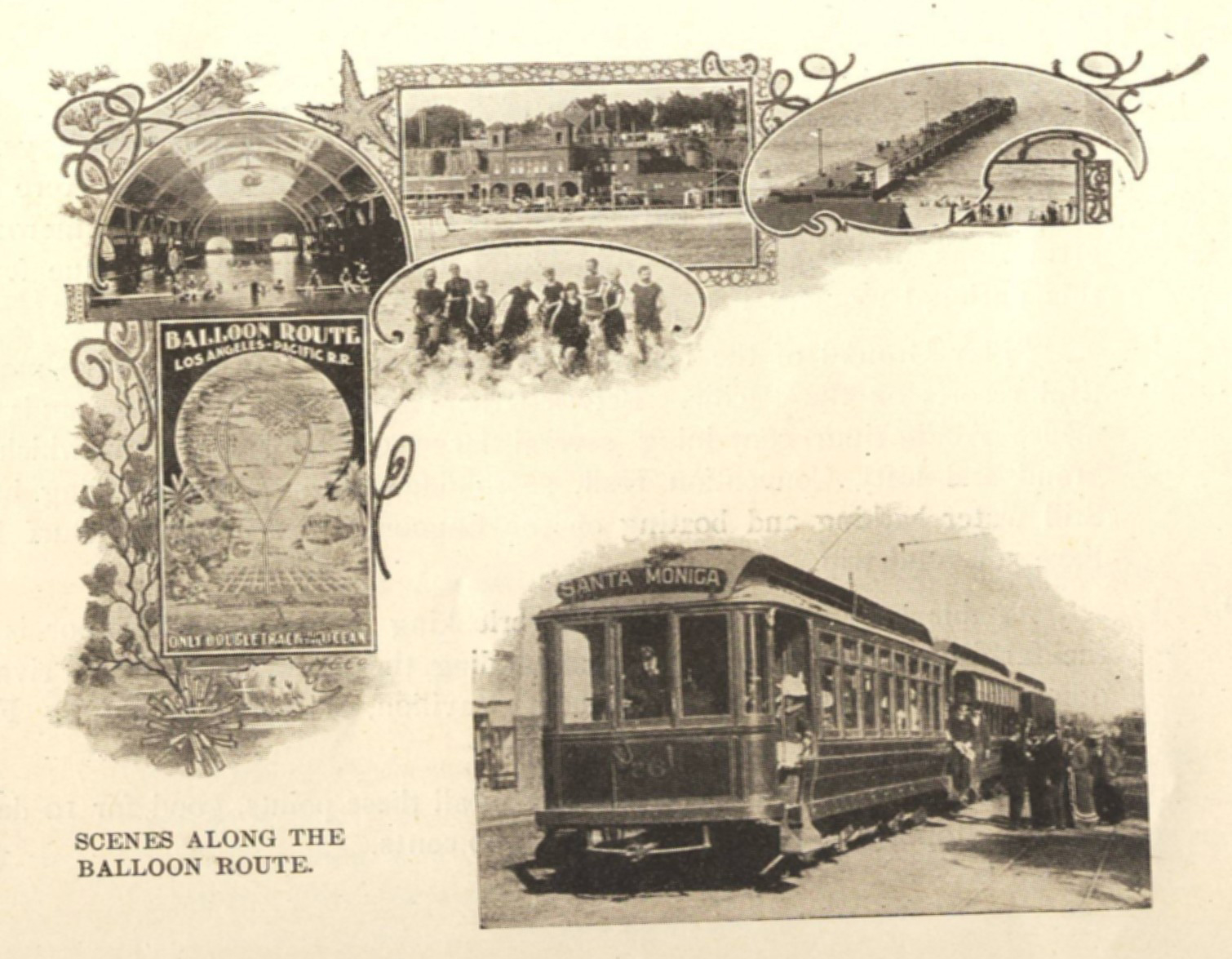
READ MORELos Angeles Pacific Railroad Balloon Route “Scenes Seen From An Electric Car” Brochure
From the brochure:
The Lines of this Company form a far more important railway system than can be judged from the number of trains arriving at and leaving Los Angeles each day. From a single track line of 18 miles in 1896 the Los Angeles-Pacific Railroad has grown to a double track system with a total of 185 miles of electric road, of which about ten miles are in Los Angeles.
Connections are made at Los Angeles with railroads diverging; at Sawtelle with Southern Pacific Company, at Inglewood with Santa Fe Railroad, at Hollywood with daily stage for Tolucca (sic), and at Redondo with Los Angeles & Redondo Railway, and with steamers for San Francisco and Coast points.
In addition to numerous intermediate points, the Company’s service reaches Hollywood, Colegrove, Sherman, Sawtelle, National Soldiers’ Home, Santa Monica, Ocean Park, Venice, Playa del Rey, Manhattan Beach, Hermosa and Redondo.
Nowhere are the elements conducive to expansion more pronounced. But the far-sighted management has not been slow in taking advantage of every point of strategic importance; so that any hope of successful competition in their territory must meet with failure.
Special Round Trip Tickets, taking in all these points, good for 10 days, and good to stop off at any or all of them, 80 cents.
Michael Patris Collection

Michael Patris Collection
Michael Patris Collection
Michael Patris Collection

Michael Patris Collection
Los Angeles & Pacific to Santa Monica Tickets
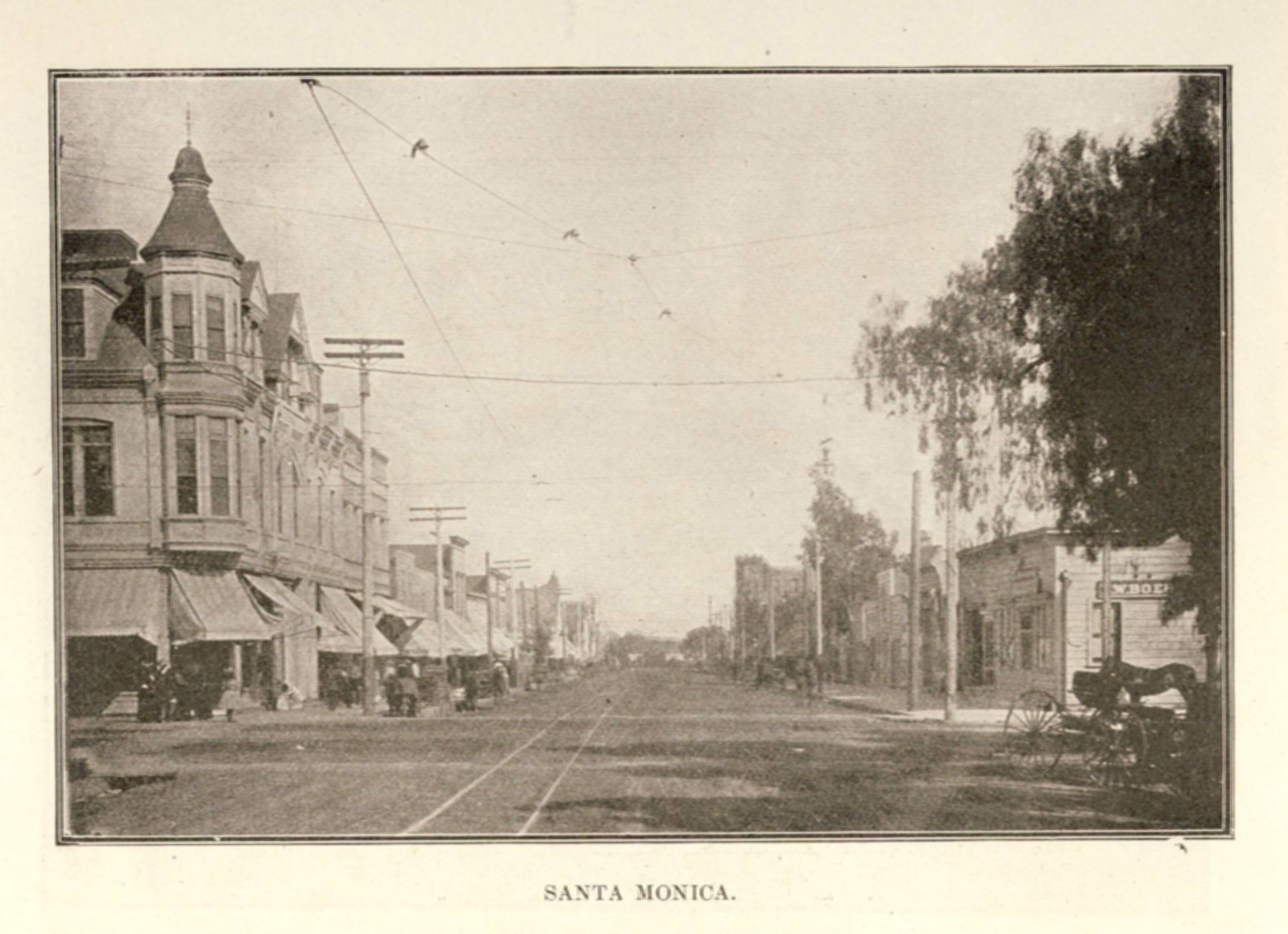
The Los Angeles Pacific Railroad was both a steam locomotive railway as well as an electric railway. It began in 1899 when “General” Moses Sherman and Eli P. Clark filed articles of incorporation. Clark would serve as president and a facsimile of his signature is on the top ticket. On June 16, 1903, the Los Angeles Pacific Railroad merged with the Los Angeles-Santa Monica Railroad Company and the Los Angeles, Hermosa Beach and Redondo Railway Company. The new name after this merger was the Los Angeles Pacific Railroad of California, but everyone still just called it the Los Angeles Pacific Railroad. The Los Angeles-Santa Monica Railroad Company was incorporated on December 2, 1902.
Over time there would be nearly 200 miles of track from the beach communities of the South Bay, including Redondo, Hermosa, Manhattan, El Segundo, Playa del Rey and Santa Monica. The lines headed eastward from the beach through the west side of Los Angeles, downtown Los Angeles, Sawtelle (The Soldier’s Home) and even through to Pasadena.
Rolling stock, in the heyday of 1906, included more than 400 pieces broken down as follows: 221 freight cars, 144 passenger cars, 17 electric locomotives, 12 repair service cars, 6 parlor cars and 5 mail cars.
From Terry Salmans: According to Interurbans Special 63 “Trolleys to the Surf” by Myers and Swett, LAP was sold to the Southern Pacific Railroad in 1906. The Los Angeles Pacific would be merged into the Pacific Electric in 1911.
By 1911 the PE could discontinue use of the steam locomotive lines, but continue to haul freight for decades.
Top ticket undated, blank on reverse. Bottom ticket back-dated 1908.
Michael Patris Collection
READ MOREDewbert L. Bourland and Los Angeles Traction Company No. 86

Guen Hodgson Sheets Collection
This absolutely stunning image was sent to us by Guen Hodgson Sheets, and here is her story:
Dewbert L. Bourland [conductor, standing on the steps] was my step great-grandfather and I know he worked for the Los Angeles Railway Co. in 1918. In this picture he looks much younger than 39 and is why I say it is early 1900s. At this time in his life he lived in Orange County.
We believe this image may actually date from the late 1890s, but we welcome any comments. And we graciously thank Guen for contributing this wonderful image to share with Los Angeles traction fans.
Guen Hodgson Sheets Collection
READ MOREKCET: L.A. as Subject: Incline L.A. Part 2 – Mt. Washington
Part 2 of KCET and USC’s look at Incline Railways in Los Angeles focuses on Mount Washington – it’s absolutely terrific, so set aside a few minutes to watch it closely. Great animations of vintage photographs, and expertly reported and edited.
READ MORELos Angeles & Pacific No. 234 at 316 West 4th Street
In this 1902 view, the camera looks to the east as Los Angeles & Pacific car no. 234 waits its departure for Venice and Santa Monica in front of the LAP Depot at 316 West 4th Street, between Hill Street and Broadway. Number 234, a narrow gauge car, will depart Downtown Los Angeles using Los Angeles Railway tracks along Spring and Main Streets. By 1912, no. 234 was completely rebuilt from top to bottom and made standard gauge. The rebuilt car became PE no. 584. All of the former LAP narrow gauge track on 4th Street and the Depot was abandoned in favor of the new Hill Street Station, which in turn would be rebuilt into the mega Subway Terminal Building in 1924-25. The 534 would burnish the rails of the PE until 1937.
Ralph Cantos Collection
READ MOREOntario & San Antonio Heights Railway Company
Steve Crise Collection
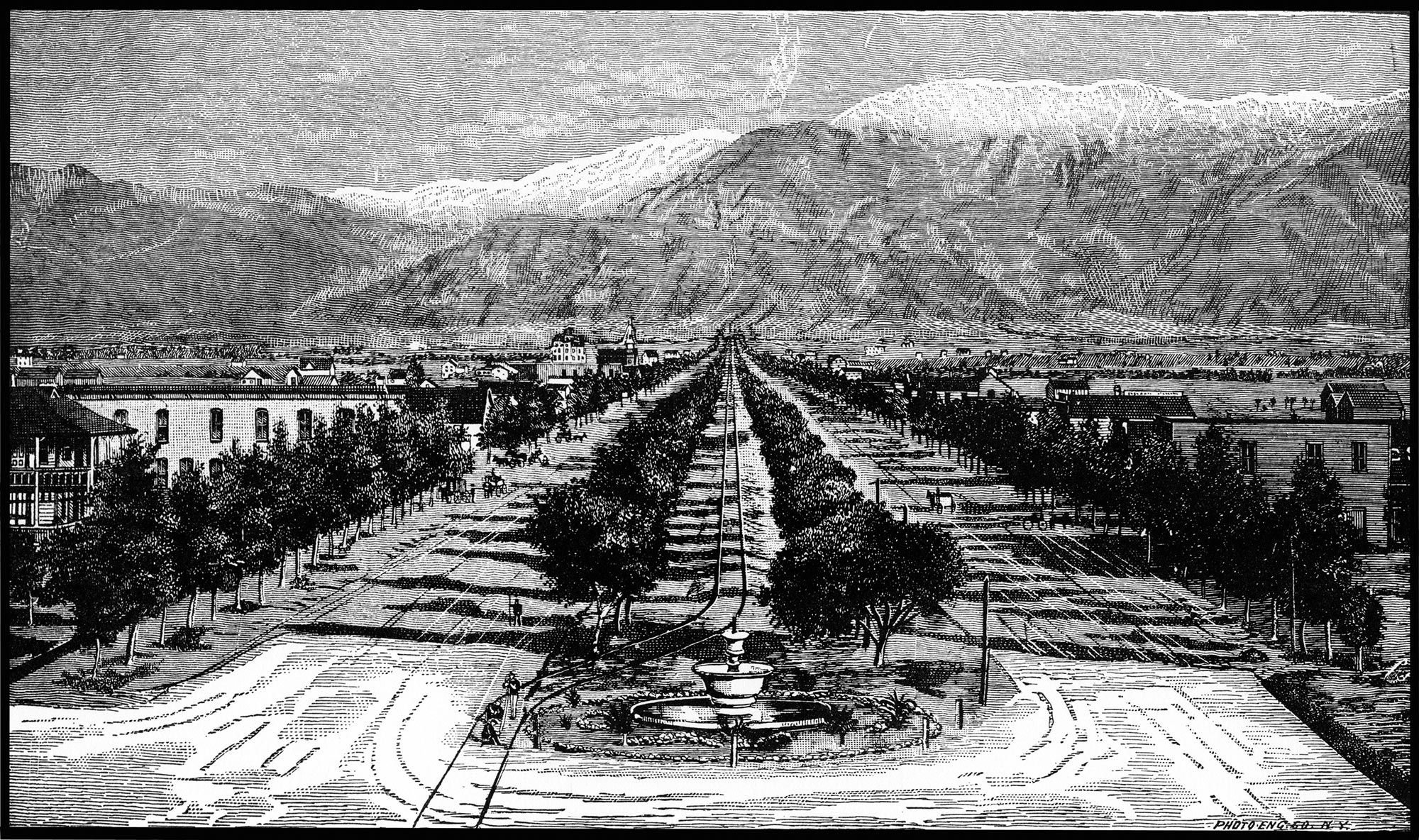
An engraving showing the Ontario & San Antonio Heights Railway Company from the foot of the line, in Ontario, looking north to Upland and Mount Baldy.
From the indispensable ERHA Site:
The line began operating with mule cars in 1887, a mule hauling the little single-truck car from State St.(Ontario) due north to San Antonio Heights, about ten miles north and 1200 feet higher; on the return trip the motive power climbed aboard a tiny trailer and coasted down with the car. When O&SA electrified the line in 1895, the mules became the property of a nearby rancher; the story goes that the temperamental animals pulled the plough fine uphill, but refused to work downhill.
A thirty-acre amusement park was built by the company of San Antonio Heights, with a powerhouse adjoining. Heavy crowds were transported along Euclid Ave. in the early days, for the line connected Ontario with Upland, provided connections between the SP Station at Ontario and the Santa Fe Station at Upland, and cared for the thongs bound for pleasure-seeking at the Park. Euclid Ave. was famous for it divided highway; in the wide center strip was a double line of huge pepper trees, and between the rows of trees, set a grass-covered private way, went the single track of this line.
Owned after electrification by Ontario Electric Company, the line became the property of the Pacific Light & Power Corporation. in a merger in 1908. Mr. William G. Kerckhoff, at that time president of PL&P, energetically pushed the expansion of the O&SA by building its branch to San Bernardino. However, the O&SA was purchased by SP on 13 April 1912 and this line, plus the line from Upland to Pomona, passed into PE hands.
Steve Crise Collection
READ MORE