Broadway Place Vanishes

Photo by Don Sims from the PRS Collection. Los Angeles Transit Lines 1532 at Broadway and Olympic Blcd, exact date unknown at this time. Photographer: Don Sims Location: South Broadway and Olympic Blvd, Los Angeles, California. Railroad: Los Angeles Transit Lines. Car # LATL 1532 Line: 5 Line Date: c. 1950 Image notes: Car is turning from South Broadway to Broadway Place. Broadway Place no longer exists, therefore we did not use this image for the Los Angeles Railway Past & Present project. Scanned from an 11 x 14 Print from the Pacific Railroad Society collection in San Dimas Ca.

[vc_row][vc_column][vc_column_text]By Steve Crise

Los Angeles Railways’ Line 5 was the systems longest route covering almost 22 miles from its northern most point in Eagle Rock to its southern terminus at Hawthorne Blvd and West Broadway in the city of Hawthorne. During its lengthy run, the 5 Line cars traversed one of the city’s shortest main drags that was right in the middle of downtown Los Angeles, a street less than 500 feet long named Broadway Place.

Broadway Place ran from the intersection of Olympic Blvd at South Broadway in a southeasterly direction to join South Main Street just north of 11th Street. As far as I have been able to figure out, the 5 Line was the only Los Angeles Railway or Los Angeles Transit Lines route to use this trackage making it an interesting adnominal within the vast system.

The Don Sims photo seen above that was shot around 1950, shows LATL car # 1532 on the 5 Line making a gentle left turn off of N. Broadway, crossing West Olympic Blvd in a southeasterly direction onto the tracks on Broadway Place.

This excellent photo was a very good candidate for the inclusion of our latest book on the Los Angeles Railway titled “Los Angeles Railway Past & Preset”, however during the lengthy process of choosing locations, shooting and editing photos for the book, Broadway Place had vanished! It disappeared under a massive new apartment complex appropriately named the Broadway Place Apartments.[/vc_column_text][mk_image src=”https://www.pacificelectric.org/wp-content/uploads/2021/12/sjc_6387crop.jpg” image_size=”full” title=”A contemporary view of Broadway Place by Steve Crise” desc=”Corner of Olympic Blvd and Broadway in Los Angeles CA to match a Don Sims shot of the same area shot in the 1950s.” caption_location=”outside-image”][vc_column_text css=”.vc_custom_1639582393135{margin-bottom: 0px !important;}”]In this photo which I made in 2013, the site was still just a parking lot as it had been for decades. I was still able to create a rather decent homage to Don’s photo of 1532. However with the site so drastically redeveloped and there being no chance whatsoever of anyone visiting the exact spot where either photo was made, we opted for a different view of Olympic and Broadway looking south toward Olympic Blvd. So consequently, we did not use Don’s wonderful image.

If Broadway Place had to disappear underneath a new development, the Broadway Place Apartments was a worthy project for its replacement. The structure nicely compliments the surrounding historic building in its Renaissance Revival style. If I didn’t know better I would think that it had been around just as long as all the other neighboring buildings.

Incidentally, the old Los Angeles Railway Building, which is just south of the Broadway Place Apartments at 1060 S. Broadway, has been revamped into the Hoxton Hotel. If you ever find yourself in the area, the Hoxton Hotel deserves a good long glance at the fantastic repurposing effort that was also made on this historic building.

[/vc_column_text][/vc_column][/vc_row]

Donald Sims 1928 – 2021

Don Sims Photograph. Image taken at Los Angeles Union Passenger Terminal. Date: 11- 1953

By Steve Crise

All of us at PERYhs.org regret to announce that Donald Sims, prolific photographer and writer, passed away on Saturday, December 11, 2021. He was 93.

Don had contributed images to our collection for use in various projects over the years. We are very grateful for Don’s generosity and we are saddened by his passing.

Don had a unique style to his photography that was easily recognizable to many railfans. His sense of composition set him apart from most other photographers of his day and that unique quality in his work lasted his entire carrier.

As an example of what I consider one of his best photographs depicting the day to day operations of the Los Angeles Transit Lines is this photo of F Line car 1444 at Los Angeles Union Passenger Terminal that Don made in November of 1953. Study it closely and see all the detail and richness confined to a single frame of film. The boarding passengers all seem to have just stepped of a recently arriving transcontinental passenger train just moments ago with their luggage firmly grasped in hand. The motorman is watching the fare box as a boarding passenger deposits his fare. The advertisement on the side of car 1444 boasts the coming of the newest model of CBS Columbia TV sets for 1954. Don really did a great job capturing a wonderful slice of daily life in Los Angeles in the 1950’s.

For a more on the work and life of Donald Sims, please visit this wonderful recollection by David Lustig at Trains Magazine.

Rest in peace, Don. — Steve Crise

The LARY-LATL H Line: Everyone wanted it, except management

LATL 1305 at Melrose and Western, H Line

[vc_row][vc_column][vc_column_text]By Ralph Cantos

When the Los Angeles Transit Lines purchased the Los Angeles Railway Co., the new corporation began an immediate house cleaning of a large portion of the LARY rail system.  LATL management called it “trimming the fat.”

On Aug. 22, 1947, all Birney-operated shuttle lines were abandoned.  Also, several major rail lines were abandoned, including the “Lovable U” Line.

One of the most popular lines to be abandoned on that fateful day was the H line. Los Angeles City Council member, the late Kenneth Hahn, was admittedly opposed to the H line abandonment.  He even went so far as to propose a court injunction to stop the H Line abandonment.

But alas, LATL went ahead with the massive rail abandonment, and to make sure the H line was gone for good, crews began ripping up the rails on two sections of the line’s private-right-of-ways, literally  minutes after the last H line car ended its run.

Today, if you know where to look, traces of the “back yard” right-of-way between Bimini Place on the west and a mile and a half to the east end of right of way at 2nd Street and Lafayette Park Place can a still be found.

All along the right-of-way easement, a utility pole line follows the rail line and newer 1950s homes are shoehorned on the narrow right-of-way between houses dating to the early 1910s.[/vc_column_text][mk_image src=”https://www.pacificelectric.org/wp-content/uploads/2021/12/latl-1212-at-la-fayette-park-place-1947-2.jpg” image_size=”full” title=”1212 leaving the right-of-way at 2nd and Lafayette Park Place” caption_location=”outside-image”][vc_column_text css=”.vc_custom_1638458392261{margin-bottom: 0px !important;}”]This scene is unrecognizable today. The house and apartment building on both sides of the tracks were bulldozed away, and replaced by a huge 1960 apartment.[/vc_column_text][mk_padding_divider][mk_image src=”https://www.pacificelectric.org/wp-content/uploads/2021/12/latl-1258-h-line-at-virgil-ave-aug.1947.jpg” image_size=”full” title=”1258 H Line at Virgil Avenue, August 1947″ caption_location=”outside-image”][vc_column_text css=”.vc_custom_1638457844035{margin-bottom: 0px !important;}”]1258 crosses busy Virgil Ave under the protection of an ACME traffic signal. Notice the traffic signal  censor on the overhead wire. That censor on the west bound track, reset the ACME signal after the H car was safely across the street. There was a censor on the east bound trolley wire as well. Today, this scene is unrecognizable. Both the nice houses on each  side of the tracks and the right-of-way, were bulldozed away years ago to make way for a large apartment building.[/vc_column_text][mk_padding_divider][mk_image src=”https://www.pacificelectric.org/wp-content/uploads/2021/12/latl-1364-at-virgil-ave-4.jpg” image_size=”full” title=”LATL 1364 at Virgil Avenue” caption_location=”outside-image”][vc_column_text css=”.vc_custom_1638457967534{margin-bottom: 0px !important;}”]Another shot of the H Line at Virgil Ave. That big, beautiful  wonderful “railfan house” is gone today.[/vc_column_text][mk_padding_divider][mk_image src=”https://www.pacificelectric.org/wp-content/uploads/2021/12/lary-1370_h-line-at-bimini-right-of-way-2.jpg” image_size=”full” title=”1370 on the H Line at Bimini right-of-way” caption_location=”outside-image”][vc_column_text css=”.vc_custom_1638458079189{margin-bottom: 0px !important;}”]1370 is seen here at the west end of right of way at Bimini Place between 1st and 2nd Streets. Today, this curve is very visible, it leads to an auto repair shop built on the spot where the 1370 was photographed.[/vc_column_text][mk_padding_divider][mk_image src=”https://www.pacificelectric.org/wp-content/uploads/2021/12/latl-1245_at-bimini-place_1947.jpg” image_size=”full” title=”LATL 1245 at Bimini Place, 1947″ caption_location=”outside-image”][vc_column_text css=”.vc_custom_1638458177852{margin-bottom: 0px !important;}”]1245 is seen here at Bimini Place and the short section of right-of-way. Today, the rails that the 1245 are on, have been uncovered and preserved.[/vc_column_text][mk_padding_divider][mk_image src=”https://www.pacificelectric.org/wp-content/uploads/2021/12/latl-v-line-rails-bimini-pl-2020.jpg” image_size=”full” title=”LATL rails preserved at Bimini Place, 2020″ caption_location=”outside-image”][vc_column_text css=”.vc_custom_1638458264819{margin-bottom: 0px !important;}”]Today, the rails leading out of the short right-of-way onto Bimini Place have been uncovered and preserved. This was the inbound track .[/vc_column_text][mk_padding_divider][mk_image src=”https://www.pacificelectric.org/wp-content/uploads/2021/12/latl-1st-street-loop-2020.jpg” image_size=”full” title=”LATL 1st Street Loop, 2020″ caption_location=”outside-image”][vc_column_text css=”.vc_custom_1638458544944{margin-bottom: 0px !important;}”]The former H Line tracks at 1st and Bimini was converted from a “run through” to a loop after the H Line abandonment . It was used by the LATL-LAMTA V line cars right up to the last day, March 31, 1963. To my knowledge, this is the very last  streetcar rail to be seen any place in LA as it looks today.[/vc_column_text][mk_padding_divider][mk_image src=”https://www.pacificelectric.org/wp-content/uploads/2021/12/1387-on-heliotope-ave-h-line.jpg” image_size=”full” title=”1387 on Heliotrope Avenue, H Line” caption_location=”outside-image”][vc_column_text css=”.vc_custom_1638458649691{margin-bottom: 0px !important;}”]LATL 1380 rolls southbound along Heliotrope Drive just south of Melrose Ave. Today, this once-tranquil scene has been shattered by the Hollywood (101) Freeway that was built over Heliotrope Drive, taking everything seen here with it. This is shortly before abandonment.[/vc_column_text][mk_padding_divider][mk_image src=”https://www.pacificelectric.org/wp-content/uploads/2021/12/heliotrope-bl-1996.jpg” image_size=”full” title=”Ralph’s wagon on Heliotrope in 1996 with freshly revealed H Line rails” caption_location=”outside-image”][vc_column_text css=”.vc_custom_1638458756914{margin-bottom: 0px !important;}”]I took this photo of my car along Heliotrope Drive in 1996, almost 50 years since the rails were paved over. The 50-year-old pavement was scraped away, revealing the perfectly preserved H Line car tracks. The Hollywood Freeway is seen in the background. We will have to wait until about 2046 to see these rails again.[/vc_column_text][mk_padding_divider][mk_image src=”https://www.pacificelectric.org/wp-content/uploads/2021/12/latl-1305-at-melrose-western-h-line.jpg” image_size=”full” title=”LATL 1305 at Melrose and Western, H Line” caption_location=”outside-image”][vc_column_text css=”.vc_custom_1638461361315{margin-bottom: 0px !important;}”]The west end of the H Line at Melrose and Western Avenues.  Car 1305 in on the H Line and car 1391 is northbound on Western Ave.  The end of rail service on both this section of the S Line on Western Ave. and the entire H Line was only days away when this photo was taken.

I must say, that if the H Line cars were still changing ends in the middle of Melrose Ave. today, auto traffic would be backed up along Melrose clear back to West Hollywood. An off-street loop or “Y” would have been built for the H Line PCCs, if Kenny Hahn had had his way.[/vc_column_text][/vc_column][/vc_row]

LAMTA P-1 3068: Un tren abandonado en el desierto más árido del mundo (Atacama – Chile)

Un tren abandonado en el desierto más árido del mundo (Atacama - Chile).

[vc_row][vc_column][vc_column_text]Ralph Cantos discovered this amazing new film from Chile regarding the sad fate of Los Angeles MTA P-1 PCC no. 3068, abandoned in a Chilean desert with its right-of-way pulled up and scrapped. Check it out![/vc_column_text][mk_padding_divider size=”20″][vc_row_inner][vc_column_inner width=”1/6″][/vc_column_inner][vc_column_inner width=”2/3″][vc_video link=”https://youtu.be/gTCTNjhndSY”][mk_padding_divider size=”20″][mk_image src=”https://www.pacificelectric.org/wp-content/uploads/2021/11/latl-3068-at-larchmont-melrose-1948-2.jpg” image_size=”full” title=”3068 in better days” desc=”LATL 3068 at Larchmont and Melrose in 1948.”][/vc_column_inner][vc_column_inner width=”1/6″][/vc_column_inner][/vc_row_inner][mk_padding_divider size=”20″][/vc_column][/vc_row]

LATL PCC Accident on the J Line (Santa Fe Avenue)

"Streetcar leaps from tracks, crashes into shop" - newspaper clipping

[vc_row][vc_column][vc_column_text]By Ralph Cantos

Although the car number if this LATL P-1  car is not visible, it is definitely a P-1, cars numbered 3001 to 3095. This photo must have been taken around 1947 to about 1950.

Notice that the car involved still has its first LATL paint scheme with the green paint coming to a “V” just above the headlight. That paint scheme ended when the cars were repainted for the first  time in the early 1950s. Notice too, that this car still retains its full-length “streamlining” along the lower roof line, something LATL removed in the mid-1950s.

Also note that the car involved still retains its 4-blade “horizontal sweep” windshield wipers, another item that LATL removed in the mid-1950s. Those factory wipers were replaced with two “arc sweep” wipers mounted at the belt rail, and  at the same time, the front windows were sealed shut.

This car was operating along south Santa Fe Avenue on the J line. On this section of the J line, hot shot operators could, and often did, open up the cars to to their full speed, which may have been the cause of this derailment.

This car was surely repaired, as only one Los Angeles PCC did not make it to the end of rail service, that car being no.3035 that was clobbered by a Santa Fe switcher  engine just outside of Vernon Yard.

Ralph Cantos Collection[/vc_column_text][mk_image src=”https://www.pacificelectric.org/wp-content/uploads/2021/11/latl-3035-at-vernon-yard-rear.jpg” image_size=”full” title=”LATL 3035″ desc=”The poor #3035 is seen here in the dirt at Vernon Yard, a few days after the accident at the Santa Fe crossing just outside Vernon Yard. She was damaged beyond repair and was cut up for parts on the spot.” caption_location=”outside-image”][/vc_column][/vc_row]

Los Angeles Railway 287: End of the Line – Almost

Los Angeles Railway 287 Huntington Standard trolley car at Vernon Yard, awaiting scrapping

[vc_row][vc_column][vc_column_text]By Ralph Cantos

Los Angeles Railway Huntington Standard no. 287 heads a long line of retired Standards at the Vernon Yard’s “scrap track.”

These unfortunate cars probably operated their last mile under their own power, as this track still has overhead. Notice that the 287 still sports a B Line slat in the roof sign box. This photo must have been taken in mid-1946.

The new Los Angeles Transit Lines is in the midst of a big “house cleaning,” sending to scrap hundreds of older, unneeded cars as hundreds of new GM Diesel buses arrive in preparation for the big 1947 rail abandonments.[/vc_column_text][mk_padding_divider][mk_image src=”https://www.pacificelectric.org/wp-content/uploads/2021/09/lary-287.jpg” image_size=”full”][vc_column_text css=”.vc_custom_1632427973844{margin-bottom: 0px !important;}”]By some miracle, the body of the 287 made it out of the Vernon Yard scrap track, in one piece, more or less. Some unknown private party purchased the “truck-less” body of 287 and had it delivered to a hill top on the outskirts of Palmdale, over looking Highway 14 and the Southern Pacific main line to Palmdale and Lancaster.

Perhaps, some unknown railfan had plans of of making the 287 into a train watchers paradise. But for reasons lost to history, what purpose the 287 was to have served, those plans never came to to be.

So for decades, the forlorn 287 would sit on that hill top, alone and abandoned, enduring endless acts of vandalization. I myself saw the 287 from Highway 14 and from occasional rail fan trips that operated along this stretch of Southern Pacific main.

As the years passed, each time I saw the 287, she looked worse than the time before, until one day, she was gone. The 287 must have been a key piece of a “dream that failed.”[/vc_column_text][/vc_column][/vc_row]

Rescue 8: The Steel Mountain

Title sequence from the 1950 TV series Rescue 8

[vc_row][vc_column][vc_column_text css=”.vc_custom_1629641732866{margin-bottom: 0px !important;}”]Ralph Cantos wrote us with a tip to search for an episode of an early fire-rescue series similar to Jack Webb’s “Emergency!” from the late 1950s entitled “Rescue 8.” One episode, entitled “The Steel Mountain,” was filmed at National Metals on Terminal Island, using the stacks of scrapped Los Angeles Railway / Transit Lines cars as part of the plot. The episode features a very young Harry Dean Stanton, as well as possibly voiceover legend Paul Frees (Haunted Mansion).

The plot synopsis:

A man and his girlfriend go to a storage yard where old trolley cars are stacked and stored. They are looking for money that was hidden under the rear seat of trolley car #1392. After finding the money, the man attempts to get down from the old stacked trolley cars when he slips and gets trapped. Wes and Skip must devise a plan to free the man without causing the stacked trolley cars to collapse.

From Ralph:

Back in 1959 there was  an episode of the weekly TV show “RESCUE-8” called “THE STEEL MOUNTAIN” and it was filmed at National Metals on Terminal Island. In this episode the bad guy gets trapped between two of the LATL H-class car bodies and has to be rescued.

When the bad guy first starts to climb up the stack, in the foreground is none other than LATL car 2501 sitting on the ground. It was later moved to OERM. The second noteworthy is car 1370. It was one of only two 1300s to get the HUNTER Roll sign on the roof, the other car being 1371. The LARY in 1930 added the HUNTER Roll signs to cars 1201 to 1260 and cars 1416 to 1450. It’s amazing that the 2501 and the 1370 are seen in the episode.

[/vc_column_text][mk_padding_divider][vc_row_inner][vc_column_inner width=”1/6″][/vc_column_inner][vc_column_inner width=”2/3″][vc_video link=”https://youtu.be/Cwf_R5x0iQk”][/vc_column_inner][vc_column_inner width=”1/6″][/vc_column_inner][/vc_row_inner][mk_padding_divider][mk_image src=”https://www.pacificelectric.org/wp-content/uploads/2021/08/lary-1392-s-line-2.jpg” image_size=”full” title=”Los Angeles Transit Lines 1392″ desc=”This is the car depicted in Rescue 8 where the stolen money was located. This undated image was captured on the S Line. Unknown photographer.” caption_location=”outside-image”][mk_padding_divider][mk_image src=”https://www.pacificelectric.org/wp-content/uploads/2021/08/lary-1370_h-line-at-bimini-right-of-way.jpg” image_size=”full” title=”Los Angeles Railway 1370 on the H Line at Bimini right-of-way” desc=”Here is car 1370 seen several times in the Rescue 8 episode. Car 1370 and 1371 were the only 1300s to have the HUNTER roof roll sign box.” caption_location=”outside-image”][/vc_column][/vc_row]

New Book: Los Angeles Railway Past and Present

Book cover for "Los Angeles Railway Past and Present"

Authors Steven Crise and Michael Patris are proud to announce the release of their latest book “Los Angeles Railway” that is now available from Arcadia Publishing as part of their Past & Present series. Steven and Michael have spent more than nine years sorting and editing through hundreds of images and visiting over 90 locations throughout the Los Angeles area to bring to print more than 80 comparative photographic studies of various locations along the old horse, cable car routes, and the later electric powered lines of the Los Angeles Railway, the Los Angeles Transit Lines and the Metropolitan Transit Authority. The studies contained within the pages of this book will surprise and amaze you with the vast and ever changing developments in the city and by the varied mass-transit systems that have come and gone over the last 150 years.

To take a short tour of Los Angeles Railway on YouTube, click here: https://www.youtube.com/watch?v=yQHYB8BWzlA
Ordering your copy of Los Angeles Railway is simple and can be accomplished by clicking here:

Steve Griffis: Subway Terminal Building and Hill Street Station

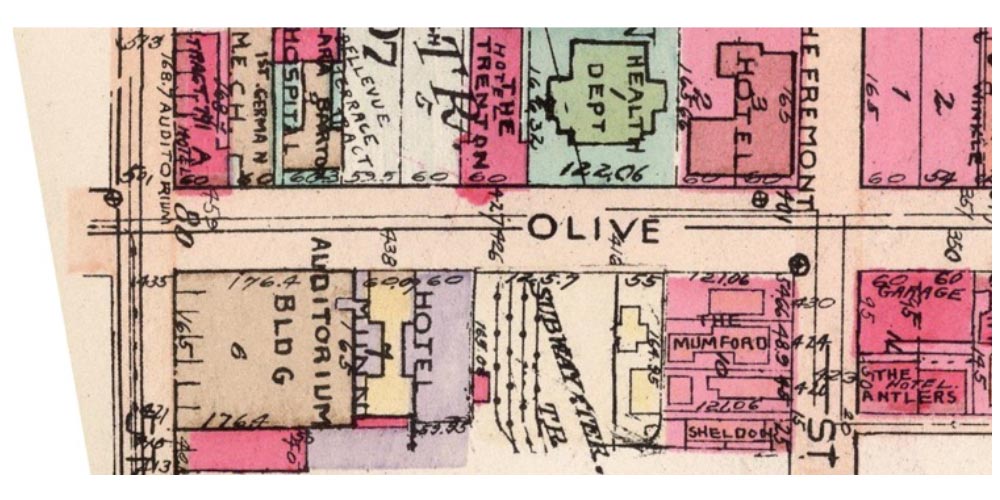
A vintage map showing the Subway Terminal Building in Los Angeles

Why are they where they are, why are they the size they are and why does the building have an extension to 4th Street?

By Steve Griffis

Being a little obsessed with Los Angeles’s original rail mass transit (before Metro), I have long thought about constructing a model of a portion of it.  Oh, sure, I’d love to recreate the whole thing but I’m not that delusional yet.

The Pacific Electric Railway stretched from Canoga Park in the west to Redlands in the east.  From Mt Lowe way up in the mountains north of Los Angeles to Balboa in the South.  In its time the Pacific Electric was the largest electric railway system in the world.  It connected all the major cities surrounding Los Angeles.

The Los Angeles Railway covered what is now called the core of Los Angeles.  From almost Hancock Park in the west to Huntington Park in the east.  From Eagle Rock in the north to Inglewood in the south.  The Los Angeles Railway was enormous.

When I began seriously thinking of constructing a portion of the Pacific Electric and Los Angeles Railway, Hill Street in downtown Los Angeles immediately came to mind as a place to start.  Pacific Electric and Los Angeles Railway both operated on Hill Street.  There were two incline railways climbing Bunker Hill and two tunnels.

But the main feature of interest on Hill Street was the Hill Street Station.  Interurban cars left from the Hill Street Station to Hollywood, the San Fernando Valley, Beverly Hills, Culver City and every beach city from Santa Monica to Redondo.

And with increasing auto congestion, a subway was built from the Hill Street Station property to west of downtown to lessen automobile impact on interurban cars to Hollywood and the San Fernando Valley.  The Hill Street Station property and surrounding properties were reorganized to make room for a Subway Terminal Building and new integrated Hill Street Station.

Back to my goal of wanting to recreate a portion of the Pacific Electric and Los Angeles Railway.  The Subway Terminal Building and Hill Street Station seemed like a challenge and so I would there to first draw the important features in CAD (Computer Aided Design).  To do so I needed measurements.  I wanted exact measurements.  Or as close as I could get.  I hate estimating.

I found some dimensions for the Subway Terminal Building on erha.org, 141’ by 330’.  Why 141’?  I was curious.  I would have expected a multiple of 5 or 10.  And what about the Subway Terminal Building Wing that extends to 4th St?  Nothing I could find.

Then I discovered the architect’s description of the Subway Terminal Building.  The Subway Terminal Building is 140’ 8.5” wide on Hill Street and 324’ from Hill Street to Olive St.  The Subway Terminal Building has a wing along one side that is 121’ 11” long and 45’ wide (the wing contains the building’s mechanical equipment which I’ll bet wouldn’t fit in the main building).  I know the new Hill Street Station is 100’ wide, obtained from the Interurban Specials on the Pacific Electric.

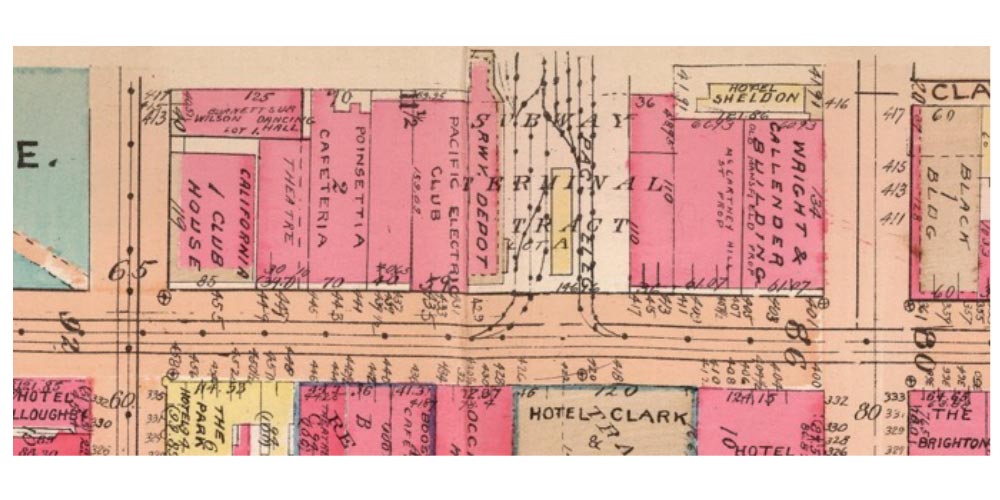
Okay, why these particular dimensions?  And then I discovered “Baist’s Real Estate Atlas of Surveys of Los Angeles, 1921.”  It’s amazing!  Page after page of maps of Los Angeles of the time showing every street, their widths, the sewer lines, fire hydrant locations and most importantly, the dimensions of every lot on every block and buildings on those lots!  And it’s all color coded!

The block which contained the Hill Street Station prior to the subway is shown unfortunately split across two different pages in the Atlas.  Because Atlas pages are not drawn exactly to scale I can’t easily join them together.  So the Hill Street Station block is shown as an upper half and a lower half.

The block is bounded by Olive Street on the top, 5th Street on the left, 4th Street on the right, and Hill Street on the bottom.  The Hill Street Station is down the middle of the block.  Railway tracks are lines with dots on them.

A vintage map of Olive Street in Los Angeles
A vintage map showing the Subway Terminal Building in Los Angeles

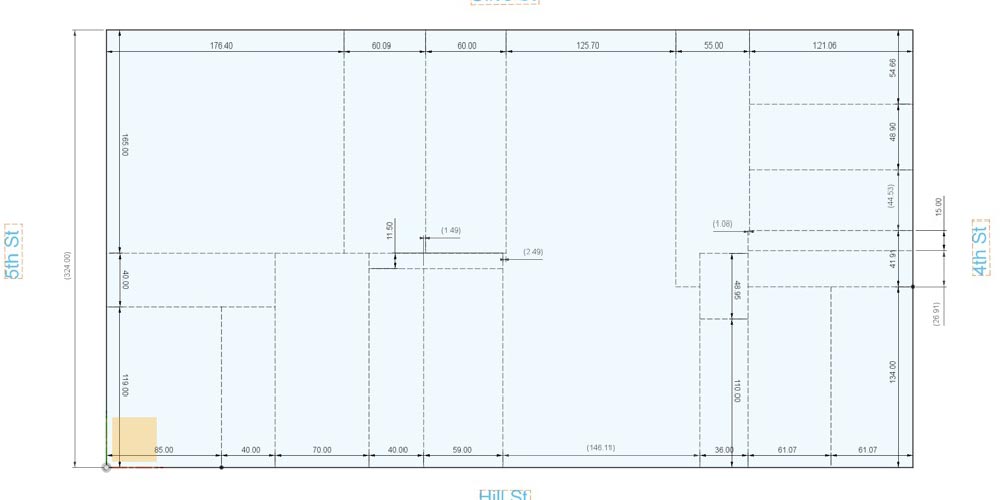
When I entered the individual lot dimensions into my CAD package I got the drawing below.  As a note, I don’t know how surveyors did measurements back in 1921 but some lot boundaries just don’t line up perfectly.  For instance, consider the 60’ lot on Olive St and the 59’ lot on Hill Street, surely the left and right boundaries must have actually lined up.  The 55’ lot on Olive St and the 36’ lot on Hill Street is even worse.  The big open area in the middle of the block is where the original Hill Street Station was located.  From pictures of the Station, its boundary sure looks rectangular.  So for the purposes of arguing how the Subway Terminal Building and Hill Street Station got their dimensions, I believe certain lot measurements are close enough.

If we add the 60’, 125.7’ and 55’ lots on Olive Street together we get 240.7’.  Subtracting 100’ for the new Hill Street Station leaves 140.7’ for the Subway Terminal Building.  Which is exactly 140’ 8.5”, the architect’s stated width.  The length is exactly 324’ which also matches.

The Subway Terminal Building’s Wing, I believe is right where the 44.53’ lot on 4th St is located.  The width is almost perfect, as is the length.  My conclusion is that the Hotel Munn, the Pacific Electric Club and other buildings were torn down to make space for the Subway Terminal Building and new Hill Street Station.  This must have been quite an undertaking for 1925.

I now had dimensions I felt were correct and when I finally build the Subway Terminal Building and Hill Street Station it’s as close as I can come to recreating the real thing as it was.

A contemporary CAD drawing of the Subway Terminal Building's dimensions
A vintage map showing the Subway Terminal Building in Los Angeles

LA’s streetcars under festive Christmas decorations: Span wires made convenient

LARY no. 3029 at 7th & Grand, 1940

[vc_row][vc_column][vc_column_text]By Ralph Cantos

Over the decades, Christmas time always meant Christmas decorations  mounted to street lights and more often, hanging from LARY-LATL-MTA and PE overhead span wires.

The overhead span wires made it very easy to hang decorations along many important avenues and boulevards when LA’s once-vast streetcar system covered the city.

In later years, Hollywood Boulevard, Pacific Boulevard in Huntington Park, and Brand Boulevard in Glendale always displayed beautiful, often illuminated holiday decorations.

Before the out break of World War II, Broadway and 7th Streets in Downtown Los Angekles also went all-out to celebrate the  Christmas season with decorations hanging from LARY span wires.

Its believed that Christmas 1941 was the last time Downtown LA went all out with  the decorations.

In this 1940 colorized black-and-white photo, LARY no. 3029 working the J line turns off of 7th street onto Grand Ave.  Holiday shoppers add to the festive atmosphere.[/vc_column_text][mk_padding_divider][mk_image src=”https://www.pacificelectric.org/wp-content/uploads/2020/12/lary-3007-on-broadway-x-mas-1940.jpg” image_size=”full” lightbox=”true” title=”Los Angeles Railway no.3007 on Broadway, Christmas 1940.” hover_image_overlay=”false”][vc_column_text css=”.vc_custom_1607959857060{margin-bottom: 0px !important;}”]Incredible crowds fill the sidewalks and streetcar safety zones at Broadway & 7th at Christmas time 1940. Decorations hanging from span wires add to the festive season. A near-new P-1 PCC working the P line takes on passengers.[/vc_column_text][mk_padding_divider][mk_image src=”https://www.pacificelectric.org/wp-content/uploads/2020/12/pe-5150-at-hollywood-highland-1953.jpg” image_size=”full” lightbox=”true” title=”Pacific Electric no. 5150 at Hollywood and Highland, 1953.” hover_image_overlay=”false”][vc_column_text css=”.vc_custom_1607959999051{margin-bottom: 0px !important;}”]The last Christmas for the PE cars on Hollywood Boulevard: Its Christmas time 1953 on Hollywood Blvd. Festive decorations hang form PE’s overhead, a yearly seen that took place for decades.[/vc_column_text][mk_padding_divider][mk_image src=”https://www.pacificelectric.org/wp-content/uploads/2020/12/pe-5028-christmas-1954.jpg” image_size=”full” lightbox=”true” title=”Pacific Electric no. 5028, Christmas 1954.” hover_image_overlay=”false”][vc_column_text css=”.vc_custom_1607960107311{margin-bottom: 0px !important;}”]The last Christmas for Pacific Electric cars on Brand Boulevard: It’s Christmas time on Brand Boulevard. Decorations hang from PE’s magnificent catenary overhead. The beautiful decorations eclipsed only by the beauty of the 5028. Roger Titus photo.[/vc_column_text][mk_padding_divider][mk_image src=”https://www.pacificelectric.org/wp-content/uploads/2020/12/latl-3165-on-east-first-st.jpg” image_size=”full” lightbox=”true” title=”LATL no. 3165 on East First Street.” hover_image_overlay=”false”][vc_column_text css=”.vc_custom_1607960196073{margin-bottom: 0px !important;}”]Los Angeles Transit Lines no. 3165 rolls along East First Street in this  Christmas 1957 photo. Today, the 3165 rolls on at the OERM museum in Perris, California.[/vc_column_text][mk_padding_divider][mk_image src=”https://www.pacificelectric.org/wp-content/uploads/2020/12/img254-2.jpg” image_size=”full” lightbox=”true” title=”LAMTA no. 3046 on Pacific Boulevard in Huntington Park, 1962.” hover_image_overlay=”false”][vc_column_text css=”.vc_custom_1607960326443{margin-bottom: 0px !important;}”]The last Christmas for LA’s PCCs in Huntington Park: this beautiful photo take by Harry D. Peat shows LAMTA no. 3046 as she swings off of Pacific Boulevard and onto Florence Avenue at Christmas time 1962. The motorman stopped the 3046 momentarily and smiled so Harry could get this timeless photo.

This is it for decorations of any type that will hang from overhead span wires along Pacific Boulevard. The J line will become history just 4 months after this photo was taken.[/vc_column_text][/vc_column][/vc_row]