Los Angeles Railway A Line car # 62 on W. Temple Street

Los Angeles Railway A Line Car 62 on West Temple Street

By Steve Crise

Los Angeles Railway Type-C center door “Sowbelly” car 62 is on the A-Line heading east on Temple Street at Parkman Avenue toward downtown Los Angeles. This car will eventually end its run at West Adams Boulevard at Alsace Avenue as can be read on the dash sign. F. J. (Frank) Bradford is the photographer who made this shot on September 9, 1945. Print courtesy of the Craig Rasmussen collection.

BunkerHillLosAngeles.com: No, Everyone, there was No Los Angeles Streetcar Conspiracy

BunkerHillLosAngeles.com has an interesting (and accurate) debunking of the long-held belief that the Los Angeles streetcar system was undermined by Big Oil, Detroit manufacturers and the like.

Los Angeles has a dark and hidden history, and here’s part of it you should know: we once had the largest, best run, most efficient, most beloved, most profitable, publicly owned streetcar system in the world. The Red Cars! But! The bloated plutocrats and greasy oligarchs said NO! Profits over people! A cackling cabal of big oil, big tire, and big auto conspired to buy up all the Red Cars and destroy them! Which they did! Then they needlessly replaced them with horrible nasty busses which people disliked so much they all went out and bought cars! And that, my friend, is the reason we now live in a dystopic autopian hellscape of traffic and smog and sprawl.

Not only that, but it was such a grand and shameless conspiracy, that Standard Oil and General Motors and Firestone Tire actually got taken to court and were found guilty of conspiracy and had to pay huge fines! But the damage had already been done to the poor beloved streetcars. All of America’s streetcars had been tossed in the sea by General Motors, and the corporate fatcats puffed contentedly on their cigars and just laughed.

Of course, none of that is true. “But Nathan,” you say, “the GM Streetcar Conspiracy is a real thing! Literally everybody knows about it!” Sorry to burst your bubble but no, the entire tale is twaddle and hogwash. Not even, like, there was a conspiracy but it wasn’t that bad. I’m saying no, it’s literally not a thing that ever existed. Don’t believe me? Read on!

Click to read the complete piece.

LATL 1160 Hosts 1952 Railfan Excursion

Ray Ballash photo. OERM Archive collection

By Steve Crise

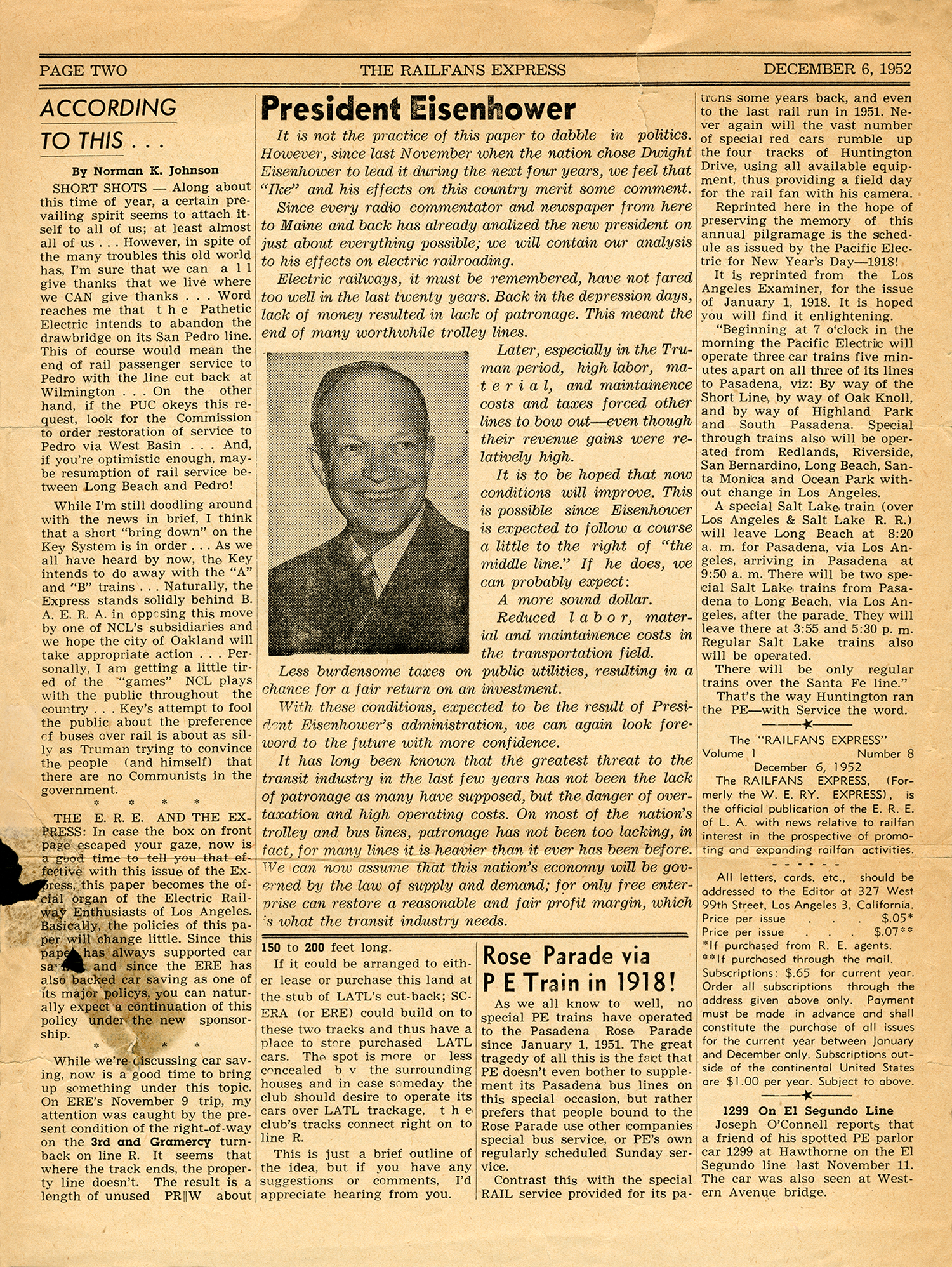
The Electric Railway Enthusiasts of Los Angeles put together their first “Special Railfans Limited” excursion that took place on November 9, 1952, and covered most of the remaining lines plus a few bonus stops along the way.

Usually, I just isolate the featured article from a newsletter and only post that edited selection on our site along with a couple of significant historical images from the trip. But I found the rest of the newsletter so fascinating that I decided to make an exception in this case and post the newsletter in its entirety, both pages.

Perhaps the most interesting article outside of the trip report is the editorial on page two commenting on the newly elected President of the United States, Dwight D. Eisenhower. A most interesting take on the how the railfans think his presidency will affect the state of electric railways in the USA over the next four years of his freshman term.  – Steve Crise 2023.

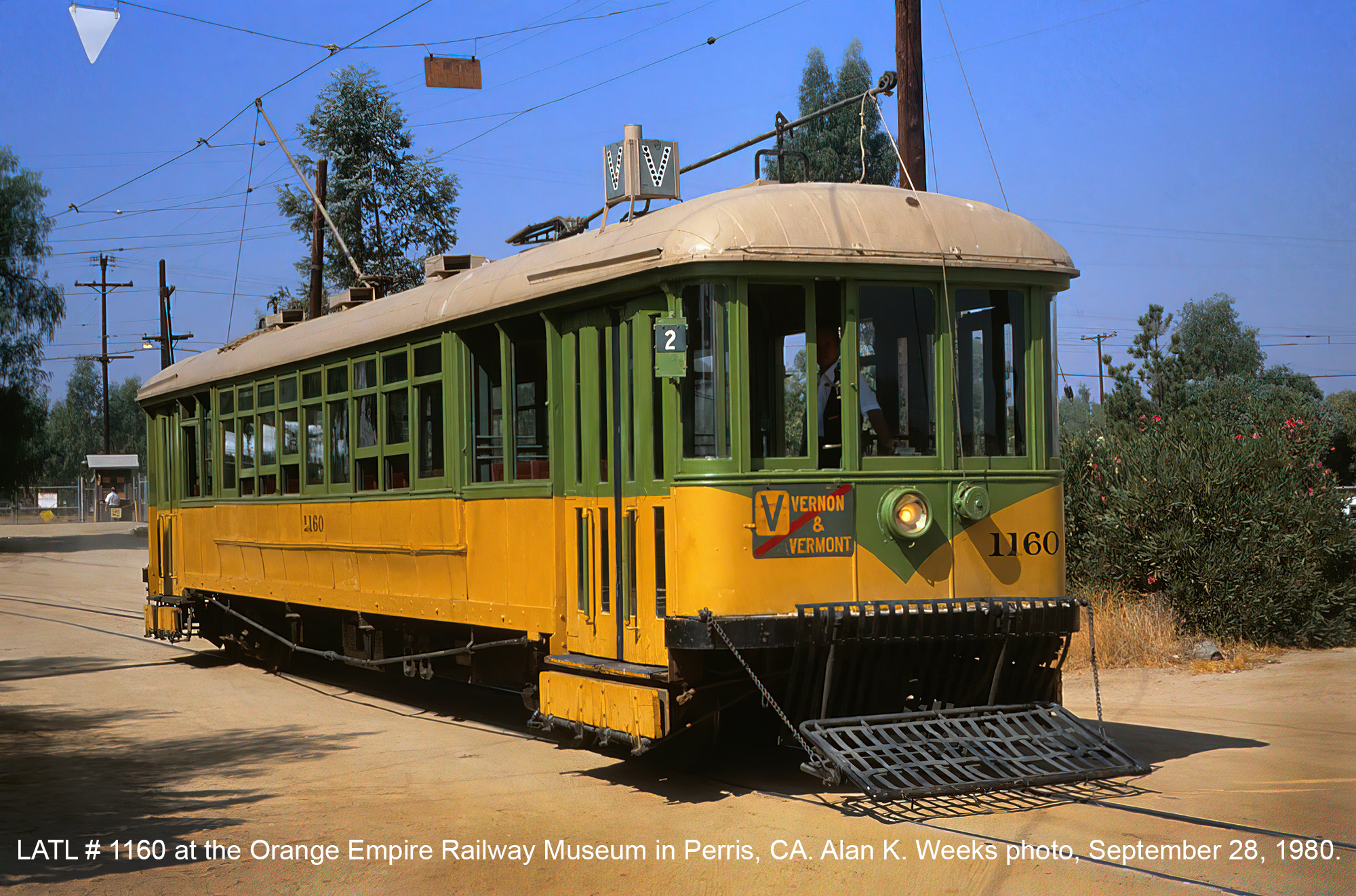
Alan Weeks made this shot of 1160 on September 28, 1980 at OERM. She was looking as if she had just emerged from the South Park Shops paint booth.

A Little Slice of Life

H.L. Kelso photo from the Craig Rasmussen Collection: PE 1370 and LARy 934 meet on the streets of Los Angeles.

By Steve Crise

The United States of America was engaged in its second year of WW II when Harley L. Kelso made this timely shot of Los Angeles Railway car 934 and Pacific Electric interurban car 1370 meeting at the intersection of Vernon Avenue and Long Beach Avenue back in 1943.

There are may sights to behold at this moment frozen in time. The L.A. Railway car is stopped just short of Long Beach Avenue to pick up and drop off passengers. It would soon depart to the eastern terminus of its V-Line run at Leonis Boulevard and Downey Road in the City of Vernon.

Pacific Electric 1370 is seen crossing Vernon Avenue in a southerly direction toward the harbors of San Pedro and Long Beach. The roller sign at the top of the car reads “Special” and all the passengers in the windows appear to be members of various branches of the military, suggesting this could be a special troop transport exclusively scheduled for military personnel only.

The “Red Spot Liquor Store” must have had a very good customer base at this location where two heavily trafficked transit lines intersected. Note the shoeshine booth has both chairs full of customers having their shoes shined.

Perhaps the most intriguing aspect of this photo is the small girl that is seemingly framed by the photographer between the two trolleys. She stares down the track as if she was disappointed that she could not board the Special train of servicemen and is looking for the next regular service car to arrive.

Also note the absence of any noticeable grade crossing apparatus protecting the trains, automobiles and pedestrians from colliding with each other. In researching this image and comparing it to other photos taken at the intersection in our collection, we could not find evidence of any grade crossing protection being installed until sometime after the war.

Today this area is still a vital transit intersection where the Metro A-Line (Blue) interchanges with Metro bus passengers of the 105, 611 and 705 Lines.

Los Angeles Railway A Line Car 62 on West Temple Street

Los Angeles Railway A Line Car 62 on West Temple Street

By Steve Crise

Los Angeles Railway Type-C center door “Sowbelly” car 62 is on the A-Line heading east on Temple Street at Parkman Avenue toward downtown Los Angeles. This car will eventually end its run at West Adams Boulevard at Alsace Avenue as can be read on the dash sign. F. J. (Frank) Bradford is the photographer who made this shot on September 9, 1945. Print courtesy of the Craig Rasmussen collection.

LATL H-Class Cars in Korea: Part 2

Andy Goddard Collection

[Above: From the Andy Goddard collection shows one of the refurbished cars waiting  to be loaded aboard a freighter that will take it to Korea. A poster on the side of the cars explains that the 60 cars are a gift to the people of Seoul from the United States.


By Ralph Cantos

As mentioned in part one of this post, about 60 assorted LARY /LATL H-4 class cars were sent to South Korea as a gift from the people of the United States to help out war-averaged Seoul, the nation’s capitol.

The 60 cars had been out of service since the massive May 22, 1955, abandonment of rail lines 5-7-8-9-F and the northern portion of the W line. The United States Government paid LATL to refurbish the 60 cars by enclosing the end sections with windows taken from cars intended for scrap, plus a fresh coat of paint.

All 60 cars were in excellent condition when shipped to Korea. As a matter of fact, all the H- and K-class cars were in excellent condition when retired in May 1955.

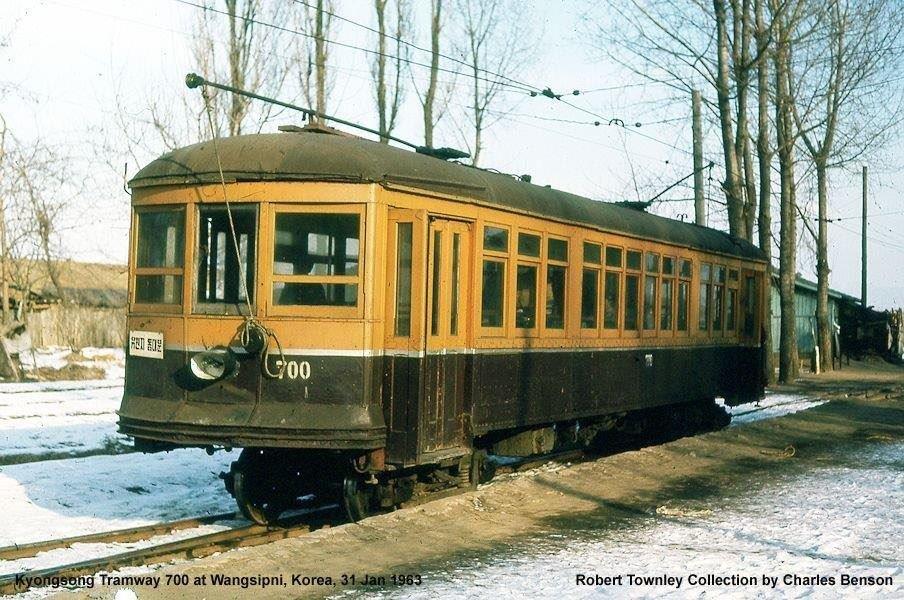
Photo #1  Photos 2 and 3 show cars in Korea.

This photo shows car no. 711 in 1960 after 5 years in service in Seoul. A little worse for wear. The Seoul Tramway System seemed to follow the maintenance practices of Pittsburgh Railways of keeping the cars in top running order, while giving little or no priority to paint and body work.

This photo taken by  Charles Benson is from the Robert Townley collection.

By 1963, the once-pristine cars were were not looking too good. Looks like the Seoul Tramway System was following the same maintenance practices as Cairo, Egypt, i.e. disregard anything not necessary to the operation of the cars, such as headlights, skirting, and steps.   By the end of 1968, the entire tramway system was abandoned. None of the former LATL H-class cars are known to have been saved.

LATL H Class Cars to Seoul, South Korea

Doomed car 1397 keeps company with one of the "lucky" cars at South Park Shops in mid-1955.

Pictured: Doomed car 1397 keeps company with one of the “lucky” cars at South Park Shops in mid-1955.

By Ralph Cantos

On May 22,1955, the Los Angeles Transit Lines scuttled 5  major car lines, all operated with H and K class cars. Lines 5-7-8-9-& F made their last runs. About a year later, the W line (what was left of it) was also abandoned.

With the 1955 abandonment, about 250 H and K cars were now surplus. It did not take long for LATL management to put the unneeded cars up for sale. As usual, National Metals & Steel on Terminal Island was the lone bidder on all but a few cars. National Metals paid about $250.00 per car. By the end of 1955, the cars were being trucked to Terminal Island.

Then, fate stepped in. When the Korean War ended, the trolley system in Seoul, South Korea was in shambles. They were in desperate need of replacement operable streetcars. It just so happened that the Seoul trolley system operated on the same 3′-6″ gauge track as did Los Angeles Transit Lines system. (Only Denver CO. had the same 3′-6″  narrow gauge track as did LA )

So the US Government stepped in and purchased about 60 H class cars that would be sent to South Korea. By the time this arrangements was made, only about 75 or 80 H class cars remained at South Park Shops, and they were owned by National Metals. The Government purchased 60 cars for twice what National Metals paid.

Then LATL was paid to refurbish the cars. The most notable modification made to the cars, was to enclose the open end sections. Windows were removed from cars still on the property and installed on the Korea bound cars. Seoul does not enjoy the same mild  weather as Los Angeles.

A fresh coat of paint and the cars were  ready for their new life in Seoul. Even though the cars escaped the scrappers torch here in LA, time finally caught up with them.

For a variety of reasons, the trolley system in Seoul was abandoned in November of 1968. The entire system was cut up for scrap — lock, rolling stock, and barrel.
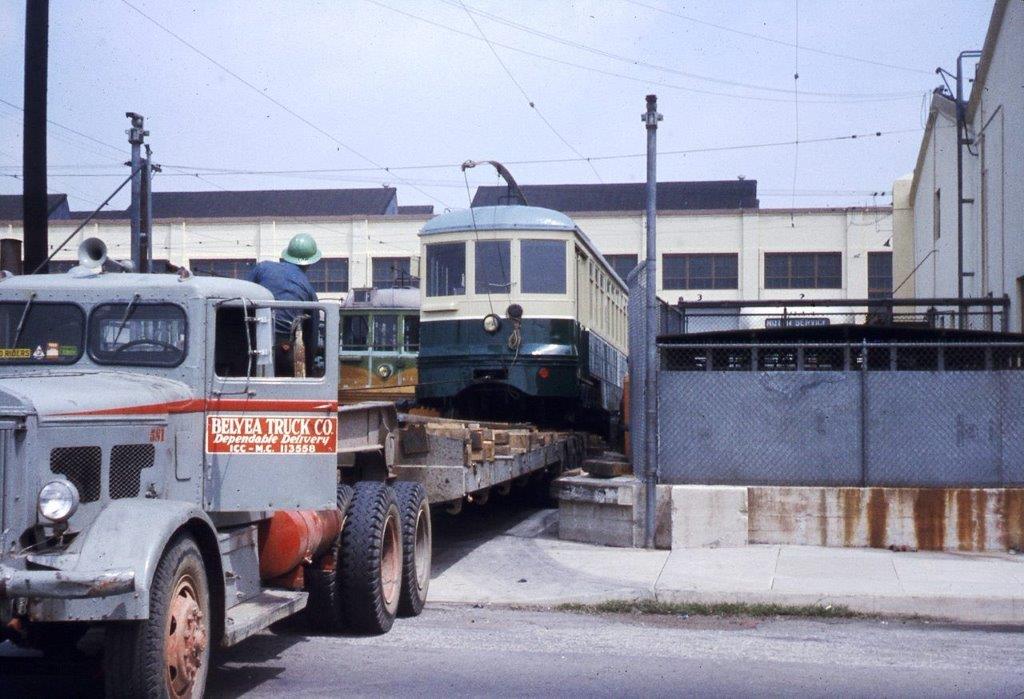
Here one of the “lucky” cars leaves South Park Shops for its trip to the LA Harbor.
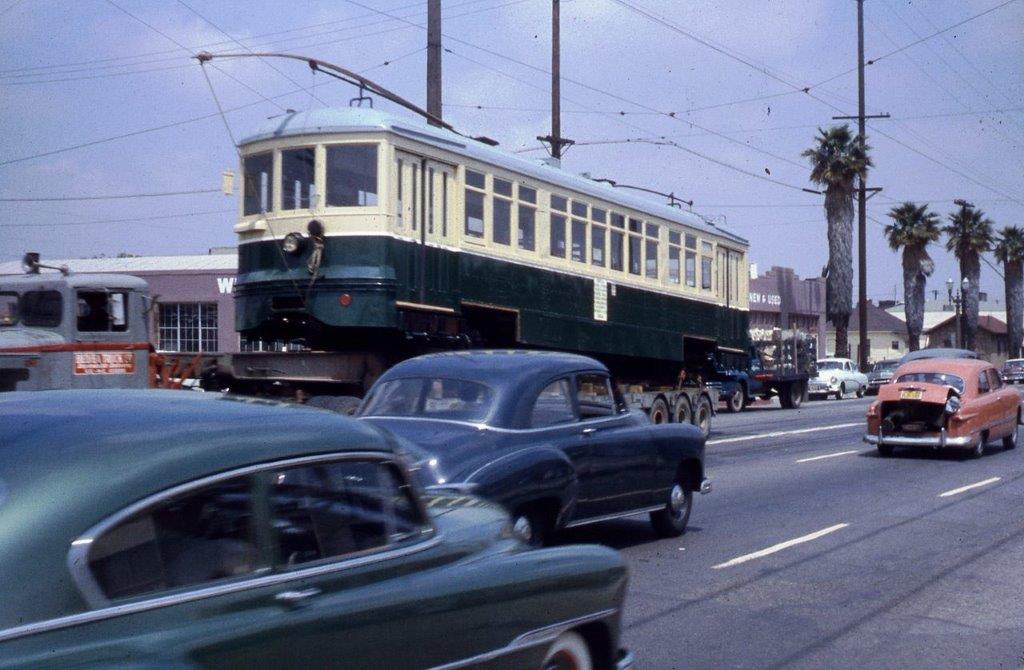
LATL Car Headed for LA Harbor: Here one of the Korea-bound cars rolls along South Figueroa Street heading for the Harbor.
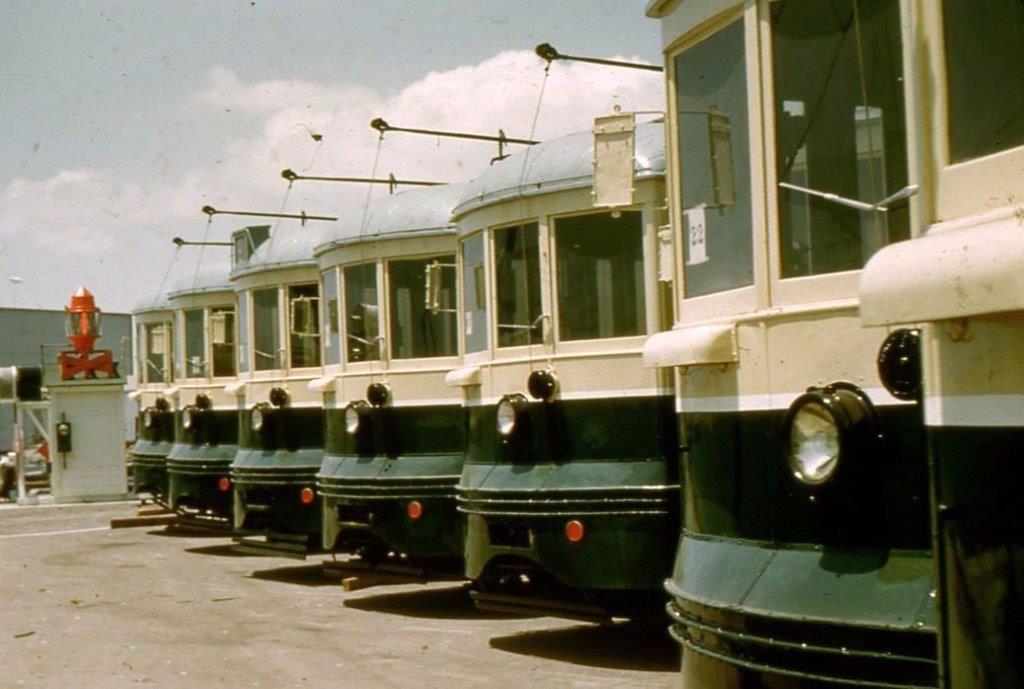
LATL H-5s ready for Korea: Here the cars sit sparkling in the sun at the Harbor waiting their turn to be loaded on a ship.
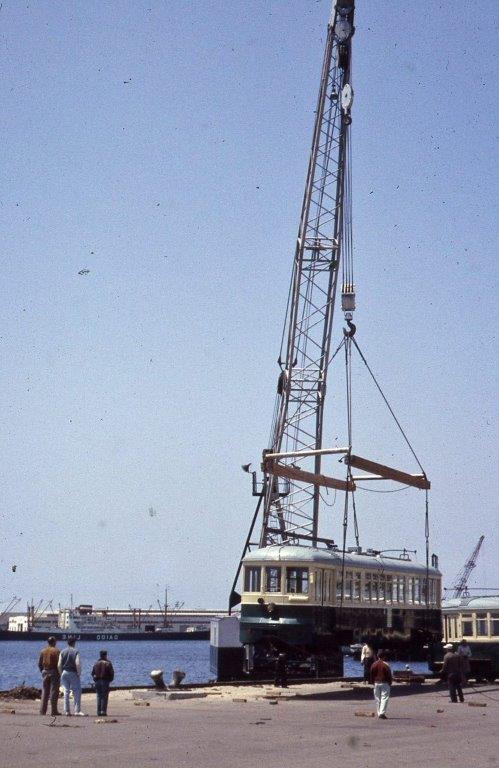
LATL H-5s for Korea: A floating crane has picked up one of the cars that will be floated over to the ship that will take them away to their new home.
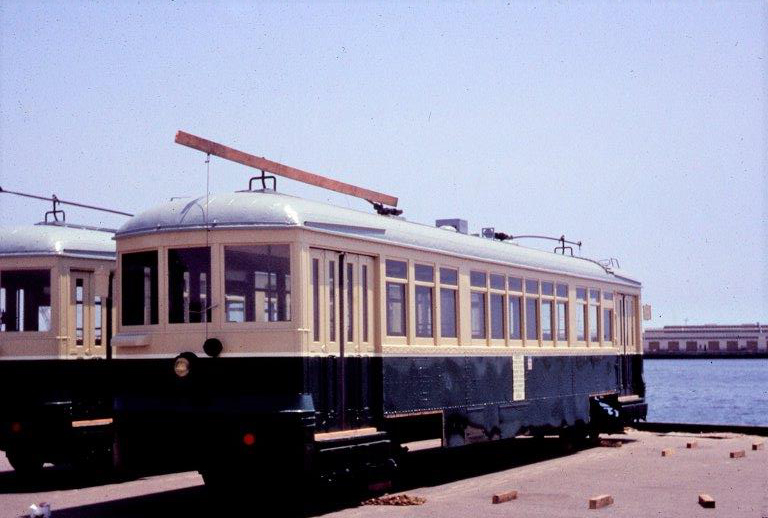
LATL H-class cars head for S. Korea: Another car waits to be loaded, its trolley pole still secured down from its truck ride to the Harbor.
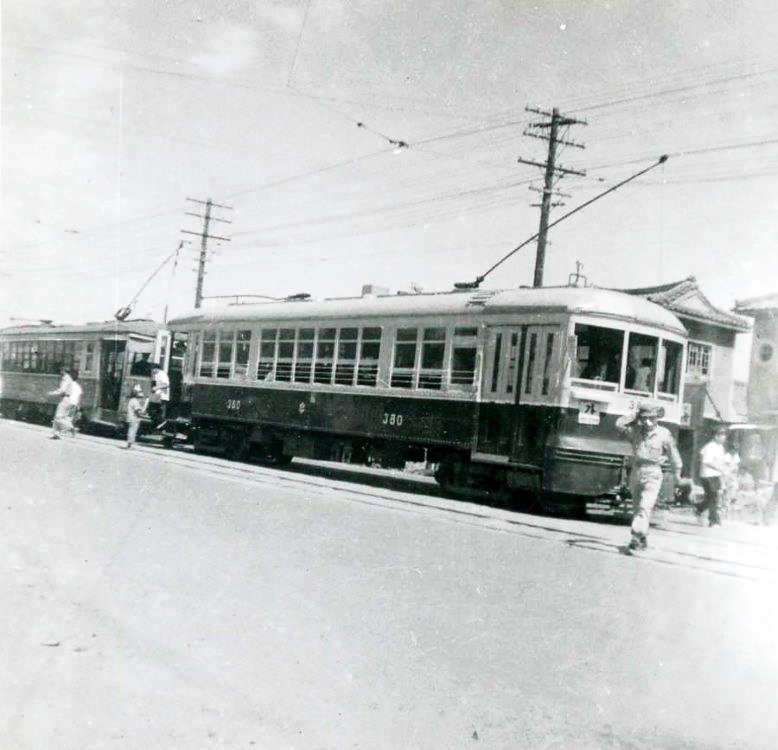
LATL H-6 in Seoul, South Korea, 1958: A faded photo from 1958.
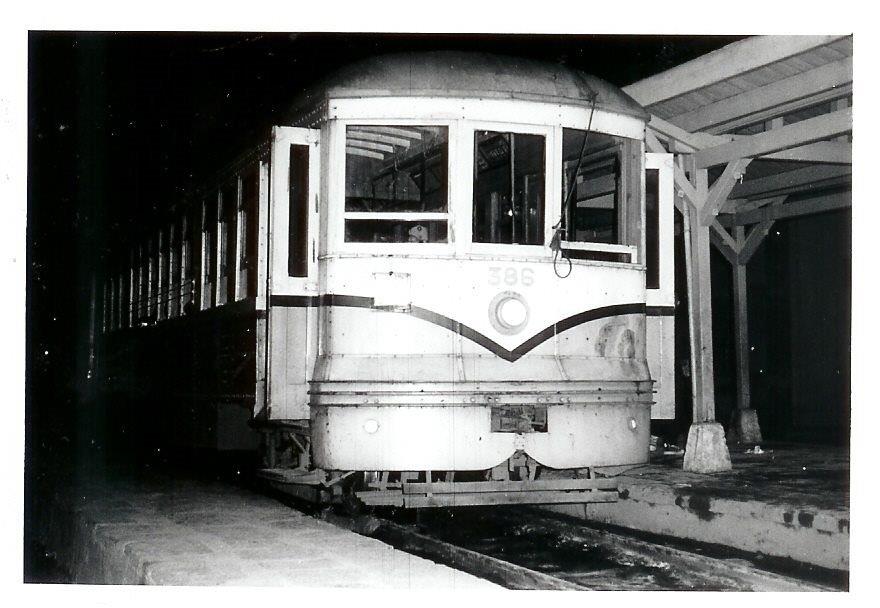
LATL Seoul H5 386: Here one of the LATL cars is photographed at the car barn.
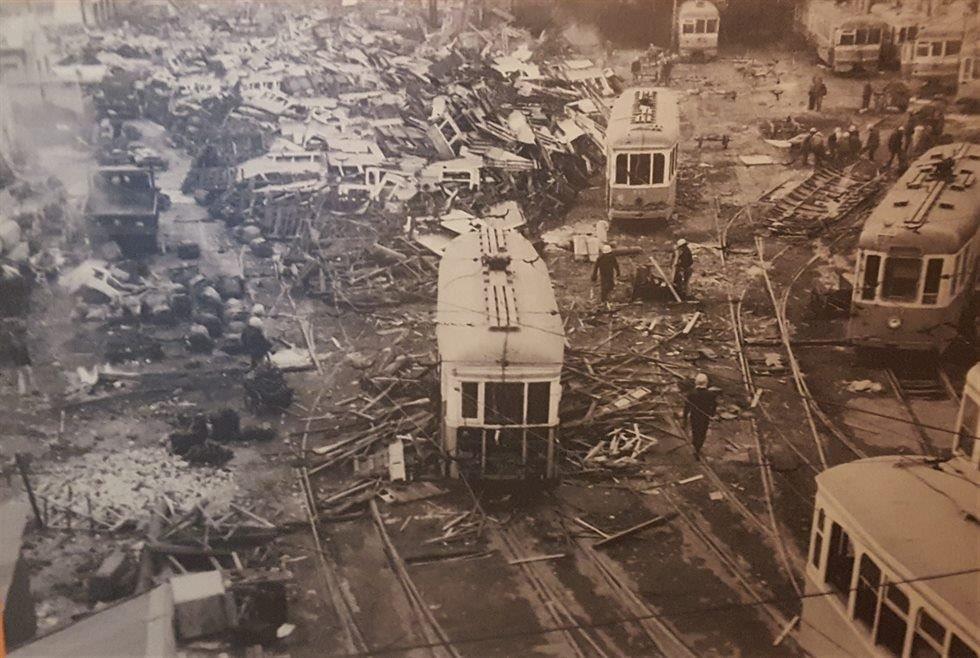
LATL streetcar in Seoul Korea scrap yard, 1968: This horrible scene taken in late 1968 at the car barn. The LATL H class cars are at the top right in this photo. EVERYTHING seen here is to be cut up for scrap Time had finally run out for these trusty old cars. None are known to have been saved.

Locating Los Angeles Transit Lines car no. 1251 on the N Line

Locating Los Angeles Transit Lines car no. 1251 on the N Line by Ken Douglas

By Steve Crise

This undated photo by Ken Douglas caught my eye the other day while researching our archive for other samples of Type H cars for a future article. This location seemed somewhat familiar to me but I could not immediately place it without doing a little hunting around on the internet first.

The usual clues that are present in a lot of the photos of streetcars are of course the street signs themselves. In this case, the name of the street crossing at this intersection would have been easily readable except for the unfortunate placement of the power pole obscuring the view of the streets sign from this particular angle.

So next we move on to the next most promising clue in the photo, a sign announcing the location of the Hotel Proctor on a building further into the background of the photo. A search on Google of “Hotel Proctor” didn’t yield any satisfactory results until about the fifth or sixth page where it suggested a most interesting resource to search, the Digital Library of the California Historical Society, in particular, a collection of photographs made by a person by the name of Anton Wagner.

Within this collection was an image Mr. Wagner made with the Hotel Proctor being listed by the archivist as being contained in one of his images. Although the Hotel Proctor is not predominately featured in the photograph, the hotel is listed in the data sheet accompanying the photo as being one of the structures in the image. It even went so far as to listed the modern day location in GPS coordinates! Of course with the GPS coordinates listed, it was no trick at all to figure out the rest.

Entering the coordinates of 34.048719, -118.268414, I was instantly transported to the intersection of James M. Woods Blvd (also known as W. 9th Street) and Garland Ave. Now things were staring to come into shape. The street scene at this intersection was becoming familiar to me again. A quick drive in a westerly direction via Google Earth revealed a match to the building once known as the Proctor Hotel, but today is now known as The Windsor located at 1415 W. 9th Street.

As mentioned earlier, the date of this photo is unknown to us. We received the image as a digital file from Ken and unfortunately there was no accompanying information in writing or in the metadata file. We had to resort to using the vehicles and their license plates as a means to narrow down the time period. To our best guess, the photo was shot sometime between 1947 and September 10, 1950. Why the date of September 10, 1950? Because it was the last day of operation for the N Line according to Ira L. Swett’s Interurban Special # 11, page 27.

Armed with all this new information, we can now confidently say that Los Angeles Transit Lines N Line car # 1251 was captured on film while traveling eastbound on W. 9th Street at Witmer Ave. around 1950.

As for the car 1251, it would go to on the serve the L.A.T.L. for another 8 years until it’s scrapping in 1958, which also coincided with the scrapping of the Los Angeles Transit Lines itself in March of that same year.

This was rather circuitous route on our quest to find this mystery location but an interesting journey none the less. I highly recommend a visit to the Digital Library of the California Historical Society and explore the Anton Wagner collection at your leisure. Here is a direct link to the photo that brought it all together:

https://digitallibrary.californiahistoricalsociety.org/islandora/object/islandora:1039

For those of you that enjoy obscure, seemingly random photographs made in and around the city of Los Angeles, the Anton Wagner collection is a great way to get lost for a few hours in the old cityscape of 1930’s Los Angeles. (5/28/2022)

A Time of Transition in Los Angeles Transit

LAMTA #3075 PE #302 H-3's on S line - 8th & San Pedro Sts

By Ralph Cantos

When the LAMTA took over transit operations from the Los Angeles Transit Lines and Metropolitan Coach Lines in March of 1958, a period of transition began.

This very interesting photo taken by Jerry Squire is from the Andy Goddard Collection and dates to mid-summer 1958.

Car no. 3075 is being operated on a fan trip to celebrate the first LA PCC to be repainted in the new LAMTA two-tone green (a leftover from MCL). The former PE Hollywood cars being used on the Watts local line would be renumbered 1800 to 1815. The Blimps would be renumbered into the 1500 and 1700s. All former LATL cars would keep their original numbers to the bitter end of rail service.

One of the first matters on the LAMTA agenda was to retire the 35-year-old H-class cars, fixtures of the S Line. In time, loops were built at both ends of the S Line to allow the PCCs to reverse directions.

So, like the first year of Amtrak, its was a photographer’s paradise; this photo is a perfect example. I am not sure of the date, but this photo shows LAMTA green PCC no. 3075 on San Pedro Street at 8th. Just behind the 3075 is yet-to-be-renumbered no. 302, later LAMTA 1502. In the distance can be seen an S Line H-3, ready to turn west onto 7th Street.

So, any photo showing an LAMTA green PCC with an H-3 in the same photo  is very rare. The opportunity to take such a photo did not last very long. By the end of 1958, PCCs had taken over S Line.

As an interesting note to this photo, hanging from the span wires are 2 car stop signs. The one on the left proclaimed, “INTERURBAN STOP;” it was dark blue with white letters. The sign next to it, a standard CAR STOP, was white with dark blue letters. Both signs were percaline.

I was at this location just by chance when the scrappers were pulling down the overhead, at this location, the VERY LAST PE style catenary to be seen anywhere in Southern California. I asked the scrappers if I could have both signs, and they were only too happy to give them to me. They said that the 2 signs had no scrap value.. Well, as the old saying goes, “one man’s junk is another man’s treasure.”

Andy Goddard Collection, Jerry Squire Photo

Video: 1930s – Views of Los Angeles in color [60fps, Remastered] w/added sound

Colorized film of 1932 downtown Los Angeles screen grab

[vc_row][vc_column][vc_column_text]From Ralph Cantos:

This video is making the rounds today on the internet, its FANTASTIC!. I put the year as 1932. Notice the “new LARY H-3s” working the 5 line. The LARY scenes are on Broadway at 7th and the PE scenes are on Hill St. at 6th. Craig Rasmussen found it today. I am sure all the railfan world is waiting to see it. Best Wishes.. Ralph


[/vc_column_text][vc_video link=”https://youtu.be/QMrDtAk79uc”][/vc_column][/vc_row]