
Pacific Electric 5160 at Park Junction
Above: Pacific Electric 5160 at Glendale and Park. Rod Crossley Photo, Pacific Electric Railway Historical Society Collection / MLPSI Collection.
By Steve Crise and Michael Patris
Looking south on Glendale Boulevard, PE 5160 stops at a traffic light at Park Avenue adjacent to Echo Park. In fact you can see a bit of the park on the left side of the frame.
Moments earlier this car departed the Subway Terminal tunnel and made her way northward up Glendale Boulevard to what was then known as Park Junction, located at Park Avenue and Glendale Boulevard. At this point the car would take the diverging rails to the left from the Glendale – Burbank Line and continue its route westbound on Sunset Boulevard, then to Hollywood Boulevard, ending its run at the West Hollywood Car House as read on the dash sign hanging on the front of the car.
Our resident automobile expert Michael Patris has identified the three vehicles in this photo as being, from left to right, a 1950 Chevrolet Fleetline Deluxe four-door sedan. Behind the Fleetline is a 1954 Chevrolet Bel Air with just a portion of the left front of the vehicle visible. On the far right of the frame is captured a 1955 Plymouth Belvedere heading south on Glendale Blvd.
This is another wonderful unpublished photograph from the late E. Rod Crosley, shot sometime around 1955.
READ MOREPacific Electric Diesels at Taylor Yard
By Steve Crise & Michael Patris
A very unusual view from inside the depths of Southern Pacific’s Taylor Yard in Los Angeles, California finds these three Pacific Electric diesel switchers spotted at the paint rack.
PE 1654, and a pair of Baldwin VO-1000’s were captured by E. Rod Crossley’s camera around 1950 set out on one of the whisker tracks of the turntable at Taylor Yard. On the nose of the second unit masking tape is visible where the orange and black tiger striping will be painted.
In 1944 the Pacific Electric began purchasing small, light-weight diesel-electric locomotives from General Electric in Erie, Pennsylvania with the aim of having them replace electric locomotives on some of their freight lines that were isolated from the rest of the electrical overhead system or those lines that were soon to be de-electrified.
Some interesting scribblings on the side of 1654 just under the numbers reads, “Super Jet” and “SP Studebaker Front.” One can only speculate that the comment about the unit being a “super jet” must refer to the locomotive’s limited speed ability of only a minuscule 35 mph.
As far as the Studebaker scribbling is concerned, perhaps that is a comment on the styling of the locomotive (think Pennsylvania’s GG-1) that somewhat resembles a popular car sold in the late 1940’s and early 1950’s made by the Studebaker Company, most notably the Studebaker Champion designed by Robert Bourke from the renowned Raymond Loewy Industrial Design Studio. The Studebaker Champion of 1950 had unique styling that perhaps prompted some unknown person to scribble their remarks on the side of the little locomotive. Maybe the paint crew at Taylor Yard will eliminate the comments with a fresh coat of Southern Pacific gloss black paint.
References: Ira Swett, Interurbans Special # 37, Southern Pacific Review 1952-82, Joe Strapac.
READ MORESGV Master Key Podcast: Michael Patris
[vc_row][vc_column][vc_row_inner][vc_column_inner width=”1/6″][/vc_column_inner][vc_column_inner width=”2/3″][vc_video link=”https://youtu.be/vhTpfvwHJSs” custom_thumbnail=”true” thumbnail_image=”15217″][/vc_column_inner][vc_column_inner width=”1/6″][/vc_column_inner][/vc_row_inner][vc_column_text]Michael Patris of the Mount Lowe Preservation Society recently appeared on the SGV Master Key Podcast. Here is their introduction:Michael Patris has always had an interest in history. Whether collecting antiques, collecting and working on antique cars, or restoring a 1923 California bungalow in Alhambra, pieces of the past always seemed too important to brush aside. After several years working in the news industry, and film industry, Michael speaks publicly about Southern California transportation, collecting antiques and, of course, Mount Lowe.
Michael is the President and founder of the Mount Lowe Preservation Society, Inc., President of the Pacific Electric Railway Historical Society, and past Sheriff of the Los Angeles Corral of Westerners (2010). Michael is also President and owner of Golden West Books, a publishing company focusing on the history of trains, trolleys, railroads and locomotive material.
One of Michael’s most well known projects is a Mount Lowe trilogy, beginning with Mount Lowe Railway, part of the History of Rail series for Arcadia Publishing. This came out in June of 2007 and already is in its ninth printing. The Barnes and Noble book signing was sold out in an hour and a half, a record for their chain. October 2010 another book for Arcadia Publishing Mount Lowe, which is part of their Postcard Series came out and more recently two more books for Arcadia Publishing have just come out, both co-authored by Michael Patris and Steve Crise, which are Pacific Electric Railway, Then and Now (December 2011) and Mount Lowe, Then and Now. (February 2012) Michael’s current projects include (sometime in the near future) another collaboration with Steve Crise on the Los Angeles Railway, Then and Now, and perhaps a book on Los Angeles Union Station featuring photos and collectibles rarely seen from this local landmark.
After wanting to share his passion for the Mount Lowe Incline Railway and Thaddeus Lowe, the man who was the leading force behind its creation, it was a natural progression to set up the non-profit Mount Lowe Preservation Society educational foundation back in 2000 which has fueled the renovation of a 14,000 square foot building in Pasadena to permanently house our collections and archives. This has led to the archives of the Pacific Electric Railway Historical Society being donated to the Mount Lowe Preservation Society as well as the gift of the publishing company, Golden West Books, donated by the late founder, Donald Duke.
Preserving the past for future generations is his way of giving something back to the community that seemed lost in history books and old photos. His drive and passion for collecting and displaying pieces related to local transportation history has been acknowledged by the Pasadena Museum of History where he has guest curated numerous displays for them and also loaned several items to the Huntington Library for the 300th Anniversary of the birth of Father Serra.[/vc_column_text][/vc_column][/vc_row]
READ MORE
Pacific Electric Magazine and the Huntington Library, May 10, 1938
Just eleven years after the passing of Henry Huntington, the Pacific Electric Railway Magazine, Volume 18 – Number 11, dated May 10, 1938, extolled the virtues of a visit to the former railroad baron’s home in San Marino. The article read as follows:
Priceless Art Treasures at Huntington Art Gallery
It was in 1910 that the late Henry E. Huntington “retired” from business to have more time to devote to his other great interest, that of collecting. He was then sixty years of age and was looking forward, after a busy life spent in developing transportation lines and real estate, to pleasurable leisure to enjoy the things he cherished – fine books and paintings, and the beauties of nature.
No one, least of all Mr. Huntington himself, could have predicted that within the next seventeen years, or until his death, he would become the world’s greatest book collector, an outstanding patron of the arts, and the donor of one of California’s most important cultural assets. Nor was the popularity to be of the institution he founded foreseen. Since the public exhibitions were opened in 1928, more than 1,300,000 people have visited and it has been necessary to revise the schedule many times. Now it is possible to visit any afternoon (except Mondays and during the month of October) from 1:15 to 4:30 o’clock, by telephoning the Exhibitions Office a few hours in advance.
To Beautify Home
When Mr. Huntington began collecting h had in mind gathering suitable paintings and other objects of art to adorn his San Marino home (now the Huntington Art Gallery) and to make it a more beautiful place in which to live. The house was completed in 1910 and one of the first purchases was a set of five magnificent French tapestry panels, made at Beauvais in 1755-56, during the reign of Louis XV. These were installed in the room originally designed to house his library, then in his New York home. Today, these tapestries, and a pair of Savonnerie carpets that were made in the period of Louis XIV, provide a perfect background for a collection of exquisitely carved eighteenth-century French furniture.
The French collections are interesting in contrast with the English furnishings made in the same century. Indeed, the house has become a museum which reveals something of the way of life in the days when the Georges ruled in England. The visitor sees the portraits (both life-size canvasses and miniatures on paper or ivory) of some of the great ladies and gentlemen who dominated Ehcnlsh society, politics, and the arts, along with the furniture such as they used. Here is a Chippendale settee on which they might have sat, a table on which the probably had tea; while on adjacent shelves are choice specimens of Chelsea porcelain similar to those that graced their drawing rooms.
Famous Masterpieces
The English portraits of the eighteenth-century are the outstanding treasure of the Art Gallery. There are fifty-eight, nearly all of them masterpieces. In one room – the New Gallery – twenty of the most important pieces hang, acknowledged the “cream” of such paintings in America. Here are “Mrs. Siddons as the ‘The Tragic Muse’,” by Sir Joshua Denolds, the greatest actress of her time; “The Blue Boy,” by Thomas Gainsborough, one of the most famous paintings in the world, and a little girl in a rose beribboned bonnet, familiarly known as “Pinkie,” by Sir Thomas Lawrence. If these paintings captivate the visitor there also many other attractions that will add to the joy and the cultural benefit of his visit. The charm of the Huntington galleries is that there is something for everyone’s taste and for varying moods.

No other portrait in the Huntington Art Collection is so popular as is “The Blue Boy.” Mr. Huntington acquired the painting in 1921, from the Duke of Westminster, in whose family it had been for more than a hundred years. It was purchased in 1770. The canvas is seventy inches high and forty eight inches wide. Mount Lowe Preservation Society Inc. Collection
To many people the great thrill to be experienced at San Marino is seeing the handwriting of such men as Christopher Columbus, Benjamin Franklin, and George Washington, or the earliest printed books, now nearly 500 years old, such as the Gutenberg Bible, or the first book printed in the English language, which came from Caxton’s press in 1477. These rarities are permanently on view in the Library, which was built in 1920 to house Mr. Huntington’s rapidly expanding collection of manuscripts and books.
In addition, there are numerous special exhibits drawn from the Library collections which interest large numbers of students and other visitors. During May these will include an exhibition commemorating the 150th anniversary of the Constitution of the United States, as well as one illustrating the transition from a Spanish-Californian culture in Los Angeles County, 1850-1870.
But if the visitor does not care for great paintings, or objects of art, or in seeing the originals of great historical or literary works, there is yet another part of the Huntington gift that few can resist – the Botanical Gardens.
Gardens on Par
Under the native oaks, of which there are many old and fine specimens, and across 50 acres of the estate, have been planted rare and subtropical trees and shrubs collected from every continent. Particularly beautiful in the spring are the Japanese Garden, the Rose Garden, and the 15 acre Desert Plant Garden. The latter collection is the most comprehensive of its kind in the world, having 25,000 cacti and other succulents. Most of these are large specimen plants, being indigenous to North and South America, the remainder from South Africa, Madagascar and the Canary Islands.
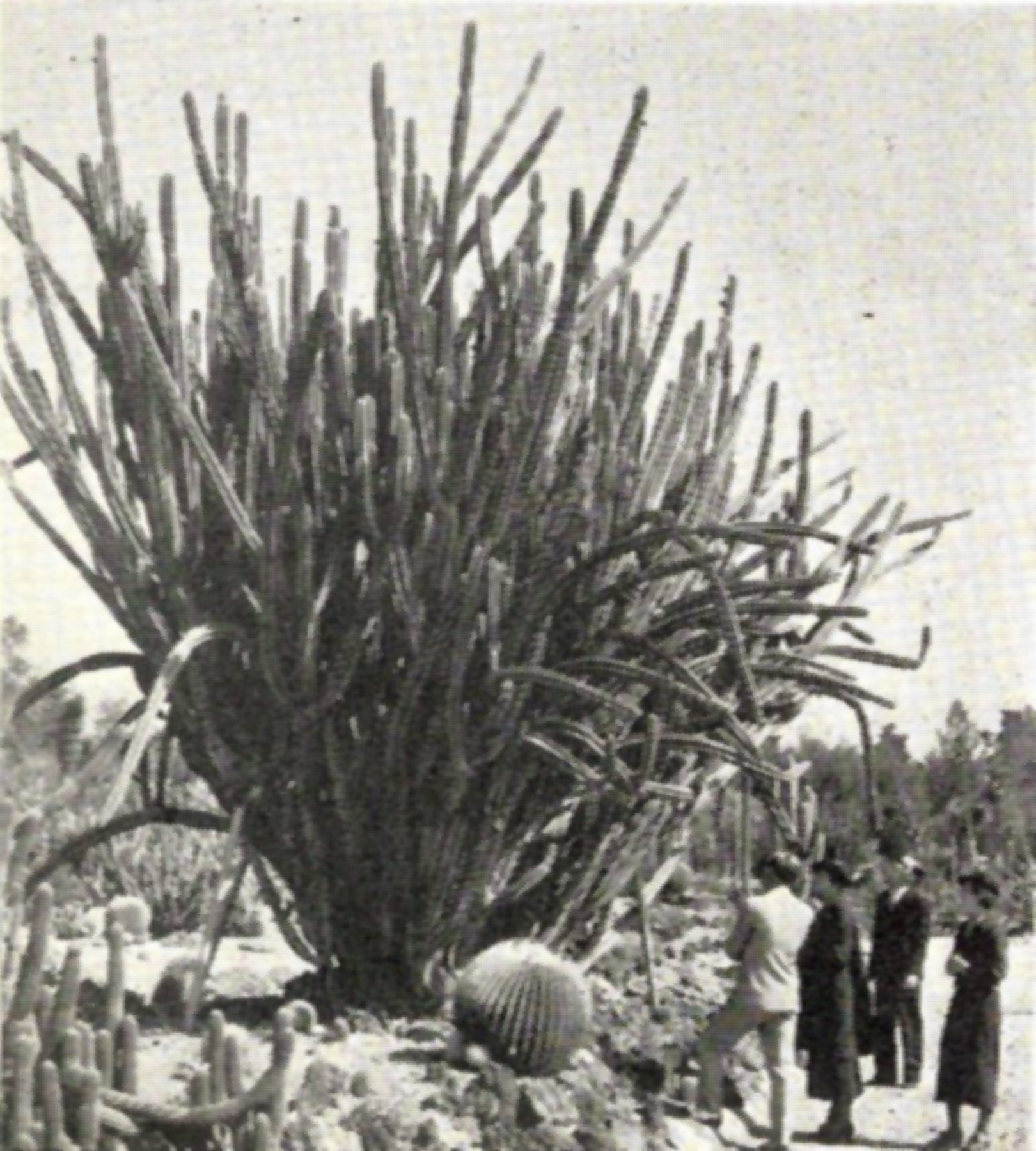
Cactus garden, Huntington Botanical Gardens. The cactus and other succulent collections cover fifteen acres and comprise about 25,000 specimens. In this view may be seen a twenty-year-old specimen of Cereus Xanthocarpus, a native of Paraguay. Mount Lowe Preservation Society Inc. Collection
To mention all of the wonders to be seen would require the space of a book. The best suggestion that can be offered for those interested is to spend many afternoons at San Marino, judging of its offerings first hand.
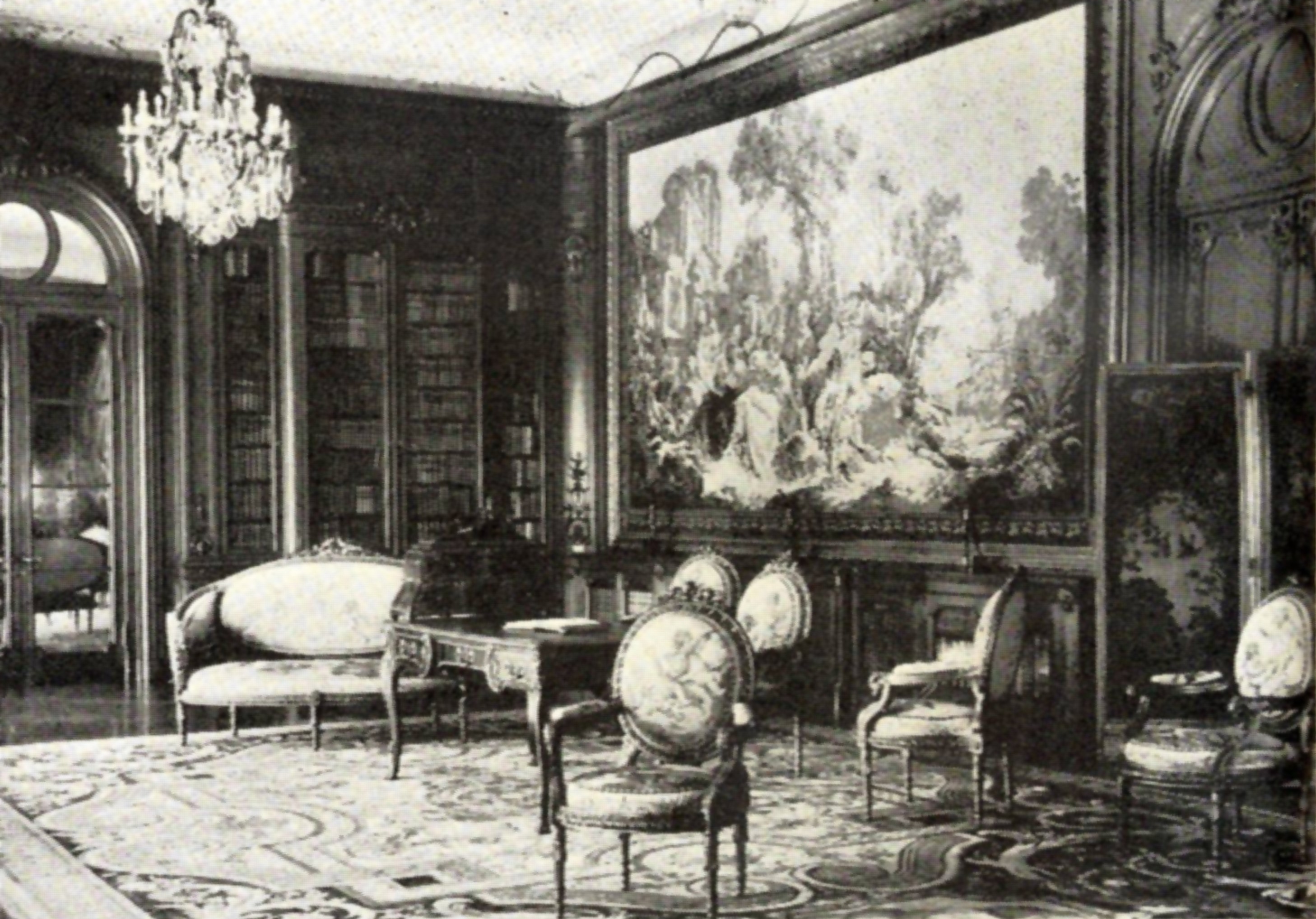
This view shows the library in the Art Gallery. On the wall is the tapestry, “The Fountain of Love,” one of a set of five panels, known as “La Noble Pastorale,” designed by Francois Boucher and woven at Beauvais in 1755-56. The rug is of the period of Louis XIV, and was made at La Savonnerie, where many rugs and panels for the Royal apartments were manufactured. Mount Lowe Preservation Society Inc. Collection
Long Beach Express Dash Sign
This Long Beach Express dash sign was used by both the Pacific Electric & Los Angeles Metropolitan Transit Authority.
Steve Crise Photo, Mount Lowe Preservation Society Collection
READ MORE023 at the San Gabriel Mission
Pausing in front of the old San Gabriel Mission, Pacific Electric no. 023 and several PE tour guides smile for the camera, attributed to Charles Lawrence, PE’s official photographer.
While the Old Mission Trolley Trip was well attended, there were two others that also were well noted; the Orange Empire Trolley Trip and the Mount Lowe Trolley Trip. One reason the Mission trip was unique was the the constant performances of the “Mission Play” by John Steven McGroarty, featuring Frederick Warde and “a cast of over 100 players” every afternoon, evenings (Wednesday and Saturday).
Among the other mentions in the mission area were “The old Grape Vine” and the “Spanish Eating House” all within a few steps of the PE stop.
Mount Lowe Preservation Society Archives, Jack Whitmeyer Collection
READ MOREFair Oaks and Colorado in May of 1946
Standing in the middle of Colorado Boulevard, looking west, just east of Fair Oaks on May 12, 1946, L. T. Gotchy catches the Pacific Electric Railway ticket office on the left and the Owl Drug Store on the right. Note the intersection has not changed immensely, and it is still referred to as Route 66. Also note the bus on the left side, stopped just short of the intersection.
Mount Lowe Preservation Society Archives, Jack Whitmeyer Collection
Here’s a contemporary view of the location:
READ MORE1127 Westbound at Arcadia Tower

Mount Lowe Preservation Society Archives, Jack Whitmeyer Collection
Pacific Electric no. 1127 heads into Los Angeles crossing the Santa Fe line at Arcadia Tower on June 2, 1946 in this L. T. Gotchy photo. In the not too distant future, the Gold Line extension will have cars running close to this same location.
Mount Lowe Preservation Society Archives, Jack Whitmeyer Collection
READ MORE1208 at the Ramona Convent in Alhambra
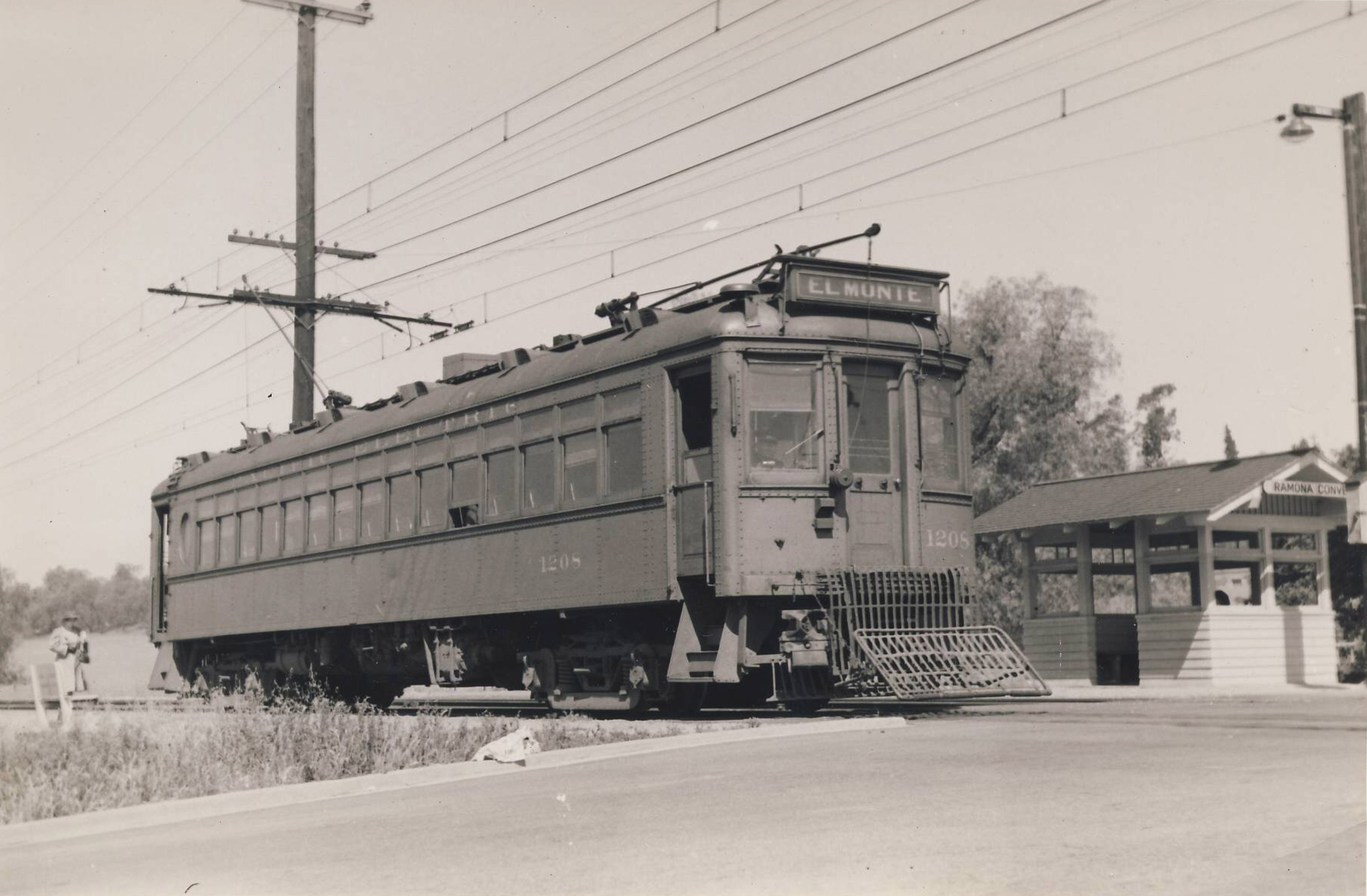
Mount Lowe Preservation Society Archives, Jack Whitmeyer Collection
Pacific Electric no. 1208 pauses at the Ramona Convent stop in western Alhambra on a morning run to El Monte in this undated, unattributed photo.
Ramona Convent Secondary School was established in 1889 as a private Catholic college prep school and is still around today; existing from before and after the running of the Pacific Electric Railway. One noted alumna was aviatrix Florence “Pancho” Barnes, daughter of Thaddeus Lowe, Jr., construction manager for the Mount Lowe Railway and granddaughter of Thaddeus S. C. Lowe.
Mount Lowe Preservation Society Archives, Jack Whitmeyer Collection
READ MOREThe Very Happy Boom, Before the Sad Bust
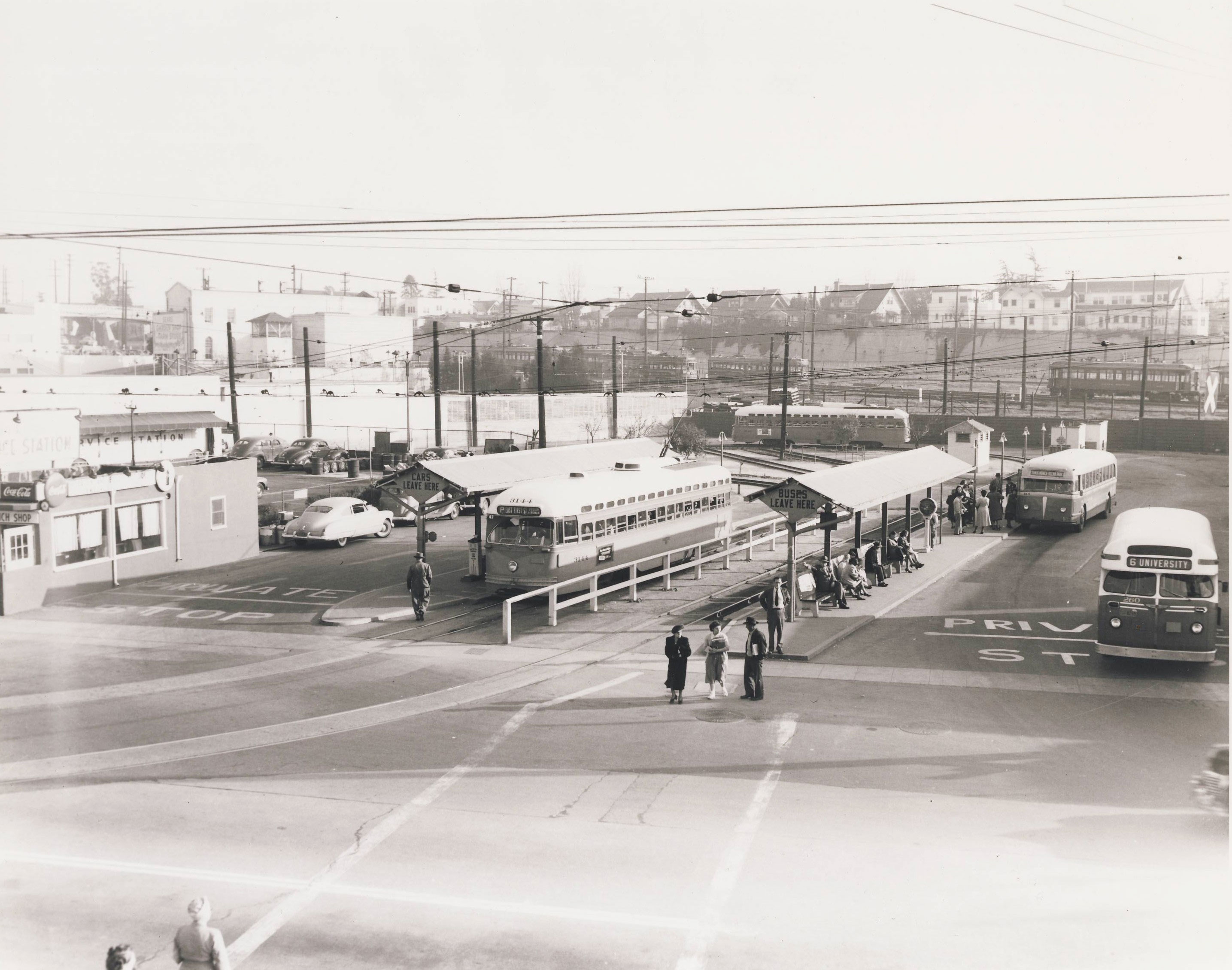
Mount Lowe Preservation Society Archives, Ross Fry Collection
By Ralph Cantos
This photo, recently discovered by traction historian Michael Patris, is remarkable to say the least. It was taken in November of 1948 at the Los Angeles Transit Line’s Rimpau loop.
Brand new PCC no. 3144 is loading passengers, for a fast, smooth, silent trip to Downtown Los Angeles. A new Bay Cities Bus Lines Checker “Transit” bus on line #6 leaves the loop. Also loading in the bus portion of the loop is Santa Monica Municipal Bus Lines no. 614, a White Motors model 798 of 1947 vintage working the #7 West Pico Blvd-Santa Monica Line. In the far back ground above it all is Pacific Electric’s wonderful old Vineyard Junction and storage yard, with 1000s and Hollywood cars awaiting their call to duty. Los Angeles rail fans could not be happier.
National City Lines, parent company to the LATL, had just purchased 40 state of the art “all-electric” PCCs for exclusive use on the heavily patronized Pico Blvd-East First St Line. It was well known in the American transit industry that National City Lines and LATL had no love for ANYTHING that operated on steel rails. It therefore came as quite a shock when the beautiful new, extra wide PCCs arrived for service in LA.
This amazing historic photo could have only been taken between November 1948 and September of 1950. In just 22 months, all the happiness and the optimistic future of rail transportation in LA would be shattered on Sept. 17, 1950, with the abandonment of the Venice Short Line, the first of many to come.
The Pacific Electric was under enormous pressure from the City of Los Angeles and the State Railroad Commission to modernize the VSL. The back bone of the VSL were the 31 handsome wooden 950s dating back to 1907. Also serving the line were two 3-car trains of 1000s dating to 1913 , also of wood construction. The “babies” of the VSL were a handful of Hollywood cars needed to protect the demanding service of the line.
LA newspapers posted photos and editorials blasting the PE over the use of the 950s and the 1000s. Both classes had been ordered off the streets of LA in 1938. The trusty cars had been saved from the scrap pile by the outbreak of World War II. Had it not been for the service of these 88 cars during the war years, it would be safe to say that LA transit riders would have “been up the proverbial creek without a paddle.”
But by 1948, the city had “looked the other way” long enough, and demanded the PE take action on the removal of the ancient cars, to protect the modern image of the City.
By 1948, plans for the future Santa Monica Freeway were firmly in place, with no provisions for rail transit in a center median. Pacific Electric management, already aware of what the Pasadena Parkway (110 Freeway) had done to passenger levels on its Pasadena rail lines eight years earlier, thought long and hard as to the future of the VSL. In short, it would have cost the PE almost 3 million dollars to modernize the VSL as a rail line, or “bustitute” the line for a scant 1 million dollars. The PE would also recoup a large portion of that expense from the scrap value of the line. It was a “no brainer”!
Buses took over on September 17, 1950, much to the dismay of passengers who seemed to love big interurbans. Small cramped gasoline powered White 798s with their smelly, underfloor 12-cylinder engines were certainly no improvement to the quality of the service on the VSL. But in all fairness, the PE really had no choice. It was the “beginning of the end” for rail transit in LA. It was a relentless, unstoppable march that would take 13 years to complete.
And so this timeless photo would all change drastically in less then two years. Only the large houses on the south side of Venice Boulevard and the West Boulevard bridge would survive into the 21 Century. EVERYTHING else in this beautiful scene — Vineyard Junction and Sub-Station, the Sears – Pico Department Store, and Rimpau Loop will all be swept away by the passage of time.
A special note regarding the Bay Cities Checker Transit bus: Very few of these buses were built between 1948 and 1949. All were gasoline powered, and featured a unique forward-facing “standee window” above the destination sign. The eight Bay Cities unites were the only ones to operate in Southern California, and very few, if any, have been preserved.
Mount Lowe Preservation Society Archives, Ross Fry Collection
READ MORE