Charles Wherry CollectionCharles Wherry Collection
By Charles Wherry
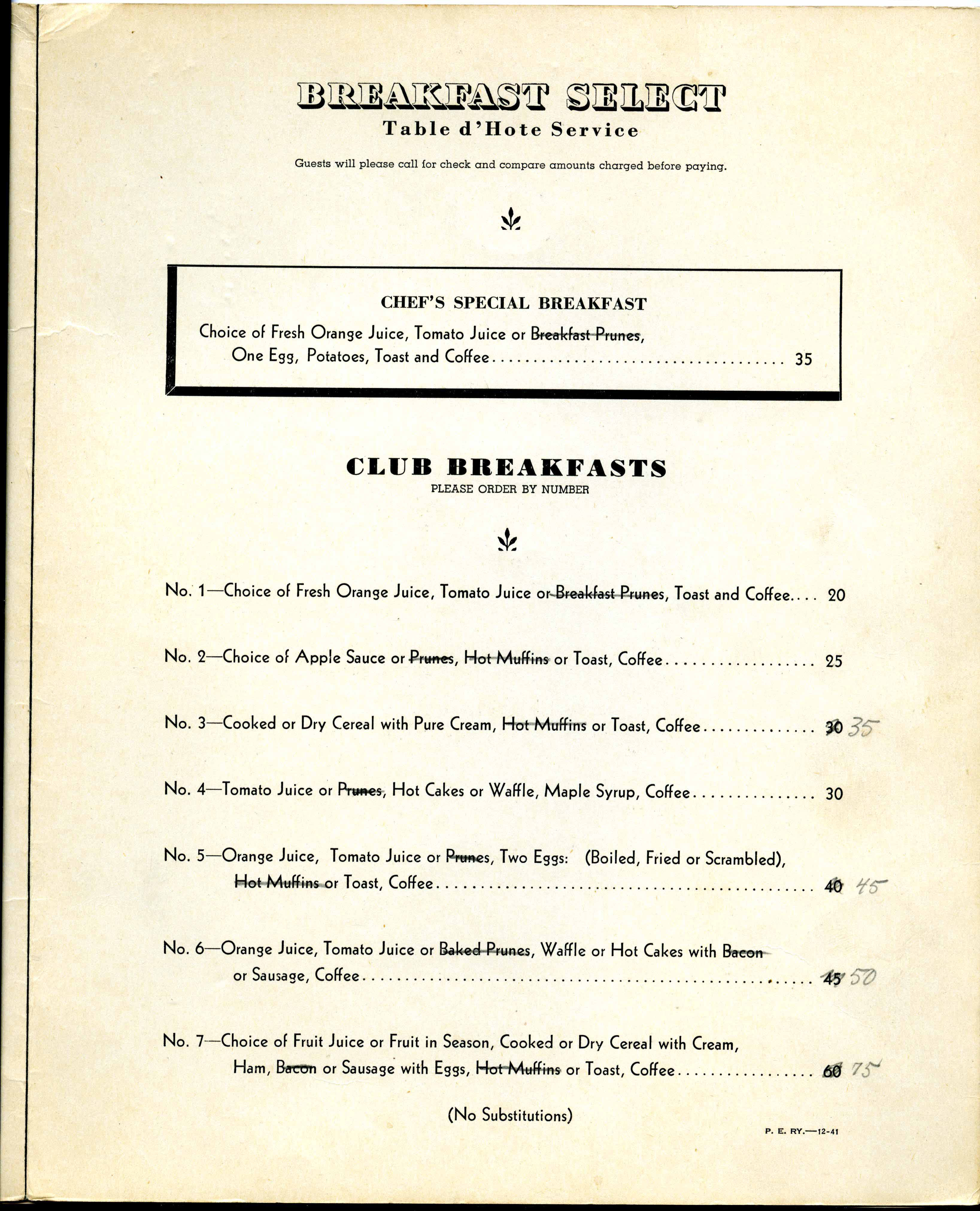
Here are three photos of a breakfast menu from the Pacific Electric Restaurant at 6th and Main Streets in Los Angeles. The date of 12-41 appears in very small print at the lower right hand corner of the third image.
The cover shows what appears to be a composite photo of Pacific Electric bus no. 1686 superimposed in front of a ‘Butterfly’ Twelve. The number of the 1200 is not discernable, however, a picture of Butterfly no. 1216 posed at a favorite location of PE company photographers just outside the Torrance shops appears to be the locale.
Donald Duke’s Volume 3, Pacific Electric Railway, Southern Division, 148 shows 1216 in an identical pose without the bus.
Reading the menu provides some interesting insights to life and dietary choices in pre WWII 1941. Notice the prices of most meat items have been penciled in and although they appear to be bargains by today’s standards, when adjusted for inflation, seem to be inline with today’s costs. The 10-cent cup of coffee equates to $1.63 in 2015. The 60-cent Breakfast Steak comes out to $9.76 today
and if you were really hungry the No. 7 Club Breakfast cost a whopping .75 cents, $12.20 today.
From the Charles Wherry Collection and William Wherry photographic archive comes more photos from Pacific Electric on tour over the Southern Pacific Covina Branch, being pulled by Southern Pacific steam locomotive 2701.
William Wherry Photos, Charles Wherry Collection
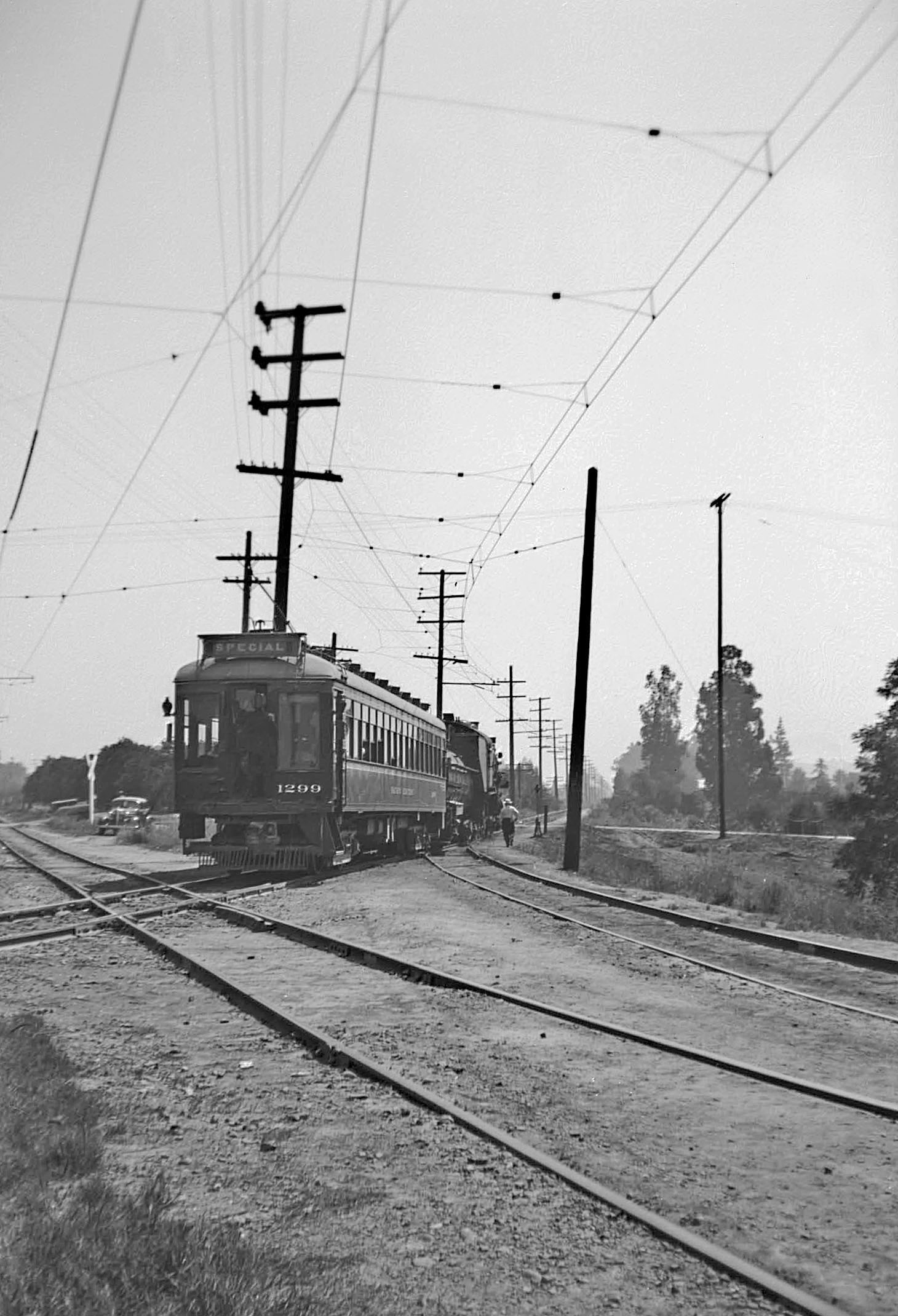
“Looking west at P.E. and S.P. Junction at Lone Hill, Calif. 1299 and 2701, 8-23-46. Road Foreman of Engines W.O. Baker just stepped off engine to replace staff in staff machine (booth behind pole). Before electrification of S.P. line”.
Both Pacific Electric and Southern Pacific utilized a staff machine system to authorize train movements on their respective lines. SP’s system began at Baldwin Park with a machine at the PE crossing. Additional machines were at Irwindale, Covina (East Switch), Lone Hill, (Junction Switch), San Dimas station, La Verne Jct. switch and Ganesha Jct.
PE’s staff system began at Monte Vista .058 miles east of P.E. Covina utilizing the same machines at Lone Hill, San Dimas, La Verne and North Pomona.
William Wherry Photos, Charles Wherry Collection
“Looking east at Lone Hill. Engine is pulling 1299 under trolley wire before uncoupling. Track to right of 1299 is connection between P.E. Covina line and S.P. line. Track behind 1299 is P.E. line to San Dimas P.E. line.” (Conductor Brocato is visible in the end door of 1299 trying to place trolley pole on wire).
William Wherry Photos, Charles Wherry Collection
“Lone Hill, Calif. Cond. Brocato and M/M A.A. Johnston after 2701 had uncoupled and was getting in the clear to permit 1299 to continue on to San B’dno”. (Conductor Brocato was still working into the 1970’s.)
This second photo of the series (original here) shows Southern Pacific no. 2701 and Pacific Electric no. 1299 at the Southern Pacific depot in Covina on August 23, 1946. I don’t know if the special stopped on this occasion. My dad was working during this time as a PE train dispatcher and presumably had advance information of the train’s itinerary. His note on the back of the contact print says: “S.P. station at Covina, Cal. Aug. 23rd 1946 before electrification. SP2701 and PE1299 inspection trip. Engr. W.H.Owen, Mtrm. A.A. Johnston, Condr. A.H. Brocato.”
The advance station sign reads: “Azusa Ave One Mile”.
On August 23, 1946, Southern Pacific 2-8-0 no. 2701 is preparing to depart Baldwin Park eastward over the SP’s Covina Branch with Pacific Electric office car no. 1299 in tow. The PE would purchase that portion of SP’s branch between Bassett, on the Sunset Route main track, and Ganesha Junction, a short distance from Pomona, on September 1, 1946 a mere 9 days later.
This trip was one that PE officials made over the line to see firsthand what their $400,000 investment looked like. The SP’s trackage between the Reliance Rock Spur, just east of Baldwin Park and Lone Hill was not electrified at this time. That would come in the next two months as PE sought a route that avoided increasing automobile congestion on their original line along Badillo Street in Covina.
Here we see some last-minute mechanical goings-on beneath 1299 as overseen by Road Foreman of Engines Baker. Engineer W.H. (Windy) Owen is keeping an eye on things while the fireman has a last look around.
William Wherry Photograph, Charles Wherry Collection
On September 30, 1951 Pacific Electric ran their last interurban train to Glendora, CA. The following month PE began to remove their famous right of way, beginning at Oneonta Park, Huntington Dr. and Fair Oaks in So. Pasadena) to Myrtle Ave. in Monrovia, west of Glendora. In order for PE to reach their remaining freight customers between Arcadia and Glendora including the non-electrified Day & Night spur which PE had taken over from SP in 1942, it was necessary to build a new piece of railroad, 2.82 miles in length, costing $436,000. The new freight line, called the Azusa Branch, was built from the Crushton spur’s north end to a connection with the Glendora line at Rivas Jct. just west of Azusa, crossing the Santa Fe at Kincaid en route. The first train over the new line ran on September 17, 1951.
The following Sunday, September 23, we find engine 1322 and caboose moving eastward after crossing the ATSF, (see the distant signal leading to the Automatic Interlocking behind the caboose) and dipping under Foothill Blvd. overpass en route to Rivas Jct. Notice the two trainmen ‘decorating’ the rear steps of 1322?
No, they’re not mad at the motorman. You see, they have made room in the cab for some visitors. This day my brother and I are occupying the left-side seat box on one of the first trips over the branch courtesy some of my dad’s working buddies. Tomorrow would be my 7th birthday and there would be plenty of time for cake and ice cream, but today is reserved for some railroading, PE style.
Who would have dreamed that 11 years and a week later I would be making my fireman seniority ‘date’ aboard one of 1322’s brothers, (1401) at the lower end of the ‘C’ Yard in SP’s Taylor yard at Los Angeles?
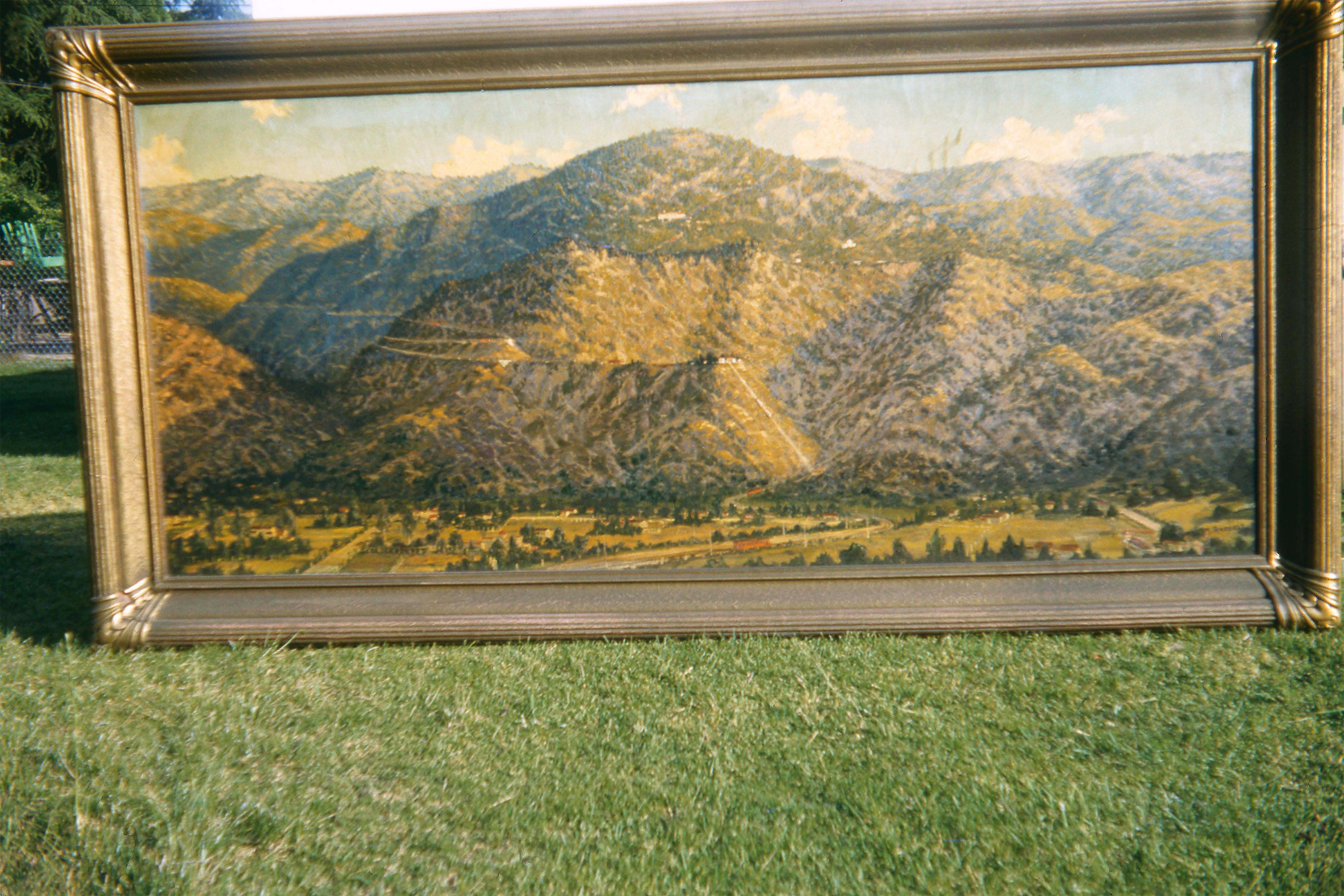
My dad worked for PE and at the time of his untimely death in 1952 was an office supervisor working in the Subway Terminal Building at 4th and Hill Streets in downtown Los Angeles. I can only assume that his daily routine took him by this oil painting on his way to and from his office. I personally have only faint memories of the layout of the PE station, but I seem to remember seeing either this oil or possibly its ‘partner’ painting when descending the ramps or stairways leading from the street level down to the track level.
Keeping in mind that I was only 7 years old at the time of his death it does seem a stretch that I should be able to say with certitude anything about my early experiences on the PE. All I can offer is that apparently I was very impressed with my brief experiences since they have remained throughout my next 63 years as if they happened just yesterday. I count myself very fortunate in this regard. I remember vividly riding the PE bus from Temple City with my brother Bill and Dad as we went to his office. After an hour or so in the office Dad would ‘assign’ his boys to a friendly crew and off we would go to Burbank or Hollywood sitting right up front with the motorman. After we arrived back at the Subway Dad would take us to lunch at Clifton’s Cafeteria. What a treat!. We would do another trip and then meet up with Dad to ride back home.
Back to the painting(s). I believe that there were two. Apparently by 1951, PE management had decided that reminders of the grand days of seeking tourist nickels and dollars by hauling them to the far flung reaches of its empire were truly over and paintings such as this one were ‘dated’ or didn’t promote the image that corporate PE wanted. Somebody in upper management made a decision to remove this one and its twin from the walls they had occupied for oh so many years. I say ‘twin’ but truth is I don’t really know what the subject of the other painting was. All I do know is that legend has it that the other oil ended up in the ownership of Jack Farrier. My dad helped Jack ‘get on’ with PE since Jack’s dad was a PE man and the family lived on El Monte Ave., a mile or so from our house. (Jack’s pictures have been used in various Interurban Specials and his face shows up in several images on this website).
William Wherry Photo, Charles Wherry Collection
Dad found out about the painting you see here, got out the utility trailer and hauled it to its new home in Temple City. Before mounting it on a wall of the garage, he thankfully paused to take this picture. As you may tell, it was taken in the late afternoon sun but, also thankfully, he used Kodachrome in his Bolsey 35mm camera and what you see here is the painting offering its ‘best side’ for history. The artist was ‘M. Rossart’. A brief web search shows a Michael Rossart was actively painting in the Los Angeles area in the 1920s and 1930s and he apparently specialized in broad landscapes. I will leave others to identify the geographical points of interest but foremost is the incline from Rubio Canyon.
I am saddened to say that all did not go well for the painting during the next 38 years. The dry heat of the California summers in the garage took a heavy toll. Over time, the canvas began to pull away from the frame and the oil paint began to crack. First my brother and then I married and moved away leaving only Mom to care for it and I’m afraid she didn’t see the historical value of it. Truth be told, neither did I at the time. I really do, now. By the time of her passing in 1989 the damage was too severe to economically repair and I made the decision to pull what little remained of the canvas from the frame and disposed of it. Someone did come by the estate sale and took the frame.
So now I can rest knowing that others with like interests can see for the first time since 1951 what thousands of commuters passed by in their daily life at the Subway Terminal Building. I hope you enjoy it as much as I have had in recounting a little of its part in Pacific Electric history.
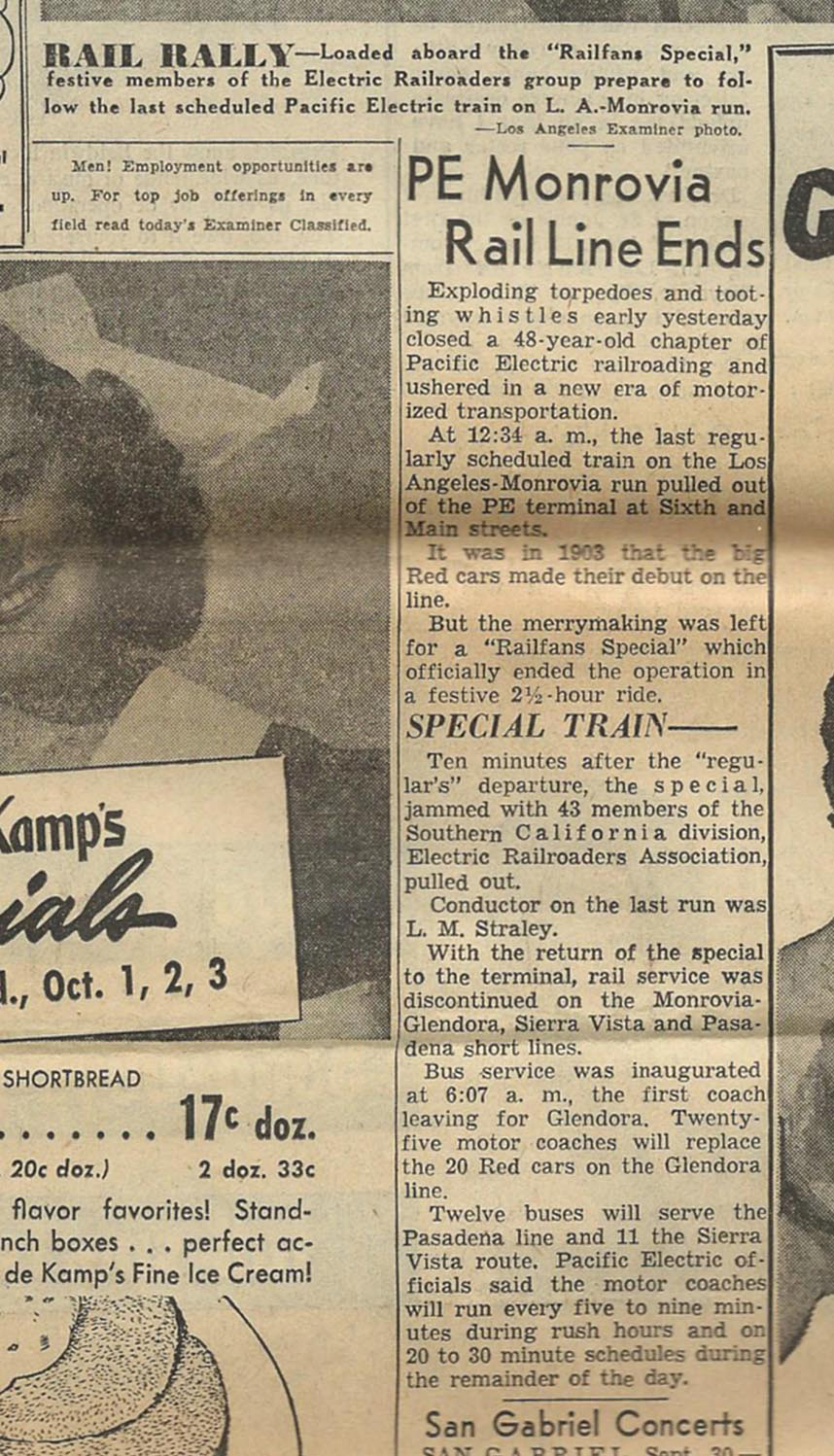
These three photos also deal with the last hours of rail passenger service on Pacific Electric’s Monrovia-Glendora line.
Los Angeles Examiner photo, Charles Wherry Collection
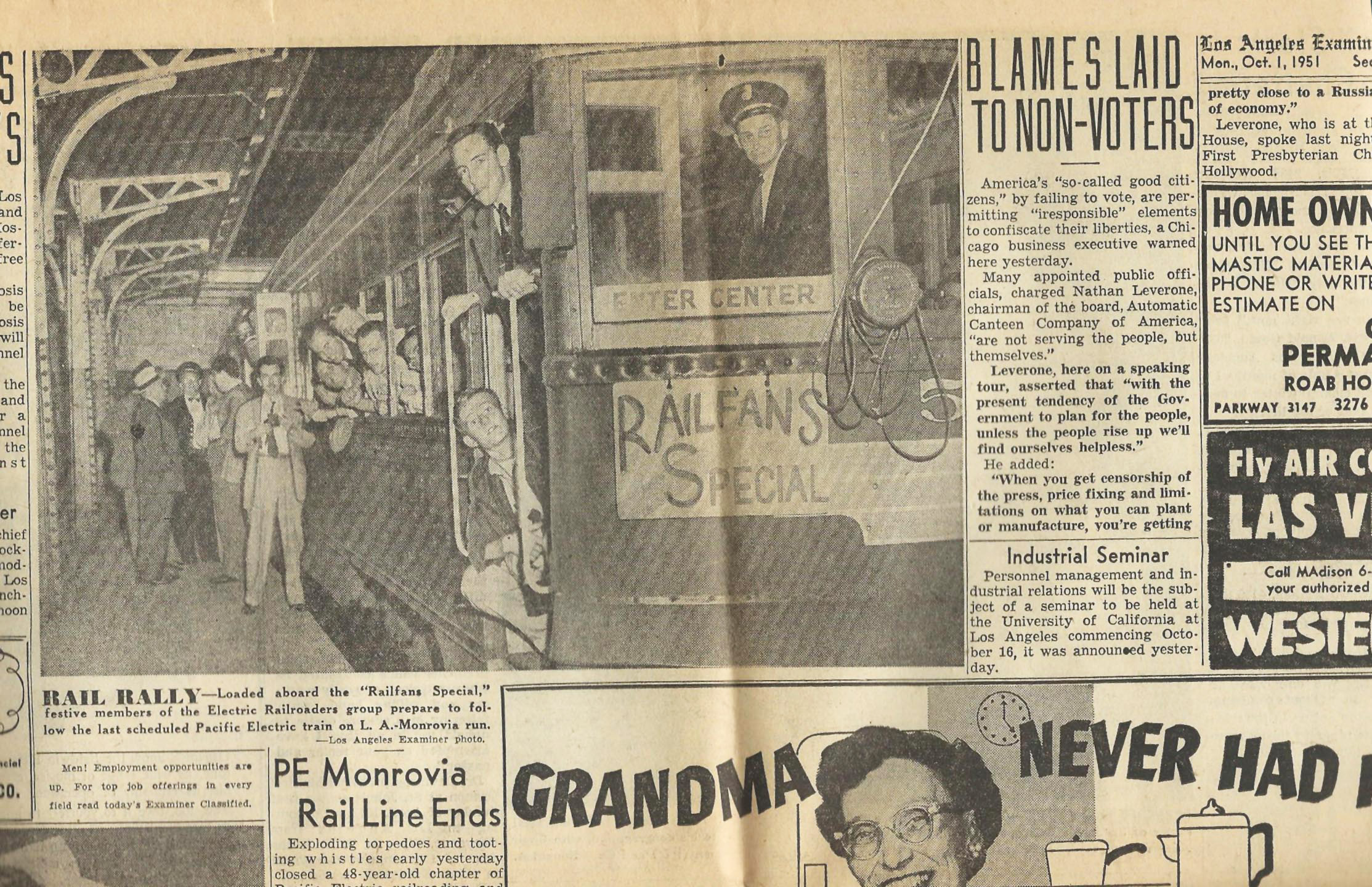
This image has previously been posted on the website but there was no accurate date given. I have included the Los Angeles Examiner’s page and date which is seen in the extreme right hand corner of the image as Monday, October 1, 1951.
And above is the accompanying text that went with the above photo. Notice that the text states:
“At 12:34 a.m., the last ‘regularly scheduled’ train on the Los Angeles-Monrovia run pulled out of the PE terminal at 6th and Main streets.”
Los Angeles Examiner photo, Charles Wherry Collection
The special ERA car followed with its 43 members 10 minutes later. As a side note, I wonder if any of the members took advantage of the 17 cents a dozen cookies that Van De Kamp’s was offering in the adjoining ad.
William Wherry photo, Charles Wherry Collection
The final image shows the last ‘regularly scheduled’ train referred to in the Examiner article.
I was aboard car no. 735 on this trip along with my brother and mother (seen in the window) and dad who took this picture.
I had just turned 7 years old and being up in the middle of the night was quite a thrill.
My PE employee timetable shows a scheduled departure of 12:35 a.m. from 6th and Main St. with a 1:24 a.m. arrival at Shamrock Avenue, which begs the question; how did we get back to L.A.? The same timetable shows the last inbound schedule from Monrovia on that long ago day to have departed 11:26 p.m. so we couldn’t have been on that. The only answer I can come up with is that we ‘hitched’ a ride with the SC-ERA folks on their inbound trip back to L.A. since theirs was not a regularly scheduled car and they had to get back home whereas we ‘regular’ riders were on our own.
I distinctly remember the explosions of the torpedoes mentioned in the Examiner piece. The noise reminds me to this day of popcorn popping in a skillet. Somewhere out in the murky dark, after a particularly loud and almost continuous barrage of torpedoes we stopped to pick up a passenger. It was Jack Farrier with a suspicious looking brown paper sack and an equally suspicious wide grin on his face. Someone asked Jack what was in the bag. “My lunch”, he responded. Everybody had a good time.
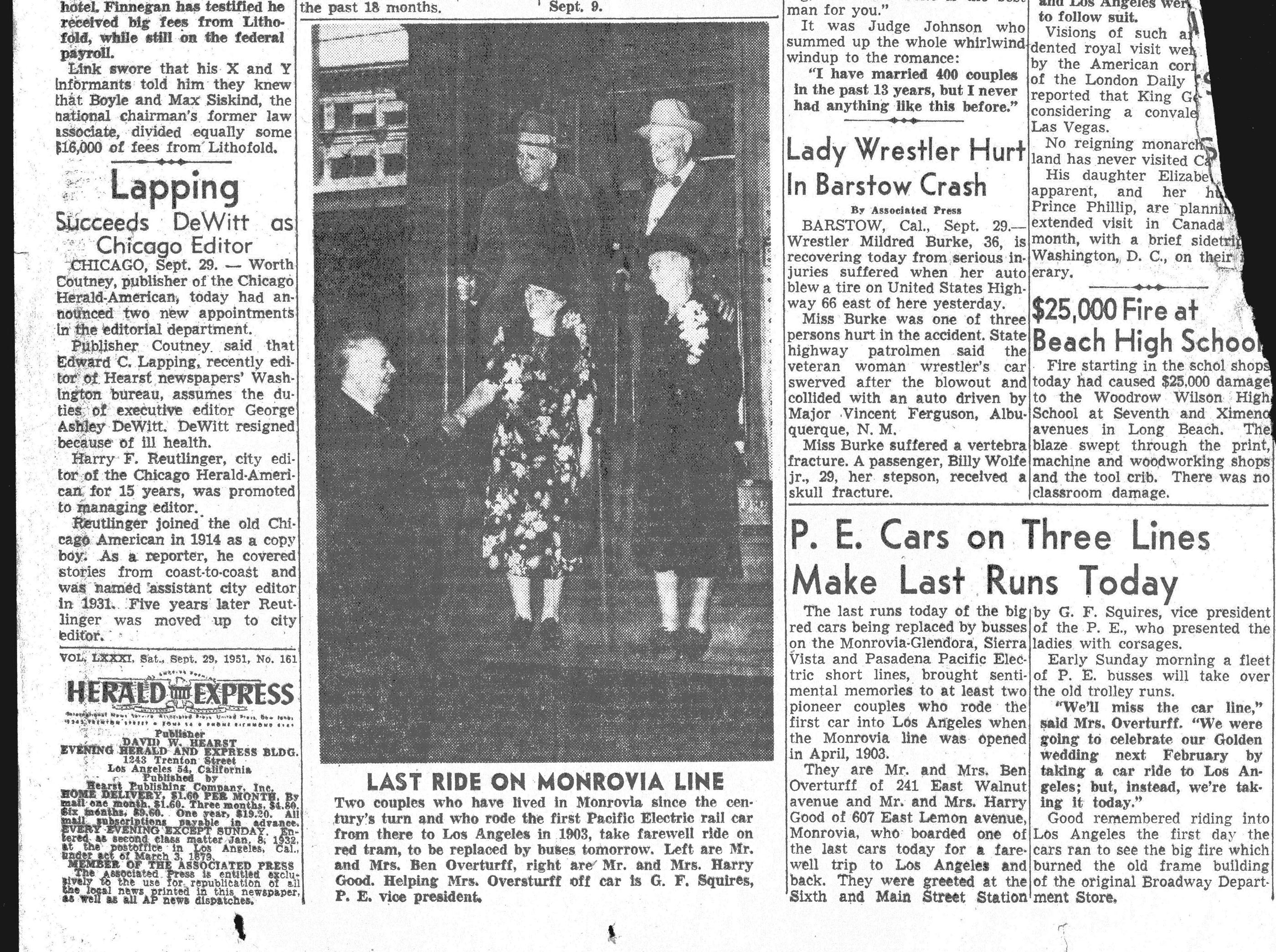
The two photos on this page are from my collection and depict PE publicity and news accounts of the final day of service on the Monrovia-Glendora line: September 30, 1951. Interestingly, Pacific Electric publicity people tracked down and found two couples who had ridden the line on its opening day in April 1903, and had them re-create their ride on the final cars from 6th and Main Street Station in Los Angeles to mark the event.
The next day, interurban service would be replaced by General Motors buses.
The first photo is a newspaper article in the Los Angeles Examiner that was published on September 29, 1951. Note the text of the article mis-names the Pasadena Short Line as the ‘Pasadena Pacific Electric short line’.
Los Angeles Examiner article, Charles Wherry Collection
The next image was scanned from an 8×10 glossy print that my dad William Wherry, a PE employee, obtained from the Director of Public Relations of the PE. On the reverse side of the print is the following caption:
These two couples were passengers on the first electric interurban car to leave Monrovia, California for Los Angeles which service was inaugurated in 1903.
Left— Mr. & Mrs. Ben Overturf, Right—Mr. & Mrs. Harry Good. G.F. Squires, Vice Pres. P.E. Railway presenting corsage.
Picture taken Sept 29, 1951, last day of rail service for passengers, at 6th & Main station.
Motor coach at right one of fleet replacing rail cars.
Pacific Electric Railway Photo, Charles Wherry Collection
Attributed to the photography of William W. Wherry, Alan Weeks Collection
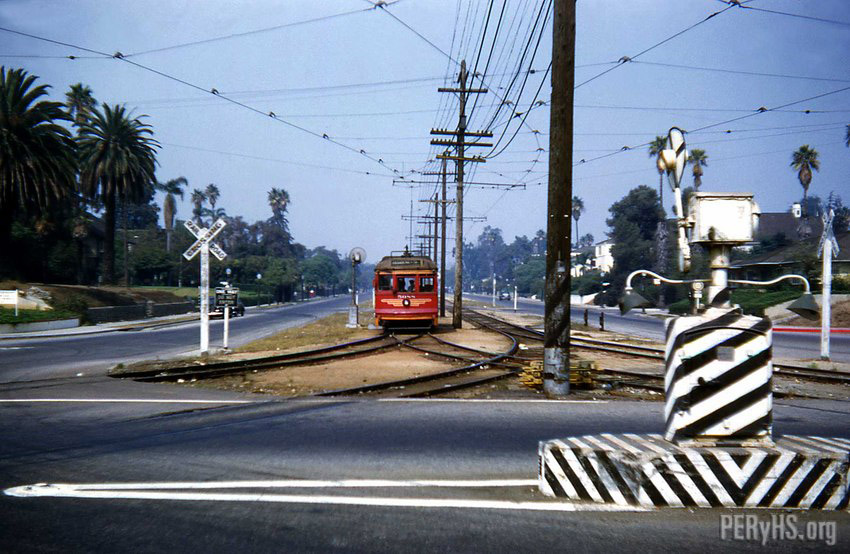
This image captures a Pacific Electric car (in Pasadena Short Line service) heading southbound on Fair Oaks Blvd. in South Pasadena as it approaches the wye at Huntington Drive and Oneonta Station. The year is believed to be 1951.
William W. Wherry Photo, Charles Wherry Collection