Pacific Electric Wreck in Santa Ana, July 12, 1927

Jeff Lear Collection, used with permission

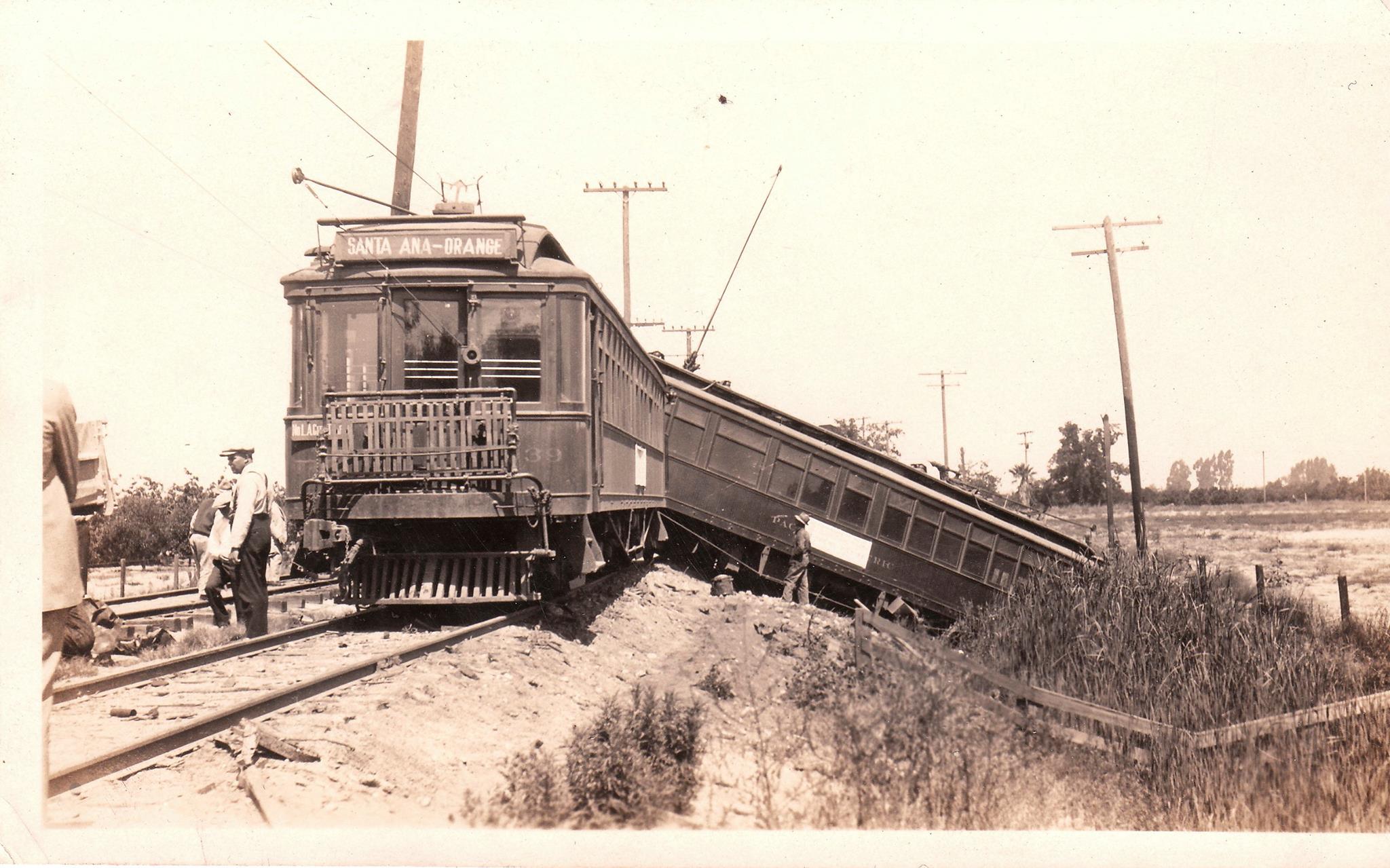
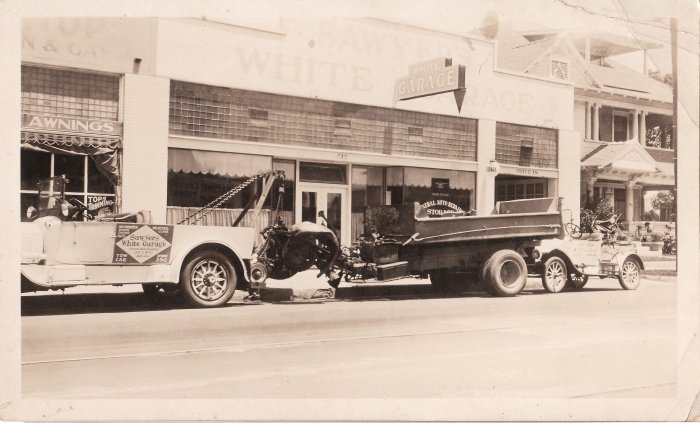
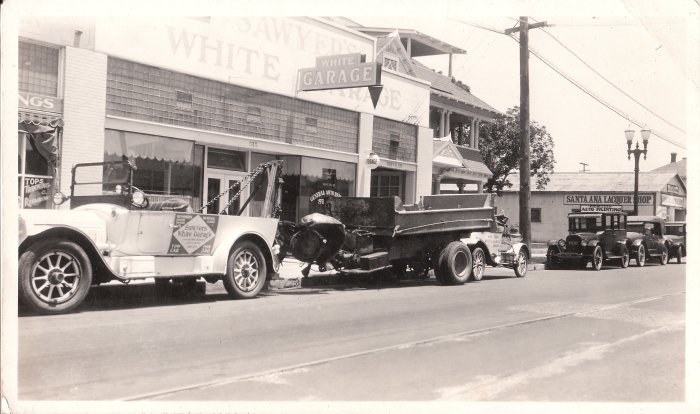
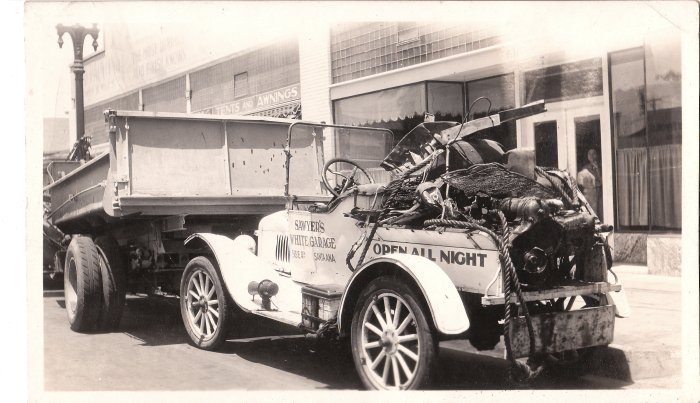
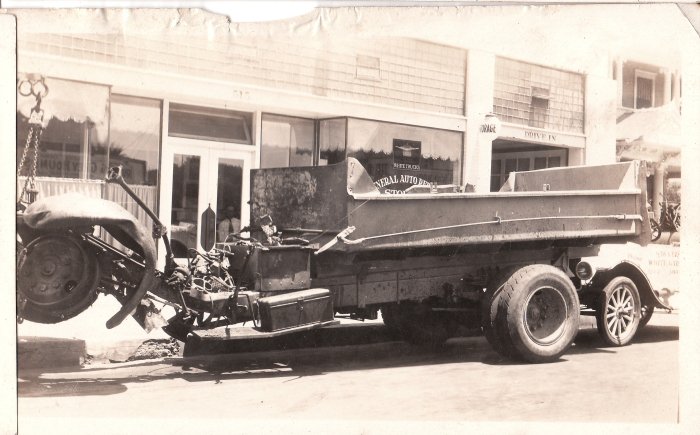
From Jeff Lear: My great grandfather was a mechanic and an avid photographer during the early part of the 20th Century. In one of my albums (which I’ve now made public) are several pictures taken by him of an accident which occurred in Santa Ana on July 12, 1927 between a Pacific Electric train and a truck. My great grandfather was called to the scene to tow one of the vehicles involved in the accident.

Further information from Jeff: While my great grandfather was an avid photographer, he made his living working in a garage, on July 12, 1927 he was called to the scene of a train vs. truck accident where the tracks cross 17th street in Santa Ana… This is how the Los Angeles Times reported it on July 13th…

FATAL CROSSING SMASH
One Killed and Two Injured as Pacific Electric Train Crashes Into Truck
——–
SANTA ANA, July 12 – One man was killed and two were injured today at the Pacific Electric crossing of Seventeenth Street, west of Santa Ana. Olen M. Lilley, 18, of Fullerton, was killed beneath the wreckage of a truck and a Pacific Electric train. The youth, a son of Mr. and Mrs. Claurant C. Lilley, 244 East Emerige Avenue, Fullerton, was crushed to death when his father’s gravel truck rolled onto the tracks in the path of an electric train bound for Los Angeles with two carloads of passengers at 8:35 a.m. The head car of the train was derailed and partially demolished as it ploughed its way into the ditch.
W.B. Artz of Tustin and Los Angeles, the father of C.O. Artz, Tustin merchant, was severely injured. He was a passenger in the head car and was removed from the wreckage to the Santa Ana Valley Hospital where it was reported that he would probably recover. Except for Motorman A.H. Norris of Santa Ana, who rode his car into the ditch, no other occupants of the train was injured. Norris suffered an injury to one foot.

Lilley’s body was removed to the Smith and Tuthill undertaking parlors in Santa Ana and later today was taken to the McAuley establishment at Fullerton. Coroner Charles D. Brown had not completed arrangements for the inquest.
Why the truck driver failed to stop at the crossing was a question that could not be answered today by witnesses of the wreck which was one of the worst in this district since two boys and a girl, of a party of six were killed in the same manner at the same crossing, two years ago.

Train crew and passengers stated that Lilley was driving his truck east on Seventeenth Street, bound toward Santa Ana while the train was traveling toward Los Angeles. The track crosses the boulevard at an angle so that the truck driver could have viewed the approach of the train without having to turn his gaze fully to the side. The vision at the crossing was unobstructed, it was said.

Ed. note: the car remaining on the track is likely PE no. 1039. Jeff has provided us with higher-resolution images of the car shots for closer examination. Thank you again, Jeff!

Jeff Lear Collection, used with permission

Jeff Lear Collection, used with permission

Video: Los Angeles in the 1920s

Here’s a vintage promotional film by Ford Motor Company documenting Los Angeles in the 1920s. Lots of action and a great perspective into how wonderful Los Angeles was as a young city in the first part of last century.

Found 8mm Pacific Electric Footage from the late 1940s

We’re thrilled to share this found footage from none other than Amsterdam, the Netherlands, by Frank M. Wiggers, who like us, shares a passion for anything railroad and mass transit.

He recently received a private film (likely 8mm) with Pacific Electric footage, and had it digitized and reached out to us for more information. We shared it with famed transit historian Ralph Cantos, who provided the following set of appraisals. Give it a watch and let us know what you think. And thank you to Frank for sharing with us!

From Ralph:

  • Very interesting footage. It  starts at Macy Street Yard and moves east along the Baldwin Park Line.
  • In the opening scenes, the 306 looks to be in A-1 condition, just out of the paint shop. I would say that 1947- 48 would be the time line of this short segment.

Please leave your additional comments below for us so that we can better document the entire clip!


LARy and PE Cars on Main Street, 1926: Not A Bus In Sight

Ralph Cantos Collection

By Ralph Cantos

This remarkable photograph taken from high atop the Pacific Electric building looks down on Main Street at 6th. A mix of southbound Los Angeles Railway (LARy) and PE cars stretch as far as the camera can see. Even though both the LARY and PE operated primitive, gasoline-powered buses of marginal size and construction at this time, most if not all important lines were operated by streetcars of the LARY and sizable interurbans of the PE.

What buses there were, usually held down runs on the “outskirts” of the City. Very few, IF ANY, bus lines operated into the Central Business District of Los Angeles.

What railfans there may have been in 1926 must have looked at this photograph with great pride and optimism. All those optimistic railfans looked to the future with great hopes for an everlasting dominance of rail transportation in Los Angeles, if not the entire USA.

But in the coming decades, circumstances and events would alter the hopes and dreams of even the most optimistic proponents of big city rail transportation. Ever-improving automobiles and technical improvements to the motorbus would bring the future of rail transit to the crisis point.

Ten years after this photo was taken, the modern, revolutionary PCC streetcar design would make its debut on the city streets of “big city America.” In the coming three decades, an army of 5000 PCCs would fight a losing battle to the finish with millions of private automobiles and hordes of buses being built by several manufacturers that were “cashing in” on the misguided investment of “flexible” bus routes and ever-expanding highway and freeway construction. This epic battle of rail vs. rubber could be equated with the “Battle of the Alamo.” PCCs slowed, but could not stop, the onslaught of trolley-to-bus conversions taking place across this country.

By 1956, a photograph taken from the top floors of the PE building would be shocking. Trolley and interurban rail transportation had vanished from Main Street and buses dominated the thoroughfare. Not even the rails remained. PE’s once-vast Southern District struggled for its very existence, with Metropolitan Coach Lines hell-bent on its total destruction.

By 1957, only 5 former LARY car lines remained, and in less than a decade, they too were gone. The battle had been hard fought, but was lost to ignorance and greed. The pleasant memories of streetcars were all that LA commuters could hold on to, until the opening of the Metro Blue line in 1989.

Since then, rail transportation has made a slow but steady return to the landscape of Los Angeles and surrounding suburbs, at a cost of unimaginable hundreds of BILLIONS of dollars to restore what was once a common sight in Los Angeles. As of 2016, half-century-old PCCs still provide nostalgic, dependable transportation in a few select US cities that were smart enough to keep them operating, or restore them back to service.

Ralph Cantos Collection

Pacific Electric 4508 on 4th Street in Santa Ana

Orange County Archives Collection, suggested by Terry Salmans

From contributor Terry Salmans, who found this Orange County Archives image on Flickr:

The photo is at the end of track on 4th St. at the Southern Pacific Santa Ana Station. Note the hood over the headlight.

The photo is unusual that there are not many views Red Cars at the Santa Ana SP Station. According to Interurbans Special 21, during World War II, alternate outbound trips from Los Angeles would continue east past the PE Santa Ana Station at 4th St. and Mortimer to the SP Station. Out of view behind the 4508 and the billboards was a small three-track yard for car storage. This trackage back to the PE Santa Ana Station and the storage yard was abandoned immediately after World War II ended.

Orange County Archives Collection, suggested by Terry Salmans

PE’s Toluca Yard, 1941: The Calm Before The Storm of World War II

Ralph Cantos Collection

By Ralph Cantos

This beautiful photo taken by Ralph Melching from the Beverly Boulevard viaduct looks down on Pacific Electric’s Toluca Yard in the summer of 1941. The freshly modernized Hollywood cars are still adorned with their very attractive silver roofs as are the “new kids on the block,” PE’s revolutionary double end-MU PCCs. Hollywood car no. 659 will be heading for West Hollywood via busy Santa Monica Boulevard.

This was the Western District at it finest. The modernized Hollywood cars were the equal to the modern PCCs of the day. They were exceptionally smooth and quiet-riding cars. Braking was about the only performance area where a Hollywood car could not match a PCC head to head.

All was tranquil on the PE in the summer of 1941. The PE was still very much an “interurban system” despite some recent rail abandonments in 1938. Those abandonments, brought on more by demands of state and city regulatory bodies demanding the PE rid the streets and right-of-ways of all wood bodied interurbans, than a lack of patronage of the effective lines.

But in just a few months of this photo, all HELL would break loose and the PE (and the LARY as well) would be put to the test. The venerable 950s and 1000s were saved from the fire and served LA’s commuters with distinction in a time of crisis.

The PCCs had only been in service little more than a year and the Hollywood cars were in top condition. The PCCs and Hollywood cars – along with virtually every rail car on the system – would be put to the test of wartime passenger traffic demands that had never been seen on the PE since its inception.

Soon the bright silver roofs on all recently modernized rail cars would give way to a more sedate gray color as a safety precaution, less a PE car be spotted by enemy aircraft that could result in catastrophic results. Fortunately, all of PE’s rail cars made it through World War II in great shape, only to face the scrapper’s torch in the coming decade.

The PE had proved its worth to the City Of Los Angeles in time of crisis, only to be given the shaft in time of peace.

Ralph Melching Photo, Ralph Cantos Collection, Pacific Railroad Society Collection