

BunkerHillLosAngeles.com: No, Everyone, there was No Los Angeles Streetcar Conspiracy
BunkerHillLosAngeles.com has an interesting (and accurate) debunking of the long-held belief that the Los Angeles streetcar system was undermined by Big Oil, Detroit manufacturers and the like.
Los Angeles has a dark and hidden history, and here’s part of it you should know: we once had the largest, best run, most efficient, most beloved, most profitable, publicly owned streetcar system in the world. The Red Cars! But! The bloated plutocrats and greasy oligarchs said NO! Profits over people! A cackling cabal of big oil, big tire, and big auto conspired to buy up all the Red Cars and destroy them! Which they did! Then they needlessly replaced them with horrible nasty busses which people disliked so much they all went out and bought cars! And that, my friend, is the reason we now live in a dystopic autopian hellscape of traffic and smog and sprawl.
Not only that, but it was such a grand and shameless conspiracy, that Standard Oil and General Motors and Firestone Tire actually got taken to court and were found guilty of conspiracy and had to pay huge fines! But the damage had already been done to the poor beloved streetcars. All of America’s streetcars had been tossed in the sea by General Motors, and the corporate fatcats puffed contentedly on their cigars and just laughed.
Of course, none of that is true. “But Nathan,” you say, “the GM Streetcar Conspiracy is a real thing! Literally everybody knows about it!” Sorry to burst your bubble but no, the entire tale is twaddle and hogwash. Not even, like, there was a conspiracy but it wasn’t that bad. I’m saying no, it’s literally not a thing that ever existed. Don’t believe me? Read on!


I enjoyed this article, and I suppose I’m a bit of a streetcar pedant, but the text contains three howlers that can’t pass unchallenged.
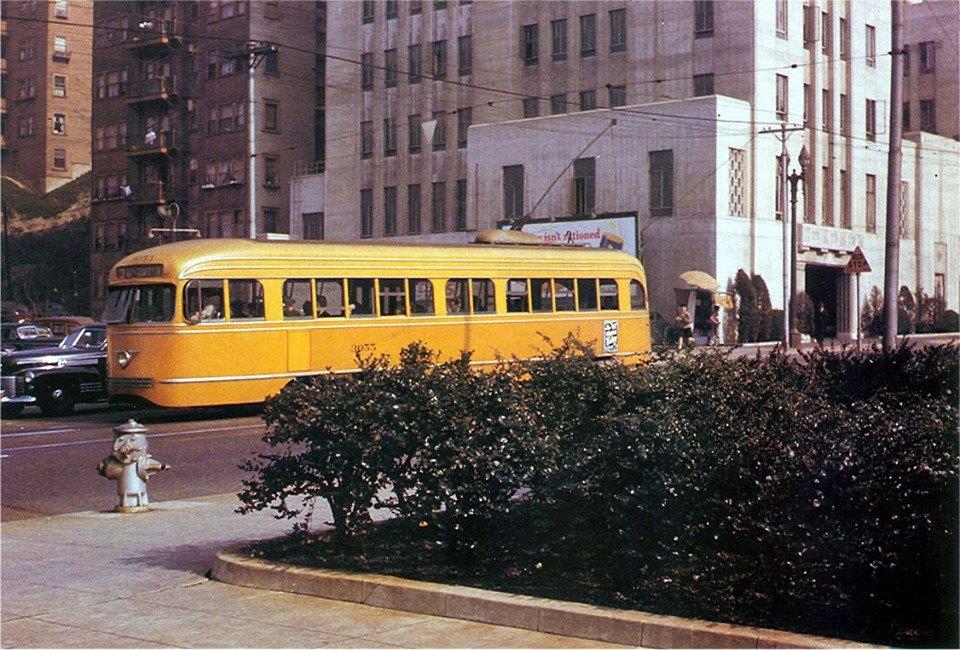
Directly below a photo of a “Hot Rod Blimp” and a mangled car the author categorically states that buses carry more passengers than streetcars. This is simply false for the era of the “streetcar conspiracy” and remains false today in an era of articulation. Seating capacity for city transit buses produced by ACF-Brill topped out at 44, while the largest Macks could seat 49, and GM “old looks” could accommodate 55. By comparison, “Big Ps” (PCC cars running on the Pico/East First line) could seat 61, and several older LARY car types could seat more than 50. (To see a fascinating report search for: lary 1944 types of passenger cars.)
In explaining why “people didn’t like streetcars” the author cites lack of air conditioning, apparently unaware that the first production, i.e., not a one-off, air-conditioned city bus debuted in San Antonio in 1948. Clearly, lack of air-conditioning was not a factor in the nationwide crash of streetcar ridership in the 20s and 30s. Optional transit bus air-conditioning did not become readily available until the late 1950s.It was not an option on GM “old look” buses until 1958.
Near the end of his article the author makes a remarkable assertion: National City Lines actually replaced most streetcars with ACF/Brill trolley buses. Wrong! On August 3, 1947 trolley coaches replaced streetcars on the #3 line. This conversion allowed the D and U lines to be abandoned. Rail line B was converted to trolley bus operation on December 5, 1948. Then on September 10, 1950, the #3 trolley coach line was extended to 3rd and Fairfax, replacing a portion of rail line S. And that was it for trolley coaches in LA–just 110 Brills, more than needed for peak service.
To the author of this article I recommend Interurbans special 59, volume 31, No. 1, Summer 1974, “The Trolley Coach in North America,” by Mac Sebree and Paul Ward. He might also enjoy Interurbans special 58, Vol. 30, No. 1, Summer 1973, “Transit’s Stepchild the Trolley Coach,” by the same authors–a scholarly achievement of the first rank. Both volumes are loaded with photos and graphics and open windows to worlds and times gone by.
Since the author of this article repeatedly characterizes streetcars as slow, noisy, unheated, and uncomfortable, he might find Interurbans special 64, 1980, “PCC The Car that Fought Back,” by Stephen P. Carlson and Fred W. Schneider, III, a useful antidote to his attitude. The collective, cooperative project, as outlined in this book, makes an invidious contrast with the later Federal Government attempt to deliver a standard American light-rail vehicle.
Sorry, must have missed that part of his disclaimer where he says, “I’m a total idiot to criticize something that I never actually experienced!”. Well bud, I did ride these streetcars and those nasty busses too. And I rode in all those cars from Morris & Opel to Bel Airs and bigger. And what I can tell you is that trolley system, even in its’ reduced state, was far better than anything else over those roadways. Frankly, I don’t really care what Los Angeles does now with their mess, but thirty years of stupidity was about enough.