
Here is a photo I took of the Pacific Electric freight lines in the 1970s.
This image shows an 86′ boxcar loaded with toys from Testor Corporation, West Los Angeles sitting in PE’s 8th Street yard.
Edward Langer Photo and Collection

Here is a photo I took of the Pacific Electric freight lines in the 1970s.
Edward Langer Photo and Collection

Here is a photo I took of the Pacific Electric freight lines in the 1970s.
This shows what kept on frustrating me the most regarding abandonment.
Edward Langer Photo and Collection

Here is a photo I took of the Pacific Electric freight lines in the 1970s.
Edward Langer Photo and Collection

Here is a photo I took of the Pacific Electric freight lines in the 1970s.

From Interurban Special #37, page 791:
The final group of second-hand cabooses was purchased from the Richmond, Fredericksburg & Potomac in 1950. This official PE view, taken at 8th Street Yard, shows 1984’s first style of PE lettering which was later changed to resemble SP’s block style lettering of the late 1950’s and early 1960’s.
Edward Langer Collection

[vc_row][vc_column][vc_column_text css=”.vc_custom_1528824133063{margin-bottom: 0px !important;}”]Mount Lowe Preservation Society Inc. President Michael Patris appears on the latest edition of “What’s Up Pasadena.”[/vc_column_text][vc_video link=”https://youtu.be/gGcYR6Nj2w4?t=11m14s” custom_thumbnail=”true” thumbnail_image=”14192″][/vc_column][/vc_row]

[vc_row][vc_column][vc_column_text]From the Edward Langer Collection comes this fascinating bit of history as written by the General Attorney of Southern Pacific Transportation Company, Randolph Karr, in 1973. Mr. Karr served for 34 years with both the SP and Pacific Electric, and his father Frank Karr served 42 years with PE, retiring in 1944 as Vice President and Chief Counsel of Pacific Electric.
This historic document details many facts of the PE’s history and demise through the eyes of those who were in its management, so it serves as a unique look into the inner workings of his beloved organization.
Edward Langer Collection[/vc_column_text][mk_button dimension=”outline” size=”large” url=”https://www.pacificelectric.org/wp-content/uploads/2018/06/railpassengerservice-historypacificelectricrailwayco-karr.pdf”]CLICK TO DOWNLOAD PDF[/mk_button][/vc_column][/vc_row]

[vc_row][vc_column][vc_column_text]From the collection of Edward Langer comes this extremely interesting wartime pamphlet entitled “This is Pacific Electric.” Best guess has this in the circa-1945 era, though could be earlier with numerous references to wartime haulage and customer numbers, plus military references.[/vc_column_text][mk_padding_divider][mk_button dimension=”outline” size=”large” url=”https://www.pacificelectric.org/wp-content/uploads/2018/05/elc-pacific-electric-magazine-1945.pdf”]CLICK TO DOWNLOAD PDF[/mk_button][/vc_column][/vc_row]

[vc_row][vc_column][vc_column_text css=”.vc_custom_1527795610325{margin-bottom: 0px !important;}”]From the collection of former Southern Pacific employee Edward Langer comes a scan of this very interesting document dated June 1, 1953, between the Pacific Electric Railway Company, Southern Pacific Transportation Company (the parent), and Integrated Ceilings, Inc.
The agreement permits Integrated Ceilings to receive service on PERY trackage at Bergamot Station in Santa Monica, California.
Edward Langer Collection[/vc_column_text][mk_padding_divider][mk_button dimension=”outline” size=”large” url=”https://www.pacificelectric.org/wp-content/uploads/2018/05/elc-pery-track-agreement-1953.pdf”]CLICK TO DOWNLOAD PDF[/mk_button][/vc_column][/vc_row]

By Stephen Dudley
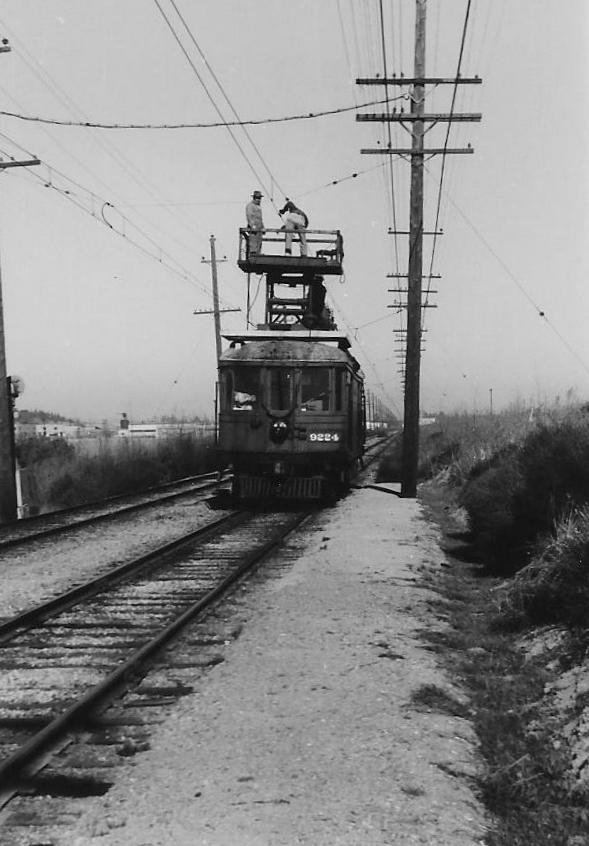
On Sunday, November 30, 1958, I happened to come by as line car #9224 (former #00164 that once served on the Western District lines) was finishing up the repairs relating to the situation described in the following quote from Timepoints, January 1959 edition.
SAGA OF THE SAGGING WIRE
Saturday night, November 29, started out like any other night on the Long Beach line, but wound up being one of the most eventful in some time.
It all started when an LA-bound train (car 1520 and deadhead 1500) arrived at the Del Amo crossing at 7:40pm. After making the safety stop, the train proceeded to cross the street and was almost across when the trolley wire in front of it broke, the trains running into same. The result was that the front of the 1520 was charred and wire came down on the north-bound track for 150 feet. About this time another two-car train appeared on the scene from the north. This train was made up of two 1800s, 1803 and 1808, enroute to Fairbanks. The two 1800s were unable to get past because of the downed wire.
By 8:10pm MTA supervisors and local police were in mass numbers on the scene–and two Long Beach trains (1503 and 1541) had ground to a halt behind the 1800s. It was decided that it would be best to clear the south-bound track and single-track all trains from Cota to Dominguez. The tower truck crew agreed and went off to tackle the wire. Apparently they were too eager, as someone had shorted things out in grand style. The ensuing 30 seconds were spent watching one of the best non-Fourth of July fireworks display in southern California. After the wire stopped glowing, it was found that another 700 feet of overhead was down and that apparently the wire still up was not shorted out after all. Moments later an LA car (1531) pulled up down the track, followed in a short time by a car that was being deadheaded to LA.
Confusion was quite evident; eight cars were stranded, wire was everywhere, and the buses that had been ordered had not yet arrived. Finally, by 9:10, the south-bound track was cleared and the four cars cautiously went on their way. After arrangements were made with the Dominguez tower, the two cars on the north-bound track backed to Cota. The deadhead car went back to Long Beach and the regular train single-tracked to the Dominguez crossover. Work continued during the night and by 9:00 Sunday morning new wire was up and the two charred cars had been removed. The line car was on the scene, its crew putting the finishing touches on the catenary. In a few hours it too was gone–peace prevailed once again on the Long Beach line.
Stephen Dudley Photos and Collection