
Los Angeles & Redondo Railway
[vc_row][vc_column][vc_column_text]By Steve CriseThe Los Angeles & Redondo Railway is one of the earliest railroads to be constructed in the Los Angeles basin. As its name suggests, it ran from the southwest corner of Jefferson and Grand to roughly Catalina and Diamond Streets in Redondo through the mostly vacant fields between the two cities. From its meager beginnings as a section of railroad right of way constructed by “The Rosecrans Rapid Transit Railway” in 1887, the LA&R eventually grew into a system of about 95 miles of 3’6” narrow gauge trackage.
To service and construct its fleet of coaches, steam locomotives and then its fleet of electric cars, the LA&R built a shop and car house in Redondo Beach on a trapezoidal piece of property bordered by Diamond Street at the southern tip of the property with N. Elena Avenue on the southwest side, Beryl Street bordered the northwest end and N. Francisca Avenue on the northeast side. The section of the road slicing on the southeast corner of the lot was Camino Real, present day Pacific Coast Highway, California State Route 1.
The location of the car house in the photo above was rumored to be in several different locations on or near this property. I set out to see if I could find the exact location of the huge structure or at least come within a few feet of where it once stood until it was destroyed by fire in 1921.[/vc_column_text][mk_image src=”https://www.pacificelectric.org/wp-content/uploads/2025/04/crc_lar_55_redondo_map-003d.jpg” image_size=”full”][vc_column_text css=”.vc_custom_1743772585885{margin-bottom: 0px !important;}”]I found a very helpful clue in the form of a map drawn by Raymond E. Younghans in Ira L. Swett’s 1957 publication of Interurbans Special No.20 “Los Angeles & Redondo,” on page 65. It places the car house at the top of the property boarding N. Elena Avenue and Beryl Street. Using this information from the Younghans map I estimated its location on a Google Map capture as to where the building would be resting atop the shopping mall that has occupied the property since the early 1960’s.
My next point of curiosity was the three cars shown in the photo. Of the three cars, only two were identified by traction expert Craig Rasmussen, the provider of the image. He noted that the car on the left was LA&R #55, the center car was not identified but the car on the right was easily identified as LA&R #15, the prestigious Redondo parlor car and the pride of the railway.
I was not able to find any specific car being numbered as 55 on the railroad. There is a mention of cars 52-56 being rebuilt steam coaches that were made into interurbans after the railroad was electricized. These second-hand steam coaches were known as the “New York” cars because their being purchased used from the Third Avenue Street Railway in New York City in 1902. It is also assumed that LA&R car #3, one of the cars from New York, was renumbered to 55. With this being the case it is reasonable to assume that there was indeed a car 55, just no record of it in any books. The closest match I could find to the car in the photo was LA&R #50 (original LA&R #10), also purchased from New York, which is seen on page 40 of the aforementioned LA&R book.[/vc_column_text][mk_image src=”https://www.pacificelectric.org/wp-content/uploads/2025/04/ilsc_pe_1400_drawing-002.jpg” image_size=”full”][mk_image src=”https://www.pacificelectric.org/wp-content/uploads/2025/04/ilsc_pe_1727_special_37-001.jpg” image_size=”full”][vc_column_text css=”.vc_custom_1743772660357{margin-bottom: 0px !important;}”]About 1907, LA&R #55 was converted into a box motor with a freight door cut into the side for easier handling of freight. After the Great Merger of 1911 Pacific Electric renumbered the car to 1400. It was again renumbered to P.E. 1727 when it was again reborn as a tower car. One more renumbering would take place in 1931. It then became P.E. #00156 before the venerable car was finally scrapped on October 5,1934 after serving three different railroads on two different coasts. And as if that wasn’t enough, it also had the distinction of operating on two separate gauges of track during its lengthy career.[/vc_column_text][mk_image src=”https://www.pacificelectric.org/wp-content/uploads/2025/04/ilsc_pe_450_class-003.jpg” image_size=”full”][mk_image src=”https://www.pacificelectric.org/wp-content/uploads/2025/04/sjcc_pe_464_rubio_sta-002.jpg” image_size=”full”][vc_column_text css=”.vc_custom_1743772720252{margin-bottom: 0px !important;}”]LA&R #204, also known as the “Redondo” parlor car likewise made the transition to the P.E in 1911 and was renumbered into PE’s #400 – #465 series cars and became PE #453. These were Los Angeles & Redondo’s final car-building product and had a very productive life on different lines throughout the system including the Glendale – Burbank Line, Rubio Canyon Line and on occasion in service for Santa Anita racetrack trains when heavy passenger traffic required their service. The entire class of the #450 – #465 cars were scrapped just a few months before the start of WW II. PE #453 had an earlier date with the scraper than most of the other cars in the series and in 1933, after 25 years of service, was discarded by the Pacific Electric and removed from the roster.[/vc_column_text][mk_image src=”https://www.pacificelectric.org/wp-content/uploads/2025/04/mapc_lar_ainsworth-06.jpg” image_size=”full”][vc_column_text css=”.vc_custom_1743772761315{margin-bottom: 0px !important;}”]The J.C. Ainsworth, a 3’6” gauged Baldwin 4-4-0 seen in the above photo was named after one of the original founders of the Redondo Railway, Captain J.C. Ainsworth. Captain Ainsworth and his business partner Captain R.R. Thompson were heavily involved in the Pacific Northwest’s lumber trade. Their goal was to develop Redondo Beach into a major Southern California port for their lucrative lumber business. The success of their efforts soon eclipsed the steam locomotives’ capabilities, and it was decided to completely abandon steam power and modernize and eclecticize the entire road to a 600-volt DC system. This is when the New York cars, once pulled by the steamer, were converted in the LA&R shops to suburban electric cars. During the long service record of the J.C. Ainsworth for the LA&R it bore no less than three different numbers; #2, #23 and #421. Incredibly, the J.C. Ainsworth survived long enough to become a piece of Pacific Electric’s rolling stock. After the 1911 merger, Pacific Electric assigned this locomotive to be #1501, appropriately fitting into the PE’s steam locomotive classification numbering system. However, the 3’6” gauged engine was never used on the PE because of its incompatibility with the standard gauge 4’ 8.5” track that the PE operated on. The ancient engine was sold in 1913 to the San Fernando Rock Company.
As this exercise aptly demonstrates, there can be countless stories buried within these historic photographs. Here at the Pacific Electric Railway Historical Society, we endeavor to seek out as many facts and stories that to the average viewer are not necessarily obvious and research and share them with the world on this site. If you have a rare or interesting image from the bygone era from one of the many early transit systems in the Southern California area, please send your image and story to us and we will do our very best to decipher and post it on PERyhs.org for all to enjoy.[/vc_column_text][mk_image src=”https://www.pacificelectric.org/wp-content/uploads/2025/04/lar_logo-003.jpg” image_size=”full”][vc_column_text css=”.vc_custom_1743772866559{margin-bottom: 0px !important;}”]Source material:
- Interurbans Special 20, Los Angeles & Redondo Railway.
- Interurbans Special 28, Cars of the Pacific Electric Vol.1 City & Suburban Cars.
- Interurbans Special 37, Cars of the pacific Electric Vol. III Combos, RPO’s, Box Motors, Work Motors, Locomotives, Tower Cars, Service Cars.
- Pacific Electric Railway Historical Society image archives. PERyhs.org
- Craig Rasmussen Collection
- Michael Patris Collection
- Steve Crise Archive
Pacific Electric 5160 at Park Junction
Above: Pacific Electric 5160 at Glendale and Park. Rod Crossley Photo, Pacific Electric Railway Historical Society Collection / MLPSI Collection.
By Steve Crise and Michael Patris
Looking south on Glendale Boulevard, PE 5160 stops at a traffic light at Park Avenue adjacent to Echo Park. In fact you can see a bit of the park on the left side of the frame.
Moments earlier this car departed the Subway Terminal tunnel and made her way northward up Glendale Boulevard to what was then known as Park Junction, located at Park Avenue and Glendale Boulevard. At this point the car would take the diverging rails to the left from the Glendale – Burbank Line and continue its route westbound on Sunset Boulevard, then to Hollywood Boulevard, ending its run at the West Hollywood Car House as read on the dash sign hanging on the front of the car.
Our resident automobile expert Michael Patris has identified the three vehicles in this photo as being, from left to right, a 1950 Chevrolet Fleetline Deluxe four-door sedan. Behind the Fleetline is a 1954 Chevrolet Bel Air with just a portion of the left front of the vehicle visible. On the far right of the frame is captured a 1955 Plymouth Belvedere heading south on Glendale Blvd.
This is another wonderful unpublished photograph from the late E. Rod Crosley, shot sometime around 1955.
READ MOREPacific Electric Diesels at Taylor Yard
By Steve Crise & Michael Patris
A very unusual view from inside the depths of Southern Pacific’s Taylor Yard in Los Angeles, California finds these three Pacific Electric diesel switchers spotted at the paint rack.
PE 1654, and a pair of Baldwin VO-1000’s were captured by E. Rod Crossley’s camera around 1950 set out on one of the whisker tracks of the turntable at Taylor Yard. On the nose of the second unit masking tape is visible where the orange and black tiger striping will be painted.
In 1944 the Pacific Electric began purchasing small, light-weight diesel-electric locomotives from General Electric in Erie, Pennsylvania with the aim of having them replace electric locomotives on some of their freight lines that were isolated from the rest of the electrical overhead system or those lines that were soon to be de-electrified.
Some interesting scribblings on the side of 1654 just under the numbers reads, “Super Jet” and “SP Studebaker Front.” One can only speculate that the comment about the unit being a “super jet” must refer to the locomotive’s limited speed ability of only a minuscule 35 mph.
As far as the Studebaker scribbling is concerned, perhaps that is a comment on the styling of the locomotive (think Pennsylvania’s GG-1) that somewhat resembles a popular car sold in the late 1940’s and early 1950’s made by the Studebaker Company, most notably the Studebaker Champion designed by Robert Bourke from the renowned Raymond Loewy Industrial Design Studio. The Studebaker Champion of 1950 had unique styling that perhaps prompted some unknown person to scribble their remarks on the side of the little locomotive. Maybe the paint crew at Taylor Yard will eliminate the comments with a fresh coat of Southern Pacific gloss black paint.
References: Ira Swett, Interurbans Special # 37, Southern Pacific Review 1952-82, Joe Strapac.
READ MOREMichael Patris Named 2022 Collector of the Year by Collector Magazine
[vc_row][vc_column][vc_column_text css=”.vc_custom_1642686013783{margin-bottom: 0px !important;}”]Mount Lowe Preservation Society President Michael Patris has been named 2022 Collector of the Year by Collector Magazine.[/vc_column_text][mk_image src=”https://www.pacificelectric.org/wp-content/uploads/2022/01/patris-collector-01-scaled.jpg” image_size=”full” title=”Collector Magazine cover showing Michael Patris as Collector of the Year” caption_location=”outside-image” margin_bottom=”30″][mk_image src=”https://www.pacificelectric.org/wp-content/uploads/2022/01/patris-collector-02-scaled.jpg” image_size=”full” title=”Collector Magazine page showing Michael Patris as Collector of the Year” caption_location=”outside-image” margin_bottom=”30″][/vc_column][/vc_row] READ MORERIP KOBE
Photo by Michael Patris
READ MORE5181 at Universal City
A very austere Universal City stop is seen in this October 11, 1952 shot. This stop was located at the Lankershim Boulevard overpass near the world-famous studio and has since been absorbed into the US 101 Hollywood Freeway.
Fred V. DuBritz Photo, Steve Crise Collection
READ MORE1299 on a Fan Trip
Looking north on Van Nuys Boulevard from Gault Street, PE 1299, their official business car, is preforming duty on what appears to be a fan trip. This Fred V. DuBritz photo was taken on May 3rd 1952. Note the incorrect destination roller sign reading “San Bernardino”. Displaying incorrect destination signs was a favorite trick of railfans to confuse unsuspecting travelers.
Fred V. DuBritz Photo, Michael Patris Collection
READ MORELos Angeles Pacific Railroad Balloon Route “Scenes Seen From An Electric Car” Brochure
From the brochure:
The Lines of this Company form a far more important railway system than can be judged from the number of trains arriving at and leaving Los Angeles each day. From a single track line of 18 miles in 1896 the Los Angeles-Pacific Railroad has grown to a double track system with a total of 185 miles of electric road, of which about ten miles are in Los Angeles.
Connections are made at Los Angeles with railroads diverging; at Sawtelle with Southern Pacific Company, at Inglewood with Santa Fe Railroad, at Hollywood with daily stage for Tolucca (sic), and at Redondo with Los Angeles & Redondo Railway, and with steamers for San Francisco and Coast points.
In addition to numerous intermediate points, the Company’s service reaches Hollywood, Colegrove, Sherman, Sawtelle, National Soldiers’ Home, Santa Monica, Ocean Park, Venice, Playa del Rey, Manhattan Beach, Hermosa and Redondo.
Nowhere are the elements conducive to expansion more pronounced. But the far-sighted management has not been slow in taking advantage of every point of strategic importance; so that any hope of successful competition in their territory must meet with failure.
Special Round Trip Tickets, taking in all these points, good for 10 days, and good to stop off at any or all of them, 80 cents.
Michael Patris Collection

Michael Patris Collection
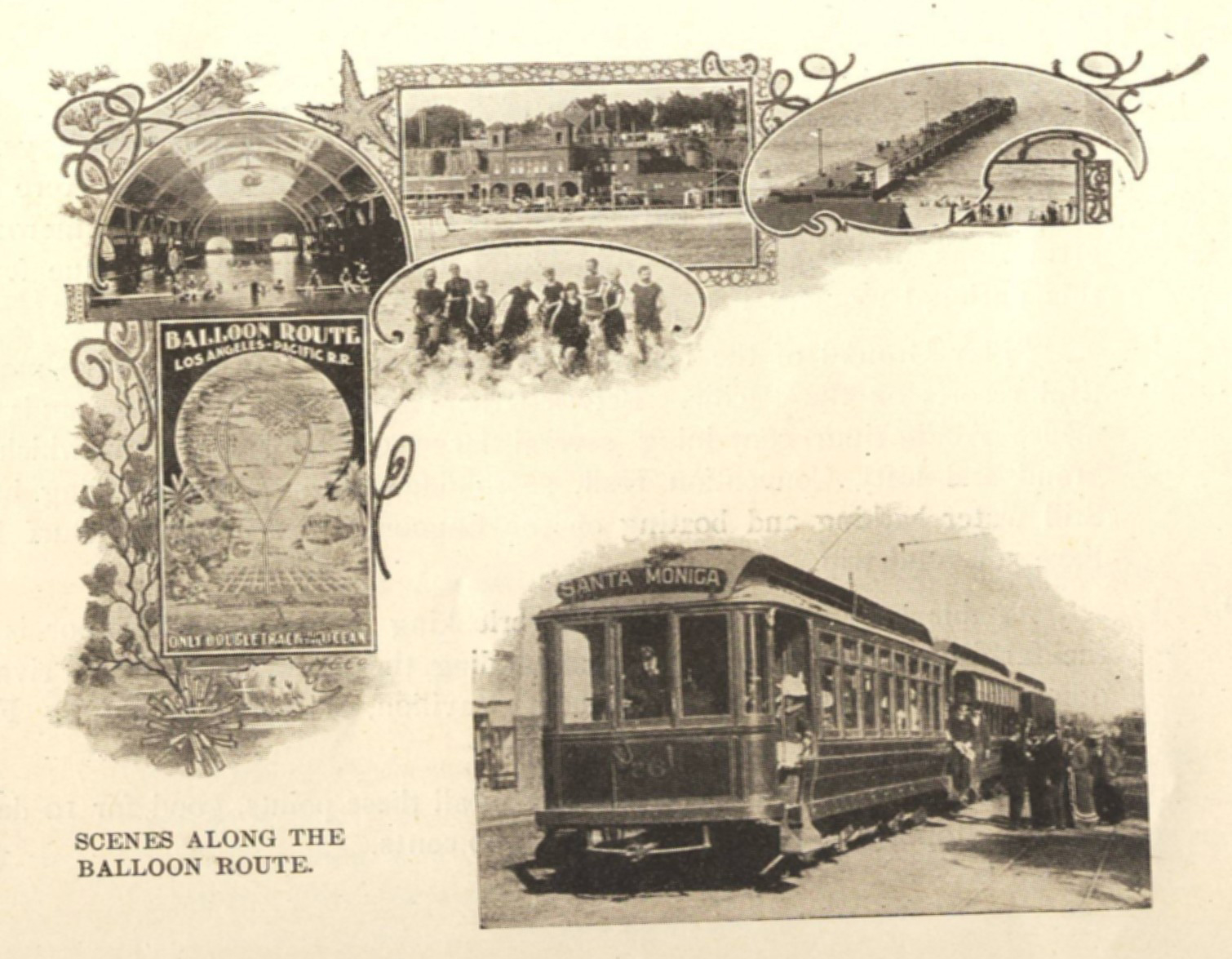
Michael Patris Collection
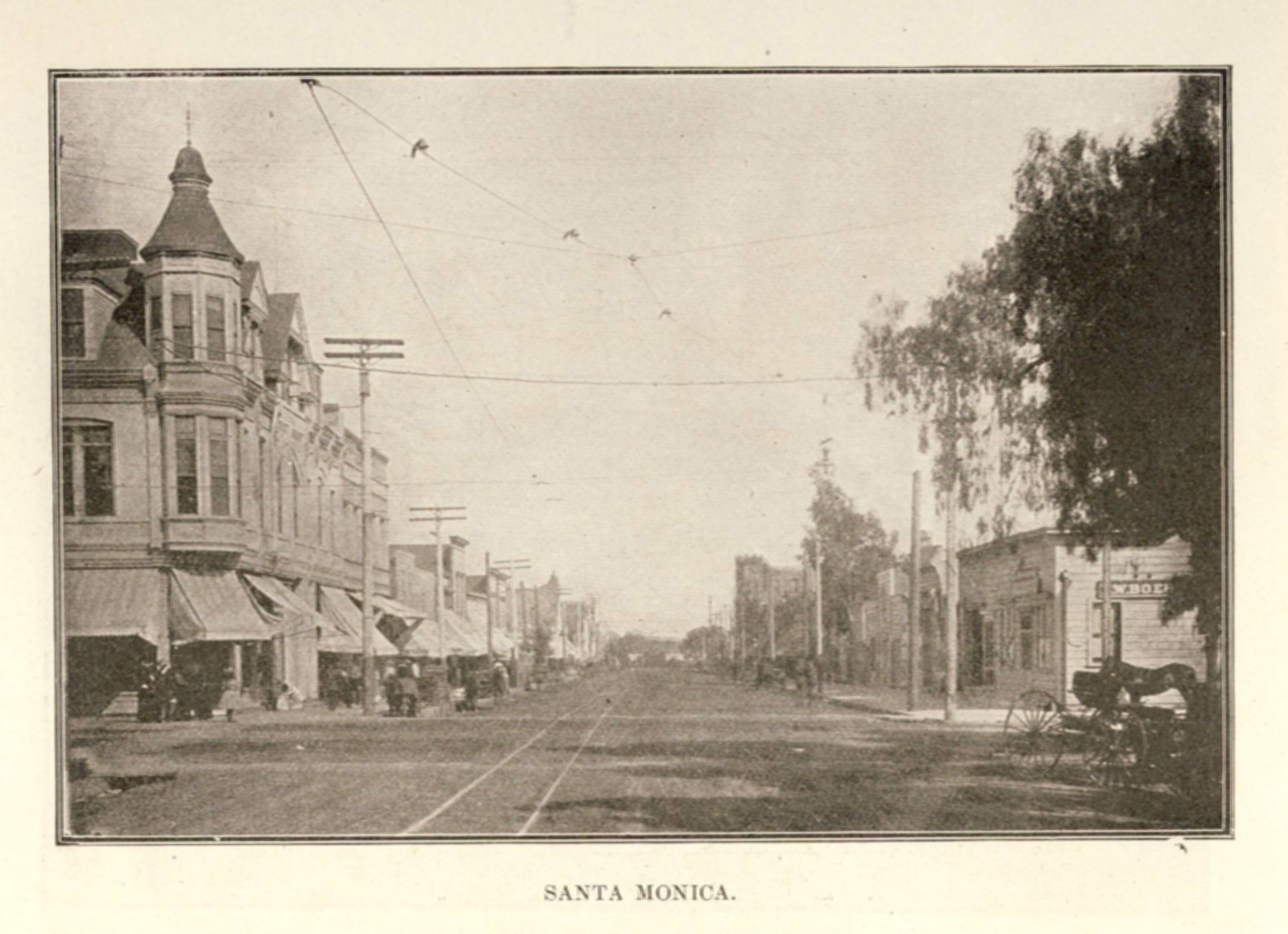
Michael Patris Collection

Michael Patris Collection
Los Angeles & Pacific to Santa Monica Tickets
The Los Angeles Pacific Railroad was both a steam locomotive railway as well as an electric railway. It began in 1899 when “General” Moses Sherman and Eli P. Clark filed articles of incorporation. Clark would serve as president and a facsimile of his signature is on the top ticket. On June 16, 1903, the Los Angeles Pacific Railroad merged with the Los Angeles-Santa Monica Railroad Company and the Los Angeles, Hermosa Beach and Redondo Railway Company. The new name after this merger was the Los Angeles Pacific Railroad of California, but everyone still just called it the Los Angeles Pacific Railroad. The Los Angeles-Santa Monica Railroad Company was incorporated on December 2, 1902.
Over time there would be nearly 200 miles of track from the beach communities of the South Bay, including Redondo, Hermosa, Manhattan, El Segundo, Playa del Rey and Santa Monica. The lines headed eastward from the beach through the west side of Los Angeles, downtown Los Angeles, Sawtelle (The Soldier’s Home) and even through to Pasadena.
Rolling stock, in the heyday of 1906, included more than 400 pieces broken down as follows: 221 freight cars, 144 passenger cars, 17 electric locomotives, 12 repair service cars, 6 parlor cars and 5 mail cars.
From Terry Salmans: According to Interurbans Special 63 “Trolleys to the Surf” by Myers and Swett, LAP was sold to the Southern Pacific Railroad in 1906. The Los Angeles Pacific would be merged into the Pacific Electric in 1911.
By 1911 the PE could discontinue use of the steam locomotive lines, but continue to haul freight for decades.
Top ticket undated, blank on reverse. Bottom ticket back-dated 1908.
Michael Patris Collection
READ MORESierra Madre Shuttle
Former Pacific Electric and Southern Pacific Railroad employee Harold Stewart captured this image of Pacific Electric no. 113 heading into Pasadena from Sierra Madre on October 1, 1940. The banner on the side advertises the Flower Show in Pasadena and the river-rock constructed home in the background still survives today at the northeast corner of Del Rey and Sierra Madre Boulevard, in the old East Pasadena neighborhood of Lamanda Park.
Harold Stewart Photo, Craig Rasmussen Collection
And today…

Michael Patris Collection