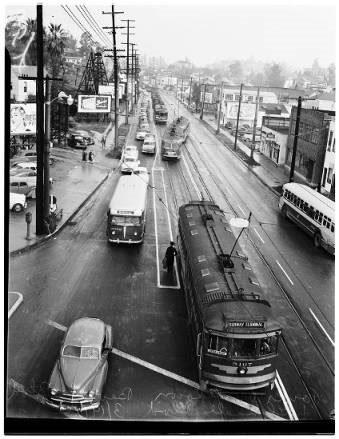
Pacific Electric 5167/717: A Lucky Warrior

By Ralph Cantos

Pacific Electric Hollywood car no. 5167 is seen here at Gardner Junction in the last days of the Hollywood Boulevard – Beverly Hills Line. After 29 years of service, the old gal still looks great having just gone through a rehab that turned her into a one-man car. She was built new in 1925 by the J. G. Brill Company as PE no. 717. She was renumbered 5167 in the 1949-50 one-man rebuild, which also included a fresh coat of paint.

Number 717-5167 was a fixture of the Western District most of its adult life, primarily working the Hollywood Boulevard and Glendale-Burbank Lines. Pacific Electric rail management had a tendency to assign cars to different lines in blocks of consecutively numbered cars. For instance, the Watts Local had cars numbered 5111 to 5125 assigned to that line, to its very last days. Hollywood Boulevard and the Glendale Line had cars numbered 5144 to 5168, while the San Fernando Valley Line featured cars numbered 5169 to 5181.

When the Valley Line closed, the “best of the best” (all former 700s) were placed in dead storage at Torrance Shops, never to run again in revenue service. The 1953 abandonment of the Santa Monica Boulevard Line saw still more Hollywood cars go into dead storage. Then in mid-1954, the Hollywood Boulevard Line was abandoned.

Out-of-service Hollywood cars were now stored anywhere the PE could find room. West Hollywood Yard was full and so several cars wound up stored at the 8th street freight yard. By the end of 1954, only 30 Hollywood cars remained in service, 15 to the Glendale Line and 15 to the Watts Line. When the Glendale Line closed, all 30 PCCs and the 15 Hollywood cars were stuffed into the Subway Terminal tunnel and put up for sale.

The future looked grim for the Hollywood cars, still in mint condition.

Meanwhile, things down at the Watts Line were not looking good. Metropolitan Coach Lines management did not give a damn about the remaining Southern District lines. By late 1955, the Watts Line was down to 12 serviceable cars. So it was decided to truck two Hollywood cars from the Subway to Watts before the rest of the unfortunate cars were sent to Terminal Island to be scrapped.

It just so happened that, cars 5166 and 5167 were located at the mouth of the Subway Terminal tunnel and were loaded up onto a pair of flatbed “low-boy” trucks for the trip to Watts — and as it turned out, a trip to eternity.

Also trucked to the Southern District at the same time was Line Car no. 00164 and an old wooden boxcar loaded with Hollywood car spare parts. Soon after the lucky 5166 and 5167 plus the 00164 and boxcar departed Toluca Yard, several flatbed trucks arrived to take the remaining 13 Hollywoods to slaughter.

And so, by sheer luck, the 5166 and 5167 went on to a new life on the Watts Line and then to Orange Empire Railway Museum.

The 5167 is now the sole remaining operable Hollywood car, now numbered 717. Long live this old warrior.

Ralph Cantos Collection

PE 950s at Olympic-San Vicente-Fairfax: A traffic nightmare today

[vc_row][vc_column][vc_column_text css=”.vc_custom_1579701455854{margin-bottom: 0px !important;}”]This interesting photo taken around 1936 shows a two-car train of Pacific Electric 950s heading to Santa Monica via Beverly Hills. The small wooden-bodied LARY bus heading east on Olympic Boulevard will make a connection with the LARY  L line at Mullen Avenue.

This line ran on an angle from Vineyard Junction to La Cienega Boulevard, then turned northwest along Burton Way until reaching Beverly Hills Station. From there, it was an arrow straight shot along Santa Monica Boulevard  to Santa Monica. The Westgate line diverged from Santa Monica Boulevard just west of Sepulveda Boulevard.

Both lines suffered  intense competition from bus lines on  all sides. Santa Monica Municipal Bus Lines, Bay Cities Transit, LA Motor Coach and LARY’s legendary P line all siphoned passengers from this line all along the way.

The PE finally pulled the poles down on July 7, 1940. A lone daily round trip franchise car struggled on until November 18, 1940.  After passenger service was abandoned, rails along the Westgate line were pulled up, and rails on Santa Monica Boulevard west of  Sepulveda Boulevard were quickly paved over.

However , rails east of Sepulveda Boulevard  remained in service for one reason or another. Rails along Santa Monica Boulevard east of Sepulveda Boulevard remained in service well into the 1980s for freight service.

Passenger service from Vineyard to Genesee Avenue continued until September of 1950. Rails along San Vicente Boulevard west of Genesee remained intact for cars pulling into and out of West Hollywood Car House and Yard  via the Sherman cut-off, until early 1951.

The last major use of these rails took place when all 50 1100-class cars that had been stored at West Hollywood operated under their own power in five-car trains. These trains operated via the cut off, San Vicente, to Vineyard, then west to Culver Junction along the abandoned Venice Short Line. At Culver Junction, the five-car trains changed ends, then headed east along the Santa Monica Air Line to AMOCO Junction, From there, the five-car trains changed ends once again and headed to the LA Harbor via the San Pedro Line.

Today, the three-way intersection of Olympic-San Vicente-Fairfax has turned into traffic nightmare. Morning and evening rush hour auto traffic passing this point has become intolerable. Try as they might, Los Angeles city traffic officials have yet to figure out a way to move auto traffic smoothly through this three-way intersection.  If just one of the traffic lights goes out of sync, then all hell breaks lose. I live in the area and avoid this intersection like the plague. It’s the ghost of Pacific Electric past.

Ralph Cantos Collection[/vc_column_text][mk_padding_divider][mk_image src=”https://www.pacificelectric.org/wp-content/uploads/2020/01/img007.jpg” image_size=”full” lightbox=”true”][vc_column_text css=”.vc_custom_1579701574283{margin-bottom: 0px !important;}”]A bird’s-eye view of this horrible three-way intersection. A lone 950 heads west just about to cross Olympic Boulevard. When rails were first built, Olympic, Fairfax and San Vicente were little more than dusty wagon trails. Who alive at that time would ever believe that today automobile traffic is so bad at this three-way intersection, it’s a wonder there has not been a road rage shooting here, but that may yet happen some day.[/vc_column_text][/vc_column][/vc_row]

Glendale-Burbank Line Scrapping: a monumental act of vandalism

[vc_row][vc_column][vc_column_text]By Ralph Cantos

PE’s Glendale-Burbank Line for it’s time, was  one of the best examples  of modern light rail transit in California. State of the art,  MU PCCs  provided base service on the line, along with refurbished  Hollywood cars. The entire line had been rebuilt from end to end in 1940 in preparation for the introduction of the new PCCs.

Several miles of the line were on private-right-of-way. Three bridges carried the rail cars over busy streets and the LA River. The mile-long subway provided the line’s cars a fast entrance and exit out of Downtown LA.

Yet all the fantastic infrastructure didn’t mean shit to the management of Metropolitan “Roach” (Coach) Lines that had taken over PE’s passenger service in mid-1953. MCL management had only one agenda, that being the complete destruction of the remaining former PE rail lines.

By the end of 1955, the Glendale-Burbank Line was history along with the Subway Terminal.  Rail service on Hollywood and  Santa Monica Boulevards had been abandoned in 1953 and 1954. The Glendale line was the last Western District line to fall. Scrapping of the line was  agonizing and slow, but sure. The tracks on Brand Boulevard were paved over almost with indecent speed. Rails were pulled up along all portions of the rights of way. The Allessandro cut was taken over by California Highway Department for use  as part of the 2 Freeway. The line was being carved up like a Thanksgiving turkey.

For the better part of four years, the line’s three bridges remained standing as a sad reminder of the efficient, former rail line. The end for the bridges would come in 1959. The photogenic trestle over Fletcher Drive, the steel deck bridge over Riverside Drive, and the 20-year-old bridge over the LA River would all fall victim to the scrapper.

And so now, more then 50 years after the abandonment, “modern” buses are mired in traffic. No doubt, had the abandoned line  remained intact, it would have by now been rebuilt into a modern light rail line.[/vc_column_text][mk_padding_divider][mk_gallery images=”14629,14630,14631,14632″ column=”4″ hover_scenarios=”slow_zoom”][/vc_column][/vc_row]

The Slow Death of the Venice Short Line Viaduct

[vc_row][vc_column][vc_column_text]By Ralph Cantos

La Cienega bridge-1953.  Three years after the moronic abandonment of the Venice Short Line. the massive bridge stands proud,  looking almost new, stripped bare of rails and overhead. This view looks north from the south side of the intersection..
[/vc_column_text][mk_padding_divider][mk_image src=”https://www.pacificelectric.org/wp-content/uploads/2019/12/pe-abandonded-vsl-over-pass-venice-at-la-cienega-1953.jpg” image_size=”full”][vc_column_text css=”.vc_custom_1575288361568{margin-bottom: 0px !important;}”]Standing atop the abandoned bridge,  looking towards Downtown  Los Angeles. Today, this same view is dominated by the Santa Monica Quagmire.[/vc_column_text][mk_padding_divider][mk_image src=”https://www.pacificelectric.org/wp-content/uploads/2019/12/pe-la-cienega-venice-bl.-bridge-demolition.jpg” image_size=”full”][vc_column_text css=”.vc_custom_1575288407546{margin-bottom: 0px !important;}”]From the south side of Venice Bl at La Cienega, looking towards the west, demolition is well underway in this 1964 view.[/vc_column_text][mk_padding_divider][mk_image src=”https://www.pacificelectric.org/wp-content/uploads/2019/12/pe-san-vicente-viaduct-demolition-1963.jpg” image_size=”full”][vc_column_text css=”.vc_custom_1575288461962{margin-bottom: 0px !important;}”]Just a few miles from Venice and La Cienega Blvds., the Pico-San Vicente viaduct demolition is well under way also.[/vc_column_text][/vc_column][/vc_row]

PE 972 and train at La Cienega: Going to beach was half the fun

By Ralph Cantos

This beautiful photograph from the Craig Rasmussen Collection was taken by the late Al Haij on a summer day in 1947 (July 11, to be exact). This three-car train of wonderful 950s is headed up by car no. 972. West of Vineyard Jct., the Venice Short Line provided superior transportation to Venice and Santa Monica bound passengers, regardless of the type of car used.

For about the last 15 years of Venice Short Line, the venerable 950s were the mainstay on the VSL. Hollywood cars and 10s were also used on this very busy line. The magnificent bridge over congested La Cienega Blvd. was the most impressive structure on the line. The bridge was constructed about 1925 to elevate the tracks over the intersection which had a tendency to flood during heavy rains. After all, La Cienega in Spanish means “the swamp.”

After the Sept. 1950 abandonment of the rail service,  inferior bus service was inaugurated with great civic fan fare. The new bus service was met with mixed feelings  by former rail passengers. The now abandoned bridge over La Cienega would remain standing for almost 15 years until construction of the Santa Monica Freeway reached La Cienega. It was bulldozed  away in the summer of 1964 along with thte equally impressive Pico-San Vicente viaduct. It seems like the City of Los Angeles was hell bent on erasing every last vestige of the once great Pacific Electric Railway.

Craig Rasmussen Collection

VJ Day on Hollywood Boulevard

[vc_row][vc_column][vc_column_text]By Ralph Cantos

August 15, 1945, was a great day for the entire world. After years of war, peace had finally had come to planet Earth. There were spontaneous celebrations all over the world. Cities large and small across the globe celebrated in the streets. New York, City, Chicago, San Francisco, and Los Angeles were no exceptions.

In Southern California, Hollywood Blvd. seemed to be ground zero for a massive gathering of joyous Angelenos. On Hollywood Blvd., PE’s Hollywood cars were in the thick of the celebrating mayhem. At the world famous intersection of Hollywood & Vine, an unidentified Hollywood car is stopped behind a 1942 Cadillac in the the happy mayhem. Further west down the Blvd. car no. 684 is finally in the clear, the rails ahead covered in mounds of paper confetti.

World peace would last little more than 5 years, when war in Korea would again drag the United States into another conflict. Many of PE’s magnificent interurbans that played such an important part of moving the masses in Southern California during World War II would now be sacrificed for the Korean War effort. Among the most notable cars to be lost were the fabulous 1200s. They were among the most magnificent interurbans ever built, the Butterfly 12s, chief among them.

Ralph Cantos Collection[/vc_column_text][mk_padding_divider][mk_image src=”https://www.pacificelectric.org/wp-content/uploads/2019/11/pe-684-on-hollywood-bl..-vj-day.jpg” image_size=”full”][vc_column_text css=”.vc_custom_1573658518509{margin-bottom: 0px !important;}”]ABOVE: Pacific Electric no. 684 prepares to move along  down Hollywood Blvd. as crowds begin to thin out.  Never again would the Pacific Electric, and the LARY for that matter, be considered such an important asset to the welfare of Los Angeles. It seems that from VJ Day onward, LA City officials began to look at the PE and LARY with  ever increasing amounts of disdain.  Talk about biting the hand that saved your ass!!![/vc_column_text][/vc_column][/vc_row]

Pacific Electric 746 at San Vicente Blvd. and Genesee Street

By Ralph Cantos

This beautiful photograph taken around 1948-49 shows Pacific electric car no. 746 laying over at San Vicente Blvd. and Genesee Street. Most likely, the 746 is working the “16th St. Local.” That line would run local service along Venice Blvd. Hill Street, Sunset Blvd. through Hollywood to Gardner Junction with some rush-hour runs going all the way to Beverly Hills Station.

On weekends, a single car would operate as the “San Vicente Shuttle” every 20 minutes. Originally, this trackage was part of the Santa Monica via Beverly Hills line that was discontinued in 1940. Thereafter, this track was kept intact to La Cienega Blvd. for  a “back door”  access to West Hollywood car house and yard via a single track, “back alley” p-r-w (private right-of-way). Passenger service was provided only as far as Genesee Street. Beyond Genesee, only dead-heading cars to West Hollywood yard used the remaining track.

The 746 looks really beautiful in this photo. For what ever reason, she looks nicely “refreshed” in what appears to be a complete repaint from roof to skirts. Notice that the words PACIFIC ELECTRIC are gone from her flanks, replaced by  a new, winged PE emblem.  Just 3 or 4 years after this photo was taken, the 746 would arrive in Buenos Aires. I am sure that railroad officials there looked at the 746 and wondered, “What the hell is wrong with those stupid Americanos?” How right they were….

Today, all the apartments on the right side of this photo still stand , but the left side of the street has completely changed. A large hospital complex now occupies that ground.

Ralph Cantos Collection

Subway Terminal Tunnel Uncovered, 1970

[vc_row][vc_column][vc_column_text css=”.vc_custom_1643759070861{margin-bottom: 0px !important;}”]By Steve Crise

During the construction of architect John Portman’s 1976 futuristic Bonaventure Hotel in downtown Los Angeles, California, a large portion of the Pacific Electric’s Subway Terminal tunnel was exposed and filled in to accommodate the foundation for the new hotel. In this July 1970 view, we are looking north from 5th Street where construction crews have uncovered a large section of the tunnel. Several hundred feet of the Subway Tunnel will eventually be removed for this construction project.

It is interesting to note that this 1970 project was not the first assault on the integrity of the Subway Tunnel. In 1967 the City of Los Angeles deemed the tunnel unsafe and wanted it to be filled in because they claimed that nothing could be built over it. This decision by the City was completely contradicted by the fact that in 1947, the Harbor Freeway which was constructed directly over the Subway Tunnel by the Army Corps of Engineers, did so without any additional bridge structures or caissons need for support.

In the background of this photo we can see the yet unfinished 4th Street Viaduct that borders the north end of the Hotels property with many of the wooden forms still in place waiting for the next pour of concrete.

Image provided by Pierre Romo from the archive of the LeRoy Crandall & Associates ©1970.[/vc_column_text][mk_padding_divider][mk_image src=”https://www.pacificelectric.org/wp-content/uploads/2019/06/lrca_pe_sub_tunnel-18.jpg” image_size=”full” lightbox=”true” hover_image_overlay=”false” align=”center”][/vc_column][/vc_row]

PE Cars on Hollywood Boulevard

[vc_row][vc_column][vc_column_text]By Ralph Cantos

PE’s “Hollywood Cars” were the dominant class of cars that operated along the famous boulevard until September of 1954.

But in this remarkable photograph taken around 1927, among the Hollywood cars is a lone 950, taking on passengers at Highland Avenue. That 950-class car was operating on the HOLLYWOOD-VENICE local line. From about 1918 until late 1928, wood cars of the 500 class handled most runs on that line, with 950s occasionally assigned to the service.

As more and more Hollywood cars were placed into service, the sight of a big 950- or 500-class cars began to diminish. By late 1928, all runs on the Hollywood-Venice were operated by Hollywood cars. Rail service to Venice was provided by the “Venice Short Line” and the Hollywood-Venice Line. Both lines started at the Subway Terminal. However, the running time for the Hollywood-Venice service took about 90 minutes as compared to the VSL running time of about 55 minutes. So, it came with little surprise that PE abandoned Hollywood-Venice rail service in mid-1940. For the next 14 years, the sight of a wood-bodied PE interurban on Hollywood Boulevard was usually a fan trip using a 950- or 1000-class car.

Every now and then, trolley wire greasier no. 00150 would appear on the boulevard, a sight truly to behold.

Ralph Cantos Collection[/vc_column_text][mk_padding_divider][mk_image src=”https://www.pacificelectric.org/wp-content/uploads/2019/05/pe-0015o-on-hollywood-bl.-1949.jpg” image_size=”full”][/vc_column][/vc_row]

Power Problems on Glendale Boulevard: Buses to the Rescue

By Ralph Cantos

As the old saying goes, a picture is worth a thousand words. While the exact details of these photos are lost to history, just looking at these photos taken on a damp March 3,1952, taken from the Beverly Boulevard bridge tells an interesting story.

It seems that the Toluca substation was experiencing some sort of power problems. The Toluca substation supplied power to the Subway Terminal, Toluca Yard, and up Glendale Boulevard to Temple Street where a insulated breaker separated this area from the Olive Substation some four miles away near Sanbourne Junction.

As inbound cars crossed Temple Street, they entered “dark territory” caused by the problem at Toluca Substation. From the looks of things, there was still some power, though very low. Several Hollywood cars were at a stand still just south of Temple Street. One outbound car is seen at Temple Street. Things would only get worse as the minutes passed.

In this photo, the outbound Hollywood car has made across Temple Street and is out of the picture. Two PE buses have arrived to help out with the problem. Passengers from the stranded cars at Temple Street can be seen walking along the damp sidewalk. At the bottom of this photo, ever-trusty no. 5167 (todays OERM no. 717) has just arrived on the inbound track, while a 2-car train of PCCs appears to be stranded on the crossover just up the street.

The 2 PCCs with 5018 nearest the camera have stopped. The front doors are open on the other car. PE White no. 2092 (1941), a stick-shift, one-door interurban model 798, is on the move, probably with a standing load of wet passengers. Across the street is a brand new 2900-series GM TDH-4801. Both poles on the 5167 are up as the motorman “changes ends.”

In this last photo, the 5167 is still in the process of changing ends as the PE White struggles to make its way out of the traffic mess. Two interesting vehicles are seen here. The car on the left of 5167 is a very low production 1942 “B-44” Oldsmobile, while the GM 2900 is virtually new, having been purchased for the forthcoming abandonment of the San Fernando Valley line at the end of 1952.

This was just another day in history of the once great Pacific Electric. A little more than a year after these photos were taken, Metropolitan Coach Lines would purchase all of PE’s passenger operations. Had this incident happened under Metro Coach ownership, I am sure Metro Coach management would have immediately applied with the PUC for total abandonment of the entire Western District.

It was not to be, at least not on this day. And so, the Western District rail operations would die a slow, but inevitable death under Metro Coach Lines ownership.. That final dirty deed took place on June 19, 1955 with the abandonment of the BEST OF THE BEST, the Glendale-Burbank line.

Ralph Cantos Collection