Pacific Electric’s Revolutionary PCCs

This is a rendering of what the cars were going to like. This is a heavily retched photo of a prewar St. Louis Car Co. PCC.

By Ralph Cantos

The order for 30 double-end, multiple-unit PCCs was placed with the Pullman Standard Company in February 1940, with the cars being delivered during the month of October 1940. The first 17 cars were placed in service during the month of November 1940 on the Glendale-Burbank Line. The next 13 cars delivered were placed in service on the very busy Venice Short Line.

In preparation for the PCCs’ service on the Burbank Line, the entire roadbed on the private right of way portions of the line was rebuilt from one end of the line to the other.

By 1940, it was common knowledge that ride quality of PCCs could be “temperamental” on open right of way track depending on the condition of the roadbed.

However, no such roadbed rejuvenation was to take place on the Venice Short Line. The tenure of the 13 PCCs on the VSL was brief, just about 3 months. At first, the front trolley pole would bounce out of the hold down hook, necessitating the trolley pole rope to be wrapped around the headlight, so the pole would not cause any damage if it came out of the hold-down hook. The big 950s and 1000s and Hollywood cars were not affected by the rough track.

And so, all 30 of the PCCs would spend their life as fixtures of the Glendale-Burbank line. When the Burbank line was abandoned on June 19, 1955, the cars were  stored in the Subway Terminal for 3 years where several cars near the portal  were vandalized by sick low-lifes that had nothing better to do than to trash the cars.

In September 1959, all 30 cars were sold to transit operations in Buenos Aires. There, the cars were modified somewhat with “train doors” being cut into  both ends of some cars, and just one door cut into a “lead car.” In this way, one conductor could handle trains of 4 and 5 cars. But the end of the most beautiful PCCs ever built came just 3 years after going into service, asp the line they operated on was abandoned. None of the cars is known to have survived.
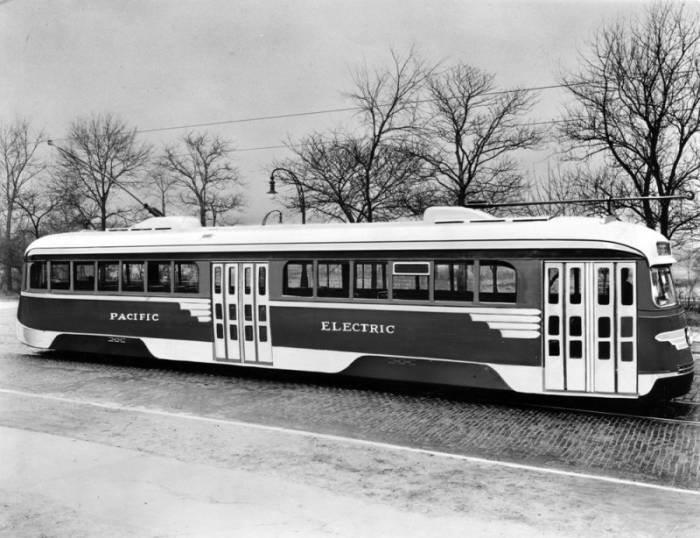
This is a rendering of what the cars were going to like. This is a heavily retched photo of a prewar St. Louis Car Co. PCC.
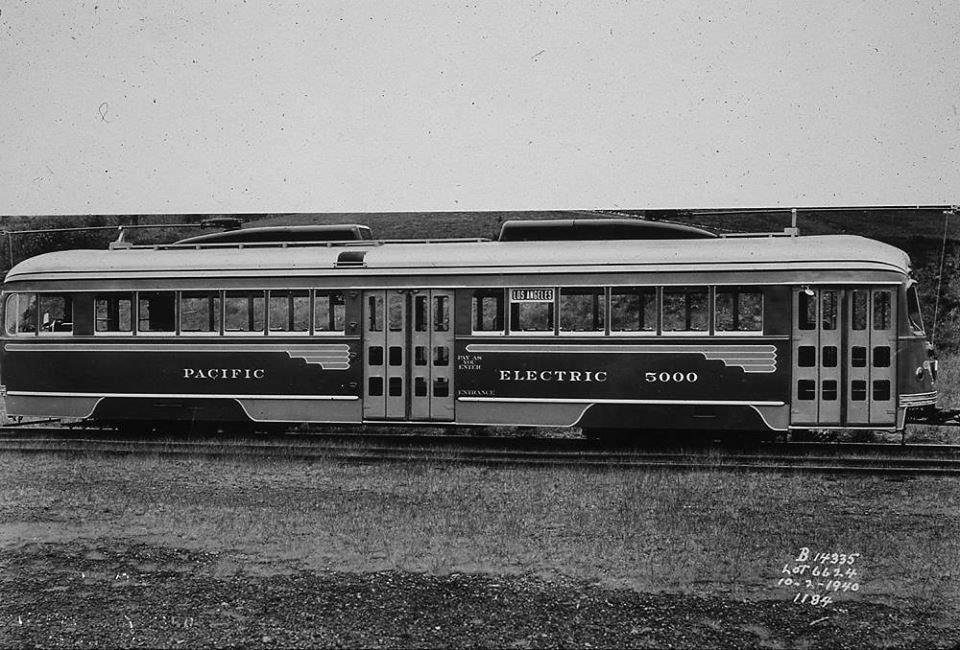
PE 5000 at the Pullman Standard Factory locked and loaded ready for shipment to Los Angeles November 1, 1940.
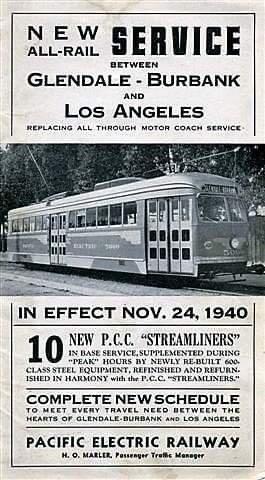
A fold out leaflet announcing the new ultra modern PCCs for the Glendale-Burbank line.
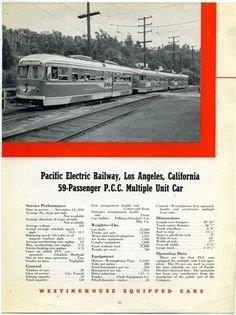
The Westinghouse Company who supplied parts for the cars was very proud of them and placed full-page ad in transit industry publications.
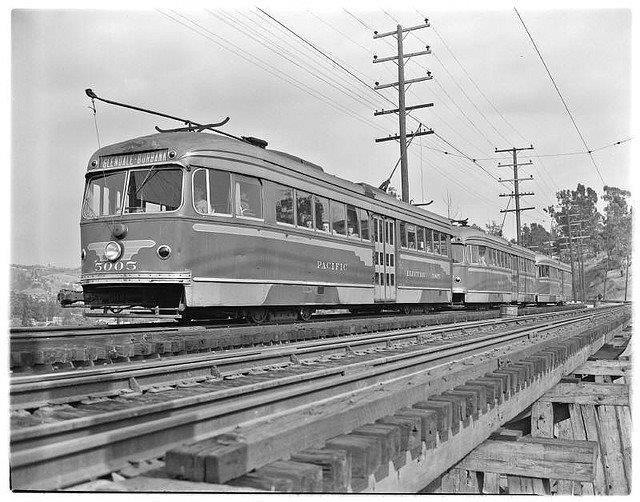
A PE publicity photo taken at the Fletcher Drive trestle taken just after the cars went into service.
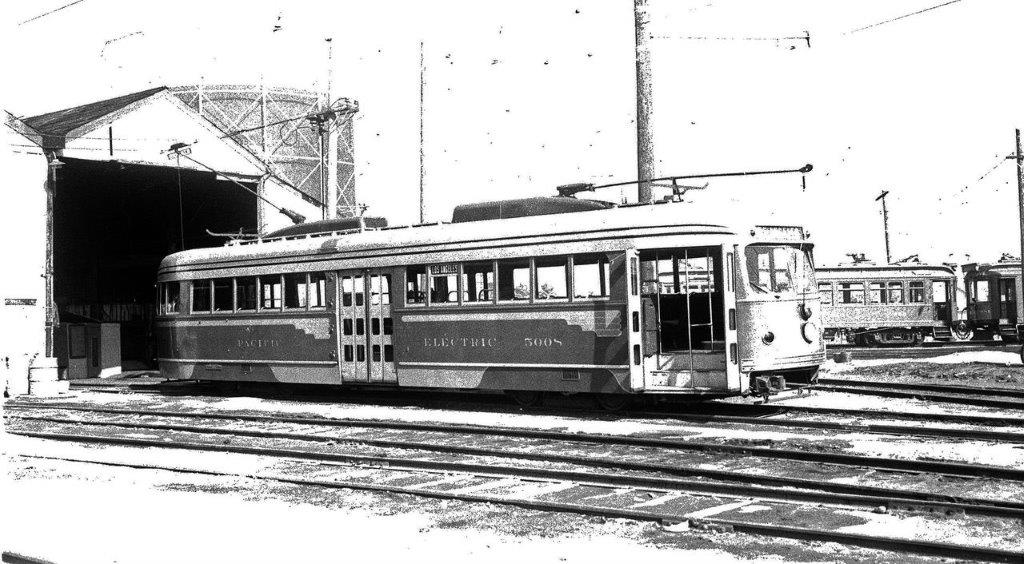
A very rare photo of 5008 taken at the Ocean Park Car House in February 1941.
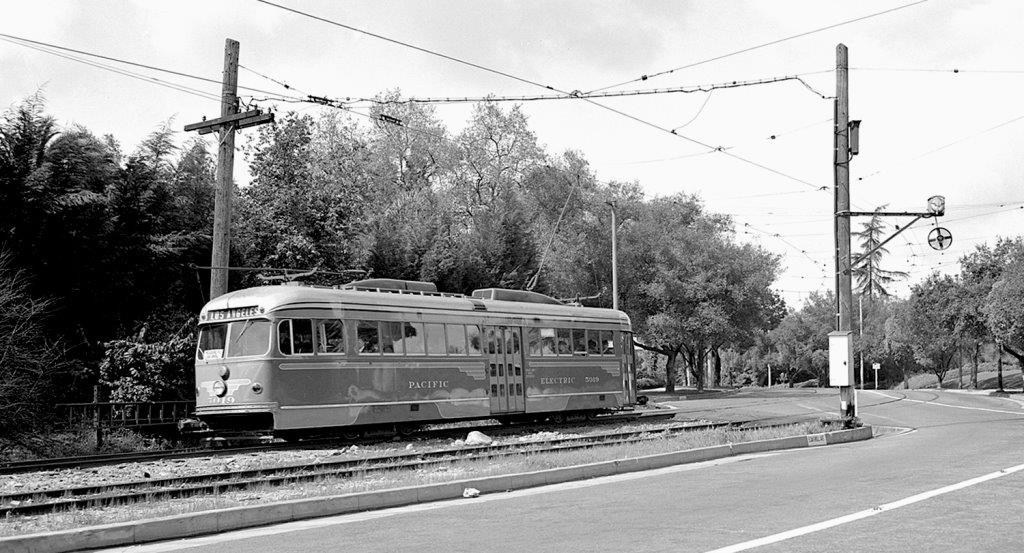
Another very rare photo of PE 5019 on the Pasadena-Oak Knoll Line near the Huntington Hotel. Again. the PCCs could not deal with the rough track. So any hope of a PE PCC operating on the Northern Distract was put to rest.
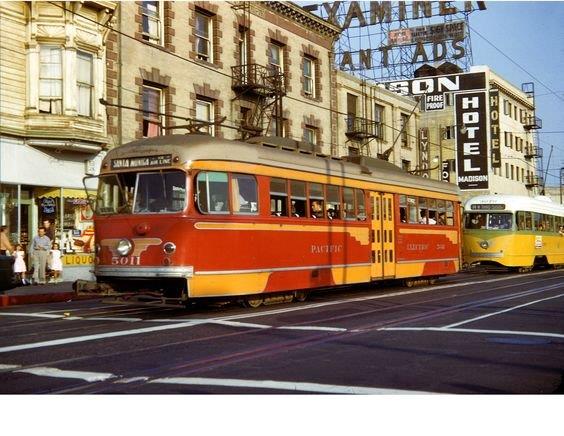
This remarkable photo was taken during a fan trip operated on October 12, 1952. The photo is on 7th Street between San Pedro and Main Streets. The PE maintained track on 7th for movements of cars into the 7th Street Surface Yard and back out onto Main Street. This was the only place in the world such a photo could be taken. Here we see 2 PCCs of different manufacturers, 2 different gauges and 2 different railway companies. Only 2 other American cities operated 2 different PCC rail systems, they being the Shaker Heights Rapid Transit System and the Cleveland Transit System in Ohio and the Illinois Terminal Railroad and the St. Louis Public Service. The PCCs of these 2 systems operated in different parts of both cities.
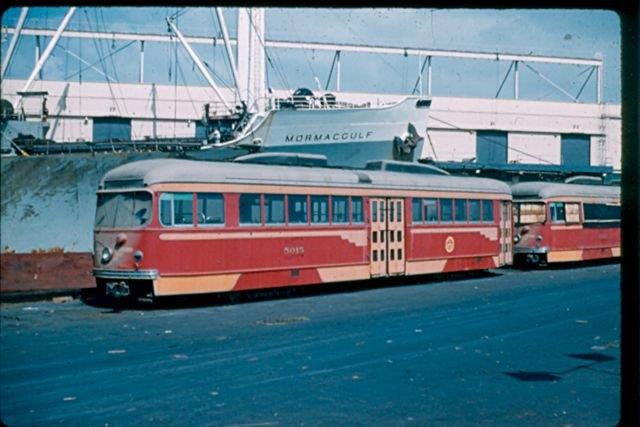
PE 5009 at the LA Harbor waits its turn to be loaded on a freighter headed for South America. The 5009 was not damaged while in storage. She was still a beautiful sight to behold.
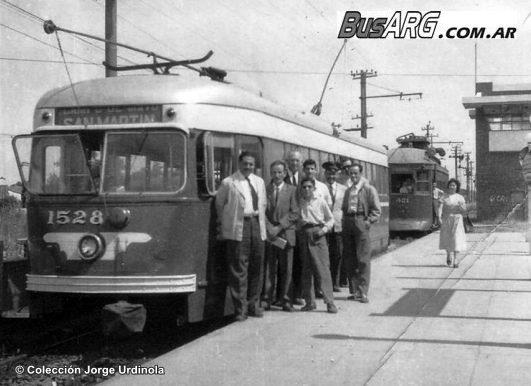
The former PE 5028, now numbered 1528 poses with railway officials just after going into service. The 1528 was the only PE PCC that was not “butchered” with train doors cut into them. She remained a double ender to the end.

Pacific Electric Conductor Edmund Daniger

Pacific Electric Conductor Edmund Daniger

[vc_row][vc_column][vc_column_text css=”.vc_custom_1711229948316{margin-bottom: 0px !important;}”]From the collection of Douglas Neilson is this undated photo of his grandfather and Pacific Electric conductor Edmund Daniger.[/vc_column_text][/vc_column][/vc_row]

Edmund Daniger and crew of PE 1607

Edmund Daniger and crew of PE 1607

From the collection of Douglas Neilson, his grandfather Edmund Daniger (right) and his crew pause on a viaduct Pacific Electric 1607 freight motor and consist somewhere in the Western District.

Edmund Daniger and crew of PE 1607

Edmund Daniger and crew of PE 1607

From the collection of Douglas Neilson, his grandfather Edmund Daniger (right) and his crew pose on the pilot of Pacific Electric 1607 freight motor somewhere in the Western District.

Edmund Daniger and crew of PE 1607

Edmund Daniger and crew of PE 1607

From the collection of Douglas Neilson, his grandfather Edmund Daniger (top) and his crew pose on the pilot of Pacific Electric 1607 freight motor somewhere in the Western District.

Edmund Daniger and crew of PE 1607

Edmund Daniger and crew of PE 1607

From the collection of Douglas Neilson, his grandfather Edmund Daniger (left) and his crew pose on the pilot of Pacific Electric 1607 freight motor somewhere in the Western District.

Pacific Electric Express Car 1464 at Huntington Beach.

Pacific Electric Express Car 1464 at Huntington Beach.

From Interurban Special # 37, page 570. 1459 – 1464. By Ira L. Swett, October 1965.

The six cars of the 1459 Class were the newest of the Portlands and the last to enter Pacific Electric service. It was a familiar Torrance sight for years to see these fine cars rusting away, either in the boneyard or in the old mill. In 1941, mounting freight caused by wartime production for allies brought about the decision to rebuild these cars into express cars.

The rebuilding was done in haste and took the easy way out; all doors were retained; upper colored windows lights were kept; side windows were merely given individual steel sheets where once passengers had looked out. In record time the six new express cars were ready for service.

Specifications:

Weight: 99,100 lbs.

Builder: Pullman, 1921

Old Numbers: O&C 213 – 218 respectively

Motors: Four General Electric 222-D (125 hp)

Gear Ratio: 20:56

Control: General Electric PC

Trucks: Baldwin 7’0, 36″ wheels

Brakes: Westinghouse AMU

All six cars were scrapped by Southern Pacific at the Alhambra Avenue shops in Los Angeles in April 1953. — Ira L. Swett, October 1965.

Pacific Electric Express Car # 1464 was photographed here at the Huntington Beach station sometime around late 1947 or early 1948. The freshly painted crossbuck provided a good clue as to when the photo was made. At its base there is a hand lettered date that reads 11-47, giving us an insight as to when this uncredited image was made. The car will finish its business in Huntington Beach and then continue southward to the Newport Beach station in Newport Beach. – Steve Crise 2024.

Pacific Electric Railway PCC no. 5028 in El Segundo

[vc_row][vc_column][vc_column_text]By Donald Duke © 1974

Before the advent of the superhighway and freeways, the Pacific Electric Railway, operating in Southern California, became the nation’s – and the worlds – largest suburban electric railway system.

Prior to World War II, the PE systematically began an abandonment program of low profit passenger lines, leaving a surplus of old wooden interurban equipment. While passenger services were terminated, the lines were kept exclusively for freight service. Customers complained the “Red Cars” were old, although well maintained, and that patrons would return if new cars were purchased. After considerable urging on the part of the California Public Utilities Commission, the PE ordered 30 PCC type suburban cars from Pullman-Standard during March 1940. The design of the new cars followed the PCC makeup, with the major exception that these cars were double-ended and equipped with multiple-unit control.

Three of the new streamliners arrived on October 21, 1940, and tested on the entire system. Seventeen additional cars were placed in service on the Glendale – Burbank Line on November 24, (1940) and the balance of the order on the Venice Short Line. Poor track on the Venice Short Line proved a handicap to the new equipment. While the trucks were smooth riding, the spring suspension created a bounce and as they moved along the rails, bent trackage. The cars were then placed on the Glendale – Burbank Line until its abandonment on Sunday, June 19, 1955.

In this scene, photographed on February 22, 1953, one of the 5000-class streamliners pulls into one of the typical Pacific Electric suburban stations of El Segundo while on a rail enthusiast inspection tour of the western lines of the road.[/vc_column_text][mk_divider][vc_column_text css=”.vc_custom_1700243983007{margin-bottom: 0px !important;}”]Addendum: Since the original release of this post card in 1974 a few more details about this trip have come to light:

This railfan excursion was sponsored by a group from the San Francisco area known as the Bay Area Electric Railfans Association. During the last years of passenger operations of the Pacific Electric Railway, Metropolitan Coach Lines and the Los Angeles Metropolitan Transit Authority groups such as the BAERA sponsored many excursions on the system that gave railfans the opportunity to pose the cars in key locations for photographs. Many of the historic images seen today of the last years of electric railroading in Southern California come from excursions like these.

Generally speaking, these excursions took place on a Sunday. This was a time in which passenger and freight activity was minimal and gave the railfans the time necessary to detrain the cars, take photographs and reboard. These excursions could have as little as one car on the trip for the fans to ride in and photograph and up to as many as five cars, which was the record for such excursions. The fare for an excursion was about $5.00 for the entire day. Some trips even offered half-day fares.

The scene in this photo was a highly unusual event. PCC cars of this type were never used on this line in regular service. When the PE completed the line to El Segundo on August 10, 1914, 800- and 1000-Class cars became the standard equipment for passenger service. So, the advent of a modern PCC car at the El Segundo Station was unique event. A key feature of many of these railfan excursions was the use of unusual rail cars at locations where they didn’t normally appear. Since the El Segundo Line lost its passenger service on October 31, 1930, some 23 years before this excursion took place, perhaps makes this photo opportunity the grandest of all events with the use of non-standard equipment in an unusual setting.

The other areas of the system that PE 5028 toured that day were Santa Monica via the Air Line, Beverly Hills, and the Whittier Line.

As Donald Duke mentioned earlier, the PE retained many of their passenger lines for freight usage. The El Segundo Line was one of their premier freight revenue lines for many years until its closure in December 1976 by its parent company Southern Pacific.


Scanned, research, edited and updated by Steve Crise. © Steve Crise 2023.[/vc_column_text][/vc_column][/vc_row]

Pacific Electric’s Rio Vista Shelter Then & Now

[vc_row][vc_column][vc_column_text]By Steve Crise

The Rio Vista shelter was once situated along the west side Vineland Ave just a few feet south of Aqua Vista Street in North Hollywood. The wooded shelter probably dates as far back as the original building of the San Fernando Valley line in 1911. The shelter served the Pacific Electric Railway faithfully until the line was abandoned on Monday, December 28, 1952.

At some point after the line was abandoned by the P.E. some hearty railfans made a heroic effort to preserve the shelter and moved it to an area inside Griffith Park that is now known as the Travel Town Museum.[/vc_column_text][mk_image src=”https://www.pacificelectric.org/wp-content/uploads/2023/10/sjc_pe_rio_vista-031a.jpg” image_size=”full”][vc_column_text css=”.vc_custom_1696790571453{margin-bottom: 0px !important;}”]It is within the confines of the Travel Town Museum that the Rio Vista shelter still see daily passenger train operations albeit on much a smaller scale, 16 inch gauge track to be precise.  The locomotive is not electrically driven but instead is propelled by a propane motored replica steam locomotive named “Courage”. For practical reasons the motor is hidden away in the tender and provides the tractive effort through a hydraulic transmission inside the locomotive that moves the train along its large circular route that runs around the museum grounds.

The shelter is not a regular stop on the line nor is it even a flag stop on the Travel Town Railroad, but at least it survives in relatively good condition and can at least boast that might be the one and only surviving Pacific Electric shelter in Los Angeles that still see regular passenger service even if the train no longer make a stop there.[/vc_column_text][/vc_column][/vc_row]