1706 Last-Day Charter
April 7, 1961: Los Cerritos
By Stephen Dudley
April 6, 1961: Just Before Abandonment
Former Hollywood Cars in Portland
In August of 1958, a row of former Pacific Electric Hollywood cars then out of service and looking a little worse for wear awaited their fate in the Portland Traction Co. yard in Portland, Oregon. Next to 4021 is 4009, a Brill Master Unit of 1930 vintage that began life in Yakima, WA, was saved after the Portland abandonment, and ultimately returned to Yakima where it now operates as part of the Yakima Trolleys collection.
Stephen Dudley Photo and Collection
Los Cerritos Time Lapse
Taken in November 1959, this time-lapse photo shows an evening train to Long Beach as it slows and then stops at Los Cerritos. The way the headlight lit up the track as the train approaches makes it look as though the train is floating on air. The lights of Long Beach glow in the distance.
Stephen Dudley Photo and Collection
Long Beach Limited at Wardlow Road
Northbound off the Los Angeles River Bridge
Power Problems on Glendale Boulevard: Buses to the Rescue
By Ralph Cantos
As the old saying goes, a picture is worth a thousand words. While the exact details of these photos are lost to history, just looking at these photos taken on a damp March 3,1952, taken from the Beverly Boulevard bridge tells an interesting story.
It seems that the Toluca substation was experiencing some sort of power problems. The Toluca substation supplied power to the Subway Terminal, Toluca Yard, and up Glendale Boulevard to Temple Street where a insulated breaker separated this area from the Olive Substation some four miles away near Sanbourne Junction.
As inbound cars crossed Temple Street, they entered “dark territory” caused by the problem at Toluca Substation. From the looks of things, there was still some power, though very low. Several Hollywood cars were at a stand still just south of Temple Street. One outbound car is seen at Temple Street. Things would only get worse as the minutes passed.
In this photo, the outbound Hollywood car has made across Temple Street and is out of the picture. Two PE buses have arrived to help out with the problem. Passengers from the stranded cars at Temple Street can be seen walking along the damp sidewalk. At the bottom of this photo, ever-trusty no. 5167 (todays OERM no. 717) has just arrived on the inbound track, while a 2-car train of PCCs appears to be stranded on the crossover just up the street.
The 2 PCCs with 5018 nearest the camera have stopped. The front doors are open on the other car. PE White no. 2092 (1941), a stick-shift, one-door interurban model 798, is on the move, probably with a standing load of wet passengers. Across the street is a brand new 2900-series GM TDH-4801. Both poles on the 5167 are up as the motorman “changes ends.”
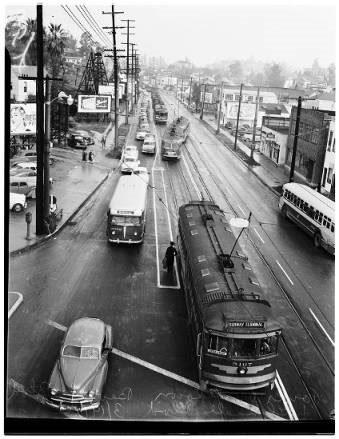
In this last photo, the 5167 is still in the process of changing ends as the PE White struggles to make its way out of the traffic mess. Two interesting vehicles are seen here. The car on the left of 5167 is a very low production 1942 “B-44” Oldsmobile, while the GM 2900 is virtually new, having been purchased for the forthcoming abandonment of the San Fernando Valley line at the end of 1952.
This was just another day in history of the once great Pacific Electric. A little more than a year after these photos were taken, Metropolitan Coach Lines would purchase all of PE’s passenger operations. Had this incident happened under Metro Coach ownership, I am sure Metro Coach management would have immediately applied with the PUC for total abandonment of the entire Western District.
It was not to be, at least not on this day. And so, the Western District rail operations would die a slow, but inevitable death under Metro Coach Lines ownership.. That final dirty deed took place on June 19, 1955 with the abandonment of the BEST OF THE BEST, the Glendale-Burbank line.
Ralph Cantos Collection
PE’s Venice Short Line: A future rapid transit prospect… SCUTTLED !
[vc_row][vc_column][vc_column_text]By Ralph Cantos
This first photo, looking north-east taken around 1949 shows a 2-car, eastbound morning rush hour train of venerable 950s crossing La Cienega and Venice Boulevards on the magnificent concert and steel bridge spanning the busy intersection. This important intersection had a tendency to flood during heavy rain storms, disrupting rail operations along the busy VSL. After all, La Cienega is Spanish for “The Swamp.” The magnificent structure was completed about 1925 giving VSL trains a safe, dry passage over the intersection, the Swamp be damned.[/vc_column_text][mk_image src=”https://www.pacificelectric.org/wp-content/uploads/2019/01/pe-vsl-viaduct-over-la-cienega-1953.jpg” image_size=”full” lightbox=”true”][vc_column_text css=”.vc_custom_1547478244055{margin-bottom: 0px !important;}”]A little more then 3 years later, this beautiful structure stands proud, but abandoned. The replacement bus service left to struggle in ever-increasing auto traffic along Venice Boulevard. By 1948 the PE was faced with falling ridership on the VSL. If the PE wanted to continue rail service, an major expenditure of almost 4 million dollars was needed to modernize and rebuild the line. About 40 new PCCs would be needed. Also needed, a complete rebuild of track, overhead, signaling and substations. Then too, the plans for the future Santa Monica Freeway had been finalized. Knowing the devastation the Arroyo Seco Parkway had done to PE’s Pasadena Short Line passenger loadings, parent company Southern Pacific was not about to make a major financial investment into a sinking ship. Replacement bus service could be implemented at a cost of about 2 million dollars. And so, on September 17, 1950, the VSL, with its future rapid transit potential, passed into history.[/vc_column_text][mk_image src=”https://www.pacificelectric.org/wp-content/uploads/2019/01/pe-abandonded-vsl-over-pass-venice-at-la-cienega-1953.jpg” image_size=”full” lightbox=”true”][vc_column_text css=”.vc_custom_1547478341414{margin-bottom: 0px !important;}”]In another photo taken in mid-1953 looking east towards Downtown LA, the magnificent Venice-La Cienega bridge stands stripped bare of rail, catenary overhead and block signals. It would remain standing until 1964 when construction of the “Futuristic” Santa Monica Freeway reached this area. The eastern approach to the bridge was in the way of the new freeway, and so, the very freeway that had cast a dark shadow on the VSL back in 1948, clamed its last VSL victim. By the end of 1964, the bridge with all it majesty, was gone, leaving buses, trucks and automobiles to once again deal with “THE SWAMP.” And as for the Santa Monica Freeway, it may have been an AUTOMOTIVE UTOPIA when first built, but today, it’s an “AUTOMOTIVE QUAGMIRE.” If your were to ask any motorist that drives that mess every day, they might answer “it sure would be nice if there was a rapid transit line on Venice Boulevard.”[/vc_column_text][/vc_column][/vc_row]


