
Looking Ahead in 1924
Our cover page depicts the entry of 1924 New Year as the radiant boy full of happiness and promise, bearing great investments for Southern California during the ensuing twelve months. His entrance bespeaks a confidence, because is represents a new capitol investment on the part of our railway management dedicated to the service of the public.
In round numbers, this investment represents capital to the extent of $7,350,000, and, while the authority for some of these expenditures was received during the latter part of 1923, it is the new year that brings most of them actually into being. In the list of new improvements and betterments to come during 1924 are the following:
Hollywood tunnel ………………………………………………………………….. $3,000,000
Fifty 600-class cars (local service) …………………………………..…………… 1,000,000
Fifty Interurban cars ………………………………………………………………… 1,850,000
San Gabriel line extension and Long Beach 2nd St. line extension …………….. 250,000
New sub-stations ……………………………………………………………………… 350,000
Additional block signals ………………………………………………………………. 250,000
Additional buses for auxiliary service ……………………………………………….. 200,000
________
$7,350,000
In reviewing the above, it would seem that our many employees are given much of which to be proud and we may be pardoned if we are boastful in telling our friends and patrons what the Pacific Electric has been and is doing in order to keep pace the phenomenon growth of Southern California and in doing so its part as a community builder.
As employees, we may well be proud of the trust bestowed upon us and the privilege of being each in his own activity an operator of this great property, not only one of the largest industrial activities of the West, but by far the greatest interurban electric railway in the world.
Oftentimes we are asked the question “What is the Pacific Electric doing as a member of the community of interests of Southern California?” It would seem that the above is a most complete answer to the inquiring minds and most conclusive showing of our confidence and interest in our community, backed up by millions of dollars in support of our assertion. It is well to bear in mind that our large expenditures is new money brought into and invested in Southern California.
READ MOREPacific News: PE Red Cars Remembered (1979)
[vc_row][vc_column][vc_column_text css=”.vc_custom_1756384334495{margin-bottom: 0px !important;}”]From the Steve Crise Collection comes this 1979 issue of Pacific News with a cover story entitled “PE Red Cars Remembered” by Harre O. Demoro.[/vc_column_text][mk_button dimension=”flat” size=”medium” url=”https://www.pacificelectric.org/wp-content/uploads/2025/08/remembering-the-pe-demoro-lo.pdf”]CLICK TO DOWNLOAD PDF[/mk_button][/vc_column][/vc_row] READ MORELos Angeles & Redondo Railway
[vc_row][vc_column][vc_column_text]By Steve CriseThe Los Angeles & Redondo Railway is one of the earliest railroads to be constructed in the Los Angeles basin. As its name suggests, it ran from the southwest corner of Jefferson and Grand to roughly Catalina and Diamond Streets in Redondo through the mostly vacant fields between the two cities. From its meager beginnings as a section of railroad right of way constructed by “The Rosecrans Rapid Transit Railway” in 1887, the LA&R eventually grew into a system of about 95 miles of 3’6” narrow gauge trackage.
To service and construct its fleet of coaches, steam locomotives and then its fleet of electric cars, the LA&R built a shop and car house in Redondo Beach on a trapezoidal piece of property bordered by Diamond Street at the southern tip of the property with N. Elena Avenue on the southwest side, Beryl Street bordered the northwest end and N. Francisca Avenue on the northeast side. The section of the road slicing on the southeast corner of the lot was Camino Real, present day Pacific Coast Highway, California State Route 1.
The location of the car house in the photo above was rumored to be in several different locations on or near this property. I set out to see if I could find the exact location of the huge structure or at least come within a few feet of where it once stood until it was destroyed by fire in 1921.[/vc_column_text][mk_image src=”https://www.pacificelectric.org/wp-content/uploads/2025/04/crc_lar_55_redondo_map-003d.jpg” image_size=”full”][vc_column_text css=”.vc_custom_1743772585885{margin-bottom: 0px !important;}”]I found a very helpful clue in the form of a map drawn by Raymond E. Younghans in Ira L. Swett’s 1957 publication of Interurbans Special No.20 “Los Angeles & Redondo,” on page 65. It places the car house at the top of the property boarding N. Elena Avenue and Beryl Street. Using this information from the Younghans map I estimated its location on a Google Map capture as to where the building would be resting atop the shopping mall that has occupied the property since the early 1960’s.
My next point of curiosity was the three cars shown in the photo. Of the three cars, only two were identified by traction expert Craig Rasmussen, the provider of the image. He noted that the car on the left was LA&R #55, the center car was not identified but the car on the right was easily identified as LA&R #15, the prestigious Redondo parlor car and the pride of the railway.
I was not able to find any specific car being numbered as 55 on the railroad. There is a mention of cars 52-56 being rebuilt steam coaches that were made into interurbans after the railroad was electricized. These second-hand steam coaches were known as the “New York” cars because their being purchased used from the Third Avenue Street Railway in New York City in 1902. It is also assumed that LA&R car #3, one of the cars from New York, was renumbered to 55. With this being the case it is reasonable to assume that there was indeed a car 55, just no record of it in any books. The closest match I could find to the car in the photo was LA&R #50 (original LA&R #10), also purchased from New York, which is seen on page 40 of the aforementioned LA&R book.[/vc_column_text][mk_image src=”https://www.pacificelectric.org/wp-content/uploads/2025/04/ilsc_pe_1400_drawing-002.jpg” image_size=”full”][mk_image src=”https://www.pacificelectric.org/wp-content/uploads/2025/04/ilsc_pe_1727_special_37-001.jpg” image_size=”full”][vc_column_text css=”.vc_custom_1743772660357{margin-bottom: 0px !important;}”]About 1907, LA&R #55 was converted into a box motor with a freight door cut into the side for easier handling of freight. After the Great Merger of 1911 Pacific Electric renumbered the car to 1400. It was again renumbered to P.E. 1727 when it was again reborn as a tower car. One more renumbering would take place in 1931. It then became P.E. #00156 before the venerable car was finally scrapped on October 5,1934 after serving three different railroads on two different coasts. And as if that wasn’t enough, it also had the distinction of operating on two separate gauges of track during its lengthy career.[/vc_column_text][mk_image src=”https://www.pacificelectric.org/wp-content/uploads/2025/04/ilsc_pe_450_class-003.jpg” image_size=”full”][mk_image src=”https://www.pacificelectric.org/wp-content/uploads/2025/04/sjcc_pe_464_rubio_sta-002.jpg” image_size=”full”][vc_column_text css=”.vc_custom_1743772720252{margin-bottom: 0px !important;}”]LA&R #204, also known as the “Redondo” parlor car likewise made the transition to the P.E in 1911 and was renumbered into PE’s #400 – #465 series cars and became PE #453. These were Los Angeles & Redondo’s final car-building product and had a very productive life on different lines throughout the system including the Glendale – Burbank Line, Rubio Canyon Line and on occasion in service for Santa Anita racetrack trains when heavy passenger traffic required their service. The entire class of the #450 – #465 cars were scrapped just a few months before the start of WW II. PE #453 had an earlier date with the scraper than most of the other cars in the series and in 1933, after 25 years of service, was discarded by the Pacific Electric and removed from the roster.[/vc_column_text][mk_image src=”https://www.pacificelectric.org/wp-content/uploads/2025/04/mapc_lar_ainsworth-06.jpg” image_size=”full”][vc_column_text css=”.vc_custom_1743772761315{margin-bottom: 0px !important;}”]The J.C. Ainsworth, a 3’6” gauged Baldwin 4-4-0 seen in the above photo was named after one of the original founders of the Redondo Railway, Captain J.C. Ainsworth. Captain Ainsworth and his business partner Captain R.R. Thompson were heavily involved in the Pacific Northwest’s lumber trade. Their goal was to develop Redondo Beach into a major Southern California port for their lucrative lumber business. The success of their efforts soon eclipsed the steam locomotives’ capabilities, and it was decided to completely abandon steam power and modernize and eclecticize the entire road to a 600-volt DC system. This is when the New York cars, once pulled by the steamer, were converted in the LA&R shops to suburban electric cars. During the long service record of the J.C. Ainsworth for the LA&R it bore no less than three different numbers; #2, #23 and #421. Incredibly, the J.C. Ainsworth survived long enough to become a piece of Pacific Electric’s rolling stock. After the 1911 merger, Pacific Electric assigned this locomotive to be #1501, appropriately fitting into the PE’s steam locomotive classification numbering system. However, the 3’6” gauged engine was never used on the PE because of its incompatibility with the standard gauge 4’ 8.5” track that the PE operated on. The ancient engine was sold in 1913 to the San Fernando Rock Company.
As this exercise aptly demonstrates, there can be countless stories buried within these historic photographs. Here at the Pacific Electric Railway Historical Society, we endeavor to seek out as many facts and stories that to the average viewer are not necessarily obvious and research and share them with the world on this site. If you have a rare or interesting image from the bygone era from one of the many early transit systems in the Southern California area, please send your image and story to us and we will do our very best to decipher and post it on PERyhs.org for all to enjoy.[/vc_column_text][mk_image src=”https://www.pacificelectric.org/wp-content/uploads/2025/04/lar_logo-003.jpg” image_size=”full”][vc_column_text css=”.vc_custom_1743772866559{margin-bottom: 0px !important;}”]Source material:
- Interurbans Special 20, Los Angeles & Redondo Railway.
- Interurbans Special 28, Cars of the Pacific Electric Vol.1 City & Suburban Cars.
- Interurbans Special 37, Cars of the pacific Electric Vol. III Combos, RPO’s, Box Motors, Work Motors, Locomotives, Tower Cars, Service Cars.
- Pacific Electric Railway Historical Society image archives. PERyhs.org
- Craig Rasmussen Collection
- Michael Patris Collection
- Steve Crise Archive
Daily Excursion Fares
By Steve Crise
As we approach the height of the summer vacation season, we present this advertisement from an unknown Southern California newspaper offering excursion fares to local Southern California beaches that various Pacific Electric Railway lines served.
We don’t know the exact date this ad ran, but there is a significant clue found in the list of the beach city routes. A 55¢ round-trip fare would bring you to the shores of some of the most desirable waterfront sites in Southern California.
Long Beach, East Long Beach, San Pedro, Wilmington, Redondo Beach, Hermosa and Manhattan were some of the locations offered to city dwellers giving a brief escape from the sweltering summer heat of the inner city and suburbs.
Of particular interest to our story and for the purpose of dating this ad I direct to your attention the cities of Hermosa and Manhattan. Passenger service along the surf-hugging main line that served both of these summer destinations, was abandoned in whole from Culver City to Redondo Beach as of May 12, 1940, thus dating this ad from a few months to a few years before service was discontinued.
As a comparison, a 55¢ fare in 1940 would fetch about $12.05 in 2024 dollars. Still a good deal considering the price of gas and parking fees near beach-side locations.
This story is also a wonderful opportunity to challenge the much-touted myth that you could ride the Pacific Electric Railway to any destination in Southern California for just a nickel. Clearly this was not the case.
PE rails followed the coastline over many route miles. Here 891 pulls into Manhattan Beach on the Redondo line. Charles D. Savage photo, image from the Donald Duke Collection
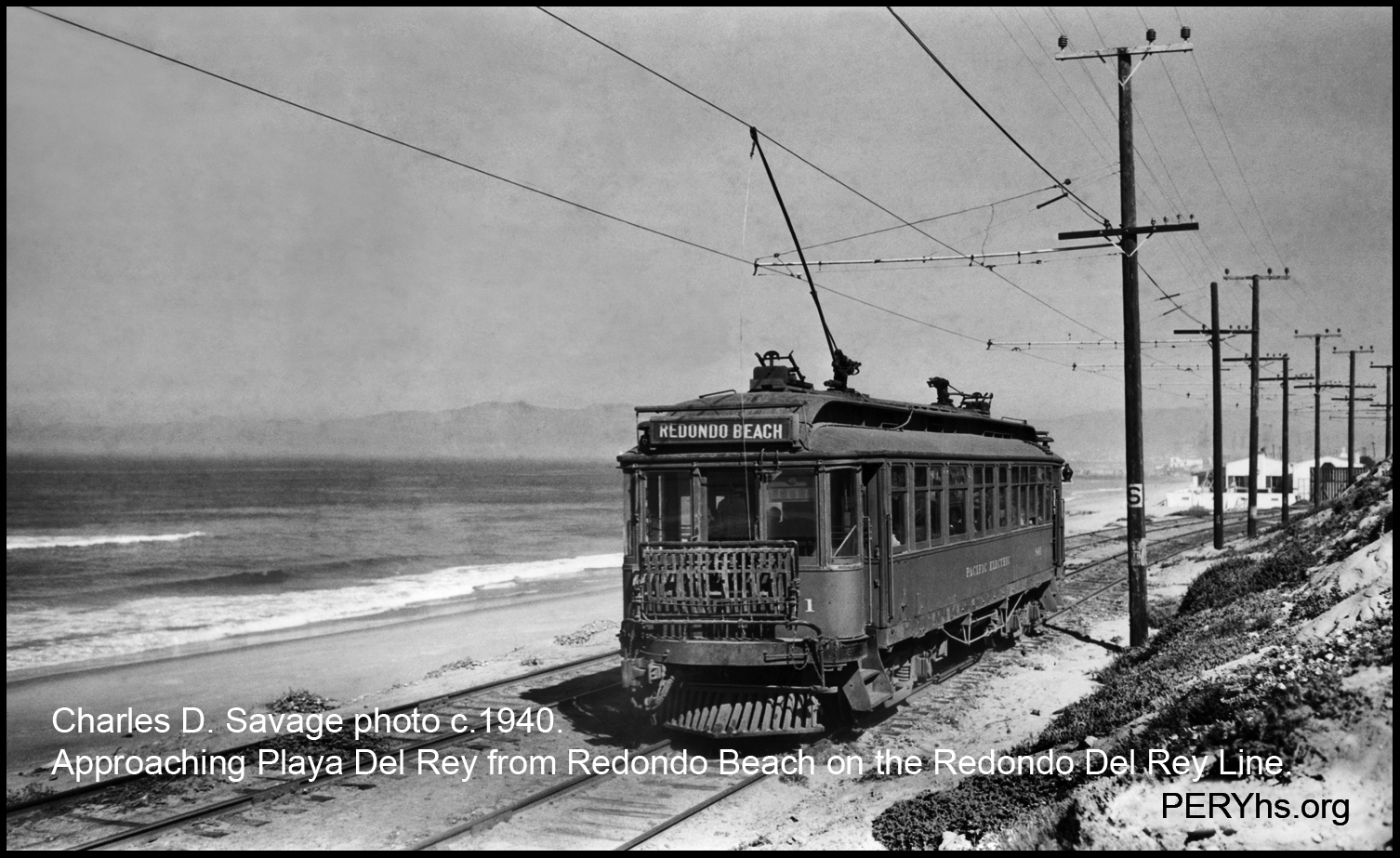
This rather well know photo accompanying our story shows an 800-class wooden Interurban car, number 841 to be exact, heading inbound to Los Angeles on the Redondo Beach Line approaching Playa Del Rey shortly before service was discontinued in 1940. Photographer Charles D. Savage used the close proximity of the crashing waves of the Pacific Ocean that were only a few feet away from the main line to perfectly illustrate one of the weaknesses of this uniquely Southern California electric railway line.
READ MOREPacific Electric Express Car 1464 at Huntington Beach.
From Interurban Special # 37, page 570. 1459 – 1464. By Ira L. Swett, October 1965.
The six cars of the 1459 Class were the newest of the Portlands and the last to enter Pacific Electric service. It was a familiar Torrance sight for years to see these fine cars rusting away, either in the boneyard or in the old mill. In 1941, mounting freight caused by wartime production for allies brought about the decision to rebuild these cars into express cars.
The rebuilding was done in haste and took the easy way out; all doors were retained; upper colored windows lights were kept; side windows were merely given individual steel sheets where once passengers had looked out. In record time the six new express cars were ready for service.
Specifications:
Weight: 99,100 lbs.
Builder: Pullman, 1921
Old Numbers: O&C 213 – 218 respectively
Motors: Four General Electric 222-D (125 hp)
Gear Ratio: 20:56
Control: General Electric PC
Trucks: Baldwin 7’0, 36″ wheels
Brakes: Westinghouse AMU
All six cars were scrapped by Southern Pacific at the Alhambra Avenue shops in Los Angeles in April 1953. — Ira L. Swett, October 1965.
Pacific Electric Express Car # 1464 was photographed here at the Huntington Beach station sometime around late 1947 or early 1948. The freshly painted crossbuck provided a good clue as to when the photo was made. At its base there is a hand lettered date that reads 11-47, giving us an insight as to when this uncredited image was made. The car will finish its business in Huntington Beach and then continue southward to the Newport Beach station in Newport Beach. – Steve Crise 2024.
READ MOREPacific Electric’s Rio Vista Shelter Then & Now
[vc_row][vc_column][vc_column_text]By Steve CriseThe Rio Vista shelter was once situated along the west side Vineland Ave just a few feet south of Aqua Vista Street in North Hollywood. The wooded shelter probably dates as far back as the original building of the San Fernando Valley line in 1911. The shelter served the Pacific Electric Railway faithfully until the line was abandoned on Monday, December 28, 1952.
At some point after the line was abandoned by the P.E. some hearty railfans made a heroic effort to preserve the shelter and moved it to an area inside Griffith Park that is now known as the Travel Town Museum.[/vc_column_text][mk_image src=”https://www.pacificelectric.org/wp-content/uploads/2023/10/sjc_pe_rio_vista-031a.jpg” image_size=”full”][vc_column_text css=”.vc_custom_1696790571453{margin-bottom: 0px !important;}”]It is within the confines of the Travel Town Museum that the Rio Vista shelter still see daily passenger train operations albeit on much a smaller scale, 16 inch gauge track to be precise. The locomotive is not electrically driven but instead is propelled by a propane motored replica steam locomotive named “Courage”. For practical reasons the motor is hidden away in the tender and provides the tractive effort through a hydraulic transmission inside the locomotive that moves the train along its large circular route that runs around the museum grounds.
The shelter is not a regular stop on the line nor is it even a flag stop on the Travel Town Railroad, but at least it survives in relatively good condition and can at least boast that might be the one and only surviving Pacific Electric shelter in Los Angeles that still see regular passenger service even if the train no longer make a stop there.[/vc_column_text][/vc_column][/vc_row]
READ MORE
Pacific Electric in Lego Land
By Steve Crise
The Texas Brick Railroad Club display of a Lego modular railroad layout that is made entirely of Lego pieces was on display at the National Train Show and 2023 National Model Railroad Association Convention that was held in August 2023 at the Gaylord Texas Resort and Convention Center in Grapevine, Texas.
One of the features on the layout is this section of street running giving tribute to the 1988 film “Who Framed Roger Rabbit.” The PE Hollywood car and station are entirely made of Lego pieces. The PE car travels back and forth on a single-track section about 5 feet long.
Note the “Cloverleaf Industries” sign posted prominently on the front of the building. Judge Doom would be proud!
To learn more about this group, please visit www.texasbrickrr.com.
READ MORERiverside – Rialto Line
[vc_row][vc_column][vc_column_text css=”.vc_custom_1687804184785{margin-bottom: 0px !important;}”]Above: A meet at Rialto Junction on June 8, 1940. The car on the right will soon depart for Riverside while the car on the left will continue its journey to San Bernardino.An Excerpt from The Lines of the Pacific Electric; Eastern District, by Ira Swett, 1954
Maps by R.E. Younghans
Research by Steve Crise
Images provided by PERYhs.org
[/vc_column_text][vc_column_text css=”.vc_custom_1687804211881{margin-bottom: 0px !important;}”]The Crestmore Line (Riverside – Rialto) was unique in that it was not owned by the Pacific Electric; Union Pacific owned it in modern times but nevertheless it was a vital link in PE’s rail empire. Its 9.33 miles cut off the corner for trains to and from Los Angeles, saving Riversiders about 5.5 miles of extra travel had they been forced to journey on PE’s own rails via Colton and San Bernardino. Local service was provided on the Crestmore Line for many years, chiefly to serve the large Riverside Portland Cement Company’s plant near Crestmore. Interurbans provided nearly all the through service, doing local work en route. Under the agreement made by P.E. and U.P., all passenger service on this line was provided by P.E., while freight trains were operated by both railroads; P.E. using electric locomotives, U.P. using steam.[/vc_column_text][mk_image src=”https://www.pacificelectric.org/wp-content/uploads/2023/06/hfs_pe_bloomington_twr-001.jpg” image_size=”full” title=”Looking south toward Riverside. The two tracks in the foreground are Southern Pacific’s Sunset Route that ran between Los Angeles and New Orleans.” caption_location=”outside-image”][vc_column_text css=”.vc_custom_1687804315068{margin-bottom: 0px !important;}”]Route
From the Rialto P.E. Station, south on Riverside Avenue, and private right of way; crossed AT&SF’s (Santa Fe) main line at MP (mile post) 0.50, and S.P.’s (Southern Pacific) main line at MP 3.40; then came Bloomington (MP 3.50), Cement Plant (MP 5.90) Alvarado (MP 7.99), Alamo (MP 8.45), Hancock (MP 8.89), and finally the Riverside P.E. Station (MP 9.58). The entire route was single track.[/vc_column_text][mk_image src=”https://www.pacificelectric.org/wp-content/uploads/2023/06/cementplant.jpg” image_size=”full” title=”A rare view of the stop at Cement Plant in Crestmore for the employees of the Riverside Portland Cement Company. The Union Pacific was the owner of this line, an unusual arrangement between two competitors.” caption_location=”outside-image”][vc_column_text css=”.vc_custom_1687804492184{margin-bottom: 0px !important;}”]
History
In 1907 the Riverside Portland Cement Company built a large operation near Crestmore, and to provide transportation for employees, built a standard gauge railroad to Riverside. On February 28th, 1908, this line (known as “The Crescent City Railway Company”) entered into an agreement with the Riverside and Arlington Railway Company by which the line was electrified. The R&A provided express and passenger service over it. The first electric car ran over the line on May 1st, 1908. On May 20th, 1911, the line was opened to Bloomington, and the final extension to Rialto opened on March 24th, 1914. The P.E. began through service to L.A. over this line on March 15th, 1915. All service was abandoned on June 9th, 1940 (franchise car to November 18th).
Operation
Service opened between Rialto and Riverside with a 90-minute headway. By 1921 we find 12 round trips daily plus three trippers each way between Riverside and Cement Plant. In 1924, 1926, 1928, 1929 and 1930 the dozen round trips daily prevailed as shown in the P.E.’s employees’ timetables, but the Cement Plant trippers dropped to two in March 1930 and to one in November 1930. The October 9th, 1932 timetable shows but nine through trips and no trippers; this was increased to ten through trips on April 15th, 1934, but was cut back to nine the following April 1st. This continued until April 11th, 1938, when service suffered a cut to but five round trips; this was cut to four on May 8th, 1939, and to one on June 9th, 1940.
The following data covers the only local cars: the best year for the line was 1914, when 360,694 passengers were carried, requiring 101,863 car miles with revenue of $16,098. In 1920, these figures became 123,728, — 37,927 — $14,424 respectively. In 1926 they dropped to 39,560 — 15,330 — $3,666 respectively. The average number of local passengers carried daily in 1926 was 108. For 1926, costs of operation was estimated to be $3,066 and taxes were $175, leaving a net income of but $425. In 1926, local cars made one round trip daily between Riverside and Rialto and three round trips between Riverside and Cement Plant. The former was a franchise trip, and the latter cared for workers meeting shift changes. One 400 class car was required.[/vc_column_text][mk_image src=”https://www.pacificelectric.org/wp-content/uploads/2023/06/jlw_pe_xxx-01.jpg” image_size=”full”][vc_column_text css=”.vc_custom_1687804570272{margin-bottom: 0px !important;}”]
Miscellany
Trolley voltage on this line was 600 (volts DC), supplied by substations No. 27 at Riverside; substation No. 47 at Rialto put out 1200 volts only for the main (San Bernardino Line). As a result, weak power was a serious problem. From Rialto to Riverside was downgrade and power shortage was not a factor; in the reverse direction, the drop in voltage due to the operation of heavy 1200 Class cars affected the speed of the cars and illumination inside them to a marked degree. This condition was made even worse when P.E. freight trains were on the line. The solution was to change to 1200 volts, but this would have required rebuilding of overhead (wire), installing a 1200 – volt motor generator set at Riverside, and eliminating local cars from the line. Due to the crowded conditions of the Riverside substation, a new building would have been required. This would have totaled nearly $100,000, so it was never done.
The most glamorous trains on this line were the “Orange Empire,” “Citrus Belt Limited” and “Angel City Limited.” As of 1921, all were run daily, with the first two operating outbound from Los Angeles and “Angel City Limited” operating inbound. “Orange Empire” departed Rialto at 10:38am, arriving Riverside 11:00am; “Citrus Belt Limited” left Rialto at 6:11pm, arrived in Riverside at 6:30pm; “Angel City Limited” departed from Riverside at 7:30am and coupled onto the Los Angeles train at Rialto at 7:54am.
Rialto Junction was a busy place down through the years; there, in front of the ramshackle shed housing the substation, Riverside cars were coupled and uncoupled from the San Bernardino – Redlands cars. The usual train from Los Angeles was two cars; the second was cut off to run to Riverside. Returning, the Riverside car coupled to the San Bernardino car for the run to Los Angeles. The motorman making the tie-ons and cut-offs was responsible for registering and checking the train register; he also took the train orders when issued. All trains were first class; inbound (Riverside to Rialto) were superior by direction to outbound trains of the same class.
To properly celebrate the opening of this line, a great fete was held at White Park, Riverside, on March 24th, 1914. A band concert, a baseball game between the Chicago White Sox and the Los Angeles Angels, speeches, a parade, and an organ recital at the Mission Inn made it a day worth remembering.
Speed restrictions as of 1924 were; 20-mph within Riverside, 25-mph on the Santa Ana River bridge, 12-mph through yard limits Cement Plant, 15-mph over Colton Avenue, Bloomington, and 20-mph within Rialto.
The Crescent City Railway Company was organized by a group of officials of the Riverside Portland Cement Company in order to provide adequate transportation for their employees. Mr. M. A. Hinshaw, Crecent City Railway president, denied more than once that he was a P.E. figurehead. The eventual sale of the company to the Union Pacific was one of the few times the Pacific Electric & Southern Pacific ever played second fiddle. The Fontana Development Company offered the Crecent City Railway free right of way if it would build there instead of Rialto from Bloomington. The map shows all to clearly the advantage of the Fontana route.
From the Colton “Courier” for October 4th, 1912: “the right of way between Bloomington and Rialto is all secured. Riverside contributed $4,000 to the fund which means that Riverside expects to get the trade of the Rialto district, which is growing like a weed. Right of way between San Berdoo and Rialto will cost $5,000. It is worth a hundred times more to that city, and San Berdoo seems to be having a real sick spell over raising the money.” Ira L. Swett – 1954[/vc_column_text][mk_image src=”https://www.pacificelectric.org/wp-content/uploads/2023/06/rey_pe_crestmore_line-map-06-scaled.jpg” image_size=”full”][vc_column_text css=”.vc_custom_1687804647658{margin-bottom: 0px !important;}”]While doing research for this article I ran across an aerial photo of Rialto that clearly shows a Pacific Electric Railway car, perhaps an 11 or 12-hundred class car, stopped at Rialto Junction between runs. It is spotted directly across the street from the Rialto Station which is still standing as of the writing of this piece. The photo was taken some time in 1938.
Steve Crise 2023.[/vc_column_text][mk_image src=”https://www.pacificelectric.org/wp-content/uploads/2023/06/rialto_station_pacific_electric_1938-01.jpg” image_size=”full”][/vc_column][/vc_row]
READ MORE
LATL 1160 Hosts 1952 Railfan Excursion
[vc_row][vc_column][vc_column_text]By Steve CriseThe Electric Railway Enthusiasts of Los Angeles put together their first “Special Railfans Limited” excursion that took place on November 9, 1952, and covered most of the remaining lines plus a few bonus stops along the way.
Usually, I just isolate the featured article from a newsletter and only post that edited selection on our site along with a couple of significant historical images from the trip. But I found the rest of the newsletter so fascinating that I decided to make an exception in this case and post the newsletter in its entirety, both pages.
Perhaps the most interesting article outside of the trip report is the editorial on page two commenting on the newly elected President of the United States, Dwight D. Eisenhower. A most interesting take on the how the railfans think his presidency will affect the state of electric railways in the USA over the next four years of his freshman term. – Steve Crise 2023.[/vc_column_text][mk_image src=”https://www.pacificelectric.org/wp-content/uploads/2023/06/1952-12-6_erela-001a.jpg” image_size=”full”][mk_image src=”https://www.pacificelectric.org/wp-content/uploads/2023/06/1952-12-6_erela-002a.jpg” image_size=”full”][mk_image src=”https://www.pacificelectric.org/wp-content/uploads/2023/06/akw_latl_1160_oerm-003.jpg” image_size=”full” title=”Alan Weeks made this shot of 1160 on September 28, 1980 at OERM. She was looking as if she had just emerged from the South Park Shops paint booth.”][/vc_column][/vc_row]
READ MORE
Interurban Memories on Vinyl, 1961
[vc_row][vc_column][vc_column_text]By Ira SwettWith this posting we offer you four recordings from side one of the 1961, 33 1/3 phonograph album release titled “Interurban Memories” from Fidelity in Motion.
The following liner notes are from the typewriter of Ira Swett, photos are from the PERyhs Archive or as noted.[/vc_column_text][vc_video link=”https://vimeo.com/826196358?share=copy”][mk_image src=”https://www.pacificelectric.org/wp-content/uploads/2023/05/ils_office_westmoreland-03.jpg” image_size=”full”][vc_column_text css=”.vc_custom_1684763682211{margin-bottom: 0px !important;}”]Seated at the typewriter is traction historian Ira L. Swett seen here with other traction fans at his home at 1416 S. Westmoreland Ave in Los Angeles, c.1950. Standing, second from the left is cartographer Raymond E. Younghans, the creator of many of the map published in Ira’s Interurban Specials.[/vc_column_text][mk_image src=”https://www.pacificelectric.org/wp-content/uploads/2023/05/bw_lamta_1522_16th-006.jpg” image_size=”full”][vc_column_text css=”.vc_custom_1684763675192{margin-bottom: 0px !important;}”]A view of the area railfans called “Whistle Alley” between Olympic Bl. and Washington Bl. LAMTA is passing the scaffolding for the construction of the Santa Monica freeway at 16th Street. 12/03/60.[/vc_column_text][mk_divider][vc_column_text css=”.vc_custom_1684763616255{margin-bottom: 0px !important;}”]Track One January 4, 1959; Afternoon.
Our mikes have been set up in “Whistle Alley,” a stretch of four-track main line in Los Angeles on Long Beach Ave. between Olympic Blvd. and Washington Blvd. Familiar PE whistles, often shrieking into wild harmonics, chronicle the comings and goings of “Blimps” – 73 feet long and 65 tons heavy of Big Red Car. They’re running on the Long Beach Line, last of PE’s once impressive array of interurban electric railway lines. Listen to the echoing of those whistle blasts as they ricochet back and forth of buildings lining the railroad![/vc_column_text][mk_image src=”https://www.pacificelectric.org/wp-content/uploads/2023/05/dnd_pe_410_wall_st-04.jpg” image_size=”full”][vc_column_text css=”.vc_custom_1684763667386{margin-bottom: 0px !important;}”]Donald Duke captured PE Blimp # 410 inbound on the Main Street Station viaduct perfectly demonstrating the length of these massive vehicles. [/vc_column_text][vc_column_text css=”.vc_custom_1684763713183{margin-bottom: 0px !important;}”]Track Two January 4, 1959; Afternoon.
Again the whistles and rumblings of the Blimps are starred. PE operated 71 of these massive vehicles, among the largest interurban cars ever built. The last Blimps were retired on April 9, 1961 when the Long Beach Line was abandoned. The line had served since 1902 as the chief rail artery between Los Angeles County’s two largest cities.[/vc_column_text][mk_image src=”https://www.pacificelectric.org/wp-content/uploads/2023/05/ref_lamta_1801_amoco-04.jpg” image_size=”full”][vc_column_text css=”.vc_custom_1684763943113{margin-bottom: 0px !important;}”]Track Three November 1, 1959; 1:15 P.M.
Again aboard for a ride to Watts on the PE’s famed “Hollywood” cars! It’s the last full day of operation for the Watts Local, which operates on the outside tracks of the Long Beach Line from L.A. to Watts, 7.45 miles south. We’re riding on the 1801, one of the few survivors of the 160 Hollywoods built in the Twenties chiefly for service on busy Hollywood Blvd. Our mikes have been set up just behind the motorman; the conductor stands half way back in this center-entrance car and his calling of streets will be heard faintly. Also to be heard, and much more plainly, are the chatterings of a loose window, the bangs of the front exit door, the conductor’s bell signal, some conversation between the motorman and a deadhead buddy, the wigwags at grade crossings, and above all that ubiquitous PE whistle with its vocal pyrotechnics. Our ride begins at the great Sixth & Main Station, and proceeds down the elevated, along San Pedro St. and Olympic Blvd with its diesel buses, then onto the local track. From there on it’s a continuing symphony of wigwag belles, auto horns, railroad crossings at Amoco Tower, Vernon Ave. and Slauson Ave., passing Blimps, buzzers sounded accompanying electric railway operations. We conclude by pulling into Watts, with it’s substation, interlocking tower, three diverging routes with their complex of slip switches, dwarf signals, and car house. It’s been a wonderful ride hasn’t it![/vc_column_text][mk_image src=”https://www.pacificelectric.org/wp-content/uploads/2023/05/dnd_lamta_dusk_shot-01.jpg” image_size=”full”][vc_column_text css=”.vc_custom_1684763814994{margin-bottom: 0px !important;}”]Track Four January 4, 1959; Afternoon.
We bid goodbye to the Big Red Cars by again listening to the talk of the four-track main, with those heavy Blimps charging down on us, then fading into the distance. This was PE – World’s Greatest Interurban![/vc_column_text][/vc_column][/vc_row]
READ MORE