
Pacific Electric Railway Company Roadway & Structures
[vc_row][vc_column][vc_column_text margin_bottom=”0″ css=”.vc_custom_1782849326295{margin-bottom: 0px !important;}”]By Alan K. WeeksI thought it was time to share an item that I have had for decades. There is a story behind this little black book. Around 1952 we started hearing rumors that the P.E. Passenger service would be sold. Several Railfan groups began to Charter the PE’s 1299 for excursions. The 1299 was one of a kind. It was not in general service. It had carpets on the floor. Leather Chairs and a Couch.
There was a large table with chairs. Unlike the other 1200’s it had a small kitchen and a Restroom. It was used exclusively for the Board of Directors to take there monthly Inspection tours.
One time on a Railfan charter trip I was sitting at the big wooden table. I noticed it had drawers. Being a curious 20 year old I looked inside. There was the little black book. I was tempted but I did not steal it.
Maybe a month later I went to the P.E. Building to see some of the officials I visited kind of regularly. I went to the sixth floor and asked to see H.O. Marler. He was head of the Passenger Traffic Dept. He had a big corner office. You could see the trains down on Main & Sixth Sts. During our conversation I asked him if he could get a copy for me of the Black Book. He said I will see what I can do.
A few weeks later I returned to see him. He was sitting behind a big wooden desk. There was a Brass Spittoon on the floor. He lit up a big Cigar and said he could not find any copies of the Black Book. He then opened a drawer, pulled out “the Black Book” and said he hoped this would do. lol
Mr. Marler was an interesting person. He worked himself up from the bottom. He started emptying waste baskets as an office boy for the Los Angeles Pacific Railroad. A predecessor R.R. to the P.E.
I suspect the book is one of a kind. Maybe custom made for the directors.[/vc_column_text][mk_button dimension=”flat” size=”large” letter_spacing=”0″ url=”https://www.pacificelectric.org/wp-content/uploads/2026/06/pacific-electric-railway-roadway-structures-directors-5-26.pdf” target=”_blank” button_custom_width=”0″ margin_top=”0″ margin_bottom=”15″ margin_right=”15″]DOWNLOAD PDF[/mk_button][/vc_column][/vc_row]
READ MORE
Looking Ahead in 1924
Our cover page depicts the entry of 1924 New Year as the radiant boy full of happiness and promise, bearing great investments for Southern California during the ensuing twelve months. His entrance bespeaks a confidence, because is represents a new capitol investment on the part of our railway management dedicated to the service of the public.
In round numbers, this investment represents capital to the extent of $7,350,000, and, while the authority for some of these expenditures was received during the latter part of 1923, it is the new year that brings most of them actually into being. In the list of new improvements and betterments to come during 1924 are the following:
Hollywood tunnel ………………………………………………………………….. $3,000,000
Fifty 600-class cars (local service) …………………………………..…………… 1,000,000
Fifty Interurban cars ………………………………………………………………… 1,850,000
San Gabriel line extension and Long Beach 2nd St. line extension …………….. 250,000
New sub-stations ……………………………………………………………………… 350,000
Additional block signals ………………………………………………………………. 250,000
Additional buses for auxiliary service ……………………………………………….. 200,000
________
$7,350,000
In reviewing the above, it would seem that our many employees are given much of which to be proud and we may be pardoned if we are boastful in telling our friends and patrons what the Pacific Electric has been and is doing in order to keep pace the phenomenon growth of Southern California and in doing so its part as a community builder.
As employees, we may well be proud of the trust bestowed upon us and the privilege of being each in his own activity an operator of this great property, not only one of the largest industrial activities of the West, but by far the greatest interurban electric railway in the world.
Oftentimes we are asked the question “What is the Pacific Electric doing as a member of the community of interests of Southern California?” It would seem that the above is a most complete answer to the inquiring minds and most conclusive showing of our confidence and interest in our community, backed up by millions of dollars in support of our assertion. It is well to bear in mind that our large expenditures is new money brought into and invested in Southern California.
READ MOREBunkerHillLosAngeles.com: No, Everyone, there was No Los Angeles Streetcar Conspiracy
BunkerHillLosAngeles.com has an interesting (and accurate) debunking of the long-held belief that the Los Angeles streetcar system was undermined by Big Oil, Detroit manufacturers and the like.
Los Angeles has a dark and hidden history, and here’s part of it you should know: we once had the largest, best run, most efficient, most beloved, most profitable, publicly owned streetcar system in the world. The Red Cars! But! The bloated plutocrats and greasy oligarchs said NO! Profits over people! A cackling cabal of big oil, big tire, and big auto conspired to buy up all the Red Cars and destroy them! Which they did! Then they needlessly replaced them with horrible nasty busses which people disliked so much they all went out and bought cars! And that, my friend, is the reason we now live in a dystopic autopian hellscape of traffic and smog and sprawl.
Not only that, but it was such a grand and shameless conspiracy, that Standard Oil and General Motors and Firestone Tire actually got taken to court and were found guilty of conspiracy and had to pay huge fines! But the damage had already been done to the poor beloved streetcars. All of America’s streetcars had been tossed in the sea by General Motors, and the corporate fatcats puffed contentedly on their cigars and just laughed.
Of course, none of that is true. “But Nathan,” you say, “the GM Streetcar Conspiracy is a real thing! Literally everybody knows about it!” Sorry to burst your bubble but no, the entire tale is twaddle and hogwash. Not even, like, there was a conspiracy but it wasn’t that bad. I’m saying no, it’s literally not a thing that ever existed. Don’t believe me? Read on!
Click to read the complete piece.
READ MOREPacific News: PE Red Cars Remembered (1979)
[vc_row][vc_column][vc_column_text css=”.vc_custom_1756384334495{margin-bottom: 0px !important;}”]From the Steve Crise Collection comes this 1979 issue of Pacific News with a cover story entitled “PE Red Cars Remembered” by Harre O. Demoro.[/vc_column_text][mk_button dimension=”flat” size=”medium” url=”https://www.pacificelectric.org/wp-content/uploads/2025/08/remembering-the-pe-demoro-lo.pdf”]CLICK TO DOWNLOAD PDF[/mk_button][/vc_column][/vc_row] READ MOREMichael Patris on the On The Move Podcast with Alan Clelland
[vc_row][vc_column][vc_column_text]Hosted by Alan Clelland, this month’s episode talks with guest Michael Patris, President of the Mount Lowe Preservation Society Inc., about a Pasadena resident of the late 1800’s who was influential ahead of and beyond his time in several different aspects of transportation and mobility, Thaddeus Lowe, whom Mount Lowe is named after.[/vc_column_text][/vc_column][/vc_row][vc_row][vc_column][vc_video link=”https://youtu.be/uiLxVQweUBc?si=-fus5dv3fR7wI9xV”][/vc_column][/vc_row] READ MORELos Angeles & Redondo Railway
[vc_row][vc_column][vc_column_text]By Steve CriseThe Los Angeles & Redondo Railway is one of the earliest railroads to be constructed in the Los Angeles basin. As its name suggests, it ran from the southwest corner of Jefferson and Grand to roughly Catalina and Diamond Streets in Redondo through the mostly vacant fields between the two cities. From its meager beginnings as a section of railroad right of way constructed by “The Rosecrans Rapid Transit Railway” in 1887, the LA&R eventually grew into a system of about 95 miles of 3’6” narrow gauge trackage.
To service and construct its fleet of coaches, steam locomotives and then its fleet of electric cars, the LA&R built a shop and car house in Redondo Beach on a trapezoidal piece of property bordered by Diamond Street at the southern tip of the property with N. Elena Avenue on the southwest side, Beryl Street bordered the northwest end and N. Francisca Avenue on the northeast side. The section of the road slicing on the southeast corner of the lot was Camino Real, present day Pacific Coast Highway, California State Route 1.
The location of the car house in the photo above was rumored to be in several different locations on or near this property. I set out to see if I could find the exact location of the huge structure or at least come within a few feet of where it once stood until it was destroyed by fire in 1921.[/vc_column_text][mk_image src=”https://www.pacificelectric.org/wp-content/uploads/2025/04/crc_lar_55_redondo_map-003d.jpg” image_size=”full”][vc_column_text css=”.vc_custom_1743772585885{margin-bottom: 0px !important;}”]I found a very helpful clue in the form of a map drawn by Raymond E. Younghans in Ira L. Swett’s 1957 publication of Interurbans Special No.20 “Los Angeles & Redondo,” on page 65. It places the car house at the top of the property boarding N. Elena Avenue and Beryl Street. Using this information from the Younghans map I estimated its location on a Google Map capture as to where the building would be resting atop the shopping mall that has occupied the property since the early 1960’s.
My next point of curiosity was the three cars shown in the photo. Of the three cars, only two were identified by traction expert Craig Rasmussen, the provider of the image. He noted that the car on the left was LA&R #55, the center car was not identified but the car on the right was easily identified as LA&R #15, the prestigious Redondo parlor car and the pride of the railway.
I was not able to find any specific car being numbered as 55 on the railroad. There is a mention of cars 52-56 being rebuilt steam coaches that were made into interurbans after the railroad was electricized. These second-hand steam coaches were known as the “New York” cars because their being purchased used from the Third Avenue Street Railway in New York City in 1902. It is also assumed that LA&R car #3, one of the cars from New York, was renumbered to 55. With this being the case it is reasonable to assume that there was indeed a car 55, just no record of it in any books. The closest match I could find to the car in the photo was LA&R #50 (original LA&R #10), also purchased from New York, which is seen on page 40 of the aforementioned LA&R book.[/vc_column_text][mk_image src=”https://www.pacificelectric.org/wp-content/uploads/2025/04/ilsc_pe_1400_drawing-002.jpg” image_size=”full”][mk_image src=”https://www.pacificelectric.org/wp-content/uploads/2025/04/ilsc_pe_1727_special_37-001.jpg” image_size=”full”][vc_column_text css=”.vc_custom_1743772660357{margin-bottom: 0px !important;}”]About 1907, LA&R #55 was converted into a box motor with a freight door cut into the side for easier handling of freight. After the Great Merger of 1911 Pacific Electric renumbered the car to 1400. It was again renumbered to P.E. 1727 when it was again reborn as a tower car. One more renumbering would take place in 1931. It then became P.E. #00156 before the venerable car was finally scrapped on October 5,1934 after serving three different railroads on two different coasts. And as if that wasn’t enough, it also had the distinction of operating on two separate gauges of track during its lengthy career.[/vc_column_text][mk_image src=”https://www.pacificelectric.org/wp-content/uploads/2025/04/ilsc_pe_450_class-003.jpg” image_size=”full”][mk_image src=”https://www.pacificelectric.org/wp-content/uploads/2025/04/sjcc_pe_464_rubio_sta-002.jpg” image_size=”full”][vc_column_text css=”.vc_custom_1743772720252{margin-bottom: 0px !important;}”]LA&R #204, also known as the “Redondo” parlor car likewise made the transition to the P.E in 1911 and was renumbered into PE’s #400 – #465 series cars and became PE #453. These were Los Angeles & Redondo’s final car-building product and had a very productive life on different lines throughout the system including the Glendale – Burbank Line, Rubio Canyon Line and on occasion in service for Santa Anita racetrack trains when heavy passenger traffic required their service. The entire class of the #450 – #465 cars were scrapped just a few months before the start of WW II. PE #453 had an earlier date with the scraper than most of the other cars in the series and in 1933, after 25 years of service, was discarded by the Pacific Electric and removed from the roster.[/vc_column_text][mk_image src=”https://www.pacificelectric.org/wp-content/uploads/2025/04/mapc_lar_ainsworth-06.jpg” image_size=”full”][vc_column_text css=”.vc_custom_1743772761315{margin-bottom: 0px !important;}”]The J.C. Ainsworth, a 3’6” gauged Baldwin 4-4-0 seen in the above photo was named after one of the original founders of the Redondo Railway, Captain J.C. Ainsworth. Captain Ainsworth and his business partner Captain R.R. Thompson were heavily involved in the Pacific Northwest’s lumber trade. Their goal was to develop Redondo Beach into a major Southern California port for their lucrative lumber business. The success of their efforts soon eclipsed the steam locomotives’ capabilities, and it was decided to completely abandon steam power and modernize and eclecticize the entire road to a 600-volt DC system. This is when the New York cars, once pulled by the steamer, were converted in the LA&R shops to suburban electric cars. During the long service record of the J.C. Ainsworth for the LA&R it bore no less than three different numbers; #2, #23 and #421. Incredibly, the J.C. Ainsworth survived long enough to become a piece of Pacific Electric’s rolling stock. After the 1911 merger, Pacific Electric assigned this locomotive to be #1501, appropriately fitting into the PE’s steam locomotive classification numbering system. However, the 3’6” gauged engine was never used on the PE because of its incompatibility with the standard gauge 4’ 8.5” track that the PE operated on. The ancient engine was sold in 1913 to the San Fernando Rock Company.
As this exercise aptly demonstrates, there can be countless stories buried within these historic photographs. Here at the Pacific Electric Railway Historical Society, we endeavor to seek out as many facts and stories that to the average viewer are not necessarily obvious and research and share them with the world on this site. If you have a rare or interesting image from the bygone era from one of the many early transit systems in the Southern California area, please send your image and story to us and we will do our very best to decipher and post it on PERyhs.org for all to enjoy.[/vc_column_text][mk_image src=”https://www.pacificelectric.org/wp-content/uploads/2025/04/lar_logo-003.jpg” image_size=”full”][vc_column_text css=”.vc_custom_1743772866559{margin-bottom: 0px !important;}”]Source material:
- Interurbans Special 20, Los Angeles & Redondo Railway.
- Interurbans Special 28, Cars of the Pacific Electric Vol.1 City & Suburban Cars.
- Interurbans Special 37, Cars of the pacific Electric Vol. III Combos, RPO’s, Box Motors, Work Motors, Locomotives, Tower Cars, Service Cars.
- Pacific Electric Railway Historical Society image archives. PERyhs.org
- Craig Rasmussen Collection
- Michael Patris Collection
- Steve Crise Archive
VIDEO: American Traditions – Trolleys
[vc_row][vc_column][vc_column_text]Transit historian Ralph Cantos discovered a new video from the American Traditions series. From the YouTube description:[/vc_column_text][vc_video link=”https://youtu.be/IYsq3CgugnQ?si=5ztwNIMp1YwqXHd7&t=2420″][/vc_column][/vc_row] READ MORETrolley cars used to be the most efficient and popular way to get around America’s bustling cities, a real American Tradition. Although they are mostly a thing of the past now, there are a few places where you can experience a taste of our glorious history. Though rare historic footage and tours of several trolley museums you’ll be surprised how important trolleys were to building America.
This series of documentary videos on American History will leave you feeling good about America, and the traditions that set us apart from any other people on Earth. From The Oregon Trail to Route 66, learn why America is the greatest nation and the leader of the free world.
Pacific Electric’s P.C.C. Cars
[vc_row][vc_column][vc_column_text css=”.vc_custom_1724599919379{margin-bottom: 0px !important;}”]By Matthew W. NawnFrom the final edition of Trolley Talk, No. 220, December 1994. Reprinted with permission. Photos from the PERyhs.org archive except where noted. Photo research and scans by Steve Crise.
By 1939, Pacific Electric Railroad’s once vast interurban system was shrinking. Declining profits had led to bus substitution on many lines. PE converted base services on its Glendale-Burbank line to bus on July 12, 1936, with trolleys running only at peak periods. The new service was very unpopular with riders who filed formal complaints to the California Railroad Commission. So many complaints were heard that in 1939 the Commission forced the PE to restore full time service with new equipment.[/vc_column_text][mk_image src=”https://www.pacificelectric.org/wp-content/uploads/2024/08/sjcc_pe_5023_pullman-004.jpg” image_size=”full” title=”PE 5023 at the Pullman Plant in Worchester, Massachusetts, 11-17-1940 © Steve Crise Archive.”][vc_column_text css=”.vc_custom_1724600017915{margin-bottom: 0px !important;}”]Trackage was rebuilt at a substantial cost. New equipment was ordered in 1939 from the Pullman-Standard Company. The order was for a double-end, multiple design of the PCC (Presidents’ Commission Car) streetcar developed in the early 1930s. The intention was originally for ten cars, but the order was for 20. However, thirty cars were actually delivered in Pullman Standard in order W6624, with 17 cars intended for the Glendale Line and 13 cars to be used on the Venice Short Line.
The new cars were unlike any cars on the PE or any PCC cars constructed previously. Constructed at a cost of $30,000 each, the cars were the first multiple unit PCCs ever built and only the second order for double ended versions. Center doors and other electrical equipment facilitated the need for an extra length car body, resulting in an overall body length of 53’10”. The cars were equipped with Clark B-2 trucks which each contained 2 Westinghouse W1432 motors rated at 55 horsepower each, resulting in an overall horsepower of 220. Control equipment was also furnished by Westinghouse. Balancing speed was 41.5, which was relatively slow but adequate for the long stretches of street running encountered on the Glendale Line. The trucks, unlike those of later PCC interurban designs, had no extra suspension resulting in a somewhat rough ride on open trackage. The cars were among the most luxurious PCC cars ever constructed, with each seating 59 passengers on revolving seats covered with Velmo mohair woven in a distinct pattern. Windows were a lift sash rather than crank operated and contained shades. Each car weight 41,600 lbs. They were numbered 5000- 5029 and painted in a new scheme, red with orange letterboards and skirts and silver trim. The cars were immediately popular with patrons. With their completion the cars were shipped from Pullman-Standard’s Worchester, Mass. facility by rail in early-to-mid 1940 and began replacing Yellow Coach 718 buses on the Glendale line starting November 24, 1940.[/vc_column_text][mk_image src=”https://www.pacificelectric.org/wp-content/uploads/2024/08/rem_pe_50xx_la_cienega-004-.jpg” image_size=”full” title=”P.C.C. cars on the Venice Short Line at Venice Bl & La Cienega. Ralph E. Melching photo, c.1941. Pacific Railroad Museum collection.”][vc_column_text css=”.vc_custom_1724600065200{margin-bottom: 0px !important;}”]Pacific Electric began operation of the 13 other cars on a combined Venice-Hill St.-Hollywood routing on February 9, 1941. The PCCs on the combined routing were also assigned to the short spur from Vineyard Junction to San Vicente and Olympic Boulevards. The 26 month trial on the combined routing was a failure, as the rough trackage, combined with the rough riding Clark trucks, deemed the cars unsuitable to the service and the 13 PCCs were turned over for operation with the other 17 to Glendale-Burbank. On the Glendale line however, the cars operated fine and were well received by both passengers and crews, who saw the PCCs as a pleasant departure from the previously used wooden relics.[/vc_column_text][mk_image src=”https://www.pacificelectric.org/wp-content/uploads/2024/08/akw_pe_5028_india-001a.jpg” image_size=”full” title=”Pacific Electric Railway # 5028 outbound approaching the Fletcher Drive trestle in May 1954. © 1954 Alan K. Weeks.”][vc_column_text css=”.vc_custom_1724600461846{margin-bottom: 0px !important;}”]PE’s patronage nearly doubled during World War II. The PCC cars were often seen operating in two and three car trains out of the Subway Terminal at rush hour. Four car trains were tried, but they were beyond the capacity of the braking system. Few alterations were made to the cars during the war. One car, number 5000, was painted in a special scheme and lettered “Fly Navy”. The special decoration lasted the duration of the war and the time immediately following.
By the end of the war, the cars were beginning to reflect the wear inflicted by the extra patronage. Profits declined once again after the war, and buses were again substituted on several lines. Beginning on July 1, 1952, 30 PCC cars and 95 White buses got a much-needed rebuilding. The program outshopped three cars a month. Each car received new floors, doors, and was repainted a simplified scheme. Silver trim stripes were eliminated along with “Pacific Electric” lettering which was replaced by a circular herald.[/vc_column_text][mk_image src=”https://www.pacificelectric.org/wp-content/uploads/2024/08/dnd_pe_5010_olympic-011b.jpg” image_size=”full” title=”Pacific Electric Railway Presidents Commission Car, PCC # 5028 on the Long Beach Line south of Olympic Blvd. c.1952. Donald Duke photo © PERyhs.org.”][vc_column_text css=”.vc_custom_1724600536672{margin-bottom: 0px !important;}”]The idea of bus substitution came back to light after the sale of PE passenger operations to Metropolitan Coach Lines on May 18, 1952. Although the sale to Metro also included some trackage and equipment, PE retained ownership of the PCCs and leased them to Metro. Metro immediately announced the possibility of bus substitution on the Glendale Line. Metro was able to gain approval for the conversion from the California Public Utilities Commission, but the Los Angeles Board of Public Utilities and Transportation protested. Metro again appealed to the PUC and finally got the approval of the Los Angeles board. The Glendale- Burbank Line was abandoned on June 19, 1955, despite objections of the Glendale City Council. The PCC cars were replaced by a fleet of 40 General Motors TDH-4801 buses.
Not long after abandonment, the PCC cars were moved from Toluca Yard to the unused subway to facilitate track removal. The cars were placed in indefinite storage in the subway after they were deemed useless on the remaining lines due to their small capacity and poor riding qualities on rough track. No buyer for the cars seemed apparent until the Ferrocaril Nacional General Urquiza Railway of Buenos Aires, Argentina received a purchase option on the cars in 1958. General Urquiza exercised its option and purchased all 30 PCCs in August 1959. The cars were then extricated from the tunnel and shipped from Port of Los Angeles Berth 232 to Buenos Aires. The subway tunnel was finally sealed after the cars were removed.
The cars were the third group of ex-PE cars on General Urquiza, the other types being ex-PE 1100 class and 600 class “Hollywood” cars. The cars were painted in a simplified red scheme but kept their PE wing decorations, lettered F.C. G. U., and numbered in the 1500 series. • The cars were modified with 16 cars having doors cut into one end and 9 cars rebuilt without control equipment and doors in each end. Four cars were not rebuilt and never saw service, and one car became a training car. Only some of the cars retaining control equipment kept a pole for shop movements, as the cars were used in trains and the trucks of the cars were fitted with shoes for third rail operation, thus making the cars the only surface PCC cars equipped for third rail operation.
The PCCs were a failure on the General Urquiza. Four years of storage in the damp Hollywood Subway virtually ruined the electrical equipment and interior fittings of the cars. Several cars even had stalactites forming on them when they were removed! Their overall poor condition, combined with General Urquiza’s rough track which made for horrible riding qualities; resulted in cracking of the truck frames, major structural deficiencies, and other problems. All of the PCCs were out of service by the end of 1962. They were replaced by ex-Key System articulated units. All 30 were supposedly scrapped during 1960-62, although one or more carbodies may remain somewhere in Argentina in use as buildings or storage sheds.
Pacific Electric’s PCC cars were one of the last attempts by the company to regain ridership lost to the private automobile. The true potential of these cars was never realized. They spent only 15 years of service in Southern California before being transferred into storage and then to a Latin American property where they were ill-suited to the tasks demanded of them. It is sad to think that no one had the insight to preserve at least one of these distinctive and unique cars for posterity.[/vc_column_text][mk_image src=”https://www.pacificelectric.org/wp-content/uploads/2024/08/rfc_lamta_3148-109a-scaled.jpg” image_size=”full” title=”LAMTA car # 3148 on borrowed trucks from the San Francisco Municipal Railway is testing on the Long Beach Line, 6th & Main St. station in February of 1960. Notice the rear mounted headlight for backing all the way from Long Beach to L.A. © PERyhs.org. “][vc_column_text css=”.vc_custom_1724600620574{margin-bottom: 0px !important;}”]It should be noted that one other PCC also ran over the Pacific Electric’s rails. In 1960, Los Angeles Metropolitan Transit Authority, successor to both the Metropolitan Coach Lines and the Los Angeles Transit Lines was looking to PCC cars as a possible replacement for older cars on the Long Beach Line. The LAMTA took narrow gauge PCC car 3148 and equipped it with trucks borrowed from San Francisco MUNI car 1024. The car was equipped with an extra long trolley pole, the shrouding around the trolley pole was modified, and the car was equipped with a backup light and an automobile horn, all this to facilitate the twenty-mile trips where the car would have to run backwards. The tests began February 16, 1960, and
6 complete round trips were made before the tests were deemed unsuccessful due to poor riding qualities. The tests ended March 7, 1960, the trucks returned to San Francisco, and the car lost its modifications and returned to service with her narrow gauge sisters. The car remained unchanged until the end of streetcar service and its sale to Egypt along with many of her sisters. Had the tests been successful, LAM TA would have purchased either the Illinois Terminal or Johnstown PCCs, both of which were on the market at that time.
Before closing, the author wishes to express his sincere gratitude to Andy Maginnis and Bill Everett, who helped with the research of this article and inspired the author to finally document the history of these often forgotten cars.[/vc_column_text][mk_image src=”https://www.pacificelectric.org/wp-content/uploads/2024/08/trolley-talk-1993-12-03e-scaled.jpg” image_size=”full” title=”Pacific Electric Railway Presidents’ Commission Cars by A.W. Maginnis, 1974″][mk_image src=”https://www.pacificelectric.org/wp-content/uploads/2024/08/trolley-talk-1993-12-04a-scaled.jpg” image_size=”full” title=”Ferrocaril Nacional General Urquiza Railway of Buenos Aires, Argentina Roster of Pacific Electric P.C.C. cars, 1960-1962″][mk_image src=”https://www.pacificelectric.org/wp-content/uploads/2024/07/sjcc_pe_excursion_fares_1935-003.jpg” image_size=”full” title=”Daily Excursion Fares “][/vc_column][/vc_row]
READ MORE
Daily Excursion Fares
By Steve Crise
As we approach the height of the summer vacation season, we present this advertisement from an unknown Southern California newspaper offering excursion fares to local Southern California beaches that various Pacific Electric Railway lines served.
We don’t know the exact date this ad ran, but there is a significant clue found in the list of the beach city routes. A 55¢ round-trip fare would bring you to the shores of some of the most desirable waterfront sites in Southern California.
Long Beach, East Long Beach, San Pedro, Wilmington, Redondo Beach, Hermosa and Manhattan were some of the locations offered to city dwellers giving a brief escape from the sweltering summer heat of the inner city and suburbs.
Of particular interest to our story and for the purpose of dating this ad I direct to your attention the cities of Hermosa and Manhattan. Passenger service along the surf-hugging main line that served both of these summer destinations, was abandoned in whole from Culver City to Redondo Beach as of May 12, 1940, thus dating this ad from a few months to a few years before service was discontinued.
As a comparison, a 55¢ fare in 1940 would fetch about $12.05 in 2024 dollars. Still a good deal considering the price of gas and parking fees near beach-side locations.
This story is also a wonderful opportunity to challenge the much-touted myth that you could ride the Pacific Electric Railway to any destination in Southern California for just a nickel. Clearly this was not the case.
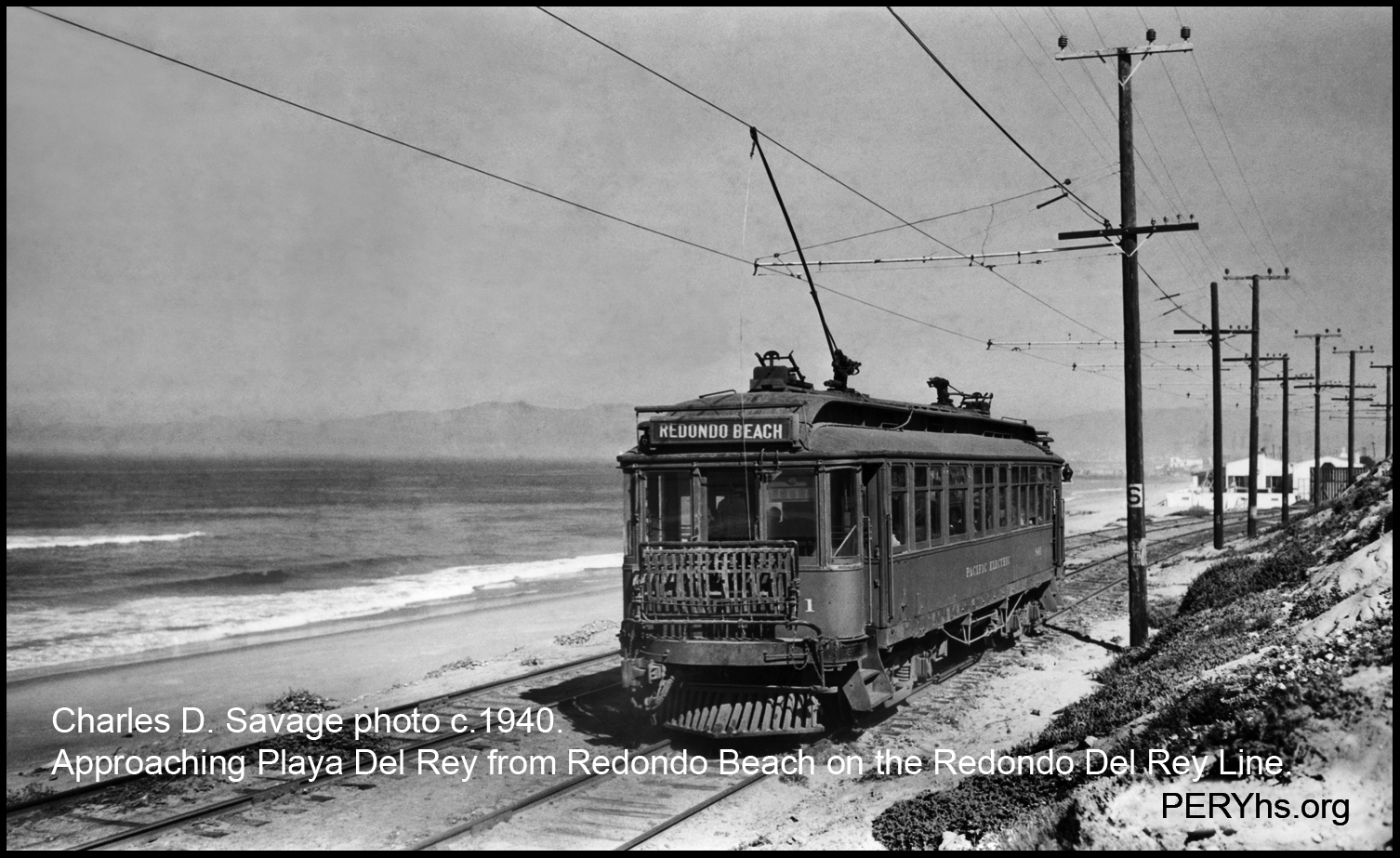
PE rails followed the coastline over many route miles. Here 891 pulls into Manhattan Beach on the Redondo line. Charles D. Savage photo, image from the Donald Duke Collection
This rather well know photo accompanying our story shows an 800-class wooden Interurban car, number 841 to be exact, heading inbound to Los Angeles on the Redondo Beach Line approaching Playa Del Rey shortly before service was discontinued in 1940. Photographer Charles D. Savage used the close proximity of the crashing waves of the Pacific Ocean that were only a few feet away from the main line to perfectly illustrate one of the weaknesses of this uniquely Southern California electric railway line.
READ MOREPacific Electric Hollywood car no. 619 outbound to Sierra Vista at Echandia Junction
Pacific Electric Hollywood car no. 619 outbound to Sierra Vista at Echandia Junction circa 1950. Pacific Electric’s Macy Street Car House is seen in the background.
Chris Taylor Collection
READ MORE