Los Angeles & Redondo Railway

By Steve Crise

The Los Angeles & Redondo Railway is one of the earliest railroads to be constructed in the Los Angeles basin. As its name suggests, it ran from the southwest corner of Jefferson and Grand to roughly Catalina and Diamond Streets in Redondo through the mostly vacant fields between the two cities. From its meager beginnings as a section of railroad right of way constructed by “The Rosecrans Rapid Transit Railway” in 1887, the LA&R eventually grew into a system of about 95 miles of 3’6” narrow gauge trackage.

To service and construct its fleet of coaches, steam locomotives and then its fleet of electric cars, the LA&R built a shop and car house in Redondo Beach on a trapezoidal piece of property bordered by Diamond Street at the southern tip of the property with N. Elena Avenue on the southwest side, Beryl Street bordered the northwest end and N. Francisca Avenue on the northeast side. The section of the road slicing on the southeast corner of the lot was Camino Real, present day Pacific Coast Highway, California State Route 1.

The location of the car house in the photo above was rumored to be in several different locations on or near this property. I set out to see if I could find the exact location of the huge structure or at least come within a few feet of where it once stood until it was destroyed by fire in 1921.
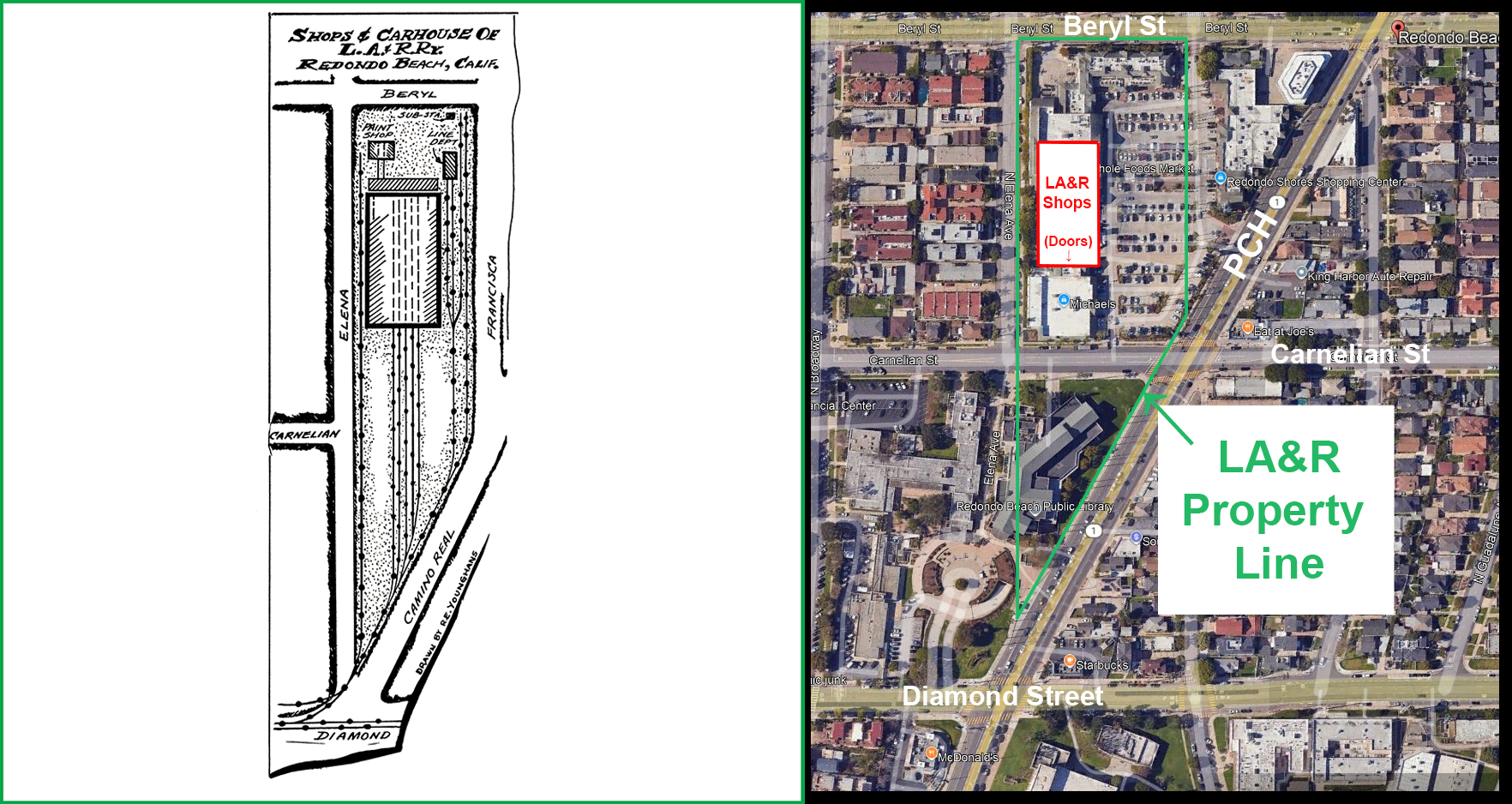
I found a very helpful clue in the form of a map drawn by Raymond E. Younghans in Ira L. Swett’s 1957 publication of Interurbans Special No.20 “Los Angeles & Redondo,” on page 65. It places the car house at the top of the property boarding N. Elena Avenue and Beryl Street. Using this information from the Younghans map I estimated its location on a Google Map capture as to where the building would be resting atop the shopping mall that has occupied the property since the early 1960’s.

My next point of curiosity was the three cars shown in the photo. Of the three cars, only two were identified by traction expert Craig Rasmussen, the provider of the image. He noted that the car on the left was LA&R #55, the center car was not identified but the car on the right was easily identified as LA&R #15, the prestigious Redondo parlor car and the pride of the railway.

I was not able to find any specific car being numbered as 55 on the railroad. There is a mention of cars 52-56 being rebuilt steam coaches that were made into interurbans after the railroad was electricized. These second-hand steam coaches were known as the “New York” cars because their being purchased used from the Third Avenue Street Railway in New York City in 1902. It is also assumed that LA&R car #3, one of the cars from New York, was renumbered to 55. With this being the case it is reasonable to assume that there was indeed a car 55, just no record of it in any books. The closest match I could find to the car in the photo was LA&R #50 (original LA&R #10), also purchased from New York, which is seen on page 40 of the aforementioned LA&R book.
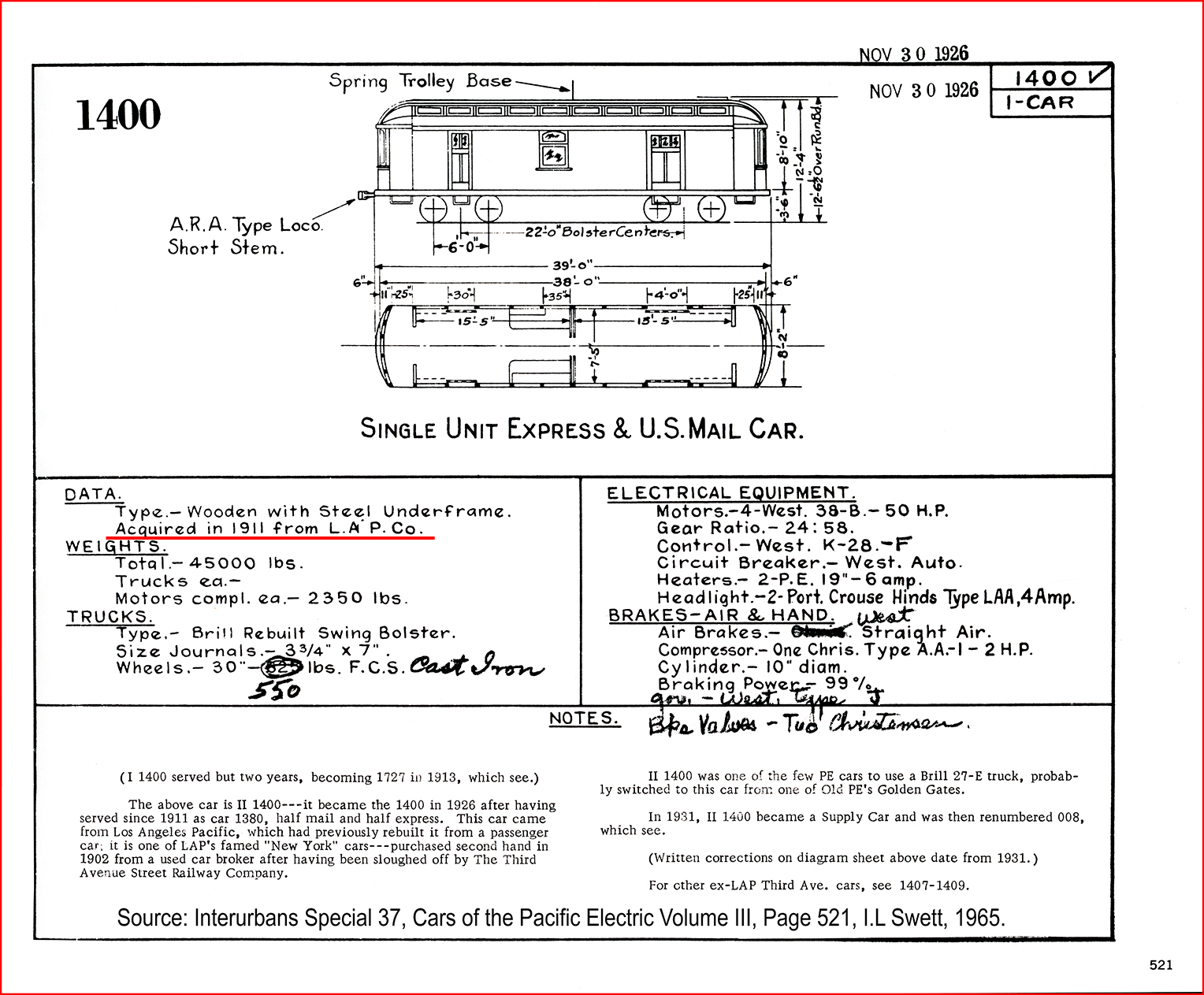
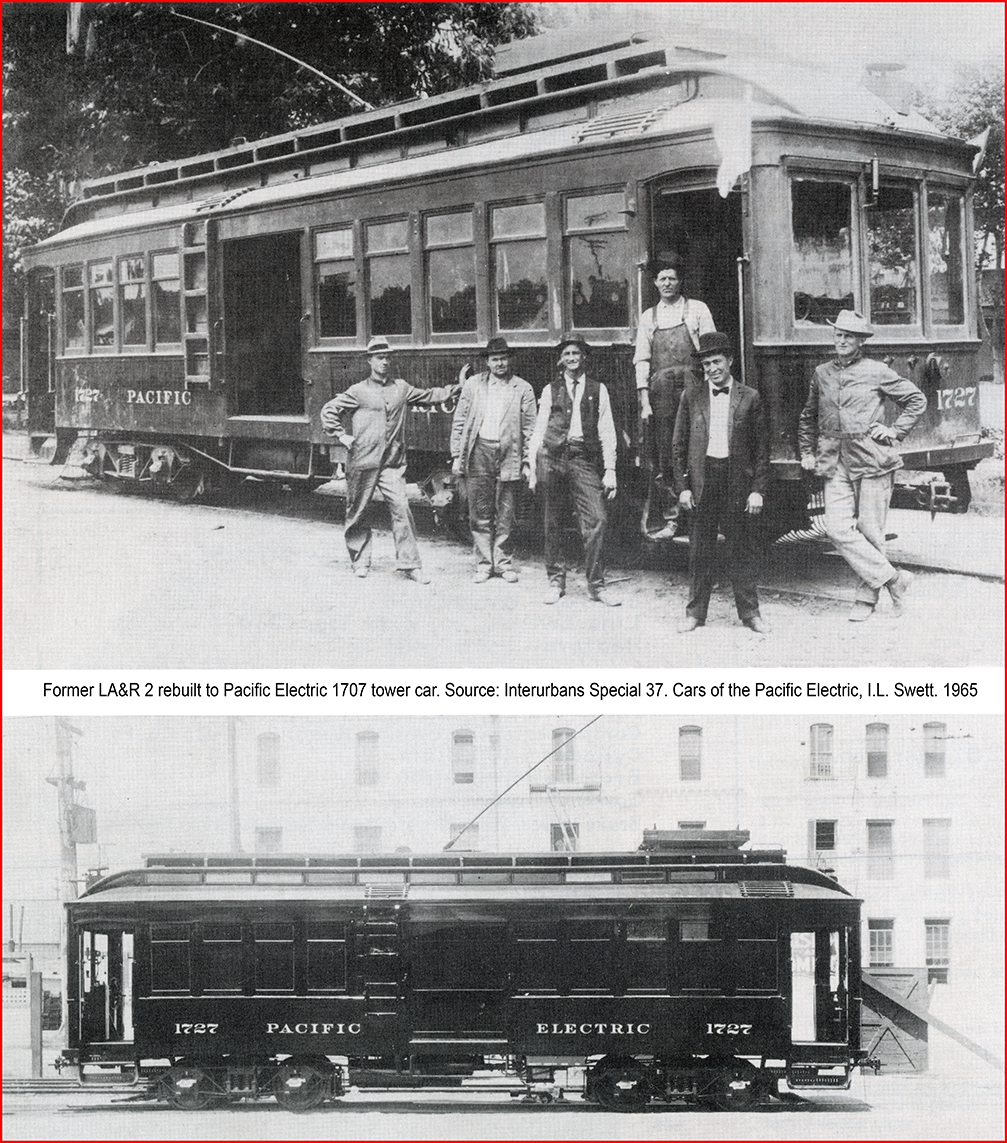
About 1907, LA&R #55 was converted into a box motor with a freight door cut into the side for easier handling of freight.  After the Great Merger of 1911 Pacific Electric renumbered the car to 1400. It was again renumbered to P.E. 1727 when it was again reborn as a tower car. One more renumbering would take place in 1931. It then became P.E. #00156 before the venerable car was finally scrapped on October 5,1934 after serving three different railroads on two different coasts. And as if that wasn’t enough, it also had the distinction of operating on two separate gauges of track during its lengthy career.
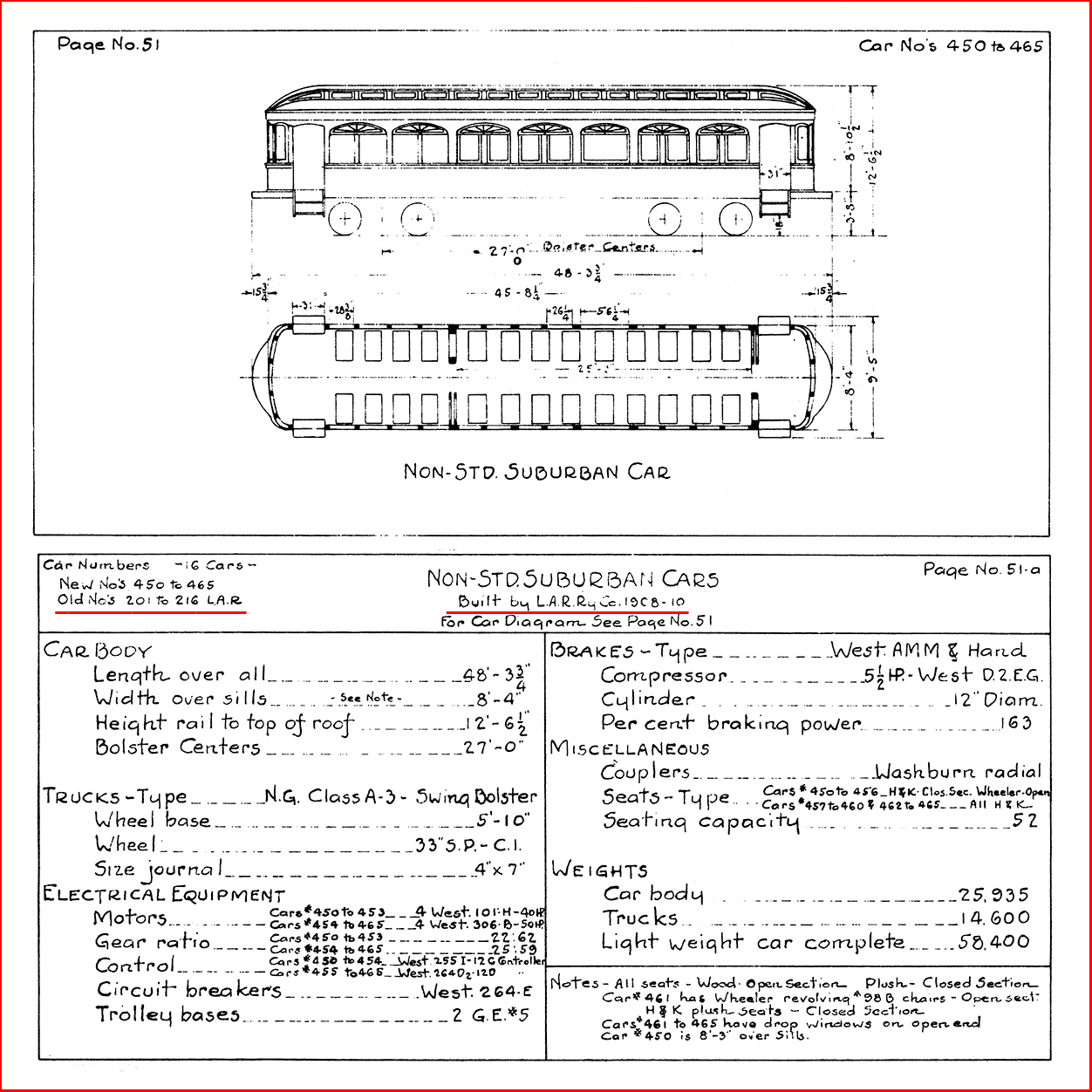
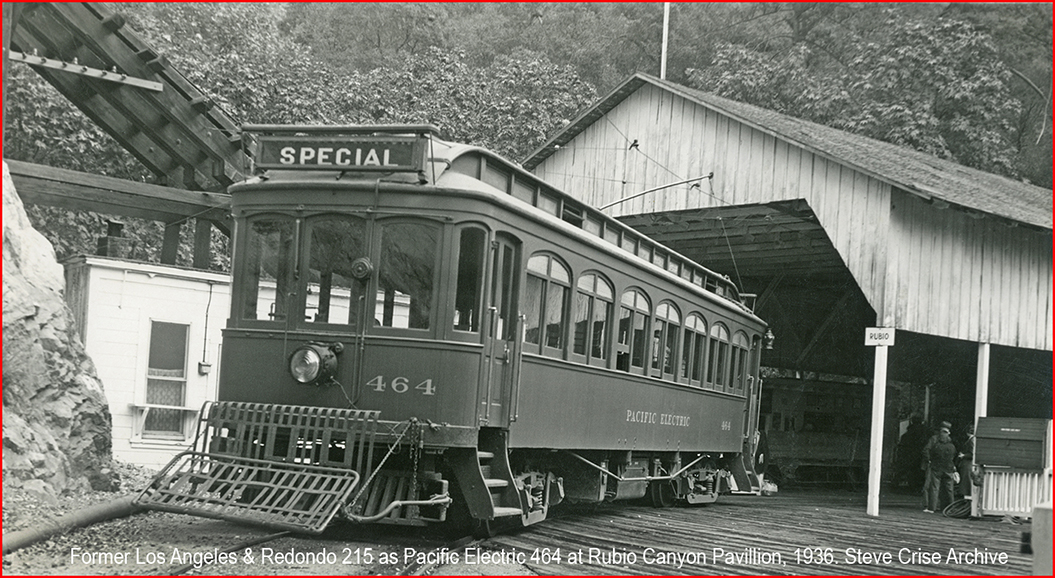
LA&R #204, also known as the “Redondo” parlor car likewise made the transition to the P.E in 1911 and was renumbered into PE’s #400 – #465 series cars and became PE #453. These were Los Angeles & Redondo’s final car-building product and had a very productive life on different lines throughout the system including the Glendale – Burbank Line, Rubio Canyon Line and on occasion in service for Santa Anita racetrack trains when heavy passenger traffic required their service. The entire class of the #450 – #465 cars were scrapped just a few months before the start of WW II. PE #453 had an earlier date with the scraper than most of the other cars in the series and in 1933, after 25 years of service, was discarded by the Pacific Electric and removed from the roster.
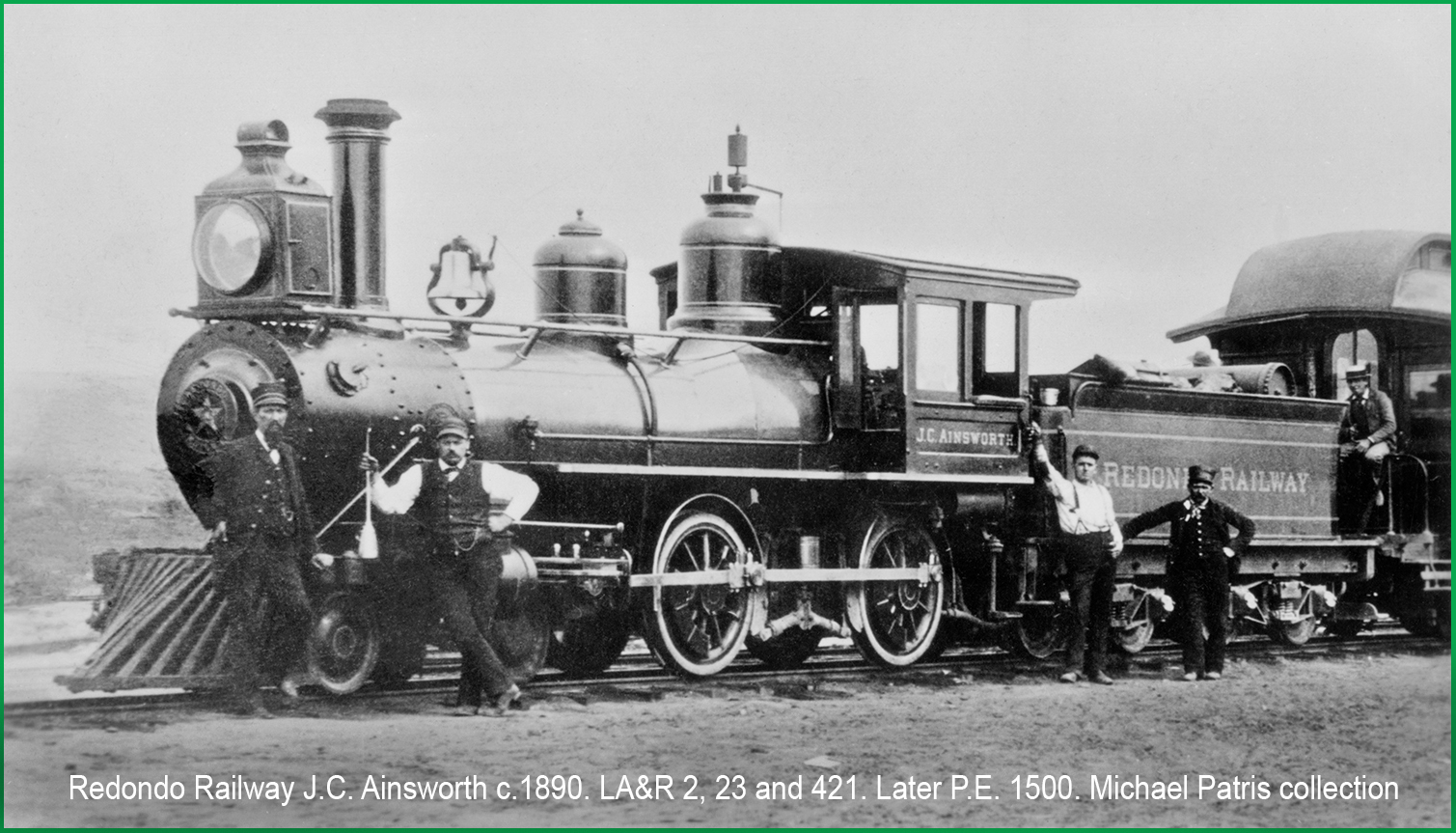
The J.C. Ainsworth, a 3’6” gauged Baldwin 4-4-0 seen in the above photo was named after one of the original founders of the Redondo Railway, Captain J.C. Ainsworth. Captain Ainsworth and his business partner Captain R.R. Thompson were heavily involved in the Pacific Northwest’s lumber trade. Their goal was to develop Redondo Beach into a major Southern California port for their lucrative lumber business. The success of their efforts soon eclipsed the steam locomotives’ capabilities, and it was decided to completely abandon steam power and modernize and eclecticize the entire road to a 600-volt DC system. This is when the New York cars, once pulled by the steamer, were converted in the LA&R shops to suburban electric cars. During the long service record of the J.C. Ainsworth for the LA&R it bore no less than three different numbers; #2, #23 and #421. Incredibly, the J.C. Ainsworth survived long enough to become a piece of Pacific Electric’s rolling stock. After the 1911 merger, Pacific Electric assigned this locomotive to be #1501, appropriately fitting into the PE’s steam locomotive classification numbering system. However, the 3’6” gauged engine was never used on the PE because of its incompatibility with the standard gauge 4’ 8.5” track that the PE operated on. The ancient engine was sold in 1913 to the San Fernando Rock Company.

As this exercise aptly demonstrates, there can be countless stories buried within these historic photographs. Here at the Pacific Electric Railway Historical Society, we endeavor to seek out as many facts and stories that to the average viewer are not necessarily obvious and research and share them with the world on this site. If you have a rare or interesting image from the bygone era from one of the many early transit systems in the Southern California area, please send your image and story to us and we will do our very best to decipher and post it on PERyhs.org for all to enjoy.
Source material:

  • Interurbans Special 20, Los Angeles & Redondo Railway.
  • Interurbans Special 28, Cars of the Pacific Electric Vol.1 City & Suburban Cars.
  • Interurbans Special 37, Cars of the pacific Electric Vol. III Combos, RPO’s, Box Motors, Work Motors, Locomotives, Tower Cars, Service Cars.
  • Pacific Electric Railway Historical Society image archives. PERyhs.org
  • Craig Rasmussen Collection
  • Michael Patris Collection
  • Steve Crise Archive

A Little Slice of Life

H.L. Kelso photo from the Craig Rasmussen Collection: PE 1370 and LARy 934 meet on the streets of Los Angeles.

By Steve Crise

The United States of America was engaged in its second year of WW II when Harley L. Kelso made this timely shot of Los Angeles Railway car 934 and Pacific Electric interurban car 1370 meeting at the intersection of Vernon Avenue and Long Beach Avenue back in 1943.


There are may sights to behold at this moment frozen in time. The L.A. Railway car is stopped just short of Long Beach Avenue to pick up and drop off passengers. It would soon depart to the eastern terminus of its V-Line run at Leonis Boulevard and Downey Road in the City of Vernon.


Pacific Electric 1370 is seen crossing Vernon Avenue in a southerly direction toward the harbors of San Pedro and Long Beach. The roller sign at the top of the car reads “Special” and all the passengers in the windows appear to be members of various branches of the military, suggesting this could be a special troop transport exclusively scheduled for military personnel only.

The “Red Spot Liquor Store” must have had a very good customer base at this location where two heavily trafficked transit lines intersected. Note the shoeshine booth has both chairs full of customers having their shoes shined.

Perhaps the most intriguing aspect of this photo is the small girl that is seemingly framed by the photographer between the two trolleys. She stares down the track as if she was disappointed that she could not board the Special train of servicemen and is looking for the next regular service car to arrive.

Also note the absence of any noticeable grade crossing apparatus protecting the trains, automobiles and pedestrians from colliding with each other. In researching this image and comparing it to other photos taken at the intersection in our collection, we could not find evidence of any grade crossing protection being installed until sometime after the war.

Today this area is still a vital transit intersection where the Metro A-Line (Blue) interchanges with Metro bus passengers of the 105, 611 and 705 Lines.

Los Angeles Railway A Line Car 62 on West Temple Street

Los Angeles Railway A Line Car 62 on West Temple Street

By Steve Crise

Los Angeles Railway Type-C center door “Sowbelly” car 62 is on the A-Line heading east on Temple Street at Parkman Avenue toward downtown Los Angeles. This car will eventually end its run at West Adams Boulevard at Alsace Avenue as can be read on the dash sign. F. J. (Frank) Bradford is the photographer who made this shot on September 9, 1945. Print courtesy of the Craig Rasmussen collection.

Report on the San Bernardino – Riverside Line October 26, 1933

PE 1214 rolls northbound on Market Street at 4th Street passing the classic Hotel Casa de Anza. Riverside, California, April 17. 1939. Charles D. Savage photo, Donald Duke collection, PERyhs.org.

[vc_row][vc_column][vc_column_text]Above: PE 1214 rolls northbound on Market Street at 4th Street passing the classic Hotel Casa de Anza. Riverside, California, April 17. 1939. Charles D. Savage photo, Donald Duke collection, PERyhs.org.

By Steve Crise

A few months ago, we received a very generous donation from a long-time supporter of the Pacific Electric Historical Society, Martin Banks. His donation of the following report titled “Report on the San Bernardino – Riverside Line, October 26, 1933,” shed some interesting insights on the finical considerations made when officials of the Pacific Electric were reviewing the profitability one of their main lines in the Eastern District, the San Bernardino – Riverside Line.

The comments contained within the report reflect the struggles of the Pacific Electric Railway trying to survive and make some sort of a profit during in the midst of the Great Depression. A breakdown of expenses and losses will be most telling of the issues needed to consider to either maintain service on the line, or to abandoned it partially or completely.

According to “Interurbans – The National Electric Railway News Digest,” Volume 12, number 2, by Ira Swett, the end of passenger on the entire Riverside Line came in the middle of WW II on January 10th, 1943.

Please enjoy this fascinating report that details the viability of the San Bernardino – Riverside Line and gain some understanding of the complexities and issues of abandoning an interurban line.[/vc_column_text][mk_image src=”https://www.pacificelectric.org/wp-content/uploads/2023/02/crc_pe_riverside_dash-002.jpg” image_size=”full” desc=”An example of a dash sign used by Pacific Electric Railway that was hung on the front of the car to better inform passengers of the eventual destination of service. Signs were approximately 24 x 15 inches, sheet metal construction with hand painted lettering. Courtesy of Craig Rasmussen collection, PERHys.org.” caption_location=”outside-image”][mk_image src=”https://www.pacificelectric.org/wp-content/uploads/2023/02/pe-riverside-report-001a-scaled.jpg” image_size=”full”][mk_image src=”https://www.pacificelectric.org/wp-content/uploads/2023/02/pe-riverside-report-002-scaled.jpg” image_size=”full”][mk_image src=”https://www.pacificelectric.org/wp-content/uploads/2023/02/pe-riverside-report-003a-scaled.jpg” image_size=”full”][mk_image src=”https://www.pacificelectric.org/wp-content/uploads/2023/02/jlwc_pe_roller_sign-01.jpg” image_size=”full” desc=”Pacific Electric roller sign showing service of towns and cities in and around the San Bernardino – Riverside area. Jack L. Whitmeyer photo. C.1940, PERyhs.org”][mk_image src=”https://www.pacificelectric.org/wp-content/uploads/2023/02/pe-riverside-report-004a-scaled.jpg” image_size=”full”][mk_image src=”https://www.pacificelectric.org/wp-content/uploads/2023/02/pe-riverside-report-005-scaled.jpg” image_size=”full”][mk_image src=”https://www.pacificelectric.org/wp-content/uploads/2023/02/pe-riverside-report-006a-scaled.jpg” image_size=”full”][mk_image src=”https://www.pacificelectric.org/wp-content/uploads/2023/02/riverside-3-scaled.jpeg” image_size=”full”][mk_image src=”https://www.pacificelectric.org/wp-content/uploads/2023/02/pe-riverside-report-008a-scaled.jpg” image_size=”full”][mk_image src=”https://www.pacificelectric.org/wp-content/uploads/2023/02/pe-riverside-report-009a-scaled.jpg” image_size=”full”][mk_image src=”https://www.pacificelectric.org/wp-content/uploads/2023/02/cds_pe_657_riverside-02.jpg” image_size=”full” desc=”PE 657 makes a stop at the Riverside Station on Market Street just south of the intersection with Mission Inn Avenue before continuing south on Market Street and on to Arlington. Charles D. Savage photo, c. 1940., Donald Duke collection, PERhys.org.”][/vc_column][/vc_row]

A Blue Goose on a Red Car Line

A Blue Goose on a Red Car Line

By Steve Crise

Over the years there have been a good number of steam and diesel locomotives displayed along Exposition Boulevard courtesy of Pacific Electric Railway’s Santa Monica Air Line. Several examples of forthcoming railroad technology and in some cases complete passenger train sets have been exhibited for public review on this busy section of track. Cross country passenger trains from the three railroads that served Los Angeles took advantage of this prime location to show off their latest equipment right in the heart of the city. Passenger trains of the Atchison, Topeka and Santa Fe, Southern Pacific and Union Pacific railroads at some point had all displayed their newest passenger trains in this area. Even General Motors showed off their “Train of Tomorrow” by making an appearance here in 1947.

This location was an obvious choice for such a public event since the area was directly across the street from Exposition Park and the campus of the University of Southern California. Streetcar service was provided by no less than four lines of the Los Angeles Railway including J, K, U and the V-Line on Vermont Avenue. All combined, they provided plenty of service to this location from almost any point in the city. The PE was also able to handle passengers that wished to visit the exhibits by providing service on their Santa Monica Air Line route.

Early on the morning of February 20, 1938, a photographer caught one of these Exposition Boulevard display events in the making as Pacific Electric freight locomotive 1616 hauls Santa Fe’s 3460, their one and only streamlined steam locomotive, across South San Pedro Street at 30th Street, once again using the Air Line rails to tow the beautiful new engine to the display area. The train seems to have paused in the middle of the crossing perhaps to give the photographers a moment to make their shots before the procession continues on its journey and proceeds to rattle across the tracks of Los Angeles Railway’s S-Line.

It is interesting to note that two key features in this photograph still remain in place at this intersection. The building at the northeast corner, 2916 S. San Pedro Street, mostly remains in its original state. And, the unusual steel lattice-work power pole is also a feature that remains in place making this an easy location to verify on Google Earth.

3460 remained in service for the Santa Fe until 1957 when she met the cutting torch at Sheffield Steel in Kansas City, Missouri, at the ripe old age of 20. She died with most of her streamlining features still intact, although by this time her beautiful two-tone blue paint job had become dirty and faded.

Pacific Electric 1616 was a Baldwin – Westinghouse product and came to the railroad as part of the last two locomotives ordered from them to be delivered to the PE in 1920. The 1616 has appeared in many photos over the years probably due to the fact most of her working life was spent in the Terminal District of downtown Los Angeles and in West Hollywood. As one would expect, the 1616 was ill-fated to a similar end that would take place in February of 1955 at Lipsett Steel Company of Huntington Park. The 1616 fared a bit better than the 3460 in terms of longevity, lasting a total of 35 years in service to the PE.

This wonderful photo came to us from the Craig Rasmussen Collection as part of his Joe Moir photo collection. Unfortunately the photographer’s name was never recorded, so it remains a mystery as to who the actual creator of this interesting photo was.

(6/15/2022)

Video: 1930s – Views of Los Angeles in color [60fps, Remastered] w/added sound

Colorized film of 1932 downtown Los Angeles screen grab

[vc_row][vc_column][vc_column_text]From Ralph Cantos:

This video is making the rounds today on the internet, its FANTASTIC!. I put the year as 1932. Notice the “new LARY H-3s” working the 5 line. The LARY scenes are on Broadway at 7th and the PE scenes are on Hill St. at 6th. Craig Rasmussen found it today. I am sure all the railfan world is waiting to see it. Best Wishes.. Ralph


[/vc_column_text][vc_video link=”https://youtu.be/QMrDtAk79uc”][/vc_column][/vc_row]

Pacific Electric No. 913: The life of a true “survivor” (sort of)

Photo by Harold F. Stewart from the Craig Rasmussen Collection

[vc_row][vc_column][vc_column_text]By Ralph Cantos

This photo taken by the late Harold F. Stewart from the Craig Rasmussen Collection shows Pacific Electric No. 913 heading west bound at Culver Junction on the Santa Monica Air Line. It’s mid-1940 and 38 years of dependable service by the 913 is nearing an end. At this date, the 913 is just one of a handful of 800s still in service. By early 1941, they were all gone.

The service life of the 131 800s is legendary in PE history. Built by the St. Louis Car Co. in 5 orders between 1902 and 1906, they were the second-largest class of cars on the PE system, second only to the 159 Hollywood cars (600-758). The 800s were to their last days the fastest interurbans on the PE system, faster than PE’s fantastic San Berdoo 12s. Only Henry Huntington’s private car “Alabama” was faster.

They were also the heaviest wood-bodied cars on the system. As built, almost half of the car body was open to the warn California climate, only a sturdy mesh screen from the floor line, to the belt rail, protected seated passengers. In June 1903, an issue of trade magazine Street Railway Journal although prizing the cars, took issue with the PE for allowing passengers in the open section, to be battered by high winds, as the 800s rolled along the open fields of early Southern California at speeds in access of 70 mph.

It did not take the PE management much effort to get the hint. At first, the mesh screen was replaced by wood paneling from the floor line to the belt rail. But this did little to soften the hurricane-force winds buffeting seated passengers in the still open section. By late 1906, the cars were fully enclosed, ending what could only be described as an early California “thrill ride.”

The PE management must have loved the 800s as they performed several experiments on the cars at one time or another. The 800s were the first cars on the PE to be equipped for MU (multiple unit) operation in 1906-07.

Also, about 1912, cars 912-917 were equipped with high-speed General Electric motors and controls in preparation for ordering the magnificent San Berdoo 12s. These six cars became known as the “GE 8s” and for the rest of the long service life, could only operate with each other. The 6 cars could not operate MU with the rest of the 800s. These 6 cars were the fastest and most powerful 800s on the system.

Strangely enough, the PE did not equip all 800s with MU controls. These cars had couplers for towing, but operated only as single cars. In 1940, as most of the 800s were being scrapped and burned, 4 800s were converted into box motors, numbered 1496-99. One of those cars, 1498 (859) was donated to the children of Los Angeles and placed on display at Travel Town in Griffith Park. There, the 1498 sat out in the open for more than 4 decades with little or no real maintenance to its canvas covered wood roof. Finally, the weight of the two 300-pound air trolley base caused the roof to almost cave in. The 1498 was donated to the Orange Empire Trolley Museum at Perris, but it was destroyed by a fire in the “out back” area where the 1498 was stored.

Today, the body of GE-8 913 remains the lone survivor of the once-magnificent fleet. It is now part of the FORMOSA CAFÉ in West Hollywood where it has resided since its 1941 retirement. Overall, the 913 is in excellent condition. The Formosa Café is a Los Angeles Cultural landmark, so I guess the 913 will be there for all time.[/vc_column_text][mk_image src=”https://www.pacificelectric.org/wp-content/uploads/2021/02/pe-913-1940-2.jpg” image_size=”full” desc=”PE 913 heading west bound at Culver Jct. on the Santa Monica Air Line in mid-1940.”][mk_image src=”https://www.pacificelectric.org/wp-content/uploads/2021/02/pe-257-1903-later-pe-913-1907.jpg” image_size=”full” desc=”PE 257 poses for the camera in 1903, short after delivery from the St. Louis Car Co. In 1907 she was renumbered to 913.”][mk_image src=”https://www.pacificelectric.org/wp-content/uploads/2021/02/pe-913.jpg” image_size=”full” desc=”And here is the 913 as she looks today. Over all, the body is in excellent condition, right down to the flag/marker bracket next to the door post. The only modification done to her body is a “train door“ cut into the other end of the car body to allow patrons and staff in enter the interior for “dining passengers.“”][mk_image src=”https://www.pacificelectric.org/wp-content/uploads/2021/02/pe-1498-at-travel-town-2.jpg” image_size=”full” desc=”Here is the former 859 at Travel Town in 1955. There she would sit, unprotected from the weather, for more than four decades.”][/vc_column][/vc_row]

LARY 357 in Troubled Waters: Navigating 7th Street

[vc_row][vc_column][vc_column_text]By Ralph Cantos

This remarkable photo taken on March 1, 1938 shows LARY car no. 357 as the “skipper” navigates the streetcar in high water along 7th Street in Downtown LA.

During the last week of February and the first week of March 1938, rain amounts of biblical proportions fell on Los Angeles.  Rain amounts of more then 10 inches fell on LA. Damage was widespread all over the city. Taking the hardest hits were the railroads. The Santa Fe, Southern Pacific, Union Pacific , and the Pacific Electric all suffered major damage to roadbed and bridges.

The rains of 1938 spelled the end of the Mount Lowe Railway. Large portions of the Alpine Division were washed away, never to be rebuilt.  The PE lost two bridges; the most impressive of the two was a portion of the Puente Largo concert-arch bridge on the Monrovia-Glendora Line. The other, less impressive PE bridge was on the San Fernando Line.

For the most part, the LARY came out of the rains with little damage.  As a result of these rains, new and sweeping flood control projects were implemented city-wide.  Probably the most notable of these flood control projects was the major improvements to the LA River. As a result, the LA River is navigable by pedestrians most of the year.[/vc_column_text][mk_image src=”https://www.pacificelectric.org/wp-content/uploads/2020/06/pe-866-on-highland-ave-1938-2.jpg” lightbox=”true” title=”Pacific Electric no. 866; image by Ernie Leo” desc=”Pacific Electric no. 866 on Highland Avenue during the torrential rains of early 1938. Image dated March 6, 1938. Courtesy Craig Rasmussen Collection.” hover_image_overlay=”false”][mk_image src=”https://www.pacificelectric.org/wp-content/uploads/2020/06/pe-335-on-franklyn-ave.jpg” lightbox=”true” title=”PE 335 on Franklin Avenue, 1938″ desc=”PE no. 335 sits alone and abandoned on Franklin Avenue in Hollywood during the Great Floods Of 1938.” hover_image_overlay=”false”][vc_column_text css=”.vc_custom_1593179283455{margin-bottom: 0px !important;}”]PE car no. 335 sits alone and abandoned on Franklin Avenue in Hollywood during the Great Floods Of 1938. The high water was just too much for the little fellow. As a result of the damage done to the 335, the little guy was never returned to service.

The PE had a large surplus of Birneys, so the 335 was a goner. Of interest to “car guys”, a 1938 Cord and a 1937 Studebaker pass the stranded 335 on the other side of the street. The Western-Franklin Line was referred to by PE crews as “The Merry Go Round,” as it really went from no where to no where.[/vc_column_text][mk_image src=”https://www.pacificelectric.org/wp-content/uploads/2020/06/pe-puente-largo-1938-wash-out.jpg” image_size=”full” lightbox=”true” title=”PE Puente Largo 1938 Wash Out” hover_image_overlay=”false”][mk_image src=”https://www.pacificelectric.org/wp-content/uploads/2020/06/pe-puente-largo-bridge.jpg” image_size=”full” lightbox=”true” title=”PE Puente Largo Bridge in Better Times” hover_image_overlay=”false”][/vc_column][/vc_row]

PE 972 and train at La Cienega: Going to beach was half the fun

By Ralph Cantos

This beautiful photograph from the Craig Rasmussen Collection was taken by the late Al Haij on a summer day in 1947 (July 11, to be exact). This three-car train of wonderful 950s is headed up by car no. 972. West of Vineyard Jct., the Venice Short Line provided superior transportation to Venice and Santa Monica bound passengers, regardless of the type of car used.

For about the last 15 years of Venice Short Line, the venerable 950s were the mainstay on the VSL. Hollywood cars and 10s were also used on this very busy line. The magnificent bridge over congested La Cienega Blvd. was the most impressive structure on the line. The bridge was constructed about 1925 to elevate the tracks over the intersection which had a tendency to flood during heavy rains. After all, La Cienega in Spanish means “the swamp.”

After the Sept. 1950 abandonment of the rail service,  inferior bus service was inaugurated with great civic fan fare. The new bus service was met with mixed feelings  by former rail passengers. The now abandoned bridge over La Cienega would remain standing for almost 15 years until construction of the Santa Monica Freeway reached La Cienega. It was bulldozed  away in the summer of 1964 along with thte equally impressive Pico-San Vicente viaduct. It seems like the City of Los Angeles was hell bent on erasing every last vestige of the once great Pacific Electric Railway.

Craig Rasmussen Collection

San Pedro Station, 1935

By Ralph Cantos

This spectacular photograph of the Pacific Electric’s San Pedro Station shows a 3-car train of 10 Hundreds waiting departure time to Los Angeles, as a former Portland Electric Express motor loads “LCL” cargo. The San Pedro Station was one of PE’s larger suburban stations. It remained in service until after the abandonment of the San Pedro Line in December of 1958. Today, there is no trace of this impressive station. Its cozy waiting room replaced by a lone wind swept bus stop bench on the street, all in the name of “progress” …What a bunch of crap!!

Craig Rasmussen Collection